Showing posts with label myth. Show all posts

Thursday, September 28, 2023

Posts, Podcasts and Publications: Endings, Identity, Preservation and Negotiation

Charlotte of Close Reading Romance has written a series of posts thinking through how

any HEA is, fundamentally, an act of inferring the future from information about the past. In queer romance, though, doing so means imagining optimism from not-always-hospitable spaces. It has also sometimes meant thinking around certain concluding structures integral to the genre – cohabitation, marriage, procreation – that haven’t always been accessible to queer protagonists. So as I often do, I started wondering about the particular prose demands of writing re-imagined pasts and imagined futures. What kind of work is done by the last sentences of queer love stories, the words that place a completed narrative into the past while opening up towards imagined futures?

Here's the Introduction to the series and links to Part 1, Part 2, Part 3 and Part 4.

Jayashree 's been promoting Creating Identity: The Popular Romance Heroine’s Journey to Selfhood and Self-Presentation so there's now a video in which she discusses the book at the Asian American/Asian Research Institute: https://aaari.info/23-09-22kamble/ and there's an episode of the podcast  ShelfLove in which she discusses the book: https://shelflovepodcast.com/episodes/season-2/episode-145/heroines-creating-identity-in-romance

Over at JPRS, Jonathan A. Allan has been worrying about how to preserve romance texts for future scholars and I do think it's a big issue, especially for works which are ebook only. Eric Selinger says that if you have any answers to the questions/issues raised in Jonathan's note, please contact the journal to add a note of your own on this topic!

And here's a list of some new publications:

Ali, Kecia (2023). "The End of the World as We Know It: Climate Catastrophe in Nalini Singh's Paranormal Romance Fiction." The Journal of the Core Curriculum: An Annual Literary and Academic Anthology in the College of Arts and Sciences at Boston University 32:81-86. [The link is to a pdf of the whole volume, which means you'll have to scroll down/do a search to find the article. It's free, though!]

Bharathi, L. Divya and K. Muthuraman, K. (2023). "Nicholas Charles Sparks’s The Notebook: A Novel Of Love Or Romance?" Journal of Namibian Studies 35, special issue 1: 3749-3755. 

Horgheim, Celina (2023). From Rape to Romance: Sexual Consent Negotiation in Romantic Retellings of the Myth of Persephone. MA Degree Secondary Teacher Programme, University of Oslo.

Petrović, Janja (2023). Breaking the stereotype – romance novel today. Masters thesis, University of Zagreb.

Monday, November 23, 2020

An Award, Congratulations and Publications: Masculinity; Movies; Hercules; Interwar Magazine Fiction

If you've got an unpublished essay on romance, you might be able to submit it for the Francis Award, which comes with a $250 USD prize and publication (after any needed revisions) in JPRS. The annual deadline for submissions will be December 31 28 February 2021, and the winner will be announced in April. 

Conseula Francis’s work on popular romance fiction focused on African American authors and representations of Black love, and priority for the Francis Award will be given to manuscripts that address Black-authored popular romance fiction and other work on Black love. Manuscripts on the diversity of, and diversities within, popular romance and romantic love culture—e.g., diversity of race, ethnicity, gender, religion, class, sexuality, disability, or age—will also be considered.

More details here: http://www.jprstudies.org/submissions/the-francis-award/

[Edited to add: "To encourage more submissions, the deadline for the Francis Award has been moved (this year and moving forward) to the end of February--in this case, Feb. 28, 2021."]

Congratulations to Inmaculada Pérez Casal on the completion of her thesis, Antecedents and Development of the Contemporary Romance Novel in English: A Study of the Contribution to the Genre by Rosamunde Pilcher and Lisa Kleypas (Universidade de Santiago de Compostela)!

Other newly completed works on romance are:

Allan, Jonathan A., 2020. “Mourning and Sentimental Heroism in Maureen Child's Lost in Sensation.” The Journal of Popular Culture. Online First. 

Allan, Jonathan A., 2020. “'And he absolutely fascinated me': Masculinity and Virginity in Sherilee Gray’s Breaking Him.” Journal of Popular Romance Studies 9. [Open access.]

Charlton, Michael, 2020. "Till Death Do Us Part: Romancing the Stone, Death Becomes Her, and the Romance Genre." A Critical Companion to Robert Zemeckis. Ed. Adam Barkman and Antonio Sanna. Lanham, Maryland: Lexington Books. 17-29.

OKell, Eleanor Regina, 2020. "Hercules as Romantic Hero in Twenty-first-century Historical Fiction." The Modern Hercules: Images of the Hero from the Nineteenth to the Early Twenty-First Century. Ed. Alastair J.L. Blanshard and Emma Stafford. Leiden: Brill. 121–145. Here's the abstract:

This chapter will examine Hercules as a romantic hero in two distinctly different examples of the historical novel, which can be classified as chick lit.: Kate Mosse’s serious historical fiction Citadel, which is set in the Languedoc during the Second World War, and Stephanie Laurens’ romantic historical fiction The Truth About Love, set in Cornwall during the Regency period. Both these novels invoke Hercules by name and the hero provides contextualisation for the events and relationships therein. For example, in Mosse the myth of Hercules’ relationship with Pyrene underpins the whole landscape (it is an origin myth for the Pyrenees) and in Laurens the Garden of Hercules forms a frequently referenced part of the landscape which is of significance for events in the plot. In both novels the presentation of Herculean myth as a background prompts the reader to extrapolate from the legend of Hercules to the characters depicted and their struggles. The similarities of and differences between the two authors’ uses of Hercules demonstrates not only that twenty-first-century chick lit. is open to exploring facets of the ancient hero’s character which go beyond monster-slaying and into the realm of the romantic/erotic but also that the genre of chick lit. can exhibit qualities more commonly associated with ‘serious’ literary fiction.

Reed, Eleanor, 2020. ‘Romance in Woman’s Weekly and Woman’s Weekly as Romance, 1918–39’, Journal of European Periodical Studies 5.2: 80–94. [Pdf available free online here.] The focus is on issues related to social class, but I thought this observation, that romance in these magazines functioned as a safe space within which to explore issues, relates to what I've described as romance's "pastoral care" function:

Interwar Woman’s Weekly fiction engages with issues including the rehabilitation of First World War veterans, marriage to a widower, frustration with housework, and single motherhood. Each story invites its reader to identify with a heroine whose experiences and dilemmas may parallel her own, and it is romance’s familiar, predictable structure that allows her to work through these potentially difficult or distressing issues. The guarantee of a happy ending establishes the story as a safe narrative space within which she can confront everyday problems. (86)

Tuesday, May 15, 2012

Her Unexpected Loathly Lady


In For Love and Money I look at a number of "mythoi" ("traditional or recurrent narrative theme or plot structure[s]") which recur in romance novels. One of them is the tale of Sir Gawain and the Loathly Lady/Dame Ragnell though, as I note, "The use of the Gawain and Ragnell mythos generally remains implicit in romances" (98).

I was agreeably surprised, therefore, when I recently found almost the whole story embedded in Deborah Hale's His Compromised Countess (2012):
as Bennett listened to his wife tell Wyn the story of Sir Gawain and the Loathly Lady, he was surprised and dismayed to discover how much the ancient legend related to their situation.

In her most dramatic tone, Caroline spun the tale for their enthralled little son. 'Once she had forced him to wed her, the hideous creature told Sir Gawain she was a fair damsel who had been placed under a terrible enchantment. By marrying her, he had broken half the curse. She could be beautiful by day so that all the world would honour and envy him for possessing so fine a wife. But alone with him at night she would be monstrous ugly. Or she could be repulsive by day and beautiful by night so that he alone could admire and love her.' [...]

'Which one did Sir Gawain choose, Mama?' [...]

'I'm glad you asked. [...] It was not easy for Sir Gawain to decide. He considered how each of those choices would affect him. Then his heart was moved with pity for what the Loathly Lady had suffered. He said he would let the decision be hers. [...] No sooner had Sir Gawain spoken those words,' Caroline continued, 'than there was a flash of sparking light and the Loathly Lady transformed into the most beautiful maiden he had ever beheld. She told him that by permitting her to choose her own fate he had freed her from the spell entirely. Now she would be beautiful all the time. Wasn't that lovely?' (313-15)

-----

Tuesday, January 01, 2008

Laura on Louise Allen's Virgin Slave, Barbarian King


My analysis of Virgin Slave, Barbarian King got so long that it wouldn't have fitted easily onto the blog so I've posted it on my website. However, as there isn't a comment facility on my website, if you'd like to comment on my analysis, please do so here.

I've focused on some key myths which I think provide a cultural context for the novel and give extra resonance to the events related in it.

One of those myths is that of Romulus and Remus, pictured here in a painting by Rubens. I thought it would make a change from the more well-known Capitoline Wolf.

Tuesday, June 12, 2007

Phillipa Ashley - Decent Exposure


Phillipa Ashley recently won the Romantic Novelists' Association 2007 Joan Hessayon Award for Decent Exposure,
her debut novel [...] published by Little Black Dress. The judges said: "This book had really great characters right from the start, especially the fish-out-of-water heroine and the hero who is 'always happiest when he's got something to be angry about'. We believed in this couple and their bumpy path to love. There is a real sense of lives lived, the close-knit team, the local rivalries, the small village, as well as the practical and psychological obstacles in the way of pulling the calendar together. We liked the humour nicely balanced with humanity and a bright, contemporary voice. Oh, and it has a cracker of a first sentence!" (Romantic Novelists' Association)
I haven't been able to find many reviews, but there's an excerpt available here.

Given that the premise of the story involves the making of a nude calendar for a charity fundraising effort, I couldn't help but be reminded of the film Calendar Girls,* but as Rosy Thornton of Birmingham Words explains, Ashley's initial inspiration was the BBC's adaptation of Elizabeth Gaskell's North and South:
Phillipa had the original idea of placing a version of Gaskell's novel in the present day [...] A sharply witty romantic comedy, it tells how PR consultant Emma Tremayne seeks to raise money and publicity for a Cumbrian mountain rescue team by means of a nude calendar – falling as she does so for ‘Mr July’ Will Tennant. Like North and South it is the story of a bright southern girl being forced to travel north, and finding a culture shock and unexpected love in the process.
What I'd like to focus on is not the story but what Jenny Crusie's been describing as 'foreshadowing' using 'subconscious clues':
Subconscious clues are the deep structure clues, really more cues than clues, triggers for the reader that she or he many not even notice, often the motifs and metaphors that run underneath the story. [...] Is anybody but an English major ever going to notice this stuff? We certainly hope not; it destroys the enjoyment of the story. Is it crucial to the depth and resonance of the story, to the catharsis of the reader at the end? Absolutely.
In Decent Exposure the subconscious clues worked for me because I didn't notice them until I'd finished the book and started to think more closely about it. The foreshadowing begins in the first few pages (they're in the excerpt). I'm going to try to avoid giving spoilers, so this will be a relatively short post and I hope it doesn't 'destroy the enjoyment of the story' for anyone.

The most obvious theme is that of nakedness:
Excuse me, love,’ said the bearded man in the front row, ever so politely, ‘did you say naked?’
Emma Tremayne clutched her folder of proposals tighter and smiled a smile that went no further than her cherry-scented lipgloss. ‘That’s right, Bob. Naked.’
Bob, bald, ruddy-faced and fifty-something, nodded as if she’d just confirmed the price of a cheese scone in the local café.
‘You mean without any clothes on?’ murmured a whippet-like lad whom Emma recognised as a local builder.
‘That’s the general idea of a nude calendar, Jason, yes.’ (2006:1)
By the end of the chapter (and the excerpt) we have Will, the hero, agreeing to pose nude, 'But only if I absolutely have to' (2006: 18). What he doesn't yet know is that by the end of the novel he'll have been forced, despite his reluctance, to lay bare his emotional life as well as his body. Emma, the heroine, is his mirror image in that she's fairly open about her relationship history. She gives a synopsis of it on page 11 to a female member of the Mountain rescue team: 'My boss was shagging my boyfriend. I threw something at her and she sacked me' (2006: 11), but she's rather more cautious about literal, physical nakedness.

A second theme is that of risk, as embodied in the activities of the Bannerdale Mountain Rescue Team. All walkers and climbers take a degree of risk, and the purpose of the team is to rescue those who get into difficulties. What Emma doesn't expect is that in helping this team who have
saved over fifty lives in the past twelve months alone and were expert at abseiling and belaying and all kinds of skills which weren’t needed among the sushi bars and coffee houses and mirror-window tower blocks of the city life Emma was used to (2006: 2)
she's going to have to literally take a risk and learn a skill which wasn't required in her previous life: abseiling. She's also going to have to take a metaphorical risk, and in both cases she'll have to trust Will. Will too is going to have to take a 'leap of faith' (2006: 267) as he falls in love.

A third theme which is foreshadowed involves spin and PR. Emma may be a 'a seasoned PR person' (2006: 2) but 'she felt she’d tasted enough deception and spin over the past few months to last a lifetime' (2006: 11). Will may not trust PR, but, as we discover, he has deliberately shaped his own public persona and the reasons for this are hinted at in the first chapter when he opposes the calendar plan on the grounds that it would make the team a 'laughing stock' (2006: 4).

Ashley also slips in details which have a deeper symbolism. For example, Emma's duplicitous ex-boss at the appropriately named 'Rogue' PR agency is called Phaedra. In Greek mythology Phaedra first of all got her husband in somewhat ambiguous circumstances (some say Theseus preferred her to her sister, Ariadne, whom he abandoned after she'd helped him escape from the Minotaur). Phaedra later became an unfaithful wife and, in some versions of her story, a mistress of spin who made false rape allegations against Hippolytus. We also learn that at Rogue
If there wasn’t a pot of Blue Mountain bubbling somewhere in the office, there was always some assistant willing to fetch a Starbucks coffee or a smoothie. Emma shivered. That last beverage was now off the menu. In fact, she hoped she’d never see one as long as she lived. (2006: 12-13)
Emma has swapped 'Blue Mountain' for the hills around Bannerdale and 'smoothies' (both the drinks and men 'with a smooth, suave manner' (OED) ) for Will, 'a man who had all the charm of a grizzly bear' (2006: 4) and whose 'designer stubble made him look more like a grizzly than ever' (2006: 7).

Ashley, Phillipa, 2006. Decent Exposure (London: Little Black Dress).

* At the end of the novel mention is made of the fact that 'a production company [...] want to make a documentary' (2006: 274) about the making of the calendar, just as happened with the story of the 'Rylstone WI Calendar: 12 sepia-tinted photographs, showing various members naked - their modesty concealed only by the jam-panned, cider-pressing paraphernalia of traditional WI pursuits' (The Guardian). This became the basis for the film Calendar Girls, though it's hardly a documentary: ' "It's 75% of the true story," he [Director Chris Cole] estimates. That number might be a little generous' (Carrano 2003).

Wednesday, March 21, 2007

Fairytales vs. Bible Stories


I'm certainly no expert on the inspirational romance sub-genre but it seems to me that, just as with the genre as a whole, it may be helpful to look at it in the light of Northrop Frye's comments about how literature is on a spectrum from the high mimetic, which 'seems to be connected [...] with [...] myth' to the low, which has a 'tendency to verisimilitude and accuracy of description' (Frye 2000: 51). In this context Frye describes the Bible as 'a definitive myth' (2000: 315) which 'presents a gigantic cycle from creation to apocalypse, within which is the heroic quest of the Messiah from incarnation to apotheosis' (2000: 316).

Secular modern romances which are closer to the high mimetic end of the spectrum may draw on myths, legends and fairytales. Jenny Crusie has observed that
There is something in the fairy tale that resonates in the romance [...] Former Harlequin editor Sherie Posesorski has said that all romance novels are “built on” fairy tales, and romance author Tiffany White writes that “fairy tales were the beginning of my love affair with the romance genre” (Crusie 1998)
Some romances display their debt to fairytales quite openly, some draw on them in more subtle ways and yet others, those which are low mimetic, seem to be grounded almost completely in 'real life'. And although the secular romances at the high mimetic end of the spectrum may not often be described as having didactic elements, neither they nor the fairytales from which they draw their inspiration are value-free. As Zipes says,
We tend to forget the socio-historical frameworks of control when we talk about reading and especially the reading of fairy tales. Both socialization and reading reflect and are informed by power struggles and ideology in a given society or culture. (1991: 55)
Fairytales tend to have a didactic purpose:
one can speak about the single literary fairy tale for children as a symbolic act infused by the ideological viewpoint of the individual author. Almost all critics who have studied the emergence of the literary fairy tale in Europe agree that educated writers purposely appropriated the oral folk tale and converted it into a type of literary discourse about mores, values, and manners so that children would become civilized according to the social code of that time. (Zipes 1991: 3)
The guidelines for inspirational romances tend to make it quite explicit that these texts will reflect the authors' religious beliefs and have a didactic, inspirational purpose. The editors of Harlequin's Steeple Hill lines, for example, 'are looking for authors writing from a Christian worldview and conveying their personal faith and ministry values in entertaining fiction that will touch the hearts of believers and seekers everywhere'.

High mimetic Christian works take their inspiration from the Christian equivalents of myth, legend and fairytales, namely Bible stories and parables, but there are also low mimetic inspirational romances. Michael Kechula's Shotsie is low mimetic, in that the characters are ordinary people (it's a revenge of the nerd story). It's got a rather hyperbolic opening metaphor, but that's in keeping with the first person narrator's voice and I certainly didn't find it 'preachy': in fact, the ending has a rather funny twist.

The picture which accompanies this post is the equivalent of writing which falls somewhere in the middle of Frye's two poles, since its religious subject matter is depicted in a way which makes this less than obvious at first glance. It's Caravaggio's Magdalene and
there are none of the usual signs of a religious scene such as a halo. A young girl, seen from above, is seated on a low stool [...]. Discarded jewellery - a string of pearls, clasps, a jar (perhaps holding precious ointment) - lies on the floor. The girl's hair is loose, as if it has just been washed. Her costume, consisting of a white-sleeved blouse, a yellow tunic and a flowery skirt, is rich. Bellori, who gives a careful description of this picture [...] regards its title as an excuse; for him it is just a naturalistic portrayal of a pretty girl. This seems to show a willful failure to understand Caravaggio's intention or the wishes of the man who commissioned it, Monsignor Petrignani. The repentant Mary Magdalene, like the repentant Peter, was a favourite subject of Counter-Reformation art and poetry, which valued the visible expression of the state of contrition 'the gift of tears'. Caravaggio's heroine is sobbing silently to herself and a single tear falls down her cheek. She is, as it were, poised between her past life of luxury and the simple life she will embrace as one of Christ's most faithful followers. (Web Gallery of Art)
Lacey, the heroine of Diana Mylek's Hook, Line & Sinker, regularly hears messages from God which, I think, makes her not quite usual and there's a framework of Biblical symbolism, yet Lacey's not a high mimetic heroine and her quest is a very domestic one. God tells Lacey that she should 'go buy a bass boat'. She accepts His advice and, when her sister Emily raises objections, points out the parallel with Noah:
Emily shook her head in confusion. “It sounds kind of…weird to me.”

“Yes, like building an ark. But look what happened to Noah for obeying.”
Lacey had been praying for God to give her guidance on 'what I needed to do to attract a man' and the bass boat idea is scripturally appropriate. Noah match-made the animals, pairing them up before they were told to go forth and multiply (Genesis 8: 16-17). Lacey's plan also means that she becomes a fisher of men (Matthew 4: 19). The humour that results from Lacey's 'fishing' is tempered by her sister Emily's need to escape from an abusive relationship. Her boyfriend has destroyed her self-esteem and as one character puts it, 'She needs to learn the difference between meek and weak'. Domestic violence and emotional abuse are clearly issues which affect a wide range of people, but religious beliefs can add an extra layer of complexity. According to Dr Lynne Baker of the University of Queensland:
“Christian women, particularly those from more fundamentalist denominations, can suffer more because of their faith,” [...].

“They may experience exactly the same issues as secular women, but have the added pressure of Christian faith, which when handled correctly can be a help, but can often serve as an extra burden.”
The fact that Emily's faith hinders her escape is touched on in this story.

I'd place J. Kathleen Cheney's haunting, bitter-sweet romance Stains of the Past (which could probably be classed as an inspirational fantasy romance) at the high mimetic end of the spectrum. Both the inspirational nature of the work, and the element which makes it high mimetic are revealed its opening paragraphs:
I believe in redemption. Every week when I go to confession, the priest tells me my sins are forgiven. I am a new person now, he has explained, and my penitence has created in me a clean heart. [...] When I touch people, I know their hearts. I know their motivations, their dreams, and their fears. That talent made me successful in my former career, for I could easily judge what a man wanted of me.
Both heroine and hero have powers which are uncommon and which remove the story from the realm of the low mimetic. And, to return to the artwork with which I began the post, the heroine's spiritual journey is reminiscent of Mary Magdalene's (at least, in the version of her story in which Mary is identified as a repentant prostitute), while the hero, like Christ, suffers for her sins. As in the Gospels, touching is sometimes associated with physical and emotional healing, but it can also be forbidden, as it was when Jesus said to Mary Magdalene, 'Touch me not' (John 20: 17). Touch, then, both in this story and in the Bible has symbolic, emotional, spiritual and physical effects and meanings.

Though this story, like Shotsie, is told in the first person, it's not just the distance between the high and low mimetic forms which separates the two: the open-endedness of the story and the depiction of sexuality are also very, very different.
  • Frye, Northrop, 2000. Anatomy of Criticism: Four Essays, with a new forword by Harold Bloom (Princeton: Princeton University Press). First published in 1957.
  • Zipes, Jack, 1991. Fairy Tales and the Art of Subversion: The Classical Genre for Children and the Process of Civilization (New York: Routledge). First published in 1983 by Heinemann Educational Books Ltd.
My thanks to Brenda Coulter and posters at her blog who gave me links to online inspirational romances. Reading them has helped me to feel slightly less ignorant about this sub-genre. If you'd like to read more online inspirational romances there are novellas and short stories, by a variety of authors, available here and Brenda has a list of several more here.

Wednesday, October 11, 2006

Plato in Dialogue with the Romance Genre

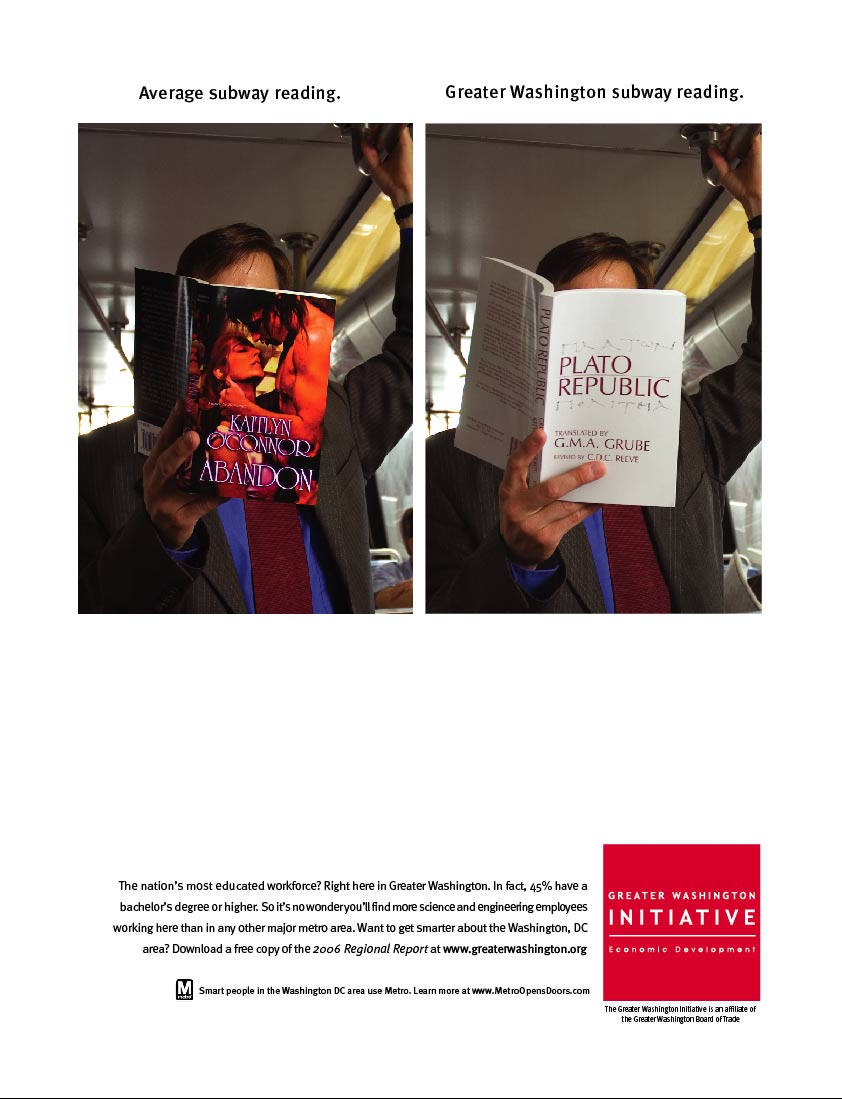
It all started out with an advert on the Washington DC Metro which was reported to the Smart Bitches. The resultant furore was reported by both The New York Times and The Washington Post, followed by comments on each article by the Smart Bitches and even more comments as the debate raged on. In the advert 'Greater Washington subway reading' material, epitomised by Plato's Republic, was being contrasted with 'average subway reading', represented by a romance novel. The implication was that Greater Washington's metro travellers, part of 'The nation's most educated workforce', of whom '45% have a bachelor's degree or higher', are well-educated people of the sort who read Plato, whereas less well-educated people read romance. For obvious reasons there were plenty of romance readers who took exception to this. For one thing, according to the RWA's statistics, 42% of romance readers 'have a bachelor's degree or higher'.

Inspired by all this controversy, I thought I'd take a look at the book which sparked all the outrage, namely Plato's Republic. It wasn't long before I came across an issue which, while dealt with only briefly in this passage from the Republic, is of vital importance to the romance genre. Cephalus, an elderly man, recalls
the aged poet Sophocles, when in answer to the question, How does love suit with age, Sophocles, --are you still the man you were? Peace, he replied; most gladly have I escaped the thing of which you speak; I feel as if I had escaped from a mad and furious master. His words have often occurred to my mind since, and they seem as good to me now as at the time when he uttered them. For certainly old age has a great sense of calm and freedom; when the passions relax their hold. (Book I, Jowett translation)
In both the classical period and in the Middle Ages, love was often seen as a form of madness:
The disease of love, according to medieval physicians, is a disorder of the mind and body, closely related to melancholia and potentially fatal if not treated. In their view, however, lovesickness did not afflict everyone alike: the sufferer was typically thought to be a noble man. (Wack 1990: xi)
If lovesickness was generally thought to result in depression and melancholy in the Middle Ages,
that is not the way it is depicted in the majority of ancient literary texts. Lovesickness, displayed in a violent or manic fashion, receives descriptions in almost all of the periods of ancient literature.(Toohey 2004: 61)
There were, however, believed to be different types of love - eros, philia and agape, and for a more detailed discussion of Plato's ideas on love see, for example, this entry from the Stanford Encyclopedia of Philosophy.

In Plato's Symposium it is explained that
love is always directed towards what is good, indeed that goodness itself is the only object of love. When we love something, we are really seeking to possess the goodness which is in it. Not temporarily of course, but permanently. And from there Plato gives his first definition of love: ‘Love is desire for the perpetual possession of the good.’ [...] But although all things love, and all men are in some sense lovers, few recognise the object of their love, that which motivates their striving, that which underlies their every desire, that which will ensure ‘perpetual possession’. This object Plato calls the Good or absolute beauty. (Amir 2001)
We may recall that Frye wrote:
We may think of our romantic, high mimetic and low mimetic modes as a series of displaced myths, mythoi or plot-formulas progressively moving over towards the opposite pole of verisimilitude
According to Frye, romances in the high mimetic mode come in for criticism because 'the interest in this sort of displaced myth “tends toward abstraction in character-drawing, and if we know no other canons than low mimetic ones, we complain of this.”' Could it be, then, that romances of this type, which are criticised for having stereotypical, unrealistic characters and plots, are in fact exploring love as the pursuit of 'the Good or absolute beauty'? To take as an example an old but important novel in the development of the genre, E. M. Hull's The Sheik, we find that the heroine, Diana Mayo (her very name recalls that of a goddess) is referred to as 'The divinity' (page 4) and one of her admirers exclaims that 'Beauty like yours drives a man mad' (page 7). In romances of the high mimetic type, the lovers are usually extremely beautiful/physically attractive, and intensely possessed of particular virtues (courage, in the case of Diana Mayo, humility and self sacrifice in the case of many other heroines, bravery in the case of many heroes). They are personifications of aspects of 'the Good' or 'absolute beauty'. Romances in the low mimetic mode, i.e. romances where the characters are more 'realistic' perhaps show how love can be compatible with daily living, without the lovers falling into the dangerous madness warned about by classical and medieval physicians.

Plato told stories, relating his ideas through the characters of Socrates and his interlocutors. Socrates is depicted using simple examples in order to approach philosophical truths, such as when he asks 'When horses are injured, are they improved or deteriorated?' during the dialogue regarding justice. It seems to me that this is not totally dissimilar to the way that romances, rather than discuss relationships or love in the abstract, ground their investigation into the causes and effects of love in a particular situation, so that it may be more easily understood by the reader.

I'd also like to take a closer look at old age, which was where we began when I quoted from the Republic. Do 'the passions relax their hold' in old age? And is this what is portrayed in the romance genre? I think it very often is, in the sense that the majority of romances portray young lovers. Sandy Oakes, for example, states that 'a romance works best when the experience is new—the younger hero and heroine falling in love for the first time'. But passion at an older age is not simply an issue affecting the characters within novels: it is also an issue which affects the perception of the romance readers, as explored in a recent At the Back Fence column at AAR, where Robin Uncapher commented that 'It’s not only younger people who find the idea of an older reader disconcerting. It’s all of us, including those of us who have passed that 40th birthday'. Michelle Buonfiglio articulated the unease that older readers can feel when they realise that they are feeling an attraction to a character who is much younger than they are: 'is it just plain creepy to think guys who are 10, 15, 20 years younger than I are sexy as hell?'. And although many romances only show passionate, romantic love between younger characters, there are some which feature older characters. Michelle mentions Candice Hern's Just One of Those Flings" which has as its hero 'an alpha younger man who's crazy about an older woman. Our heroine's got to convince herself that his attraction to her is real, not some fetish; that her desirablity transcends her age'. Age is also an issue in Jessica Hart’s Contracted: Corporate Wife. The heroine is divorced, and the mother of a fourteen-year-old girl and an eleven-year-old boy:
She was attractive enough, but she had to be at least forty-five, and it showed in the lines around her eyes.
That cool, composed look had never done anything for him, anyway. He liked his women more feminine, more appealing, less in control. And younger. (2005: 6).
Patrick, the character making these observations, is himself ‘in his late forties’ (2005: 10). His opinion of Lou begins to change when she smiles:
Lou smiled up at the barman as he materialised out of the gloom, and Patrick’s hand froze in mid-tap as he felt a jolt of surprise. He hadn’t realised that she could smile like that.
She never smiled at him like that. [...] Not the warm, friendly smile she was giving the barman now, lighting her face and making her seem all at once attractive and approachable. (2005: 10)
The double standard, which generally leads people to consider an age-gap more appropriate if the man is the older of the couple, is directly challenged by Lou:
The boy was clearly trying to impress Lou, Patrick thought disapprovingly, watching his attempts at banter. She had only smiled at him, for heaven’s sake. Anyone would think that she was hot, instead of nearly old enough to be his mother. Just what they needed, a barman with a Mrs Robinson fixation. [...] Patrick glowered at the barman’s departing back. ‘Thank God he’s gone. [...]’
‘I thought he was charming,’ said Lou, picking up her glass.
She would.
‘Don’t tell me you’ve got a taste for toy boys!’
‘No – not that it would be any business of yours if I did.’ [...]
‘You don’t think it would be a bit inappropriate?’ he countered.
Lou stared at him for a moment, then sipped at her champagne. ‘That sounds to me like a prime case of pots and kettles,’ she said coolly. (2005: 11)
As Lou observes, Patrick’s girlfriends ‘look a good twenty years younger’ than him (2005: 12). She also acknowledges that ‘She was a middle-aged woman and it was well known that you became invisible after forty’ (2005: 12). Of course, this being a romance, Patrick eventually loses his arrogance and after that evening he starts to think of Lou in a new way.

Jennifer Crusie is another author who has written a romance about a heroine who is over forty. In Anyone But You, a forty-year-old heroine is paired with a thirty-year-old hero. The heroine's attempts to make her body into the ideal of female beauty are shown to be futile; this is not a novel in the high mimetic mode. Instead she realises that 'I wanted to give him a perfect body, and all he wanted was mine' (2006: 218).
  • Amir, Lydia, 2001. 'Plato’s Theory of Love: Rationality as Passion', Practical Philosophy, November 2001, Volume 4.3: 6-14.
  • Crusie, Jennifer, 2006. Anyone But You (Richmond, Surrey: Harlequin Mills & Boon).
  • Hart, Jessica, 2005. Contracted, Corporate Wife (Richmond, Surrey: Harlequin Mills & Boon).
  • Toohey, Peter, 2004. Melancholy, Love, and Time: Boundaries of the Self in Ancient Literature (Ann Arbor: University of Michigan Press).
  • Wack, Mary Frances, 1990. Lovesickness in the Middle Ages: The ‘Viaticum’ and its Commentaries, University of Pennsylvania Press, Middle Ages Series (Philadelphia: University of Pennsylvania).

Saturday, September 30, 2006

The Dangerous Lover

That's the title of Deborah Lutz's recent book (full title The Dangerous Lover; Gothic Villains, Byronism, and the Nineteenth-Century Seduction Narrative ). The central thesis of the book concerns the dangerous lover, and it seems to me that what Lutz has to say about this character type illuminates the discussion we've been having about risk, eroticism and romances which function on a mythical level. There's a synopsis and a link to a pdf of the introduction and first chapter available, but to give you a flavour of what the book's about, here are some quotations:
Standing always under the sign of longing is the dangerous lover—the one whose eroticism lies in his dark past, his restless inquietude, his remorseful and rebellious exile from comfortable everyday living. His ubiquity marks him as always central to what we mean when we talk about existence and the modern self. (2006: ix)
Caught up in an everyday world of all that appears closest and most familiar to us, we believe that our existence can be explained by what we know well. But ontologically, our most authentic selves lie in what is most mysterious and strange — what appears to be furthest from us. Confronted with authentic being, we feel a sense of terror in the face of the unknown. The dangerous lover narrative makes the same argument about ontology—that our “true” selves reside in what is most strange and enemy-like, in the dangerous
other. (2006: x-xi)
The romance heroine finds her most authentic self at the heart of what seems at first most foreign and outside her way of being—an arrogant, hateful other. Romance moves always toward discovery and approaching the impenetrable: what is uncovered is authentic existence in the uncanny other; at the very heart of what appears to be not ours comes what we must fully own as ours. (2006: xi)
In her study of early romance genres (from 1674 to 1740), Ros Ballaster creates two categories of use here: didactic love fiction and amatory fiction. [...] Ballaster’s category of didactic love fiction—romance that has a didactic project, is future-directed, and attempts to represent a moral way of living, a “just” kind of love (depending on what constitutes the “morals” of the particular time period in question). On the opposite extreme, the dangerous lover type falls under the rubric of amatory fiction. Amatory fiction cannot be, generally speaking, recuperated morally, nor does it play out in a socially sanctioned realm. The anarchical rebelliousness of the dangerous lover narrative — its moments of frozen inarticulateness — undercut a didactic project. In its aestheticization of failure, dangerous love has its foundations in the finitude of being, on the edge of silence, in fragmentation, and in disintegration. Dangerous love plays with the outside — of possibility, life in society, happiness. (2006: 2)
On some level the dangerous lover hides in myth; he retreats from present being into being an other from the past. And to love a dangerous lover is also to step into the fantasy of mythology and its truth, seemingly frozen yet always shifting. To retreat into myth is to step out of the present and re-create a past, larger than life. (2006: 4)
His seductiveness can be located here: the one who loves him can grasp the power of impossibility; she can make the world possible by being, herself, the plenitude, the immanent meaning of existence for him. The hero’s belief in his brilliance, his superior, misanthropic position above all others and their run-of-the-mill lives, is so very believable to the heroine that to change this decimation to plenitude becomes her reason for being. (2006: 5)
The dangerous lover narrative exemplifies, in its movements and its central concerns, the angst of being itself. The unfathomable mystery of existence in the world and the longing it perpetuates—the longing to fully be, to be sure what to do with the world that surrounds us—is the same desire the heroine of the romance has for the dangerous beloved. This is the desire to desire; it is desire per se. (2006: 20)
Oh, and she mentions Laura Kinsale's essay in Dangerous Men, Adventurous Women in one of the endnotes:
As has been argued about Jane Eyre, often the heroine’s search to read the hero is a search for her own dark depths, her perhaps angry, sexual, insane, powerful, and free side, expressed by the hero, her double. To some extent, the dangerous lover always acts as a placeholder for desire. An investigation of this would be another historical trajectory entirely, one that waits to be written. An analogy is Gilbert and Gubar’s Madwoman in the Attic, which charts the ways Jane’s anger and sexuality are expressed through Bertha as her double. Also, Laura Kinsdale [sic] discusses the hero as double for the heroine in contemporary romance in Dangerous Men and Adventurous Women. (2006: 96)
I did have some relatively minor quibbles about the book, which I mentioned on the Romance Scholar listserv, but these were about small details, not about the central thesis of the book, which is interesting and, I think, very relevant to the discussions we've been having lately.

Tuesday, June 27, 2006

Frye on Romance

One advantage of blogging seems to me that I can jump around from topic, and hope somehow that it all coheres in the end. Blogging with others, group blogging (grogging?) multiplies the likelihood that we'll skitter from topic to topic in a sometimes-random, sometimes-provocative way.

Tonight, for example, I'm not going to discuss my first romance course at all, except to say that one of the most useful approaches we took to the genre last fall turned out to be a very old-fashioned one, influenced not at all by feminism or cultural studies. I gave my students a handful of passages from Northrop Frye's Anatomy of Criticism--passages on romance, on comedy, and on various literary "modes"--and used them to situate a number of our texts, starting with Sarah Bird's The Boyfriend School. With each version of the class, I've added a few more passages to the mix.

Here's the most recent version--I hope it's useful to someone out there! If anything here strikes a chord, I'd love to hear about it.

--E

Northrop Frye, Anatomy of Criticism: Four Essays. Princeton UP, 1957

Notes in brackets [like this] are paraphrased; notes in quotation marks are actual quotations.

33: [Fictions may be classified by the hero’s power of action, which may be greater than ours, less than ours, or roughly the same. If “superior in kind” to nature and to us, then “the hero is a divine being, and the story about him will be a myth”; “if superior in degree to other men and to his environment, the hero is the typical hero of romance, whose actions are marvelous but who is himself identified as a human being.”

33: In a romance, “the ordinary laws of nature are slightly suspended: prodigies of courage and endurance, unnatural to us, are natural to him, and enchanted weapons, talking animals, terrifying ogres and witches, and talismans of miraculous power violate no rule of probability once the postulates of romance have been established. Here we have moved from myth, properly so called, into legend, folk tale, marchen,” etc.

33-4: Other steps down the ladder of genres are: High Mimetic Epic and Tragedy (hero is superior to other men, but not order of nature or social criticism) >> Low Mimetic comedy and realism (hero is one of us, and we demand some everyday probability to the story) >> Irony / lit of the absurd (hero is inferior in power and intelligence to us, so that we look down from above, and “we judge by the norms of a greater freedom”)

37: “Romance…is characterized by the acceptance of pity and fear, which in ordinary life relate to pain, as forms of pleasure.”

44: “New Comedy normally presents an erotic intrigue between a young man and a young woman which is blocked by some kind of opposition, usually paternal, and resolved by a twist in the plot which is the comic form of Aristotle’s “discovery,” and is more manipulated than its tragic counterpart. At the beginning of the play the forces thwarting the hero are in control of the play’s society, but after a discovery in which the hero becomes wealthy or the heroine respectable, a new society crystallizes on the stage around the hero and his bride.” In some comedies, like Shakespeare’s, “the struggle of the repressive and the desirable societies” can play out as “a struggle between two levels of existence, the former like our own world or worse, the latter enchanted and idyllic.”

51: “the mimetic tendency itself, the tendency to verisimilitude and accuracy of description, is one of two poles of literature. At the other pole is something that seems to be connected both with Aristotle’s word mythos and with the usual meaning of myth. That is, it is a tendency to tell a story which is in origin a story about characters who can do anything, and only gradually becomes attracted toward a tendency to tell a plausible or credible story.”

52: “We may think of our romantic, high mimetic and low mimetic modes as a series of displaced myths, mythoi or plot-formulas progressively moving over towards the opposite pole of verisimilitude, and then, with irony, beginning to move back.”

131: In visual art, “’Realism’ connotes an emphasis on what the picture represents; stylization, whether primitive or sophisticated, connotes an emphasis on pictorial structure.” In literature, too, this contrast applies.

134: “The mythical mode, the stories about gods, in which characters have the greatest possible power of action, is the most abstract and conventionalized of all literary modes, just as the corresponding modes in other arts—religious Byzantine painting, for example—show the highest degree of stylization in their structure.”

135: “The occasional hoaxes in which fiction is presented, or even accepted, as fact…correspond to trompe l’oeil illusions in paining. At the other extreme we have myths, or abstract fictional designs in which gods and other such beings do whatever they like, which in practice means whatever the story-teller likes.”

By MYTH we mean stories in which actions occur “near or at the conceivable limits of desire” (136).

“Myth, then, is one extreme of literary design; naturalism is the other, and in between lies the whole area of romance, using that term to mean…the tendency…to displace myth in a human direction and yet, in contrast to ‘realism,’ to conventionalize content in an idealized direction. The central principle of displacement is that what can be metaphorically identified in a myth can only be linked in a romance by some form of simile: analogy, significant association, incidental accompanying imagery, and the like. In a myth we can have a sun-god or a tree-god; in a romance we may have a person who is significantly associated with the sun or trees.”

138: the interest in this sort of displaced myth “tends toward abstraction in character-drawing, and if we know no other canons than low mimetic ones, we complain of this.”

139: “This affinity between the mythical and the abstractly literary illuminates many aspects of fiction, especially the more popular fiction which is realistic enough to be plausible in its incidents and yet romantic enough to be a ‘good story,’ which means a clearly designed one. The introduction of an omen or portent, or the device of making a whole story the fulfillment of a prophecy given at the beginning, is an example. Such a device suggests, in its existential projection, a conception of ineluctable fate or hidden omnipotent will. Actually, it is a piece of pure literary design, giving the beginning some symmetrical relationship with the end, and the only ineluctable will involved is that of the author.

In romance we see a “tendency to suggest implicit mythic patterns in a world more closely associated with human experience,” while in what we call “realism” the tendency is to “throw the emphasis on content and representation rather than on the shape of the story,” although if we step far enough back from the text, we can often see the “mythopoeic designs” that structure the material (139-40).

162: “Tragedy and comedy contrast rather than blend, and so do romance and irony, the champions respectively of the ideal and the actual. On the other hand, comedy blends insensibly into satire at one extreme and into romance at the other; romance may be comic or tragic; tragic extends from high romance to bitter and ironic realism.”

167: “Comedy usually moves toward a happy ending, and the normal response of the audience to a happy ending is ‘this should be,’ which sounds like a moral judgment. So it is, except that it is not moral in the restricted sense, but social. Its opposite is not the villainous but the absurd, and comedy finds the virtues of Malvolio as absurd as the vices of Angelo.”

169: “The society emerging at the end of comedy represents…a kind of moral norm, or pragmatically free society. […] We are simply given to understand that the newly-married couple will live happily ever after, or that at any rate they will get along in a relatively unhumorous [meaning “not ruled by fixed emotions, or ‘humors’ in the old medical sense] and clear-sighted manner.”

169-70: “the movement from pistis to gnosis, from a society controlled by habit, ritual bondage, arbitrary law and the older characters to a society controlled by youth and pragmatic freedom is fundamentally, as the Greek words suggest, a movement from illusion to reality. Illusion is whatever is fixed or definable, and reality is best understood as its negation: whatever reality is, it’s not that. Hence the importance of the theme of creating and dispelling illusion in comedy: the illusions caused by disguise, obsession, hypocrisy, or unknown parentage.”

170: “Comedy regularly illustrates a victory of arbitrary plot over consistency of character.”

170: “Happy endings do not impress us as true, but as desirable, and they are brought about by manipulation. The watcher of death and tragedy has nothing to do but sit and wait for the inevitable end; but something gets born at the end of comedy, and the watcher of birth is a member of a busy society.”

171: a 3-part structure of comedy: “the hero’s society rebels against the society of the senex and triumphs, but the hero’s society is a Saturnalia, a reversal of social standards which recalls a golden age in the past before the main section of the play begins. Thus we have a stable and harmonious order disrupted by folly, obsession, forgetfulness, ‘pride and prejudice,’ or events not understood by the character themselves, and then restored.” […] “of course very often the first phase is not given at all: the audience simply understands an ideal state of affairs which it knows to be better than what is revealed in the play, and which it recognizes as like that to which the action leads. This ternary action is, ritually, like a contest of summer and winter in which winter occupies the middle action….”

179: “An extraordinary number of comic stories, both in drama and fiction, seem to approach a potentially tragic crisis near the end, a feature that I may call the “point of ritual death”—a clumsy expression that I would gladly surrender for a better one.” […] “Sometimes the point of ritual death is vestigal, not an element in the plot but a mere change in tone.”

181: “The presiding genius of comedy is Eros, and Eros has to adapt himself to the moral facts of society. […] Ambivalent attitudes naturally result, and ambivalence is apparently the main reason for the curious feature of doubled characters which runs through all the history of comedy.”

181: “The action of comedy, like the action of the Christian Bible, moves from law to liberty.”

182: “Shakespeare’s type of romantic comedy” may be called “the drama of the green world, its plot being assimilated to the ritual theme of the triumph of life and love over the waste land.” […] “The action of the comedy begins in a world represented as a normal world, moves into the green world, goes into a metamorphosis there in which the comic resolution is achieved, and returns to the normal world.”

183: “The green world charges the comedies with the symbolism of the victory of summer over winter.”

183-4: “The green world has analogies not only to the fertile world of ritual, but to the dream world that we create out of our own desires. This dream world collides with the stumbling and blinded follies of the world of experience, of Theseus’s Athens with its idiotic marriage law…” and other examples. “Thus Shakespearean comedy illustrates, as clearly as any mythos we have, the archetypal function of literature in visualizing the world of desire, not as an escape from ‘reality,’ but as the genuine form of the world that human life tries to imitate.”

186: “The romance is the nearest of all literary forms to the wish-fulfillment dream, and for that reason it has socially a curiously paradoxical role. In every age the ruling social or intellectual class tends to project its ideals in some form of romance, where the virtuous heroes and beautiful heroines represent the ideals and the villains the threats to their ascendancy. […] Yet there is a genuinely ‘proletarian’ element in romance too which is never satisfied with its various incarnations and in fact the incarnations themselves indicate that no matter how great a change in society, romance will turn up again, as hungry as ever, looking for new hopes and desires to feed on. The perennially child-like quality of romance is marked by its extraordinarily persistent nostalgia, its search for some kind of imaginative golden age in time or space.”

193: “the reward of the quest [in romance] usually is or includes a bride”

193-4: “The quest romance has analogies to both rituals and dreams…. Translated into dream terms, the quest-romance is the search of the libido or desiring self for a fulfillment that will deliver it from the anxieties of reality but will still contain that reality. […] Translated into ritual terms, the quest-romance is the victory of fertility over the waste land. Fertility means food and drink, bread and wine, body and blood, the union of male and female.”

195: “The characterization of romance follows its general dialectic structure, which means that subtlety and complexity are not much favored. Characters tend to be either for or against the quest. […] Every typical character in romance tends to have his moral opposite confronting him, like black and white pieces on a chess game.” We may thus have a contrast “between the lady of duty and the lady of pleasure,” for example, or noble characters paired with rustic clowns, Sancho Panza figures who offer a contrasting note of realism.