Showing posts with label Charlotte Brontë. Show all posts

Thursday, April 11, 2013

Call for Papers: The Long (British) 19th Century


Journal of Popular Romance Studies
CALL FOR PAPERS

Romancing the Long British 19th Century

The long British nineteenth century (1789-1914) appears to have the long global twentieth century (including the first decades of the twenty-first) in its thrall. Regency and Victorian settings proliferate in popular romance fiction, ranging from scenes of domestic life within the United Kingdom to British espionage in Europe and British colonial settlements. Retellings and “sequels” of Jane Austen’s novels line our (digital) bookshelves and fill fan-fiction websites, spilling over most recently into the YouTube sensation The Lizzie Bennet Diaries. Such adaptations of Austen’s novels, along with film and TV versions of the Brontë sisters’ Jane Eyre and Wuthering Heights, and Elizabeth Gaskell’s North and South, suggest that modern audiences cannot get enough of stories about Georgians, Victorians, and Edwardians in love.

The Journal of Popular Romance Studies seeks papers on this enduring love affair with 19th-century Britain. Why does a period that is historically associated with the establishment of the Industrial Revolution, the consolidation of the Empire, and the coalescing of middle-class mores now strike us as a particularly “romantic” era? How do popular and middlebrow media from around the world construct, interpret, and recast the world of 19th c. Britain, broadly construed? What do these interpretations say about our current moment and our modern (or postmodern) thoughts and feelings about romance?

We welcome submissions that explore these and related questions from any disciplinary or theoretical angle. We invite papers that cover different media, including (paper and digital) literature, film, TV, online content, and marketing.

This Special Issue of The Journal of Popular Romance Studies is guest edited by Jayashree Kamble and Pamela Regis. Please submit scholarly papers of no more than 10,000 words, including notes and bibliography, by March 1 2014, to An Goris, Managing Editor, at  managing.editor@jprstudies.org.  

Submissions should be Microsoft Word documents, with citations in MLA format. For more information on how to submit a paper, please visit http://jprstudies.org/submissions/

Tuesday, February 22, 2011

High and Low


I was reminded of Mills & Boon's current "The Powerful and The Pure" mini-series when I saw the following call for papers, for a conference to be held in Dundee on the 8th and 9th of June:
Call for Papers: Ninth Annual English Postgraduate Conference
High and Low: Cultural Levels in Word and Image

High and Low is the ninth annual Postgraduate Conference held by the English Programme, University of Dundee, and runs in conjunction with the Scottish Word and Image Group annual conference. It will address configurations of high and low in literature and visual media and is particularly interested in the perceived distinction between highbrow art and lowbrow entertainment, and the ways in which middlebrow texts, and other amalgamations of these two categories, are able to negotiate the apparent gulf between them. Of particular relevance to this dichotomy are texts that have been subject to critical re-evaluations over time, works that mix the sacred and the profane, and artistically sophisticated products of trash culture.
Full details are available here. So, back to "The Powerful and The Pure." Kate Walker has written a novel for this mini-series which contains
reworkings of classic romantic stories from literature. The other books in the series are by Sharon Kendrick - The Forbidden Innocent (Jane Eyre), Cathy Williams - In Want of A Wife? (Pride and Prejudice) and Kate Hewitt — Mr & Mischief (Emma) My own story is a reworking of one of my favourite novels of all time - Wuthering Heights — and it will be called The Return of The Stranger.
Here's the cover of the first in the series (and hopefully I've copied the html properly, so that if you click on the cover, it'll take you to an excerpt):


Since the conference is interested in images as well as texts, here are some covers for Jane Eyre itself. All three come from Penguin's website: the first seems to me to position the novel as a "high" novel, the second looks as though it's trying to appeal to a different market segment (maybe Young Adult?), and the third cover is from a Signet edition.


Here's the cover of the Mills & Boon reworking of Pride and Prejudice alongside two covers for the original novel (the first is from Penguin, the second from Headline). The layout of the M&B cover and the Penguin one are rather similar, while the Headline version looks as though it's hoping to convince readers that Austen is chick lit.


Stirling University's The Gothic Imagination blog gives another example of interesting relationships between "high" and "low":
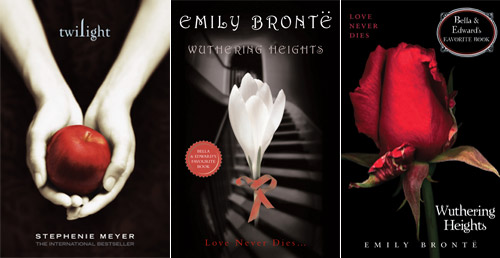
The Twilight books are vaguely inspired by 3 novels: Wuthering Heights, Pride and Prejudice, and Romeo and Juliet. You’ll no doubt have seen the Harper Collins reissue of Wuthering Heights in 2009.

As well as being branded with the Twilight colours, Wuthering Heights is given its celebrity endorsement; it is, we are assured, ‘Bella and Edward’s favourite book’. There’s a quite fascinating process of framing going on here as a result of branding. Wuthering Heights, appropriated by Meyers in her series, is retrospectively reframed by that to which it gave issue, and constituted in a different way, for a different (and particular) readership.
----

Thursday, August 06, 2009

Real Men Talking

When Charlotte Brontë's Jane Eyre was first published, under the pseudonym of "Currer Bell," the reviewers
were tricked into self-revelation. In the course of their fervent speculations about the identity of the author of Jane Eyre, they disclosed their firm convictions - or, to be more accurate, their prejudices - about the capabilities and limitations of women writers. Take, for example, Elizabeth Rigsby's famously scathing review, which offers clear evidence that the novel could not have been written by a woman [...]. Most engaging of all was the conclusion reached by Edwin Percy Whipple. He decided that Jane Eyre was the collaborative work of three siblings, two brothers and a sister [...] Whipple presumes that a woman must have had a hand in the writing, given details of dress, the sick chamber, and certain feminine "refinements of feeling," but then clarity, decisiveness, profanity, brutality, heat, passion, animal appetite, and slang - these are clear hallmarks of masculine writing. In fact, these markers of the male intellect are so conspicuous that the novel must have been written, at least in part, by that indisputably masculine mind, the author of Wuthering Heights. (Levine 70-72)
The author of Wuthering Heights was Emily Brontë, a woman.

I was reminded of these reviewers convictions about male and female authors when I read the comments an editor had made about Bev Vincent's writing:
The story was written from the point of view of a male protagonist. These comments are all from the same editor:
  • “It’s quite a challenge for a writer of one sex to explore writing from the perspective of the opposite sex. Bev Vincent has not done a convincing job.”
  • “The story seems far too personal, introspective and emotional for a man”
  • “And I can’t think of many guys from [setting] who call home every Sunday afternoon to talk to their family” [Emphasis his or hers].
  • “Most men don’t think deeply about the dewy greenness of nature.”
  • “She needs to write more convincing [sic] from a man’s perspective.” (via Ampersand, at Alas, a blog)
Bev Vincent wrote a post about the experience. He is in fact a man and
this was the most autobiographical story I’ve ever written, and all the things that the editor complained about were my real observations and my real thoughts cast into the mind of a fictional character participating in fictional events. I did, in fact, call home every Sunday afternoon to talk to my parents, while they were still alive.

To compound his or her arrogance, the editor claims that my prose is “overly elegant,” which is presumably his or her way of saying that a man would never write or think in elegant terms. Guess that means I write like a girl.
Bev doesn't write romance, but I've seen comments on romance websites about authors, writing under female names, whom readers suspect are really men and I've also seen plenty of advice to authors wanting to ensure that their male characters sound like real men. Leigh Michaels, for example, gives advice on
the main ways in which real men and women differ when it comes to talking - and how your characters should differ if they're going to be convincing. [...] Men use shorter and fewer sentences; women use longer, more complex sentences and string more of them together. Men say something is blue; women say it's robin's-egg blue, or navy, or teal.
Men talk about actions or things; women talk about feelings. (166)
Michaels seems to have expectations of men and their use of language which match those of Bev Vincent's editor. Men, it would seem, are expected to be less emotional, less verbal, and less good at observing details. Deborah Cameron, however, points out that the scientific research that has been done in this area does not support such conclusions:
The idea that men and women metaphorically "speak different languages" - that they use language in different ways and for different reasons - is one of the great myths of our time. Research debunks the various smaller myths that contribute to it: for instance, that women talk more than men (research suggests the opposite); that women's talk is cooperative and men's competitive (research shows that both sexes engage in both kinds of talk); that men and women systematically misunderstand one another (research has produced no good evidence that they do).

There is a great deal of similarity between men and women, and the differences within each gender group are typically as great as or greater than the difference between the two. Many differences are context-dependent: patterns that are clear in one context may be muted, nonexistent or reversed in another, suggesting that they are not direct reflections of invariant sex-specific traits.
It should also be noted that how "real men" and "real women" speak may differ very significantly from one culture to another. For example
In the village of Gapun in Papua New Guinea, when a woman is annoyed with her husband, she swears at him for 45 minutes, at the top of her voice so the neighbours catch every nuance. During this “kros” — the word means “angry” — the target is not allowed to answer back, nor may anyone interrupt until she’s given her feelings full expression.

And what expression it is. The anthropologist Don Kulick recorded a typical kros: “You’re a ****ing rubbish man. You hear? Your ****ing ***** is full of maggots. You’re a big ****ing semen *****. Stone balls! ...****ing black *****! You *****ing mother’s ****!”

When the flowers of English womanhood carry on like this — at closing time on Friday night in Ipswich, say — they’re thought to be behaving laddishly. When the housewives of Gapun turn the air blue, however, they are only doing what comes naturally to a woman. The village men, apparently, pride themselves on their ability to conceal their opinions and express themselves indirectly: if they need to get a grievance off their chests, they get their wives to do it for them. (Herbert)
Clearly if a romance were to be set in Gapun, the author would only be able to write "real men" by utterly disregarding much of the existing advice about how to write "real men." Thinking about places which are distant chronologically rather than geographically, it seems to me that the mainly male Romantic poets, or an author like Thomas Hardy who produced long and very detailed descriptions of landscape, probably didn't write in a way that would convince Bev Vincent's editor they were real men and, even bearing in mind that people's written language can differ considerably from their spoken language, they probably didn't speak the way Michaels says real men do.

Female authors writing contemporary romances set in their own part of the world could take PBW's advice and "Hang out with some real live men. Note their body language, speech, and mannerisms. Observe how their behavior changes, and what triggers those shifts" but this wouldn't be so much help with depicting real men from different cultures, including those from different historical periods.

And how much reality do readers and authors want and need anyway? Anne Marble, in her advice on writing romantic dialogue, states that
Dialogue Should Not Reflect Real Life Too Closely

This sounds counterintuitive at first. How can dialogue sound authentic and yet not reflect real life closely? I'll give you the answer in a metaphor. The best dialogue is like vanilla extract. Instead of bottling every line of speech characters would use when speaking with each other, dialogue should give us the essence of their conversations.
Could it be that when many authors write "real men," they're actually writing men that their readers will believe are real, even though many actual real men, including Bev Vincent, in fact express themselves in language which might be deemed false or overly feminine by readers?

[Since I mentioned the Brontë sisters and I'm discussing "real men", I thought I'd add a link I was sent by Angel, about Emily, Charlotte and Anne. It's a cartoon which encapsulates their differing preferences in men (as heroes).]

The image at the top of the post was created by "Francis Barraud (1856-1924) [who] painted his brother's dog Nipper listening to the horn of an early phonograph during the winter of 1898" and it came from Wikimedia Commons. As adopted by the Victor Talking Machine Company in their advertising, the dog was described as listening to "His Master's Voice."

Monday, December 10, 2007

The M&B heroine fights back


In what might be considered a follow-up to Julie Bindel's recent comments on Mills & Boon romances, on Saturday the Guardian published an article by Tanya Gold. She's digging even deeper into the Mills & Boon archives than Bindel did, and is also making generalisations:
these are not disempowerment fantasies, they are in fact the opposite. [...] They were among the first popular novels to depict women who work - all Mills & Boon women work (unless they are kidnapped). Critics complain the books are materialistic and venerate the aristocracy. In fact the Mills & Boon heroine is ordinary, often orphaned (parents tend to die in boating accidents) and plain.
Since this is not an accurate description of all Mills & Boon heroines, I begin to suspect that this is the same Tanya Gold who's fascinated by Jane Eyre: 1
This novel is simply the best novel ever written [...]. It's romantic fiction redux and it's there to heal your pain. [...]

Mr Rochester [...], whom Jane first meets when he falls off his horse, "has a dark face with stern features and a heavy brow; his eyes and gathered eyebrows looked ireful and thwarted".

Do you get the idea? Do you recognise this tender brute from Barbara Cartland, Mills and Boon, Neighbours? [...]

In Rochester, Charlotte wrote a hero no real man can ever touch. Jane Eyre should be subtitled Revenge Of The Parson's Daughter because she spoilt real love for us all.

He is the man in every film, book or TV series you ever wanted; the dark darling you can save from himself. Plus Thornfield would be fab to redecorate.

And Jane is so ordinary, "poor, obscure, plain and little", that anyone could get him. He chucks the glamourous beauty Blanche for Jane. He falls, like a god, into our laps.
But to get back to the vintage Mills & Boons, Gold states that
far from being misogynistic, men who are cruel to women are punished horrifically by the Mills & Boon gods. If your lover takes advantage he will be blinded. If he lies to you he will develop amnesia and think he is a child. If he cheats on you he will have his arms blown off by a landmine. Is that really a disempowerment fantasy? Or is that what I really, really want?

And Mills & Boon was multicultural long before it became fashionable. "I am a foreigner, and you English distrust foreigners," said the hero in They Meant to Marry (1934). "Oh, not since the war," replies his heroine. By the 1950s Mills & Boon woman had junked the Englishman altogether - and found time to smash the glass ceiling. In The Hospital in Buwambo (1957), Dr Sylvia Phillips is told "Africa is no place for a woman". She spits back: "We do everything nowadays" - leaving the hero to have his arms blown off (yes, another one).
Again, I suspect the influence of Mr Rochester, who loses his sight in a fire. Gold is quite clearly writing with her tongue stuck firmly in her cheek, no doubt to protect it from the explosions, as she concludes that "Mills & Boon women respect themselves and expect the men who love them to respect them too - if they don't, they'll get their arms blown off," but this is clearly a spirited defence of the novels from someone who enjoys reading romantic fiction. Read separately, Bindel and Gold's articles would be highly misleading; read together, they possibly balance each other out.

1 It seems likely that Tanya Gold writes for both the Guardian and the Daily Mail. Certainly the Tanya Gold who writes for the Guardian has also written about Jane Eyre.


The picture of the cover of The Hospital in Buwambo is of the Harlequin edition, and is from the Fantastic Fiction database.

Sunday, January 07, 2007

Famous Literary Predecessors of the Modern Romance Novel

My New Year's resolution was to read and blog about some of the predecessors of the modern romance novels published today.* I also qualified this by adding that I'd only blog about some of the less well-known novels. That's because some of these predecessors are among the most famous novels written, and (a) you can read about them in great detail elsewhere and (b) anything I could write here would look a bit feeble in comparison with the volumes of literary criticism on them that already exist. I will, though, mention some of the famous literary predecessors of the modern romance very briefly. I'm sticking to novels which are romance according to the RWA definition, i.e. novels that have 'a central love story and an emotionally satisfying and optimistic ending'. For reasons of space, if a particular author has written more than one romance I'll usually just list one of them.
  • 1740, Richardson, Samuel, Pamela: or, Virtue Rewarded. This is Richardson's 'most widely read work. At once profoundly influential, yet heavily and publicly vilified, the novel's publication marked the beginning of one of the most astounding moments in literary history and laid the foundation for Richardson's status as one of the founding fathers of the modern novel.' (Batchelor 2002). Regis dedicates a chapter to it (2003: 63-74). You can read a brief description of the novel here, and see illustrations from five eighteenth-century editions here.
  • 1778, Burney, Frances, Evelina: Or, The History of a Young Lady's Entrance into the World . This was 'a critical success, receiving praise from respected individuals, including the statesman Edmund Burke, and literary critic Dr. Johnson. It was admired for its comic view of wealthy English society, and for its realistic portrayal of working class London dialects' (Wikipedia). It was initially published anonymously, which led 'leading London society to speculate on the identity of the writer, who was universally assumed to be a man', though Burney's identity was later revealed and 'She was taken up by literary and high society and became the first woman to make writing novels respectable' (The Burney Society). Another aspect of Evelina which was of great significance for future women writers was that 'The "comedy of manners" genre in which she worked paved the way for Jane Austen, Maria Edgeworth, and other 19th-century writers' (The Burney Society).
  • 1813, Austen, Jane, Pride and Prejudice. Sarah's already claimed Austen as a romance author, and this novel is so well-known and well-loved that it hardly seems to require any further description from me, but if you'd like the Spark Notes, they're here, and, as they say, 'Pride and Prejudice contains one of the most cherished love stories in English literature: the courtship between Darcy and Elizabeth'. Colin Firth's portrayal of Darcy in the 1995 BBC adaptation is extremely popular. The link to the text of the novel will take you to the Republic of Pemberley site, where you can find a wealth of information about Austen, her novels and her times. You can also see Regis (2003: 75-84), and the chapter's titled 'The Best Romance Novel Ever Written', which makes Pam's feelings on this novel extremely clear! My favourite Austen is Persuasion, but I know I'm in the minority on this.
  • 1847, Brontë, Charlotte, Jane Eyre. If you haven't read it, and want a quick synopsis, there's one here, or you can look at the Spark Notes. The Victorian Web has plenty of very short articles on many aspects of the novel, including its political and social context, treatment of gender issues, and imagery/symbolism. See also Regis (2003: 85-91).
    When Jane Eyre was published in 1847, it became a bestseller. The reviews were on the whole favorable. There was much speculation about whether the writer was a man or a woman [...]. When it became known that a woman had written such a passionate novel and seemed so knowing sexually, the reviews became more negative. [...] The reviewer for the Rambler expressed a criticism that was made against all the Bronte novels--coarseness. The reference to "grosser and more animal passions" is a roundabout way of saying "sex." (Melani 2005)
  • 1847, Brontë, Anne, Agnes Grey. There's a synopsis here, where the observation is made that
    Anne's first novel resembles in its calm naturalism nothing so much as one of the later Austen novels, with the vital difference that her heroine is a working woman. It deserves, far more than Jane Eyre, the description 'governess novel', because Agnes's experience is far more typical, and the predicament of the occupation is analysed much more closely. (Brontë Parsonage Museum and Brontë Society).
    Agnes Grey isn't as famous as Jane Eyre, but personally I prefer both it and Anne's The Tenant of Wildfell Hall, which 'A number of contemporary critics have recognized [...] as a landmark feminist text' (Downey, 2000) to the other Brontë novels. Whatever the reason, I can manage perfectly well without the brooding Mr Rochester (and particularly without the horrible Heathcliff).
  • 1854, Gaskell, Elizabeth Cleghorn, North and South. There's a synopsis here. Unlike the Brontës, Gaskell shows us the industrial activity which contributed so greatly to the Victorian economy.
    The novel is famous as an "industrial novel" that engages [with] class struggle and suffering in newly industrialized Victorian cities like Manchester (or, as Gaskell calls it, Milton) and as an important female bildungsroman or coming-of-age novel. Margaret's public intervention in the strike ranks among the most exciting moments in Victorian literature. (Literature, Arts and Medicine Database)
  • 1861, Trollope, Anthony, Framley Parsonage. There's a synopsis here and it was with this novel that 'Anthony Trollope enjoyed his first popular success. It is the fourth of Trollope's Chronicles of Barsetshire - a set of six novels that share a fictional geography, interlaced characters, and a thematic preoccupation with the church in a Cathedral town' (Regis 2003: 93). Although a 'thematic preoccupation with the church' might sound a little dull, it really isn't. This is a church rife with the equivalent of modern office politics, and for those of you who like series of romances which follow a group of characters, Trollope's Chronicles of Barsetshire provide an example of rich and complex world-building. His other series, the Palliser novels, again involve politics, though this time the plots 'usually involve English politics in varying degrees, specifically in and around Parliament' (Wikipedia). Trollope was an extremely prolific author, and this may well have been a trait he learned from his mother:
    Fanny Trollope [...] had been writing, industriously, a record of her crazy trip to America. She called it: Domestic Manners of the Americans. It was published, and quickly became a bestseller. [...] It gave Anthony an insight into how a professional writer should write. From his mother's example (she was constantly writing for many years, although she never quite achieved the same degree of success), he learned the habit of sheer hard work. (The Trollope Society)
    One might make comparisons with Nora Roberts' work habits, but unfortunately for Trollope, 'After his death Trollope's literary reputation sank low, and he was regarded as something of a journeyman of letters. This arose partly from the revelation in his Autobiography that he treated literature as a trade and wrote by the clock' (The Victorian Web). It rose again, however, as the mass of writing about his work testifies, and he still has plenty of enthusiastic fans in the UK, US and elsewhere.
  • 1872, Hardy, Thomas, Under the Greenwood Tree. I know this isn't the most famous of Hardy's works, but it seems only right to include Hardy who is, as the Penguin Reader Factsheet acknowledges, 'one of the greatest novelists of the nineteenth century' and 'This charming, timeless story of rural life gave Hardy his first real taste of fame and success'. Or, as one reader candidly describes it,
    it's a book with about the least plot you will ever find in a novel. It's also on the short side. Unusually for Hardy's novels. it has a happy ending - however Far from the Madding Crowd, the next one he wrote, does too - it was only as Hardy's reputation grew that he could afford to upset his public at the end of every book.
    I was amused to note that one of the minor characters, whom some consider a witch, is called Mrs Endorfield.
  • 1908, Forster, E. M, Room with a View. As Regis observes, 'E. M. Forster may have ended this novel happily, but he was by no means sanguine about happy endings in general' (2003: 99). It's fame is probably due at least in part to the award-winning 1986 Merchant Ivory film. The Spark Notes are here.
Can you think of any others? I thought of including George Eliot's Daniel Deronda, but although it has a love story and a happy ending, I'm not sure whether the love story between Daniel and Mirah is 'central'. I also considered Dickens' Great Expectations, but again, I wasn't sure if Pip and Estella's relationship is really 'central'. And how about D. H. Lawrence's Lady Chatterley's Lover? It certainly has a central love relationship and the ending, if not happy, seems relatively optimistic. What do you think?

Even incomplete as it is, what this list suggests to me is that (a) as we've discussed previously, men can write romance/romantic novels and (b) that the so-called 'constraints' of writing within the romance genre (which basically amount to the need to end a love-story happily) in no way preclude the creation of a work of literary merit.

----
  • Regis, Pamela, 2003. A Natural History of the Romance Novel (Philadelphia: University of Pennsylvania Press).
* I'm taking the term 'today' somewhat loosely, to mean 'anytime in the past few decades'. Having been a medievalist, a decade or two seems like a short space of time to me. I'm sure geologists would consider a decade the equivalent of a mere blinking of an eye.

Saturday, September 30, 2006

The Dangerous Lover

That's the title of Deborah Lutz's recent book (full title The Dangerous Lover; Gothic Villains, Byronism, and the Nineteenth-Century Seduction Narrative ). The central thesis of the book concerns the dangerous lover, and it seems to me that what Lutz has to say about this character type illuminates the discussion we've been having about risk, eroticism and romances which function on a mythical level. There's a synopsis and a link to a pdf of the introduction and first chapter available, but to give you a flavour of what the book's about, here are some quotations:
Standing always under the sign of longing is the dangerous lover—the one whose eroticism lies in his dark past, his restless inquietude, his remorseful and rebellious exile from comfortable everyday living. His ubiquity marks him as always central to what we mean when we talk about existence and the modern self. (2006: ix)
Caught up in an everyday world of all that appears closest and most familiar to us, we believe that our existence can be explained by what we know well. But ontologically, our most authentic selves lie in what is most mysterious and strange — what appears to be furthest from us. Confronted with authentic being, we feel a sense of terror in the face of the unknown. The dangerous lover narrative makes the same argument about ontology—that our “true” selves reside in what is most strange and enemy-like, in the dangerous
other. (2006: x-xi)
The romance heroine finds her most authentic self at the heart of what seems at first most foreign and outside her way of being—an arrogant, hateful other. Romance moves always toward discovery and approaching the impenetrable: what is uncovered is authentic existence in the uncanny other; at the very heart of what appears to be not ours comes what we must fully own as ours. (2006: xi)
In her study of early romance genres (from 1674 to 1740), Ros Ballaster creates two categories of use here: didactic love fiction and amatory fiction. [...] Ballaster’s category of didactic love fiction—romance that has a didactic project, is future-directed, and attempts to represent a moral way of living, a “just” kind of love (depending on what constitutes the “morals” of the particular time period in question). On the opposite extreme, the dangerous lover type falls under the rubric of amatory fiction. Amatory fiction cannot be, generally speaking, recuperated morally, nor does it play out in a socially sanctioned realm. The anarchical rebelliousness of the dangerous lover narrative — its moments of frozen inarticulateness — undercut a didactic project. In its aestheticization of failure, dangerous love has its foundations in the finitude of being, on the edge of silence, in fragmentation, and in disintegration. Dangerous love plays with the outside — of possibility, life in society, happiness. (2006: 2)
On some level the dangerous lover hides in myth; he retreats from present being into being an other from the past. And to love a dangerous lover is also to step into the fantasy of mythology and its truth, seemingly frozen yet always shifting. To retreat into myth is to step out of the present and re-create a past, larger than life. (2006: 4)
His seductiveness can be located here: the one who loves him can grasp the power of impossibility; she can make the world possible by being, herself, the plenitude, the immanent meaning of existence for him. The hero’s belief in his brilliance, his superior, misanthropic position above all others and their run-of-the-mill lives, is so very believable to the heroine that to change this decimation to plenitude becomes her reason for being. (2006: 5)
The dangerous lover narrative exemplifies, in its movements and its central concerns, the angst of being itself. The unfathomable mystery of existence in the world and the longing it perpetuates—the longing to fully be, to be sure what to do with the world that surrounds us—is the same desire the heroine of the romance has for the dangerous beloved. This is the desire to desire; it is desire per se. (2006: 20)
Oh, and she mentions Laura Kinsale's essay in Dangerous Men, Adventurous Women in one of the endnotes:
As has been argued about Jane Eyre, often the heroine’s search to read the hero is a search for her own dark depths, her perhaps angry, sexual, insane, powerful, and free side, expressed by the hero, her double. To some extent, the dangerous lover always acts as a placeholder for desire. An investigation of this would be another historical trajectory entirely, one that waits to be written. An analogy is Gilbert and Gubar’s Madwoman in the Attic, which charts the ways Jane’s anger and sexuality are expressed through Bertha as her double. Also, Laura Kinsdale [sic] discusses the hero as double for the heroine in contemporary romance in Dangerous Men and Adventurous Women. (2006: 96)
I did have some relatively minor quibbles about the book, which I mentioned on the Romance Scholar listserv, but these were about small details, not about the central thesis of the book, which is interesting and, I think, very relevant to the discussions we've been having lately.

Saturday, July 15, 2006

Aphrodite visits Parnassus

Academic critics of romance fiction have long been preoccupied with a single question: is the genre good for women readers? This worry may be patronizing, but it has a pedigree. Doesn't Don Quixote pose the same question about chivalric romance? Certainly Plato fears that a steady diet of poetry--by which they mean fiction, made-up things, and not just verse--will rot the minds of the populace as surely as Krispy Kreme doughnuts will rot their teeth. (I know, I know, but what's the classical equivalent? Some sort of baklava?) Sir Philip Sidney's defense of poesy might then serve as a defense of romance, too, with a little judicious editing:
The lawyer saith what men have determined, the historian what men have done. The grammarian speaketh only of the rules of speech, and the rhetorician and logician, considering what in nature will soonest prove and persuade, thereon give artificial rules, which still are compassed within the circle of a question, according to the proposed matter. The physician weigheth the nature of man’s body, and the nature of things helpful or hurtful unto it. And the metaphysic, though it be in the second and abstract notions, and therefore be counted supernatural, yet doth he, indeed, build upon the depth of nature.

Only the romance writer disdaining to be tied to any such subjection, lifted up with the vigor of her own invention, doth grow, in effect, into another nature, in making things either better than nature bringeth forth, or, quite anew, forms such as never were in nature, as the heroes, demi-gods, cyclops, chimeras, furies, and such like; so as she goeth hand in hand with nature, not enclosed within the narrow warrant of nature's gifts, but freely ranging within the zodiac of her own wit. Nature never set forth the earth in so rich tapestry as romance writers have done; neither with pleasant rivers, fruitful trees, sweet-smelling flowers, nor whatsoever else may make the too-much-loved earth more lovely; nature's world is brazen, romance writers only deliver a golden.
The debate J sparked a few days ago about why romance heroines have to be so good--not patient Griseldas, to be sure, but drawn to virtue even at their caustic best--makes new sense if we read the genre through Sidney's eyes. "Now, to that which is commonly attributed to the praise of history...as though therein a man should see virtue exalted and vice punished,—truly that commendation is peculiar to romance fiction and far off from history. For, indeed, romance ever setteth virtue so out in her best colors, making Fortune her well-waiting handmaid, that one must needs be enamored of her." Or, I suppose, we might cite Wilde: "The good end happily, and the bad end unhappily. That is what fiction means."

Recently I spent some time thinking about romance fiction and poetry in another, less high-flown context: an essay on novels with poet-protagonists for the wonderful journal Parnassus: Poetry in Review. I wasn't just being a naughty boy, smuggling a copy of Georgette Heyer up to the High Table, although I won't deny that it was fun. I also wanted to contribute, in however small a way, to the new front of academic writing about romance: that [insert preferred adjective] body of criticism which does not ask whether the books are good for their readers, but tries to read them otherwise.

Here are the opening sections, in which romance fiction appears. The piece is called "Foils and Fakers, Monsters and Makers," although I will always think of it by its original working title, "Buffy the Poetry Slayer":

Foils and Fakers, Monsters and Makers

In my twenties, newly married, eager to please my wife, I cozied up to her six best friends, the novels of Jane Austen. We didn’t get along. Maybe Elizabeth Bennett’s quip about “the efficacy of poetry in driving away love” hit a little too close to home. (Like Darcy, I preferred to consider poetry the food of love, especially on our honeymoon.) A hundred pages into Persuasion, I balked again, this time on behalf of poor Captain Benwick, “a young man of considerable taste in reading, though principally in poetry,” to whom Anne Elliot recommends “a larger allowance of prose.” What was Austen’s problem? Had I known that Charlotte Brontë once wondered, with Pride and Prejudice in mind, whether there could ever be “a great artist without poetry,” no doubt I would have quoted her in defense of my slandered art. Lucky in my ignorance, I held my tongue, and have lived to find myself, like all good husbands, properly humbled.

In the last year I have become an aficionado of the poetry-bashing or poetry-praising novel, and still more of the novel-with-a-poet-protagonist. (Der Dichtersroman, I guess this last would be.) As you might expect, such books are a disparate lot. Some authors merely lift a verse, like a champagne flute, to toast a character’s passion or aplomb:

“I like my afterglow with you in motion. I measure time by how your body sways.” He bit her earlobe and she rolled to look up at him. “Okay,” he said. “I just like my afterglow with you.”

His eyes were dark as ever, but now they were hot, too, intent on her, and he took her breath away. Good grief, she thought. Look at him. He’s beautiful.

“By how my body sways?” she said instead.

“It’s from a very hot poem,” he said. “It comes to mind whenever I watch you move.”

Poetry, she thought. He’ll be surprising me forever.

-(Jennifer Crusie, Fast Women)

Others, like Austen, use poetry to limn their own genre. Persuasion, for example, hints that the novel can offer not only the pathos of Captain Benwick’s beloved Scott and Byron and the sober moral precision that Anne Elliot prescribes in its place, but also a dose of forgiving, tender humor foreign to both.

When it comes to poets as characters, the diversity continues. If many novelists treat them lightly, as foils or poseurs, still more trade on the ancient glamour of the Poet as archetypal maker, and pour out their prose as an offering to raise that noble ghost and question it on topics that more sophisticated critics now avoid. (Sappho, Ovid, and the British Romantics get this nekuia-treatment most often, thanks to their mysterious and ever-compelling lives, but the same rite summons the confected Victorian poets of A. S. Byatt’s Possession: A Romance.) Neither indulgent nor spellbound, a few novelists patrol the graveyard of verse like Buffy the Poetry Slayer, poised to unmask a monstrous ego or put a stake through the heart of an undying, undead reputation. Milton!” they cry—and it is Milton, often enough—“Thou should’st not be living at this hour!” And the battle is on.

Foils and Fakers

For an introduction to the pleasures of the poet- or poetry-novel, however, you’ll probably want to start with something less fraught than Paul West’s Sporting with Amaryllis or Peter Ackroyd’s Milton in America. The book that won me over was a classic Regency romance: The Grand Sophy, by Georgette Heyer, inventor of the genre. The poet here is one Augustus Fawnhope, with whom Miss Cecilia Ombersley has, unfortunately, fallen in love, despite his slim prospects. A youngest son with no inheritance to speak of, Fawnhope lacks—because he’s a poet, naturally—any inclination to take up a “humdrum” position in government. Alas, he seems just as unlikely to win fame or fortune through his verse. As Cecilia’s mother observes in the opening chapter, “though his poems are very pretty, bound up in white vellum, they don’t seem to take very well, I mean, not at all like Lord Byron’s.” The billet-doux that arrives a few pages later bears this out: Nymph, when thy cerulean gaze Upon my restless spirit casts its beam— Cecilia’s older brother and financial guardian, Charles Rivenhall, is outraged:

“I thank you, I have no taste for verse!” interrupted Mr. Rivenhall harshly. “Put it on the fire, ma’am, and tell Cecilia she is not to be receiving letters without your sanction!”

“Yes, but do you think I should burn it, Charles? Only think if this were the only copy of the poem! Perhaps he wants to have it printed!”

“He is not going to print such stuff about any sister of mine!” said Mr. Rivenhall grimly, holding out an imperative hand.

Heyer nicely pokes fun here not only at Augustus, whose ill-timed and wispy effusions punctuate the novel, but also at Charles, our stuffy-but-goodhearted hero. Among the many things our heroine, the freewheeling Sophy, will teach him is a lesson about poetry familiar (like so much of Regency romance) from Pride and Prejudice. Fawnhope’s work isn’t “about’ much of anything, really, except its author’s need to churn out euphony. As for his love of Cecilia, one good sonnet—or, in this case, one good verse drama—will starve it away entirely.

Although The Grand Sophy aims to melt in your mouth like the best English trifle, Heyer takes her role as dessert chef quite seriously, and her sure hand with Fawnhope shows throughout . His poetic self-involvement, for example, may be a familiar caricature, but Heyer uses it deftly to underscore the novel’s concern with “fit conversation,” in Milton’s fine old phrase, as both the proof and the embodiment of love. The more Sophy and Charles square off, like the Spencer Tracy and Katherine Hepburn of 1816, the better they suit each other, and that suitability plays out as a shared mastery of language. Unlike Charles’s erstwhile fiancée, Eugenia Wraxton, but quite like Charles himself, Sophy can turn on a shilling from the high-society pieties of the ton—from the French bon ton, don’t you know—to boxing slang to blunt negotiation. Fawnhope, by contrast, fawns and hopes, and the more he murmurs verses, the more he proves himself, in Sophy’s words, “the kind of man whom the waiters serve last,” too lost in thought to procure a covered chair for his female companions when it starts to rain. By the time Fawnhope has failed to help Cecilia’s younger sister through an illness—he dashes off a pretty pair of verses, wistful and grateful, respectively, as the girl first fails and recovers—we know the affair is over.

It feels just, then, not malicious, that Fawnhope should be the only major character who is not engaged to anyone, in the end. Like Austen in Persuasion, albeit more comically, Heyer makes poetry seem an art of the solitary self. It may be recited, even given to others, but it’s fundamentally about its own concerns, its own artistry, and Fawnhope admits as much. “Marriage is not for such as I am,” he shrugs to Cecilia when she breaks off their engagement, echoing the words of Gilbert and Sullivan’s Reginald Bunthorne, left single at the close of Patience:

BUNTHORNE. In that case unprecedented,
Single I must live and die –
I shall have to be contented
With a tulip or lily!

Takes a lily from button-hole and gazes affectionately at it.

ALL. He will have to be contented
With a tulip or lily!
Greatly pleased with one another,
To get married we/they decide.
Each of us/them will wed the other,
Nobody be Bunthorne's Bride!

Bunthorne, of course, famously parodies Oscar Wilde, and there’s a none-too-subtle jab at his sexuality in that rhyme about his love of a “li-lie.” Does Fawnhope, too, sketch the Poet as sexual introvert? My sense is no, given his closing work-in-progress, an ode to Sophy. “I have abandoned the notion of hailing you as Vestal virgin,” he declares, moments before Charles finally proposes to her. “My opening line now reads, Goddess, whose steady hands upheld—but I must have ink!” Exit Poet, pursuing a Muse. The story may now come to its properly comic, properly marital conclusion.

As you may have guessed, I’m rather fond of Fawnhope—and so, one suspects, is his author. Effusive, abstracted, entirely silly, entirely sincere, he stands at some distance from his more devious relative Bunthorne, a fake who lets us in on the game:

Am I alone,
And unobserved? I am!
Then let me own
I’m an æsthetic sham!
This air severe
Is but a mere
Veneer!
This cynic smile
Is but a wile
Of guile!
This costume chaste
Is but good taste
Misplaced!
Let me confess!
A languid love for Lilies does not blight me!
Lank limbs and haggard cheeks do not delight me!
I do not care for dirty greens
By any means.
I do not long for all one sees
That’s Japanese.
I am not fond of uttering platitudes
In stained-glass attitudes.
In short, my mediævalism’s affectation,
Born of a morbid love of admiration!

Gilbert, throughout Patience, stages a fencing match between poetry, whether of Archibald Grosvenor’s “Idyllic” or Bunthorne’s “Fleshly” school, and the exact, exuberant wit of his libretto. The former tend to the banal and the meaningless, respectively. (“The meaning doesn’t matter if it’s only idle chatter of a transcendental kind,” Bunthorne observes in his patter-song.) The librettist, by contrast, is a master craftsman. Like Wilde the master of epigram, and unlike Wilde the poet, he offers sprezzatura and not overwrought Rites and Impressions. When he’s funny, it’s deliberate.

The Grand Sophy stages a rivalry between the most admired, least popular of genres and the most despised but most read, with Heyer using Fawnhope to pin down what makes a novel novelistic, at least in the limited instance of romance fiction. Or rather, Heyer restages this little debate, which was carried out in earnest back when novels were an upstart form and poems still commanded a share of the literary marketplace. Neither Captain Benwick nor Anne Elliott, you’ll remember, is an intellectual, yet both agree on “the richness of the present age” where poetry is concerned, and their conversation assumes a reader familiar, at least by name, with Marmion, The Lady of the Lake, The Bride of Abydos, and The Giaour, although perhaps as puzzled as Austen’s characters as to “how the Giaour was to be pronounced.” There are, to be sure, recent popular novels that take poetry seriously, but they do so as boosters, to show that it, too, can be a popular art. A Wild Pursuit, by Eloisa James, boasts several scenes where poems are put to use for seduction or courtship, and James—the nom de plume of Fordham English professor Mary Bly—observed in The New York Times that readers contacted her eagerly, afterward, to ask where they could obtain more work by her featured sixteenth-century poet, Richard Barnfield. (Here, at least, a sonnet gets to be the food of love!)

What would a contemporary novel look like that considers poetry to be an actual rival, an equal, alternative art?

***
At which point I shift to the rest of the novels--the only other romance I discuss is A. S. Byatt's Possession: A Romance, and I'll save my thoughts on that for another day.