Showing posts with label Regencies. Show all posts

Monday, June 18, 2018

Georgette Heyer Conference Tomorrow

The Nonesuch? Georgette Heyer and Her Historical Fiction Contemporaries

The Nonesuch? Georgette Heyer and Her Historical Fiction Contemporaries Tuesday 19 June 2018, 9.15am - 5.30pm 


The programme can be found here but in case that doesn't work and/or to preserve the details for posterity, here's a list of the papers and their authors:

Kim Sherwood (UWE Bristol) - "Pride and Prejudice: Metafiction and the Value of Historical Romance in Georgette Heyer"

Lisa Hopkins (Sheffield Hallam University) - "Shakespearean Echoes in Heyer’s Regency Novels"

Laura George (Eastern Michigan University) - "‘A little out of the way’: the dandy heroine in Regency Buck"

Kathleen Jennings (University of Queensland) - "Heyer... in Space! The Influence of Georgette Heyer on Science Fiction"

Vanda Wilcox (John Cabot University) - "Georgette Heyer, Wellington’s army and the First World War"

Geraldine Perriam (University of Glasgow) - "The Not-so-silly-ass: Freddy Standen, his Fictional contemporaries and Alternative Masculinity"

Tom Zille (Humboldt University) - "Georgette Heyer and the Language of the Historical Novel"

Deborah Longworth (University of Birmingham) - "From Almack’s to Astley’s: Regency World-building in the work of Georgette Heyer"

Sally Moore (University of Hertfordshire) - "Divorced, Beheaded, Died . . . The Problem with the Tudors in Romance Fiction"

Holly Hirst (Manchester Metropolitan University) - "Georgette Heyer and Redefining the Gothic Romance"

Stacy Gillis (Newcastle University) - "‘Ordinary People’: Austen and the Literary Genealogy of the Regency Romance"

jay Dixon (Independent Scholar) - "The Regency Novel under Heyer’s Influence"

Louise Allen (Independent Scholar) - "Writing in Heyer’s Shadow"

Roundtable discussion on Teaching Popular Historical Romance in the Literature Curriculum - Deborah Longworth, University of Birmingham

Lucie Dutton (Birkbeck, University of London) - "A Reluctant Movie"

Amy Street (Independent Scholar) - "Guilty Pleasures: Georgette Heyer"

Helen Davidge (Independent Scholar) - "Data Science, Georgette Heyer's Historical Novels and her Readers"

Roundtable discussion on Branding for the digital generation: Georgette Heyer’s book jackets as expressions of publishing contexts and fields - Mary Ann Kernan, City, University of London; Kim Wilkins, University of Queensland; Samantha Rayner, UCL

Plenary: Professor Kathryn Sutherland, Senior Research Fellow, St Anne's College Oxford, " 'Where history says little, fiction may say much': women writers and the historical novel"

Thursday, May 10, 2018

New to the Wiki: Death, Monsters, Migrations, Du Maurier and more

Here are the new entries, recently added by Christina Martinez and me.

Leonzini, Alexandra, 2018. 
‘“All the Better to Eat You With”: The Eroticization of the Werewolf and the Rise of Monster Porn in the Digital Age.’ Exploring the Fantastic: Genre, Ideology, and Popular Culture. Ed. Ina Batzke, Eric C. Erbacher, Linda M. Heß, Corinna Lenhardt. Bielefeld: transcript. 269-294. [“Starting her analysis with 19th-century horror fiction before moving to 20th-century films and 21-century romance and erotic literature, Leonzini traces the changes in the construction of the gendered and sexualized body of the figure of the werewolf” (12) and there is therefore quite a lot of reference to romance, which is deemed to have laid the groundwork for modern monster porn. Excerpt.]
Lowery, Karalyne, 2018. 
"The Militarized Shapeshifter: Authorized Violence and Military Connections as an Antidote to Monstrosity." University of Toronto Quarterly 87.1: 196-213. Abstract.
O'Mahony, Lauren. 2017. 
"Death and the Australian Rural Romance Novel." TEXT: Journal of Writing and Writing Courses, vol. (Supplement 45), Oct. 2017, pp. 1-14. [Full text]
 
Salvador Miguel, Nicasio, 1995. 
¿Hay precedentes de la novela rosa? Letras de la España contemporánea. Homenaje a José Luis Varela, ed. N. Salvador Miguel (Alcalá de Henares: Centro de Estudios Cervantinos): 319-327. [Full text]
Suman [Sigroha], 2018. 
"Gendered Migrations and Literary Narratives: Writing Communities in South Asian Diaspora." Millennial Asia 9.1: 93-108.[Full text] [On "educated skilled women from South Asia who migrate as ‘trailing spouses’" and turn to romance-writing as an alternative, portable career.]
Turner, Katherine. 2017. 
"Daphne Du Maurier's Mary Anne: Rewriting the Regency Romance as Feminist History." University of Toronto Quarterly: A Canadian Journal of the Humanities, vol. 86, no. 4, pp. 54-77. [Abstract]

Vitackova, Martina, 2018. 
"Representation of racial and sexual ‘others’ in Afrikaans popular romantic fiction by Sophia Kapp." Tydskrif vir letterkunde 55.1. 122-133. Abstract and link to pdf


Thursday, April 02, 2015

Romance VII: Queer Love, Multiplicity, and the (Cruel) Optimism of the HEA

Romance VII: Queer Love, Multiplicity, and the (Cruel) Optimism of the HEA


Serial Monogamy? Archetype, Formula, and Variation in Paranormal Romance.

(Maria Ramos-Garcia,  South Dakota State University)

This paper will analyze the effect of serialization in the way romantic relationships are depicted in paranormal romance. The serial form tends to stretch a conflict, while the romance demands the HEA of a new couple on each installment. These seemingly opposed forces at play account for the creation of more varied relationships, a smorgasbord of options within the restrictions of a specific fictional world. Furthermore, the supernatural character of those relationships allows for levels of physical (but also ideological) experimentation that would be harder to accept by many readers in a single-title or realistic setting. It is my contention that the careful analysis of this “variation within the paradigm” will allow for new avenues of research on the nature of mainstream romance in the 21st Century. This paper specifically will analyze the variation on the physical descriptions of heroes and heroines, their previous sexual history (or lack thereof), the progression of their sexual and emotional connection, and the further evolution of established relationships on later books, especially regarding work and reproduction. It will also explore the implications of emerging story lines that challenge the heteronormative, monogamous expectations of mainstream romance, such as J.R. Ward’s inclusion of a homosexual couple as protagonists of one her “Black Dagger Brotherhood” novels, and Lynn Viehl’s happily ever after of a female protagonist with two individual males that through supernatural means are condemned to share the same body. I believe this line of study will contribute to delineate the ever-changing boundaries of romance and to expose both its potential and its limitations.


Love and Plurality: Ensemble Casting and Modularity in Contemporary Rom-Coms

(Katherine Morrissey,  University of Wisconsin-Milwaukee)

The traditional boy-meets-girl story has typically been one of courtship. Two young people meet, stumble towards love, and then commit to spending their lives together. While the bulk of romantic films still focus on the stories of white, heterosexual, and upper-middle class characters, today's romantic films often depict not one courtship narrative but many. These films utilize ensemble casting and overlapping storylines in order to depict multiple romantic journeys within the space of a single film. In this paper I focus on two recent romantic films: What to Expect When You're Expecting (2012) and He’s Just Not That Into You (2009) and examine how the films’ narrative structures stretch to accommodate their multiple protagonists. I argue that these films adopt a modular approach to narrative and storytelling, using ensemble casting as a strategy for expanding the versions of relationships and family that can be addressed within a single film. Modularity has previously been identified as an essential element of digital media (Manovich), as a type of narrative play with time and memory (Cameron), and as an enactment of contemporary labor conditions (King). Contemporary romantic films reveal another side of modularity: its utility for managing ideological tensions and providing narrative space for conflicting cultural norms.  These films test a variety of configurations for romance and partnership, testing the limits of romance narratives and the scope of possibility for happy endings.


Blurred Lines: Queering Gender, Masculinity, and the Regency Romance

(Dawn Gott, University at Buffalo-SUNY)--Dawn was unable to present [EMS]

Regency romances are well-loved by the romance readership and have well established tropes that are easily identifiable—witty repartee, the aristocracy, Prinny, the ton, etc… When something is as comfortable and recognizable as the plot devices, tropes and general framework of a Regency, authors have room to stretch the boundaries of the sub-genre to engage the readerships’ attention and subtly tweak established mores. I will interrogate  the sub-genre, using  a queer theoretical framework, focusing on five romances—Dara Joy’s Ritual of Proof, Wen Spencer’s A Brother’s Price, and J.L. Langley’s My Fair Captain, The Englor Affair, and My Regelence Rake. These romances provide cultural insight into American society; especially as love, sex, and romance no longer seem to be constrained by heteronormative boundaries. In addition to looking at how these romances trouble the Regency sub-genre, I will also examine how they question patriarchy, gender, and masculinity. Indeed, Joy and Spencer’s romances address these themes utilizing the traditional hero/heroine (male/female) duo while Langley’s trio are all non-traditional hero/hero (male/male) romances. Regencies have been around for many decades, a stable and seemingly unexciting romance field. Yet, because the Regency provides an established milieu, it is available as a springboard for experimentation in themes and tropes that reveals much about modern American culture. These five romances use the Regency structure to create new ideas for classic love stories and blur the lines between gender and masculinity, queering the Regency in a manner that both old and new fans of the sub-genre can appreciate.


Happily Ever After's Cruel Optimism

(Jonathan Allan, Brandon University)

This paper focuses its attention on the “happily ever after,” often considered central to theories of the popular romance novel, particularly in the American Tradition. However, a close reading of the RWA definition notes that it is less about “happily ever after” and an “optimistic” ending. This paper, thus, focuses on optimism as a theoretical rubric through which to think about the popular romance novel. In particular, this paper brings together the insights of Lauren Berlant and Lee Edelman.

Friday, January 06, 2012

Bearing Free Heyer Stories I've Travelled Afar


Following the recent JPRS call for papers on Georgette Heyer, I was reading Jennifer Kloester's new biography of Heyer (some reviews can be found here, here and here and there's a preview here).

Kloester's mention of a short story " 'On Such a Night', which [Heyer's] agent sold to an Australian magazine (so far the story remains undiscovered, with no indication of what it was about or the period in which it was set)" (148) sent me off to see what I could find. Perhaps unsurprisingly, my journey didn't lead me where I hoped it would, though I did discover that on Wednesday 24 November 1937 the story was broadcast on Australian radio (Station 2GB between 11.45 and 12 noon).

I did, however, find two short stories by Heyer, "Lady, Your Pardon" and "Incident on the Bath Road," which were entirely new to me. So, in the spirit of Epiphany, I thought I'd bring you some gold from an archival treasure Trove. Below are links to those two stories and a few others you may or may not have already read. I've also discovered serialised versions of a number of Heyer novels, so I've included links to those too, though only to the first page of each installment, or this post would have got unmanageably long.

--------
Short Stories

"A Proposal to Cicely" (1922)- via Jane Austen's World. [According to Fahnestock-Thomas, it was first published in The Happy Magazine, 4 September 1922 (5) and it is reprinted in her Georgette Heyer: A Critical Retrospective.]

"Runaway Match" (1936) - (1), (2), (3) and (4) - The Australian Woman's Weekly, 12 June 1937. [According to Fahnestock-Thomas, who reprinted it in her book, this was first published in Woman's Journal in April 1936 (20).]

"Lady, Your Pardon" - (1), (2), (3) and (4) - The Australian Women's Weekly, 3 April 1937. [This story was originally titled "Pharaoh's Daughter" (Kloester 163) and since Heyer thought "it has the makings of a novel" (Kloester 221) the opening scenes became the basis of her full-length Faro's Daughter (1941). The two stories do, however, develop quite differently.]

"Incident on the Bath Road" -  (1), (2), (3) and (4) - The Australian Women's Weekly, 29 May 1937.

"Love is a Hazard" - (1), (2), (3) and (4)- The Australian Women's Weekly, 10 July 1937. [This is a version of "Hazard," one of the short stories later published in Pistols for Two (1960).]

"Pursuit" (1939) - via the Internet Archive. [According to Fahnstock-Thomas this was first published in The Queen's Book of the Red Cross. She reprints it in her book.]

"The Duel" - (1), (2), (3), (4) and (5) -  The Australian Women's Weekly, 28 October 1953. [This short story was later published in Pistols for Two.]

Historical Romances (mostly Regency)

The Black Moth (1921) [This is the full novel, I think, because it's out of copyright.]

Simon the Coldheart (1925)- in 5 parts in the Australian Women's Weekly.
20 Dec 1978; 27 Dec. 1978; 3 Jan. 1979; 10 Jan. 1979; 17 Jan. 1979.

Gay Adventure [Regency Buck] (1935)- The Australian Women's Weekly.
6 July 1935; 13 July 1935; 20 July 1935; 27 July 1935; 3 Aug. 1935; 10 Aug. 1935; 17 Aug. 1935; 24 Aug. 1935; 31 Aug. 1935; 7 Sept. 1935; 14 Sept. 1935; 21 Sept. 1935; 28 Sept. 1935; 5 Oct. 1935; 12 Oct. 1935; 19 Oct. 1935; 26 Oct. 1935; 2 Nov. 1935.

Kloester writes that Heyer was
incensed by the discovery that Dorothy Sutherland [editor of Woman's Journal] had re-named Regency Buck, Gay Adventure, with a caption that read: 'Gay Adventure - in the Dare-Devil Days when Men were Men and Women Seductively Coy!' above an illustration that made her strong-minded  heroine look exactly like the sort of insipid female she despised. Georgette found this sort of take on her work maddening, for she worked hard to lift her plots, characters and dialogue out of the rut of stereotypical and formulaic fiction. [...] She wrote to her agent to express her outrage: '[...] I am so furious I can't bring myself to reply. She chose that filthy title, Gay Adventure (it makes me sick to write it) without one word to me!' Nothing incensed Georgette more than interference in her work and Dorothy Sutherland's meddling was something she would not easily forgive. (147)

The Talisman Ring (1936) - The Australian Women's Weekly
5 Dec. 1936; 12 Dec. 1936; 19 Dec. 1926; 26 Dec. 1936; 2 Jan. 1937; 9 Jan. 1937; 16 Jan. 1937; 23 Jan 1937; 30 Jan. 1937; 6 Feb. 1937; 13 Feb. 1937.

An Infamous Army (1937) - Australian Women's Weekly
22 Jan. 1938; 29 Jan. 1938; 5 Feb. 1938; 12 Feb. 1938; 19 Feb. 1938; 26 Feb. 1938; 5 March 1938; 12 March 1938; 19 March 1938; 26 March 1938; 2 April 1938; 9 April 1938.

Friday's Child (1944) - Australian Women's Weekly
29 Jan. 1949; 5 Feb. 1949; 12 Feb. 1949; 19 Feb. 1949; 26 Feb. 1949; 5 March 1949; 12 March 1949; 19 March 1949; 26 March 1949; 2 April 1949; 9 April 1949; 16 April 1949.

The Reluctant Widow (1946)- Sydney Morning Herald , starting 31 Aug. 1946
1, 2, 3, 4, 5, 6, 7, 8, 9, 10, 11, 12, 13, 14, 15, 16, 17, 18, 19, 20, 21, 22, 23, 24, 25, 26, 27, 28, 29, 30, 31, 32, 33, 34, 35, 36, 37, 38, 39, 40, 41, Conclusion.

Arabella (1949) - in 10 parts in the Australian Women's Weekly
2 Jan 1952; 9 Jan. 1952; 16 Jan. 1952; 23 Jan 1952; 30 Jan. 1952; 6 Feb. 1952; 13 Feb. 1952; 20 Feb. 1952; 27 Feb. 1952; 5 March 1952.

The Grand Sophy (1950) - in 8 parts in the Australian Women's Weekly
28 Jan. 1953; 4 Feb. 1953; 11 Feb. 1953; 18 Feb. 1953; 25 Feb. 1953; 4 March 1953; 11 March 1953; 18 March 1953.

Bath Tangle (1955) - in 6 parts in Australian Women's Weekly
30 March 1955; 6 April 1955; 13 April 1955; 20 April 1955; 27 April 1955; 4 May 1955.

Sprig Muslin (1956) - in 7 parts in the Australian Women's Weekly
4 April 1956; 11 April 1956; 18 April 1956; 25 April 1956; 2 May 1956; 9 May 1956; 16 May 1956.

April Lady (1957) - in 5 parts in the Australian Women's Weekly
3 April 1957; 10 April 1957; 17 April 1957; 24 April 1957; 1 May 1957.

Sylvester (1957)- in 7 parts in the Australian Women's Weekly
11 June 1958; 18 June 1958; 25 June 1958; 2 July 1958; 9 July 1958; 16 July 1958; 23 July 1958.

Venetia (1958) - in 5 parts in the Australian Women's Weekly
22 April 1959; 29 April 1959; 6 May 1959; 13 May 1959; 20 May 1959.

The Unknown Ajax (1959) - Australian Women's Weekly
1 June 1960; 8 June 1960; 15 June 1960; 22 June 1960; 29 June 1960.

Historical Fiction

Royal Escape (1938) - Australian's Women's Weekly
18 Nov. 1939; 25 Nov. 1939; 2 Dec. 1939; 9 Dec. 1939; 16 Dec. 1939; 23 Dec. 1939; 30 Dec. 1939; 6 Jan. 1940; 13 Jan. 1940; 20 Jan. 1940.

Detective Novels

The Unfinished Clue (1934) - "Complete Booklength Novel" in the Australian Women's Weekly, 10 August 1935.

Death in the Stocks (1935) - "Long Complete Book-Length Novel" in the Australian Women's Weekly, 8 June 1935.

Behold, Here's Poison! (1936) - Australian Women's Weekly
23 Nov. 1940; 30 Nov. 1940; 7 Dec. 1940 ;14 Dec. 1940; 21 Dec. 1940; 28 Dec. 1940; 4 Jan. 1941; 11 Jan. 1941; 18 Jan. 1941; [it would appear there is no issue for 25 Jan. 1941] ; 1 Feb. 1941.

No Wind of Blame (1939) - Australian Women's Weekly
19 April 1947; 26 Apr. 1947; 3 May 1947; 10 May 1947; 17 May 1947; 24 May 1947; 31 May 1947; 7 June 1947; 14 June 1947; 21 June 1947; 28 June 1947; 5 July 1947.

Detection Unlimited (1953) - in six parts in Australian Women's Weekly
3 Feb. 1954; 10 Feb. 1954; 17 Feb. 1954; 24 Feb. 1954; 3 March 1954; 10 March 1954.

If any of those links are faulty, please let me know. I was very careful, but there were so many links to insert I may have slipped up somewhere.

This Australian Women's Weekly review of The Spanish Bride, from 29 June 1940, may also be of interest. It includes a photo of Georgette Heyer which I hadn't seen before and the reviewer draws parallels between the historical context of the novel and that of 1940:
AT such a time as this, with the newspapers carrying, every day, news of further advances on the part of troops driven forward by the will of a ruthless, determined, strongly armed aggressor, there is a message of comfort in this story of a desperate war, against another Continental dictator, over a hundred years ago.
Kloester also notes the relevance of world politics to Heyer's output:
The idea that war was impending pervaded British life throughout the late 1930s and each of Georgette's historical novels written between 1936 and 1939 was about war. After An Infamous Army was published she decided to write the story of Charles II's escape from Cromwell's England following the Battle of Worcester in 1651. (185)
---
  • Fahnestock-Thomas, Mary. Georgette Heyer: A Critical Retrospective. Saraland, AL: Prinnyworld, 2001.
  • Kloester, Jennifer. Georgette Heyer: Biography of a Bestseller. London: Heinemann, 2011.
The image of the Three Wise Men carrying gold, frankincense and myrrh, came from Wikimedia Commons.

Tuesday, November 10, 2009

Heyer 2009: Jay Dixon: 'Heyer and Place'


Jay Dixon has worked as an editor at Mills & Boon, is the author of The Romance Fiction of Mills & Boon 1909-1990s and also wrote a short essay, "An Appreciation of Georgette Heyer," in 2002 to mark the centenary of Heyer's birth.

Dixon began her paper, ‘Heyer and Place,’ by reading from the opening of Powder and Patch. Before starting work on this paper, Dixon had been under the impression that this description was a long one, but on returning to the novel she discovered that it is, in fact, rather short although it succeeds in summing up Sussex in one sentence. Indeed, Dixon suggests that Heyer's descriptions of place are, in general, not very long. Heyer and Dixon then took us to the bustling, bewildering London which flashes past the eyes of Judith Taverner (Regency Buck) as she arrives by coach. Again, Heyer uses few words but succeeds in capturing the essence of the place.

Dixon noted that although Heyer's descriptions of landscapes tend to be short, her descriptions of homes tend to go into considerable detail: a page in The Foundling and no less than four pages in Civil Contract in which the hero's new father-in-law refurbishes the hero's town house as a surprise after his marriage to the heroine. There is also considerable attention paid to items of clothing and to matters of fashion.

In Cotillion the reader accompanies Freddy and Kitty on a quick tour of the sights of London but on the whole Heyer's London is basically Mayfair, comprised of places such as Almack's and the streets in which the ton were to be found. It is a small social space, almost a village. The same is true of Bath in which Heyer mentions streets and place names: Upper Camden Place, the York Hotel, etc. It is these names, from both London and Bath, rather than long and detailed descriptions, which seem to conjure up the Regency period for readers.

Heyer contrasts the city, London, with the countryside, idealising the latter. Almost all of Heyer's heroes have country estates and the romantic resolutions of the novels often take place in the country, or are precipitated by the flight of others to the country. It is interesting to note that in the original version of Powder and Patch, which was first published by Mills & Boon with the title The Transformation of Philip Jettan and under the pseudonym "Stella Martin," in the final chapter the hero took his heroine to Paris but in the re-written version we are told that the couple will retire to Sussex, where they will live as a country gentleman and his wife.

Dixon referred to Susanne Hagemann's "Gendering Places: Georgette Heyer's Cultural Topography," Scotland to Slovenia: European Identities and Transcultural Communication. Proceedings of the Fourth International Scottish Studies Symposium, edited by Horst W. Drescher and Susanne Hagemann (Frankfurt am Main: Lang, 1996, pages 187–199). Dixon agrees that London is gendered as masculine. It is the site of male power since it is here that the Prince Regent is generally to be found and where the Houses of Parliament are located. By contrast men associated with the country, such as Gilly, the hero of The Foundling, are more feminine. Dixon sees Bath as a feminised space because women tend to dominate in Heyer's depiction of it. It is a small city set in the countryside where women such as the heroines of Black Sheep and Lady of Quality can live independently (albeit with a female companion), and young ladies do not need to be accompanied by a maid as they would in London. Although Bath features most heavily in these two later works, it also appears in earlier novels including The Black Moth, The Corinthian and Friday's Child.

Dixon concluded by musing on whether Heyer paid more attention to fashions in clothing and home interiors because they changed relatively quickly in response to fashion, whereas landscapes tend to change more slowly. Perhaps, however, what interested Heyer, who had often felt an outsider, was the evocation of a period, the Regency, rather than specific geographical locations. It was in the period of the Regency that Heyer felt at home.

Thursday, March 29, 2007

Regency Romances


The RITA finalists for 2007 have been announced and this year there will be no 'Best Regency Romance' awarded at the Romance Writers of America's RITA ceremony. The guidelines for this category were as follows:
Best Regency Romance
Romantic historical novels with primary settings during the Regency period, typically 1795-1840. The word count for these novels is 40,000-85,000 words.

Judging guidelines: The category includes comedy of manners as well as darker stories, and the books may contain a variety of story elements, such as sexual content, paranormal elements, mystery, suspense, adventure, and non-traditional settings. (RWA)
According to The Nonesuch, 'Signet had the longest running Regency series, beginning in the late 1970s and ending in February of 2006' and 'Zebra began publishing Regencies in the mid-1980s. [...] Zebra stopped its traditional Regency line in October 2005'. Given the disappearance of these print 'traditional Regency' lines it presumably seemed more practical to include any shorter regency novels in the 'Best Short Historical Romance' category since 'The word count for these novels is 40,000-95,000 words'.

The tone and content of Regency romances was summarised by Jo Beverley in a piece at AAR which focused on this sub-genre:
Beverley says that before the birth of the Regency historical,"It was a given that books set in Regency society were in that sub-genre 'Regency Romance.' This sub-genre was marked by storylines that were located within the English upper class (rarely if ever were the principals Scottish, Irish, or Welsh) and character behaviour that stayed within that society's rules, more or less. If characters behaved otherwise there were consequences, or at least the risk of consequences, so they had to be discreet. This led to there being very little explicit sex as most books were courtship books, but limited sex became a mark of the genre and I'm not sure why. I think it has to be because the roots were clearly Heyer and more distantly, the Austen angle on the Regency."
Jo Beverley's got some short stories on her website and although they're much shorter then a traditional Regency romance, they have a very 'trad Regency' feel to them. The Duke's Solution and The Christmas Wedding Gambit are both very Heyer-ish and both feature characters who are not quite what they first seem. Beverley's Jane Austen and the Mistletoe Kiss, as its name suggests, pays homage to Austen.

The traditional Regencies haven't vanished for ever, though. Many of the older Regency romances are being republished by Belgrave House in ebook format (they also offer a free novella, Lady Bountiful, by Laura Matthews, though you do need to email them an order before you can read it). Some new ones are still being published by Harlequin/Mills & Boon, while other new Regency romances are appearing in e-book format. Cerridwen Press has a small Regency line named Cotillion. Lesley-Anne McLeod has been published in ebook format by Awe-Struck E-Books and Uncial Press, and she has some free short stories here.

---

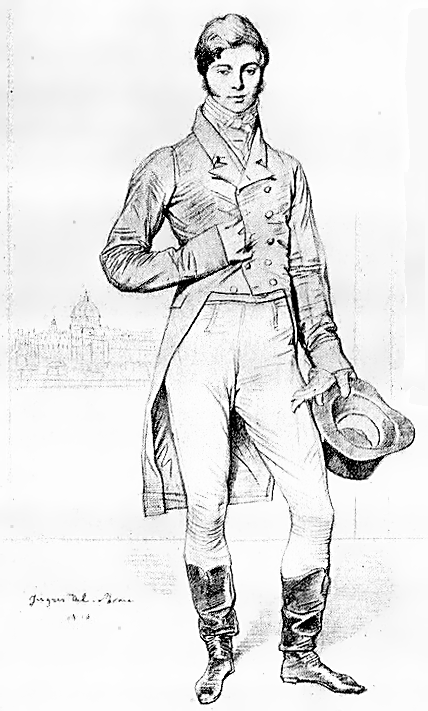
The illustrations are of a lady wearing 1815 walking costume, from Ackermann's Repository (at Wikipedia), and a sketch of Lord Grantham by J.A.D. Ingres, 1816, also from Wikipedia. In this context I think the lady looks as though she's been highly distressed by the ending of the Regency romance lines, or it may be that she's upset that Lord Grantham isn't paying her any attention.