The title of
Nerd in Shining Armor is clearly a play on the phrase '
a knight in shining armour' and given that I'd recently written about
chivalry, I couldn't resist picking this up. I'm going to have to give a few spoilers, so if you're just looking for a review, you might want to look at
AAR's review of the novel, or the one
at The Romance Reader, or
Mrs Giggles'. There are excerpts
here and
here and a sort of epilogue to the epilogue
here.
Susan Scribner, at TRR describes it as 'a quick, breezy (albeit silly) read', while Blythe Barnhill at AAR comments that 'When Gen talks about her childhood, she manages to touch on every possible stereotype, and I found it all a little hard to believe'. I'm of the opinion that this book is full of deliberate parodies of romance and movie conventions and clichés, as well as of
stereotypes about hillbillies and
nerds, an opinion which is reinforced by the titles of some of the other novels in Thompson's Nerd series:
Nerds Like It Hot (
Some Like It Hot);
Gone With the Nerd (
Gone With the Wind);
The Nerd Who Loved Me (
The Spy Who Loved Me).
Parody can be hard to pin down, and people do sometimes say or write things which are meant to be parody but which are not recognised as such, and the reverse can also happen. I happen to think that the parody here is deliberate, but without confirmation from the author I can't be certain I'm right. What I'll do is try to demonstrate how a variety of romance conventions are included, only for the reader's expectations to be confounded by parodic reversals, or for the situation to be described in a comic manner.
Our heroine, for example, is in love and thinks that she will be the one to tame the rake (she's a secretary, he's the boss, a
common pairing in romance):
Nick might not realize it yet, but he needed her in his life. [...] He was gorgeous, rich, and single. And wounded. Not anywhere you could see, but deep in his soul. [...] Nick was an orphan who'd had a rough childhood, so he didn't trust people (2003: 2)
We also learn that he, like so many romance heroes, has a smell which the heroine finds irresistible: 'that purely sinful, strip-naked-for-me aftershave' (2003: 2). The hero's unique scent is one of the details that romance authors are often advised to include, and
Karen Weisner, for example, gives the example of one of her heroine's who 'loves the way the hero smells, so much so that she tries to buy his cologne to wear herself' and
Gail Gaymer Martin writes that 'The sense of smell is often captured in the awareness of perfume or after shave'.
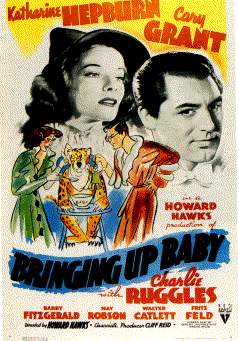
He's also described by reference to a movie hero: 'He was the spitting image of
Cary Grant in
Bringing Up Baby' (2003: 4), and that's a technique which is also used not infrequently in romance novels (though it can have its
disadvantages). Unfortunately for Gen, though, this selfish, promiscuous man is not going to be changed by the love of a good woman, and he's not the hero of this romance. In fact, he's the villain.
AAR's
November 13th At the Back Fence column dealt with obnoxious heroes, and one poster responded by saying that sometimes the main difference between a hero and a villain isn't so much the way they treat the heroine (because some heroes treat the heroine atrociously) but simply that the author has decided that this man is going to be the hero, so the heroine falls in love with him and he has a sudden change of heart and (usually) behaviour towards the end of the novel. Romance readers are also used to the convention that the first eligible man described in a romance is usually the hero.
Liz Fielding, for example, says of the hero and heroine that
These are the most important characters in a short romance. The sooner you can introduce them the better. On the first page is good. In the first paragraph is better. In the first line if at all possible. [...] The reader is like a newly hatched chick, programmed to bond with the first likely character she meets. Ensure that it is the hero or heroine.
Because of this convention, readers are primed to recognise the hero, even if he behaves like a villain (this is not the case in Gothic romances, where for much of the book the heroine and the reader remain unsure of the identity of the hero, and may for a long time think that the hero is a villain). Thompson turns the convention on its head, and thus for a time confuses a reader who expects Nick to be the hero.
And here is the nerd-hero:
His eyes were red, his glasses smudged, and his dark hair stood out in sixty-eleven directions. To make matters worse, he'd decked himself out in a sweet-potato-orange plaid shirt and pants the color of a rotten eggplant. Because he was tall, there was a lot of orange plaid and a lot of rotten purple, and all of it was wrinkled (2003: 5).
He has a habit of thinking up computing-related metaphors, for example Jack's thoughts about Gen's eyes sound just a little like a geek version of
Shakespeare's Sonnet 130, in which Shakespeare rejects the clichéd descriptions of female beauty. Where Shakespeare says that 'My mistress' eyes are nothing like the sun; / Coral is far more red than her lips' red', Jack describes Gen's eyes as 'that blue-green color that reminded him of a tropical lagoon picture he'd used once as a screen saver. He'd loved the color of the water in that screen saver.' (2003: 68). Clearly Jack doesn't mean this to be satirical, but I wonder if a description such as this is gently poking fun at the descriptions of other romance heroine's eyes.
Jack never stops being a nerd, but during their adventure his outer appearance is transformed:
"You do have manly sex appeal, Jackson." She seemed quite amazed by the discovery. [...] I would never have thought so, but with your beard, and-"
"It was rough on your face. I'm sorry about that."
"The beard made all the difference. When you kissed me I felt like a maiden captured by a pirate, a maiden who had been flung down on the sand and ... well, you know what I mean."
"Ravished?" (2003: 72)
Pirates are, of course, the swashbuckling heroes of
many classic movies and romances. And Thompson even manages to fit in a pretend forced seduction. Jack
lifted her over his shoulder [...] She struggled and kicked, but she was careful not to kick him anywhere that she'd do damage. The more she struggled and wiggled against him, the more she liked his idea. But she didn't want him to know that yet. [...]
"You're going to force me to have sex with you?" [...]
"It won't be forced and you know it."
He had a point. "Then could we ... pretend it's forced?"
His laugh was breathless. "Sure. One ravishing coming up."(2003: 206)
As
Candy at The Smart Bitches says, rape and forced seduction has long been a staple of the romance genre, and the original romance genre rapes and forced seductions were not humorous:
Rapist heroes are not nearly as common as they used to be. Between 1972 and about 1988, you couldn’t swing a dead cat without hitting a rapist hero in the face. Starting in about the mid-80s, though, the tides started turning, and by the mid-90s, rapist heroes were mostly a thing of the past, although forced seductions still popped their heads up here and there. (There are readers who maintain there’s no difference between forced seduction and rape, of course.)
Thompson's example, with Jack cast as the pirate seducer but with an entirely willing 'victim' playfully subverts these romance conventions.
The actions of the villain involve at least 2
movie-villain clichés, though Thompson makes them more plausible than usual by making the villain worried about leaving bullets in the bodies and/or not having anywhere to dispose of them:
The bad guy, having finally gotten the good guy into his clutches, will usually spend a few meglomaniac minutes gloating over his victory and his opponent's downfall. This increment of time will prove just enough to allow the good guy to figure a way out of his predicament, or just long enough to allow a rescue attempt. The bad guy, instead of simply offing the captured good guy on the spot, will devise some sort of drawn-out, fiendishly clever method of execution that will take enough time to allow the good guy to figure out his escape.
I wonder also if the situation the two find themselves in is intended to recall faintly that of
Robinson Crusoe. Crusoe manages to rescue some supplies, and so does Jack, though in this case the supplies include condoms and a curling iron rather than the more practical tools salvaged by Crusoe. One might also wonder, in this context, whether Gen, with her knowledge of how to survive in the outdoors, is the female equivalent of Crusoe's Man Friday, and the references to filmstars from the 1940s (see below) perhaps reinforce the possibility that Gen is being cast as Jack's
Girl Friday.
For all that this is a light-hearted romance, there is a serious theme in here, about not judging people on appearances alone. Gen eventually says of Jack 'You're ... you're real, Jack. [...] So many people in this world look like they came right off the assembly line some people factory. They wear what everybody else wears and they talk like everybody else talks."
Like she'd been trying to do herself.' (2003: 215). He certainly isn't the usual type of romance hero. Jack also comments on appearances, though, being a nerd, he uses a metaphor from computing: 'relationships were so damned complicated. With computers it was strictly WYSIWYG, What You See Is What You Get, and he loved that. With women you could never tell. Like Genevieve - a perfect example [...] Genevieve had always reminded him of a movie star from the forties -
Katharine Hepburn, maybe, or
Lauren Bacall' (2003: 15). Jack's exactly right, but this appearance did not come naturally to Gen, whose mother had 'learned everything she knew about manners and fashion from watching Katharine Hepburn, Lauren Bacall, and
Ingrid Bergman. She'd done her best to teach those things to Genevieve' (2003: 14). I'm assuming that the repetition of these names is deliberate, as they occur on adjacent pages and emphasise the extent to which Gen's 'look' has been carefully created. It also takes an effort to maintain, and 'the deeper they got into this mess [the adventure they end up on], the more she was reverting to the little hillbilly she once was' (2003: 65). Jack is a nerd, but his problems with colour-coordination are due to him being colour blind, and underneath them he's got an impressive body and a loving heart. And as for the glasses? Well, Gen has a pair too, she just doesn't wear them, because glasses 'made her look like too much of a nerd' (2003: 30).
If you've read this book, did you think it was spoofing romance genre conventions? If you haven't, do you think that there are some romance clichés which are ripe for parody?
- Thompson, Vicki Lewis, 2003. Nerd in Shining Armor (New York: Bantam Dell).