Showing posts with label Julie Cohen. Show all posts

Thursday, September 28, 2006

Different preferences - variety and change in the romance genre

In the past week there seems to have been a spate of discussions about what's erotic, and what's not, which has led on to discussions about what romance readers do and don't want. On the 26th of September there was a Salon article in which Esther Perel told readers that:
Erotic desire [...] thrives on mystery, unpredictability and politically incorrect power games, not housework battles and childcare woes. Furthermore, increased emotional intimacy between partners often leads to less sexual passion.
You can find experts who'll tell you the complete opposite:
Real intimacy is frightening. It requires a kind of openness, honesty and self-respect that most of us aren't used to. But Schnarch's 30 years of counseling couples has convinced him that it's worth it. [...] Best of all, the sex often becomes more relaxed, creative and connected. Literally and figuratively, no one's hiding in the dark anymore.
Laura Kinsale made a comparison between what Perel had to say about marriage and the romance genre:
The great mistake about the romance genre is, and always has been, to literalize the stories. The critics make this mistake, the censorious make this mistake, and lately even the readers seem to make it, too. Readers have become self-conscious about their fantasies, largely because the fantasies have been conflated with real life political issues for the last few decades.
she adds that
It sometimes begins to seem to me that a goodly percentage of present day romance readers are actually frightened of reading about a real conflict in a book. It's as if they would prefer a therapy session between the characters, with a moderator present to keep things under control while the hero and heroine get equal time to present their side of the story and work through their issues.
This led to a discussion at the Smart Bitches, (27th September) including a comment by Robin that
I think the core of her position is in her comment about the “literalization” of Romance. If I understand Kinsale’s argument, it goes something like this: while so many of our fantasies, archetypes, myths [...] relate to the taboo, to violence, to dark eroticism, etc., in our Romance novels, we’ve moved farther and farther away from honoring those symbolic and metaphoric and mythic levels and have instead grounded all this stuff by inappropriately writing and talking about it in the same way we’d talk about real life issues.
So, does everyone want a marriage of the sort described by Perel, or romance that functions on mythic levels? I'm not sure we all do. Different readers will have different preferences. Personally, I enjoy romances which relate to 'real life issues', and if they did happen to include a therapy session with Dr Oz Strummer I wouldn't complain. In fact, Julie Cohen's Being a Bad Girl, in which he appears, is a good example of how the portrayal of the development of intimacy, real life issues, psychological analysis, and sex scenes can be combined.

Also on the 27th Larissa Ione, blogging at Romancing the Blog asked if it's 'possible that the “high” we get from reading erotic romance has changed our preferences for content…permanently?'. Again, several readers popped up with dissenting views, saying that they preferred romances which were less explicit, and you can even find a reader such as Daisy Goodwin, who says that she doesn't 'want sex [in romantic novels] unless it is comically bad'.

Getting away from issues of eroticism and fantasy, there are some scenarios which are more popular with some people than others, and the differences make themselves felt at a national level as well as between individuals:
Japanese readers love stories about Arabian sheiks and Mediterranean heroes, but don't like romances set in hospitals or rural American settings," Belinda explains. She also adds that Harlequin book covers portraying pregnant heroines, doctors, babies and children typically sell below average.
Whatever one's personal preferences, this evidence of variety within the genre seems to me to be a positive thing, as long as all readers are able to find some novels which they enjoy. It does mean that an author is never going to be able to please every single romance reader, but publishers have long been aware of this fact: Harlequin's many different lines are evidence of that.

So, without getting into a discussion of what's erotic and what's not, because that's a topic that's been heatedly discussed elsewhere, do you enjoy the diversity of the genre, or do you actually find most romances rather similar? Are you able to find romances which suit your tastes or do you lament the passing of a golden era in romance writing?

Tuesday, September 26, 2006

Julie Cohen - Being a Bad Girl (2)

Okay, so carrying on from yesterday's post, I'll take a closer look at the themes of fantasy and role-playing.

The novel explores why people choose to take on particular roles, either by putting on a costume or by emphasising a particular part of their personality, and the extent to which this can be liberating or restrictive. Again, as with Oz's comments about the subconscious, one can apply this to the novel itself, but this time to the act of reading, rather than the act of writing, since many readers of romance say that the novels allow them to explore their fantasies without trying to physically act them out.

Readers, like the audience for the bachelor auction at which Oz meets Marianne, know the difference between fantasy and reality. Jack, Oz’s friend, observes that they ‘know that you’re Dr. Oscar Strummer, clinical psychologist, university lecturer, and eligible bachelor. But you’re giving them an extra fantasy to buy' (2006: 13). The reader/viewer has the safety of knowing that what they’re reading/seeing is ‘safe’, but at the same time they can experience the thrill of the fantasy. And when Jack adds that Oz should ‘Forget the Ph.D. [...] Tonight, you’re a sex object to dozens of women. Maybe hundreds’ (2006: 14), we know that Oz’s audience includes the thousands of readers of the novel. Marianne, too, wants that fantasy: ‘Let me live the fantasy, for once. Let me let go’ (2006: 32). Dr Oz remembers that ‘He kept telling his patients that fantasies were a normal, healthy way of expressing their desires and if they didn’t hurt anybody, there wasn’t any harm in trying to act them out’ (2006: 33). Romance novels with strong sexual or erotic elements aren’t necessarily encouraging their readers to act out the fantasies, but they would seem to legitimise the reader’s fantasies, telling them that it’s acceptable to think about such things since they are ‘normal’ and ‘healthy’ and don’t ‘hurt anybody’.

Marianne, we discover, is trying to escape her 'good girl' image. She’s spent years trying to be, and succeeding at being, the town good-girl, the beautiful, successful pageant queen. She’s ‘practically the town princess. Webb High veledictorian. Webb County Cotton Queen just like your mama [...] MBA from Duke just like your daddy’ (2006: 9) and, though no-one else knows it, ‘she’d pressured herself into an eating disorder, trying to make herself even more perfect’ (2006: 9). The pressure to be a 'good girl' almost destroys her, but although she now wants to be a 'bad girl', she can’t escape her own personality, and she puts almost as much pressure on herself when it comes to building a 'bad girl' persona. Having run to her cousin Warren (who owns a bar), she decides to become a bartender. Though Warren laughingly exclaims that she’s going to ‘take one load of training before you’re good enough to be a bartender’ (2006: 7) she quickly improves. Oz asks
“How did you become such a good bartender?”
“I practiced. A lot.”
“You said you were Portland’s newest bad girl. Have you been practicing that, too?” (2006: 124).
When it comes to deciding what to wear for the Hallowe’en costume party, Marianne realises that ‘She didn’t need to choose something to fit her new “bad girl” image. Oz had made it clear he didn’t believe in that image, anyway.’ (2006: 132). And yet, the costume she does choose has some ‘cool shoes’ (2006: 132), the bright red, shiny high heels worn by Dorothy, which may recall the ‘pretty red high heels’ (2006: 120) she wore in the previous scene when she was being a very provocative ‘bad girl’ in red high heels and matching lingerie. While Marianne may be mostly a good girl, and thus more suited to wearing a Dorothy costume than a 'bright red outfit she'd seen [...] The Bedazzled devil suit' (2006: 131), she retains something of the confident, red-heels-wearer about her. Like the 'bad girl' Marianne, she is a sexually aware and enjoys the speed and daring of riding a motorbike. Marianne's true nature is therefore somewhere between her 'bad girl' persona and that of the innocent Dorothy. So when she chooses to dress as Dorothy she adapts her costume so that it reflects her personality: ‘though her hair was plaited into innocent braids, her mouth was outlined in red lipstick. Okay, Dorothy was never going to be a bad girl. But she didn’t have to be a nun’ (2006: 132). What being with Oz has taught Marianne is that she can 'not try to be perfect. I can be myself' (2006: 206). Neither her 'good girl', nor her 'bad girl' persona were the true Marianne: neither allowed her to be herself, but both contained elements of the real Marianne.

Oz learns from his role-playing too. In the past Oz had put some effort into changing his image: he was the ‘geekiest kid at Portland High’ (2006: 15), ‘a ninety-eight pound weakling’ so he ‘joined the rowing team when I got to Harvard’ (2006: 123). While his 'bad boy' look, forced on him by Jack, is not one he chose, he recalls that as ‘juniors in high school’ he and his friends used to wear fake tattoos ‘to look older’, and Kitty, Jack’s wife observes that ‘Girls wear makeup to look older, boys wear fake tattoos’ (2006: 15). Experimenting with looking different is part of growing up, and it can also be used by adults who want their outward appearance to be ‘read’ by the viewer. Although Oz thinks ‘Borrowed bike. Borrowed clothes. She liked all the things about him that weren’t really him’ (2006: 29), as we’ve already noted, Oz ends up buying the bike and accepting his love of speed, and, on a less metaphorical and more earthy level, it’s not true that at first sight Marianne only likes the things that aren’t real about Oz – she most certainly appreciates the body within the clothes.

Dressing up is part of the Cinderella story – her fairy godmother gives her a makeover so that her outward appearance matches her inner beauty. Another common motif in romance is the heroine who dresses up as a boy, thus displaying to the reader (and the hero) her ‘masculine’ qualities such as courage and athletic skill. The disguises may not be real (the heroine is not really a boy) and yet they do reveal some truth about the character (she has ‘masculine’ qualities).

Disguises, then, can both conceal and expose, and are a mixture of truth and fiction:
“People think we put on costumes to disguise who we really are,” Oz said. “But I’m beginning to understand that it’s when we pretend to be other people that we reveal the most about ourselves.” [...] “For example, I felt silly in that motorcycle outfit when I first put it on. But as soon as I met you and saw how you saw me in it, I realized that I’d been denying my reckless side for far too long.” (2006: 139)
  • Cohen, Julie, 2006. Being a Bad Girl (Richmond, Surrey: Harlequin Mills & Boon Limited).

Monday, September 25, 2006

Julie Cohen – Being a Bad Girl (1)

No, this isn't a review. It's going to be like the analyses I've done of the metaromances, except that this time I'm going to look at imagery as well as at themes. It got rather long, which is why I'm splitting this up into two posts. I'll put up the second in a day or two.

Before I begin, I should mention that this book is a Mills & Boon’s Modern Romance Extra-Sensual (in the line formerly known as ‘Harlequin Temptation’). Julie Cohen has given seminars on writing sex scenes and you can read an excerpt which demonstrates her skill at this, but it's not something I'm going to discuss here. If you haven’t read the book and want to see a review, there’s one here.

I'm not going to discuss the sex, or the plot development, or the characterisation and I may give spoilers. So, now that I’ve bored or scared off almost all my potential readers, for those who’re still sitting comfortably, I’ll begin.

The hero of Being a Bad Girl, Dr Oz Strummer, is a psychologist and as the novel progresses he makes observations about his own and the heroine’s motivation. However, given that he’s a fictional character, who sprang from the brain of Julie Cohen, and she has an M.Phil. in English Literature (her thesis included ‘a whole chapter on the Cottingley fairy photographs’) and is an English teacher, it’s perhaps not surprising that his statements can also be understood to refer to the processes by which authors create themes and imagery in their writing.

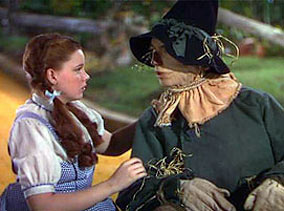
So, what does Dr Oz Strummer have to tell us? Well, when Marianne turns up dressed as Dorothy, while Oz is dressed as the Scarecrow
they burst out laughing together.
“You’re a very sexy Dorothy,” he said, looking her up and down. She felt herself blush.
“It was just the first costume I came across. I didn’t -” Suddenly she realized why Oz had dressed up as the Scarecrow. His name. Her cheeks felt even hotter.
“I didn’t choose it because you’re called – I mean, I closed my eyes. It was a random choice.” She stopped, and looked up into his laughing, knowing hazel eyes.
“You’re going to say that nothing is random, aren’t you?”
“It’s a well-known theory that our subconscious expresses itself in our least deliberate actions,” he replied. (2006: 133)
Romance authors, whether subconsciously or deliberately, use imagery which complements the themes in the story they're writing. Julie Cohen is in the latter group, playfully using imagery and then making explicit its meaning; there are no accidental uses of clichés in this novel. For example, when Marianne, the heroine, muses that she wouldn’t ‘know what a bad boy was like unless one came up and bit her on the behind’ (2006: 11) she immediately pours herself a tequila and raises a toast ‘to an imaginary bad boy. “To bites on the behind”’ (2006: 12). When Oz is given a fake tattoo to wear of ‘a large sword with a snake twining around it’ (2006: 15) he knows that these are ‘Two blatant phallic symbols. Jack and Kitty weren’t being subtle in the least’ (2006: 15). And then Oz takes Marianne to the beach at night, where she can see the lighthouse: ‘ “A pillar of fire by night,” Oz said. “That’s what Longfellow called it.”’ (2006: 52). Julie quoted this passage of the novel and discussed it on her blog, so you can go there and see how the imagery adds to the emotional effect of the scene. What’s particularly interesting is that the same object, the lighthouse, can be interpreted/‘read’ differently by two different people. For Marianne the lighthouse makes her think ‘beautiful, perfect, and alone [...] she wasn’t like that perfect, lonely lighthouse anymore. She’d moved up here to change: to become happy and carefree’ (2006: 52). Oz, on the other hand, says that ‘I brought you to the biggest phallic symbol in the neighborhood [...] I think I mentioned Longfellow, too’ (2006: 55).

I won’t list all the imagery and innuendo in the novel, but I will give just one more example which is key to understanding Oz: his motorcycle, which is not, in fact, his. It’s part of the persona that’s being forced upon him by his friends who are dressing him up for a charity bacherlor auction and making him look like a 'bad boy' biker. Despite this, it does reflect an aspect of Oz’s personality. When he first sees the ‘flame-colored, chrome-girdled Harley Davidson’ (2006: 15) he imagines it ‘thrumming under his hands [...] the feeling of the road rushing under the wheels. Then real life and responsibility came back to him’ (2006: 15). But Oz’s ‘real life’ and his responsibilities are changing, which is perhaps why he buys the bike. Oz, it turns out, likes speed and sometimes wants to be free from ‘Responsibility. My job. My life. Who I am’ (2006: 78). The bike is ‘Freedom on two wheels’ (2006: 17). But speed, risk, and freedom are not enough to make Oz happy. When he goes on a night ride by himself ‘The fantasy wasn’t working. The Harley was a stunning machine. It responded to his every touch with perfect precision and awesome power. And it felt like a stupid, inanimate pile of metal and rubber when he was on it alone’ (2006: 70). He wants both excitement and stability, freedom and commitment, ‘I need something and somebody permanent’ (2006: 103). Stability on a motorbike with a passenger riding pillion can only be achieved through trust ‘I’ll trust you not to crash’ (2006: 39) and physical closeness, ‘hold on tight to me’ (2006: 39), with both driver and passenger having to ‘let our bodies work together with the bike’ (2006: 40). That applies not just to riding the bike, but also to sex, ‘Their bodies worked together, as they had on the motorcycle’ (2006: 171) and to the emotional side of the relationship between Oz and Marianne.

The lessons that Oz learns with Marianne and the motorbike also help explain why he changes his mind about his sister’s forthcoming wedding. He had thought that she was too young to get married (2006: 99-100), but, by the end of the novel he knows that, given the right riding partner, speed and excitement can be combined with safety. His sister, though she’s rushing to get married at an early age is not making a mistake, because she’s chosen her partner well.

I also thought the names of the hero and heroine were interesting. Julie Cohen says that ‘I named Oz after Joe Strummer in The Clash, because he died the same week I invented Oz’, but the surname sounds not dissimilar to the words ‘thrum’. Oz's surname, then, may echo the ‘thrumming [...] the satisfying roar’ (2006: 15) of the motorbike. His first name is Oscar, but he’s known as Oz, and Marianne thinks ‘Oz was a good name for a biker [...] A wizard on a motorcycle’ (2006: 20). Marianne’s surname is Webb, and her hometown is Webb, and that possibly reflects the fact that she’s been caught up in a web of rules, and is now trying to break free: ‘Make up the rules yourself, mused Marianne. After years of having the rules made up for her, that sounded exactly like what she was looking for’ (2006: 11). Marianne is the name of the ‘national emblem of France’, ‘a personification of Liberty and Reason’. These are qualities which are combined in the intelligent, freedom-seeking Marianne Webb. The French Marianne is often portrayed bearing her breast, and Marianne Webb’s bid for liberty involves exploring her sexuality. If we compare this heroine to other Mariannes in literature, we may note that she is much more fortunate than Marianne in Austen's Sense and Sensibility, who also falls in love with a bad boy, Willoughby, though of course Willoughby is a truly bad boy, not simply one who breaks a few rules. Oz combines the romantic and sexual appeal of the bad boy with the stability and wisdom of a Colonel Brandon. Or perhaps her name owes something to the song Marianne, about another Marianne who likes the seaside, sung by Terry Gilkyson & The Easy Riders (Oz's bike is a low rider (2006: 39)).

All of the above regarding Marianne’s name is pure speculation, and I suspect that I may be wrong. Nonetheless, since the reader doesn’t often know the author’s intentions, it can be interesting to analyse the possible associations that particular names have for the reader. Readers certainly have preferences regarding names for heroes, and, as mentioned previously, alpha heroes are not infrequently named after predatory birds and animals. Trying to work out the connotations and derivation of a name is something that Marianne does. Oz’s name makes her think both of the Wizard of Oz and ‘Ozzy Osbourne’ (2006: 47), but in fact he got the nickname for quite another, very innocent reason. So, if my analysis of Marianne’s name is wrong, I’m not in bad company.

  • Cohen, Julie, 2006. Being a Bad Girl (Richmond, Surrey: Harlequin Mills & Boon Limited).