Showing posts with label disability. Show all posts

Saturday, September 12, 2026

New Publications: Barbara Cartland, Olivia Waite, Talia Hibbert, E. Marlitt, Romance Readers, and much, much more

An item I missed last year, and which is in a book that is freely available for download is:


Hall, Cailey (2025). “Redefining the Archive in Queer Historical Romance Novels.” Unsettling Sexuality: Queer Horizons in the Long Eighteenth Century. Ed. Jeremy Chow and Shelby Johnson. Newark: University of Delaware Press. 95-108.

It focuses on Olivia Waite's The Lady's Guide to Celestial Mechanics (2019).

---

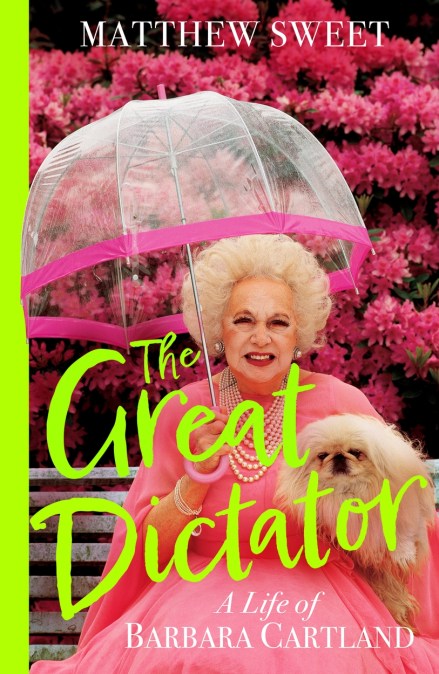
The Great Dictator 

Recently published is a biography of Barbara Cartland, by Matthew Sweet. The entry in the RSDB includes links, including to earlier biographies and autobiographies. Sweet's The Great Dictator: A Life of Barbara Cartland has been reviewed by the BBC (and the article includes a quote from our own Dr Amy Burge). 

--

And now on to the other new works: 

Brown, Cheyenne (2026). I Read It for the Plot: Romance and Identity on BookTok. Master of Arts thesis, The University of North Carolina at Charlotte. [Excerpt]

Creel, Stacy and Walker, Crystal (2026). "SLIS Notes: Psst...Do You Have this Dirty Book?," Mississippi Libraries: Vol. 88: No. 1, Article 3.

 
Florimond-Clerc, Adeline and Louis Gabrysiak (2026). "Lire la New Romance : pratiques, réceptions et illégitimation." Revue française des sciences de l’information et de la communication 31.
 
Florimond-Clerc, Adeline and Louis Gabrysiak, "New romance." Publictionnaire. Dictionnaire encyclopédique et critique des publics. Mis en ligne le 24 mars 2026.
 
Hunter, Kathryn M. (2026). “Desert Dreams: Valentino, Lawrence, and Sheik Fantasy in 1920s Australia.” Journal of the Royal Australian Historical Society 112: 56-76. [Link, abstract and some quotes.] 
 
Ingram, Toni (2026). "Romantasy, Virginity and Other Fictions." Sexuality & Culture. Online First. 
 
Jones, Bethan (2026). Sight Loss and the Tethered Self in 21st Century Novels. Cham: Palgrave Macmillan. [The chapter on romance is titled "Blind Love and the Will to Run in Romance Fiction by Eric Lindstrom and Lucy May Lennox". More details here.]
 
Kamblé, Jayashree (2026). "Race, religion, and the politics of desire in Talia Hibbert’s A Girl Like Her and Take a Hint, Dani Brown." Literature, Critique, and Empire Today. Online First. [Abstract

O’Connell, Mark Joseph (2026). “No More Martyrs: Heated Rivalry, Queer Romance and the End of Tragic Legitimacy.” Journal of Popular Television 14.2: 161–79. [This is mostly about the TV version of Heated Rivalry, but it does mention the novel and romance conventions. Abstract]. 

Ottaviani, Lauren (2026). "(Re)Defining Irish Womanhood: Serials and Short Stories in The Lady of the House (1890-1914)." The Edinburgh Companion to Irish Literature and Periodical Culture. Ed. Elke D'hoker and Phyllis Boumans. Edinburgh: Edinburgh University Press. 143-158. [Excerpt

Partzsch, Henriette, Päivi Lappalainen, Katja Mihurko, Viola Parente-Čapková, Marie Nedregotten Sørbø, and Suzan van Dijk (2026). "One Woman Writer Everywhere: The Ubiquitous E. Marlitt". Redrawing Europe’s Literary Map. Ed. Henriette Partzsch and Viola Parente-Čapková. Leiden, The Netherlands: Brill.


Pierini, Francesca (2026). Romancing Literature: When Literary Fiction Meets Genre. Abingdon: Routledge. [Link and excerpts here.]

Thursday, May 19, 2022

New Issue of JPRS on Black Romance, and other new publications

Issue 11 of the Journal of Popular Romance Studies features a special issue on Black Romance, edited by Margo Hendricks and Julie Moody-Freeman. Among other items, it includes the following articles:

Other recent publications about romance are:

Abrahamsson, Elin (2022). "Rättvisemärkt romantik: Feelgood, flärd och feminism i samtida svensk romance." in  Speglingar av feelgood: Genre, etikett eller känsla? 185-230.

Bilodeau, Isabelle (2022). "How Romance Translators Write Themselves and Their Readers into Afterwords." Departmental Bulletin Paper 47:81-98.

Deng, Yiwei (2022). "The Aesthetic form of Childhood Sweetheart: I Love You, None of Your Business." Frontiers in Economics and Management 3.4: 625-629.

Larson, Christine and Elspeth Ready (2022). "Networking down: Networks, innovation, and relational labor in digital book publishing." New Media & Society. Online First. https://doi.org/10.1177/14614448221090195

Nankervis, Madison (2022). “Diversity in Romance Novels: Race, Sexuality, Neurodivergence, Disability, and Fat Representation.” Publishing Research Quarterly. Online First. https://doi.org/10.1007/s12109-022-09881-6

Saturday, March 26, 2022

New Publications: Disability, Folklore, Gender, Literature, Linguistics, Sexuality

The 2022 volume of the Journal of Popular Romance Studies is now being published (articles etc. are published throughout the year). At the moment, there is only one article available (by Bonnie White, see below) but there are also some book reviews.

Here's my round-up of recent publications:


Allan, Jonathan A. (2022). “ ‘A Most Unlikely Hero’: Disability, Masculinity, and Sexuality in Harlequin Superromance Novels.” The Male Body in Representation: Returning to Matter. Ed. Carmen Dexl and Silvia Gerlsbeck. Cham: Palgrave Macmillan. 215-235. [Abstract here]

Garber, Linda (2021). Novel Approaches to Lesbian History. Cham, Switzerland: Palgrave Macmillan. [This is not just about lesbian historical romance, but there is a discussion which is particularly focussed on romance in the chapter titled "Everything You Always Wanted to Know About Lesbian Sex* *But Only In Historical Fiction." An excerpt can be found here.]

Ivanski, Chantelle, Marta M.Maslej and Raymond A. Mar (2022). "Empirical Approaches to Studying Emotion in Literature: The Case of Gender." The Routledge Companion to Literature and Emotion, Ed. Patrick Colm Hogan, Bradley J. Irish and Lalita Pandit Hogan. London: Routledge.  [See https://rsdb.vivanco.me.uk/bibliography/empirical-approaches-studying-emotion-literature-case-gender for links. At the time of writing, the chapter was available in full via Google Books.]

Lecercle, Jean-Jacques (2022). "Interpellation and Counter-Interpellation in the Novel." The Rhetoric of Literary Communication: From Classical English Novels to Contemporary Digital Fiction. New York: Routledge. [Excerpt here.]

Pierini, Francesca (2021). " “Sharing the Same Soil:” Sally Rooney’s Normal People and the Coming-of-Age Romance." Prospero. Rivista di letterature e culture straniere :141-166. [It argues "for the importance and validity of a genre and the field of expertise attached to it – scholarship of the (popular) romance – that has developed, during the last decades, and especially since the beginning of the current century, important analytical tools for reading and understanding the representation of love in literary as well as popular narratives. Despite the undeniable revitalisation generic forms of literature are currently undergoing, the romance – and its critics – tend to remain excluded from academic debates concerning such revival."

Šmídová, Monika Markéta (2021). Five Thousand for Justice: The Use of English Folklore in the Novels of KJ Charles. Masters thesis, Masaryk University.

van Halteren, Hans (2022). "Automatic Authorship Investigation." Language as Evidence: Doing Forensic Linguistics.  Ed. Victoria Guillén-Nieto and Dieter Stein. Palgrave Macmillan. 219-255.

White, Bonnie (2022). "Freedom, Sincerity, and the Modern Woman in the Interwar Romances of Berta Ruck." Journal of Popular Romance Studies 11.

Thursday, April 23, 2020

Papers that would have been given: BGSU conference

The Bowling Green State University romance conference would have started yesterday. Here's Wednesday's schedule: https://scholarworks.bgsu.edu/researchingromance/2020/4-22/

To help spread awareness of what colleagues are researching, at a time when people can only do this online, I'll post the titles of papers, including a link to the abstracts.

Carry Me Over the Threshold: Using Popular Romance Novels in Women’s and Gender Studies Classes to Teach Disciplinary Threshold Concepts 
Jessica Van Slooten, University of Wisconsin Green Bay

Jodi McAlister, Deakin University, Australia
Claire Parnell, University of Melbourne
Andrea Anne Trinidad, Ateneo de Manila University, Philippines

Mary Lynne Nielsen
Keira Soleore
Nicole M. Jackson, Bowling Green State University
Jamee Nicole Pritchard, University of Wisconsin - Milwaukee

Qiana Whitted, University of South Carolina - Columbia

Amanda Allen
Sarah Slocum
Jessica A. Kahan

Rebecca Baumann, Indiana University - Bloomington
Rebecca Romney

Here's Thursday's schedule: https://scholarworks.bgsu.edu/researchingromance/2020/4-23/

Malia S. Jackson
Alexandra Sterling

Lee Tobin McClain, Seton Hill University
Sarah Wendell
Stefanie Hunker, BGSU
Anna Michelson, Northwestern University
Nicole Falls

Christine Larson, University of Colorado Boulder
Melinda Utendorf
Darcey Lovell, University of Rhode Island

Heather M. Schell, George Washington University

Kathleen Kollman, Bowling Green State University
Maura Kenny, CUNY Graduate Center


Trinidad Linares

Sunday, July 09, 2017

News + New Items: Thai Romance, Keepers, Disability and more


I'm always very happy to see scholars moving into the field of romance studies, so I'm glad to be able to mention that Johanna Hoorenman "is currently working on a cultural history of Native American themed popular romance novels, tracing the roots of the subgenre to early American women's captivity narratives and James Fenimore Cooper's The Last of the Mohicans" (http://muse.jhu.edu/article/662582).

Ria Cheyne's written a post for Public Books about "Disability and the Romance Novel."

Kecia Ali's been at Smart Bitches Trashy Books to talk about her Human in Death: Morality and Mortality in JD Robb’s Novels.

Mary Lynne Nielsen writes at Dear Author that "the idea of some level of financial security is interwoven in romance."

Christian Peukert and Imke Reimers have found that "romance novels are more likely to be self-published than other genres [...]. The difference becomes particularly evident after 2010, as self-publishing became a successful “mainstream” distribution channel" and "After 2008 (the year after the introduction of the Kindle), there is a small increase in advances for romance novels, compared to a slight drop in advances for other genres. More pronounced, there is a sharp increase in deal sizes for romance novels after 2010 (the introduction of the iPad), whereas the deal sizes for all other categories remain almost constant." They write that:
The fact that more deals were made with future stars among the romance genre throughout the time period of our study suggests that publishers have been able to predict the future success of romance novels better than the success of non-romance books. After 2010 – concurrent with the large rise in self-publishing among romance bestsellers – the ability to predict bestsellers among romance novels increased further, with an increase in the share of future bestsellers among romance deals from about 2% to 5%.

New to the Romance Wiki academic bibliography are:

Markert, John, 2017. 
“God is Love: The Christian Romance Market.” Publishing Research Quarterly. Online First.
Christian publishers have long produced romance novels, but the production of these slim books of love have not been a significant part of their overall output. This started to change in the 1980s in response to the increased sensuality found in secular romance novels. The Christian romance has undergone even more of a resurgence at the outset of the new millennium for the same reason: secular romances have notched up the sensuality of their romances today and Christian houses have responded to their constituents who tire of the sexual slant of these secular novels. Indeed, the strength of the Christian market has not gone unnoticed by mainstream houses and numerous secular houses, notably Harlequin, are today producing Christian-themed romances. The secular Christian message is somewhat attenuated, however, which helps explain the continued popularity of those romances produced by Christian publishers. (Abstract)
Khuankaew, Sasinee, 2017. 
"Femininity and Masculinity in Twenty-First Century Thai Romantic Fictions." The Asian Conference on Literature 2017: Official Conference Proceedings. [pdf available free in full online]
This paper is a thematically chronological supplement to the work in
Khuankaew, Sasinee, 2015. 
"Femininity and masculinity in three selected twentieth-century Thai romance fictions." Ph.D thesis, Cardiff University. Abstract Pdf
Veros, Vassiliki, 2017. 
"Keepers: Marking the Value of the Books on my Shelves." Proceedings from the Document Academy 4.1, Article 4. [pdf available free in full online]

Sunday, May 21, 2017

Romance News Roundup: PhD opportunity, conference report, disability project, diversity at risk, new publications

There's a PhD opportunity at the University of Tasmania:
Popular Fiction in the Twenty-First Century
This scholarship provides $26,682pa (2017 rate) living allowance for 3 years, with a possible 6 month extension.
Popular fiction is the most significant growth area in trade publishing in the twenty-first century. This project is premised on the view that popular or genre fiction is a sector of the publishing industry, a social and cultural formation, and a body of texts. It will offer new insights into contemporary literary culture through systematic investigation of the contemporary significance of one or more popular genres (crime, thrillers, romance, or fantasy) in the twenty-first century. By employing a mixed methodology combining discourse and textual analysis, quantitative and qualitative data collection and analysis, and/or creative writing, Popular Fiction in the 21st Century aims to contribute to the increasingly urgent demand for conceptual and methodological frameworks for studying genre fiction.
More details here.

If you don't follow the Pink Heart Society blog, you might want to take a look at Amy Burge's report on the 2017 PCA/ACA conference. Ria Cheyne's there too, introducing her Disability and Romance Project, which recently gained funding from the RWA.

Unfortunately there's bad news as well as good in the romance world and
Romance Writers of America is saddened by the news that Harlequin will be ending publication of five of their series lines in 2018.
According to an announcement RWA received, the following lines will close: Harlequin Western (June 2018), Harlequin Superromance (June 2018), Love Inspired Historical (June 2018), Harlequin Nocturne (December 2018), and Kimani Romance (December 2018).
More details here. As pointed out by Kay Taylor Rea,
this news is a huge blow to the romance community for a very big reason: Harlequin is closing Kimani Romance.

Why is this a big deal? The vast majority of Harlequin titles penned by black women are published as Kimani titles. The Kimani Romance line is described as stories featuring ‘sophisticated, soulful and sensual African-American and multicultural heroes and heroines who develop fulfilling relationships as they lead lives full of drama, glamour and passion.’ These titles cover a number of subgenres, so hopefully Harlequin will make a concerted effort to integrate existing series and current authors into other lines. 

I’ll be keeping an eye out for official word from Harlequin and will certainly be watching how the Kimani authors are treated. This could be a huge setback for diversity in romance.
More details here.

And, finally, the latest publications to be added to the Romance Wiki:
Gardner, Jeanne. 2011. 
"'True-To-Life': Romance Comics and Teen-Age Desire, 1947-1954." Forum for World Literature Studies, vol. 3, no. 1, Apr. 2011, pp. 118-128. 
Kamble, Jayashree, 2017. 
"From Barbarized to Disneyfied: Viewing 1990s New York City Through Eve Dallas, J.D. Robb’s Futuristic Homicide Detective." Forum for Interamerican Research 10.1 (May 2017): 72-86.[Available free and in full online.]
 
Zhou, Yanyan, Bryant Paul and Ryland Sherman, 2017. 
"Still a Hetero-Gendered World: A Content Analysis of Gender Stereotypes and Romantic Ideals in Chinese Boy Love Stories." Sex Roles. Abstract

Thursday, April 06, 2017

New Disability and Romance Project

Ria Cheyne is
excited to announce the launch of the Disability and Romance Project!  Please check out the project website at www.disrom.com or follow on Twitter @DisRomProject.

As some of you know, I've been researching the representation of disability in romance for a while now; this new project will gather data from romance readers, writers and other industry professionals with the aim of better understanding how readers respond to depictions of disability in romance, what motivates authors to write disabled characters, and if there are any barriers to publishing romance novels featuring disabled characters.  

I'm delighted to have received funding from the RWA Academic Research Grant for the second phase of the project, which focuses on writers.  The first phase focuses on readers, and our reader survey is now available at:


Monday, April 03, 2017

RWA Academic Grant Awarded, What's New to the Wiki and a Couple of Other Links


The 2017 RWA Academic Research Grant has been awarded to:

Dr. Kate Brown, Huntington University
Dukes, Dowers, Devises, and Demesnes: The Paradoxical Place of English Law in the Historical Romance

RWA awarded funding to Dr. Kate Brown's project, which explores how English common law and constitutionalism give fundamental structure and substance to the historical romance genre.


Dr. Ria Cheyne, [Liverpool Hope] University
The Disability and Romance Project

RWA awarded funding to Dr. Ria Cheyne's project, which seeks to advance the scholarly conversation about disability and romance and will also engage with romance readers, writers and other industry professionals to encourage new conversations about romance, disability and representation.

I've only added a couple of items to the Romance Wiki bibliography recently, so I thought I'd add a few blog posts to today's post:

Anne N. Bornschein took a look at "a romance novel that deals with the history of women’s academic work—particularly in the sciences—and how it has often been erased, dismissed, or appropriated by male colleagues."

Olivia Waite observes that "writers make millions upon millions of tiny, instinctual decisions that add up to internally consistent structures" and suggests it's important to start "recognizing the partly hidden pattern[s]."

And new to the Wiki are:
Cheyne, Ria, 2017. 
"Disability Studies Reads the Romance: Sexuality, Prejudice, and the Happily-Ever-After in the Work of Mary Balogh." Culture - Theory – Disability: Encounters between Disability Studies and Cultural Studies. Ed. Anne Waldschmidt, Hanjo Berressem and Moritz Ingwersen. Bielefeld, Germany: Transcript. 201-216.
 
Matthews, Amy T., 2016. 
'Entangled: the exegetical process of a romance writer', Arts and Humanities as Higher Education December 2016.
Dr Amy T. Matthews also writes literary fiction as "Amy T Matthews" and romance fiction as "Tess LeSue." She is hoping to bring her three personae together:
The HEA is a non-negotiable element of romance and one I want to use in my literary romance novel (it is already a staple in my historical romances). The parameters I am giving myself for the literary romance is that it must be structured around at least one romantic relationship between a man and a woman (although there may be more than one), and that it must end optimistically, with a happy ending (although not necessarily the same kind of happy ending as a traditional romance). I do not want to sidestep the inevitability of suffering. I want my characters to experience love and romance in the context of real world pressures – infidelity, mental illness, bereavement  – and I want to face up to the inescapable finality of death, while still (somehow!) managing to reach that optimistic ending. This will be a point of difference between popular romance and my literary novel, and I hope it’s one I can navigate without slipping from ‘romance’ into ‘love story’.

Thursday, January 05, 2017

New to the Wiki: Virginity, the Hymen, Desire, Bodies, Blackness and Disability


Burge, Amy, 2016. 
"‘I Will Cut Myself and Smear Blood on the Sheet’: Testing
Virginity in Medieval and Modern Orientalist Romance." Virgin Envy: The Cultural Insignificance of the Hymen. Ed. Jonathan A. Allan, Cristina Santos, and Adriana Spahr. London: Zed. 17-44.
Amy Burge's " 'I Will Cut Myself and Smear Blood on the Sheet': Testing Virginity in Medieval and Modern Orientalist Romance," focuses on representations of the virginity test. Burge explores six sheikh popular romance novels, all featuring virgin heroines. She positions these texts alongside two popular English medieval romances, Bevis of Hampton (c. 1300) and Floris and Blancheflur (c. 1250). She analyzes the persistent reference in all of these texts to the virginity test used to prove women's virginity. Pointing out that these tests are easily manipulated, thereby highlighting their unreliability, Burge reminds us that the sole purpose of testing female virginity is to secure male ownership of women in a heteronormatively gendered society. (6)
Hirdman, Anja, 2016. 
"Speaking through the flesh: Affective encounters, gazes and desire in Harlequin romances," MedieKultur: Journal of media and communication research 32.61: 42-57. [PDF available for free]
Drawing from the cross-disciplinary field of affect theory, the article examines the writing of desire in Harlequin romances through the delineation of gendered encounters. Against the backdrop of earlier feminist critiques of romance fiction, it argues that Harlequin’s intense focus on corporeal sensations and gazes encompasses a looking relationship that differs significantly from the visual mediation of gender and desire. With its use of an extended literary transvestism, a double narrator perspective, and the appropriation of a female gaze, Harlequin offers readers an affective imaginary space in which the significance of the gendered body is re-made, re-versed, and the male body is stripped of its unique position.

McAlister, Jodi, 2016. 
"Between Pleasure and Pain: The Textual Politics of the Hymen." Virgin Envy: The Cultural Insignificance of the Hymen. Ed. Jonathan A. Allan, Cristina Santos, and Adriana Spahr. London: Zed. 45-64.
In [...] "Between Pleasure and Pain: The Textual Politics of the Hymen," Jodi McAlister explores the history of the representation of the hymen in Western literature romances. Her analysis ranges from the thirteenth century, with Le roman de la rose; to the seventeenth century, with the ballad A Remedy for Green Sickness (1682) and A Dialogue between a Married Woman and a Maid (1655); through to experts from "Sub-Umbra, or Sport among the She-Noodles" and "Lady Pokingham, or They All Do It" from Pearl (a magazine published in 1879-80); and up to examples taken from the twentieth century and twenty-first century, using Beyond Heaving Bosoms and recent autobiographical stories of virginity loss. By examining blood, pain, and (im)perforability - common motifs associated with the hymen - in all of these texts across such a vast array of periods, McAlister reveals the discourse over the female body across time. In doing so, she discovers that the perception of virginity loss (the rupture of the hymen) brings about a profound transformative change in women; it is the journey toward adulthood, sexual maturity, and pleasure. More so, from the earliest to the latest of these romances, McAlister argues that the role of women has greatly improved: the transformative change moves from being that imposed externally by the man to that becoming internal to the woman. Finally, and tellingly, McAlister's analysis, by moving from early literary texts to current autobiographical stories (a point of friction in her chapter between literary texts and real lives), shows that in the latter texts the hymen is less concrete: the broken hymen does not and cannot fulfill the expectation of the transformative changes long promised by our cultural imaginary. (6-7)
Schalk, Sami, 2016. 
"Happily Ever After for Whom? Blackness and Disability in Romance Narratives." Journal of Popular Culture 49.6: 1241–1260. Excerpt
In the United States, people with disabilities are often represented as nonsexual, having either no desire or capacity for sexual interactions. This stereotype is supported by the lack of mainstream representation and by the historical denial and punishment of the sexualities of people with disabilities through eugenics, forced sterilization, institutionalization, exclusion from sex education, and more [...]. In contrast, the sexuality of black people has been abundantly represented as a problem that needs to be controlled. Black feminists argue that sexuality and gender are always already racialized, and sexual-racial stereotypes, like the Jezebel, dominate contemporary cultural representations of black women. While the sexualities of black people have been more often represented than the sexualities of disabled people, these representations have typically been oppressive nonetheless.
Positive, perhaps even liberatory, scripts of black and disabled people's sexualities are largely nonexistent, especially in mainstream culture. As a result, writers of popular fiction have sought to depict black and disabled people's experiences in the popular romance genre. (1241)

Monday, December 05, 2016

Deadline Extended: Francis Award ($250 USD + Publication)

The International Association for the Study of Popular Romance (IASPR) is has extended the deadline for the Conseula Francis Award for the best unpublished essay on popular romance media and / or the logics, institutions, and social practices of romantic love in global popular culture. Submissions must now be received by Friday, January 6, 2017.  The winning essay will receive a $250 USD cash prize and be published in the peer-reviewed Journal of Popular Romance Studies, pending any needed revision according to the judges’ comments.

Essays submitted for the Francis Award may focus on work in any medium (e.g., fiction, film, TV, music, comics, or advice literature) or on topics related to real-world courtship, dating, relationships, and love. Conseula Francis’s work on popular romance fiction focused on African American authors and representations of Black love, and priority for the Francis Award will be given to manuscripts that address the diversity of, and diversities within, popular romance and romantic love culture: e.g., diversity of race, ethnicity, gender, religion, class, sexuality, disability, or age.

All submissions should be sent to Erin Young, Managing Editor of the Journal of Popular Romance Studies, at managing.editor@jprstudies.org. Please put “Francis Award” in your subject line. All submissions must be Microsoft Word documents, with citations in MLA format; in keeping with JPRS publication guidelines we will consider essays of 5000 to ~10,000 words in length. Please remove your name or the name of any co-authors from the submitted manuscript; in your cover-letter email, please provide your contact information (address, phone number, e-mail address) and a 150-200 word abstract of the submission.

The judges for the Francis Award will be a mix of established and emerging scholars in the field of Popular Romance Studies, chosen by IASPR. The award winner will be announced in April, 2017; each year’s winner will be invited to join the panel of judges for the following year.

Wednesday, February 03, 2016

Out Now! Pursuing Happiness: Reading American Romance as Political Fiction


My new book is out at last! Here's the blurb:
The dominance of popular romance in the United States fiction market suggests that its trends and themes may reflect the politics of a significant proportion of the population. Pursuing Happiness explores some of the choices, beliefs and assumptions which shape the politics of American romance novels. In particular, it focuses on what romances reveal about American attitudes towards work, the West, race, gender, community cohesion, ancestral “roots” and a historical connection (or lack of it) to the land. The novels discussed include works by Suzanne Brockmann, Beverly Jenkins, Karin Kallmaker, Pamela Morsi, Nora Roberts, Sharon Shinn, Linnea Sinclair and LaVyrle Spencer.

"Pursuing Happiness explores the ways that popular American romance novels engage such matters as US gender roles, attitudes toward disability, the myth of the frontier, individualism and community, and racial violence and discrimination. A thoughtful study with a refreshingly topical focus.” — Prof. William Gleason, Princeton University, co-editor of Romance Fiction and American Culture: Love as the Practice of Freedom?

Pursuing Happiness is an insightful and entertaining look at the inherent, often invisible, politics that underlie America’s most popular genre of fiction.”— Isobel Carr, romance writer.

I've got more detailed information about each of the chapters here.

At the moment it's available in Kindle format from from Amazon  .ca, .com, .de, .es, .fr, .it, .uk, in paperback from Lulu and in pdf (and I think epub) from my publisher, Humanities Ebooks.

The paperback should become available from other booksellers in about six weeks or so.

Thursday, April 02, 2015

Romance VIII: Imperialism, Transnationalism, and the Politics of Genre


Romance VIII: Imperialism, Transnationalism, and the Politics of Genre


Imperial Affairs: Colonialism, race and the early twentieth-century romance novel

(Hsu-Ming Teo, Macquarie University)

The romance novel became a distinct genre during the zenith of the British Empire and, unsurprisingly, women writers used Britain’s colonies as exotic backdrops for their love stories. At a time when many men insisted that the empire was ‘no place for a white woman’, romance novels from the 1890s to the Second World War spread imperial fantasies of women who travelled to the colonies, hunted, worked as governesses, nurses and secretaries, managed households, ran viable plantations, fended off attacks by ‘the natives’, fell in love, married and made a place for themselves in the empire.   This paper explores how dreams of love and empire building bloomed in the Kenyan novels of Florence Riddell and Nora K. Strange; the Rhodesian and South African romances of Gertrude Page; the New Guinean romances of Beatrice Grimshaw; and the Raj romances of Maud Diver, Ethel M. Dell, Bertha Croker, Alice Eustace and many more. Martin Green has argued that ‘the adventure tales that formed the light reading of Englishmen for two hundred years … were, in fact, the energizing myth of English imperialism … they charged England’s will with the energy to go out into the world and explore, conquer, and rule’. Romance novels may not have created such determinedly colonizing drives among women, but they were important nonetheless because they purportedly disseminated ‘knowledge’ about Britain’s colonies and naturalized colonial possessions and racial hierarchies among women readers. At the same time, they unintentionally foregrounded the fragility of love relationships between British men and women by portraying the strains colonizing activities placed on interpersonal relations and the racial anxieties caused by the sexual attractiveness of ‘native’ men.  

Tears and Desires: Qiong Yao’s Romantic Melodrama in a Transnational Frame

(Danju Yu, Stony Brook University)

Qiong Yao, the renowned Taiwanese female novelist, is known for her sensational novels that depict pathos, overwrought emotions and the ostensibly suffering female protagonists. The visual adaptation of one of her most popularly-received novel, You Can’t Tell Him (Tingyuan Shenshen, 1972), tells the story of a female schoolteacher’s rendezvous with a student’s blind father, who eventually discovers that this mysterious school teacher happens to be his beloved ex-wife who has been reported dead for years. The novel as well as its film adaptation mimic Jane Austen’s 1847 bildungsroman novel, Jane Eyre, while the narrative is relocated to Taiwan in the 1970s with the backdrop of problematic Cold War geopolitics and Taiwan’s rapid economic boom. Embedded in the romantic love affair are the film’s detailed depiction of Taiwan’s budding tea farm business and the growing community of working class women. This paper examines the gothic elements, melodramatic narrative, elaborate mise en scène to tease out the underlying neoliberal desires expressed through the tears and desires of female protagonists. In addition, this paper intervenes in the derogatory reading of Wenyi Aiqing melodrama (romance melodrama) films by shifting the attention to excessive emotions that provide ruptures in dominant ideologies. By tracing the transnational trajectory of You Can’t Tell Him, I explore romance melodrama and its role in opening up new spaces for female discourse.


“I’m Just Telling You a Story, That’s All”: The Reading and Misreading of Gendered, Raced, and (Dis)Abled Bodies in Courtney Milan’s The Heiress Effect

(Mallory Jagodzinski, Bowling Green State University)
Courtney Milan is quite well-known in the romance industry for walking away from a “very nice deal” at Harlequin to successfully self-publish her subsequent novels and for writing characters one doesn’t often see in the genre (such as virgin heroes, suffragette heroines, and heroines whose characters are defined by the work they do). In interviews, she alludes to the fact that this is because she has more freedom to write these characters due to the fact that there is no publisher asking her to make her characters more generic and typical. In her 2013 novel The Heiress Effect, which is set in 1867, Milan writes a “B” romance featuring an epileptic heroine, Emily, and an Indian student studying at Cambridge, Anjan.

In this paper, I show how Milan builds the romantic relationship between the heroine and hero through the reading and misreading of bodies in regards to gender, disability, and race. I argue that Milan uses the constraints placed on Emily and Anjan’s bodies by systems of power and privilege to illustrate the ways our society has and continues to allow bodies to speak for individuals rather than trusting their stories. It is only after Emily and Anjan begin telling stories to one another about their possible courtship that the two are able to achieve the genre’s requisite happily ever after, which I assert to be Milan’s insistence on importance of diverse representation in the stories American culture tells itself about who is worthy of love.


Brothers Under Covers: Race and the Paranormal Romance Novel

(Amanda Hobson, Ohio University)

From sparkling teen-angst-filled “vegetarians” to crime fighting warriors, the vampire hero has become a mainstay in novels, films, and television. Vampires have held the imaginations of readers since the time of the “penny dreadful” and Dracula.  In contemporary American culture, the vampire has shifted beyond the borders of the horror and science fiction genres to become a featured icon in the romance genre. The subgenre of paranormal romance has inundated the publishing market over the last decade for both adult and young adult romance readers.  One of the most glaring and intriguing aspects of these vampire romance novels is their consistent whitewashing.  Just where are all the undead heartthrobs of colour, and why are they seemingly absent? Though this piece will focus on Black vampire heroes specifically, where are the women of colour as female leads?  While these vampire romance novels may have periphery characters that are people of colour, they remain almost entirely populated by whites, mainly Americans descended from European heritages.  I explore the representations of race and ethnicity within the paranormal subgenre, focusing on two popular series as guideposts: Kerrelyn Sparks’s Love at Stake series and J.R. Ward’s Black Dagger Brotherhood series. How can a reader understand issues of race and ethnicity within these vampire romances?  The vampire, who has long-stood as the iconic symbol for the Other, reconstructs oppression within the narratives of these paranormal romance novels first by eliminating race and ethnicity from the vast majority of the texts and then by reinforcing the cultural stereotypes of Black masculinity.  The genre in which the vampire fiction is written matters a great deal for the representation and inclusion of Black vampires.  Using genre theory and critical race theory, this paper examines the lacuna of race and ethnicity present within vampire romance fictions.
Saturday, March 08, 2014

20 March: Workshops in Washington


Love That Dares
Thursday, March 20, 2014 from 1:00 PM to 7:00 PM (PDT)


The George Washington University in Washington, DC is holding a free event about diversity in popular romance which, while aimed at their students, is open to the public.


Three Workshops on Diversity in Popular Romance


1pm:   theme: GLBTQ romance
hosted by: Sarah Frantz (Riptide Publishing)
book club selectionBlessed Isle, by Alex Beecroft

2:30:   theme: African-American popular romance
hosted by: novelist Beverly Jenkins 
book club selection: her own Deadly Sexy

4:10:  theme: People with disabilities in popular romance, with
hosted by: Emily Baldys (Zane State)


Reception to follow

If you want to attend any or all of these you need to book in advance via this website and Heather Schell, who's involved in organising it, says that as it's
an interactive event, [...] attendees are expected to read the assigned novel (all are available on amazon.com).  Each workshop will also include a brief writing exercise. 

Wednesday, April 03, 2013

Disability Studies Reads the Romance


Ria Cheyne's latest article, "Disability Studies Reads the Romance" is out now in issue 7.1 of the Journal of Literary & Cultural Disability Studies. The article explores the depiction of disability in a selection of romance novels. This is a rather understudied area of both popular romance studies and disability studies:
Cultural disability studies scholars have repeatedly criticized academics in the humanities for perpetuating a “critical avoidance” (Bolt) of disability and disability issues. Yet cultural disability studies scholars themselves have been reluctant to engage with certain types of cultural production, and romance novels are a prime example of this. As the most popular of the popular genres, romance novels are an obvious site of investigation for a field concerned with the effects that representations of disability have upon the world. Though recent articles by Kathleen Miller, Emily Baldys, and Sandra Schwab indicate the productive potential of a dialogue between disability studies and popular romance studies, the critical conversation about disability in romance novels has only just begun. Focusing on selected novels by Mary Balogh, a bestselling author of historical romance, I argue that romances with disabled protagonists offer significant opportunities to challenge negative stereotypes around disability. (37)
Cheyne focuses on "the six books in the Slightly series (published 2003–04),
and the Simply quartet (2005–08)" (39) and argues that,
In the context of a contemporary culture in which there is “a pervasive cultural de-eroticization of people with disabilities” (Mollow and McRuer 4), the emphasis placed on the development of a sexually satisfying relationship is significant. Anna Mollow and Robert McRuer note the “segregation” of “sex and disability” in “dominant cultural representations” (2). Depicting disabled heroes and heroines in satisfying sexual relationships and as erotic agents, as Balogh does, challenges this segregation. [...] More broadly, the depiction of disabled characters achieving the HEA is significant in a society still dominated by tragedy-model perspectives and thus ambivalent about whether disabled people are worthy or desiring of love. (40)
She also addresses the question of whether disabled secondary characters are marginalised and/or used as "yardsticks" to measure the tolerance, good nature etc of non-disabled primary characters.
-----
Cheyne, Ria. "Disability Studies Reads the Romance." Journal of Literary & Cultural Disability Studies 7.1 (2013): 37–52.

Saturday, February 02, 2013

Riveted by Race, Disability, Gender and Sexual Orientation


I've just put up a blog post at my own website about romance and the ways in which it's been used to explore issues including racism. One of the books under discussion is Meljean Brook's Riveted. I don't usually cross-post but given the success of Riveted I thought it might be of interest to readers of TMT who don't usually visit my personal blog.

Monday, October 22, 2012

Sandra on Seeing Clearly


In “‘It Is Only with One’s Heart That One Can See Clearly’: The Loss of Sight in Teresa Medeiros’s The Bride and the Beast and Yours until Dawn,” published in the most recent issue of the Journal of Literary & Cultural Disability Studies, Sandra Schwab asks "How is disability, in particular visual impairment, used in romance fiction?"

It's not a question that can be answered fully in just one paper, so Sandra focuses her discussion on two novels by Teresa Medeiros. As stated in the abstract, Sandra concludes that "Medeiros rejects various dominant cultural stereotypes about visual impairment and disability such as the disempowerment and perceived helplessness of blind characters" but she adds that,
even if in The Bride and the Beast the lack of sight becomes a vehicle to criticize the body cult in romance fiction and even if Yours until Dawn rejects many common stereotypes about disability and closes with a reference to the old body, the literal cure in both novels aims at normalizing the bodies of the protagonists and thus results in what Davis has called “the neutralizing of the disability” (542). In regard to visual impairment, this is a common trope in romance fiction, whereas other forms of disability are often used to enhance the dark appeal of the male protagonist and act as externalizations of his inner wound. Though the genre thus creates new stereotypes about disability, [...] it generally rejects depictions of disability as a disempowering force that creates helplessness and dependence. (288)
-------
Schwab, Sandra. “‘It Is Only with One’s Heart That One Can See Clearly’: The Loss of Sight in Teresa Medeiros’s The Bride and the Beast and Yours until Dawn.” Journal of Literary & Cultural Disability Studies 6.3 (2012): 275–289.

Thursday, June 07, 2012

Brushing Aside Criticism


When one's a reader of a type of fiction about which sweeping negative generalisations are made, it can feel satisfying to respond with equally sweeping but positive generalisations. Some of those negative generalisations probably do deserve to be consigned to the dustbin of history. Others, though, contain rather more than a grain of truth and so, having recently come across a number of freshly written critiques of romance, I felt it was appropriate to share them here.

The first is Amanda Joyal's M.A. thesis, "From Victorian Literature to the Romance Novel: Disability and the Courtship Plot," which comes complete with its own counter-example. It
is largely concerned with popular romance novels as a site of criticism for disability because of its widespread popularity and locates Victorian fiction such as Jane Eyre and Olive as the predecessors of modern romance novels. Stereotypes of disability that pervade Victorian literature tend to be present in the modern romance; characters desire cures for their disabilities and operate as pitiable figures within the courtship plot. I analyze the ways in which the disabled protagonists of Yours Until Dawn, Stranger in Town, and Annie's Song must be rehabilitated by their partners in order to be a viable participant in the courtship plot. For male characters, this involves reclamation of their masculinity in order to compensate for the feminization of their disability. Disabled female characters seem to have very little involvement in their own rehabilitation and instead rely on their male partners. In contrast, the heroine of Mouth to Mouth needs no rehabilitation in order to be seen as a sexual partner. Laurel represents a unique case that disability scholars should pay more critical attention to.
Unfortunately, I haven't been able to find any more detail about the thesis, other than that it was completed in 2012 at the University of Wyoming.
The second is by Cora Buhlert, who takes a closer look at the defence of romances which is based on the idea that they're "expressions of women's fantasies":
E.L. James [...] said [...] that the [Fifty Shades] trilogy is fantasy and portrays the sort of fantasy that people would not necessarily want in real life. We’ve heard this sort of explanation before as an apologia for the rapetastic bodicerippers of the 1970s and 1980s or for the continuing popularity of romances featuring ultra-possessive alpha males. And I cannot discount these explanations, because people have wildly different fantasies, as is their good right. But nonetheless, whenever I read another apologia that a book/film/series with stone age gender relations is just an expressions of women’s fantasies of ceding control, because they have to be so strong in real life all the time, I inevitably shake my head and think, “Whose fantasy exactly? Cause it sure as hell ain’t mine.”

I guess the main problem here is that a lot of what is considered romantic and swoonworthy in the Anglo-American part of the world, not just doesn’t do a thing for me, I actively dislike it. And I only wrote Anglo-American, because E.L. James, author of Fifty Shades of Grey, is British. But mainly, books like Fifty Shades of Grey or Harlequin Presents (which have several British authors as well) or the rapetastic bodicerippers of yesteryear are an American phenomenon and reflect the conflicted American attitudes about sexuality, namely that the only way a woman is allowed to enjoy sex without being labeled a slut is if she’s forced into it by an overpowering man. The old bodiceripper style romances were never as popular in Europe (including the UK) as in the US and most European readers I have spoken to actively hated them.
The third is from acrackedmoon at Requires Only That You Hate. The language is strong and I'm sure we could all think of romances which would serve as counter-examples. That doesn't invalidate her critique though: if anything, her "hatred and geekrage" seems to me to demonstrate the extent of the pain which romances can cause some people:
I don’t know about other queer women, but to me the prevalence of romance–not as a genre by itself, but romance as a pop-culture entity–fucked me up pretty severely [...] if you’re telling me that romance is categorically feminist, you’re contributing to this large damage in an insidious, silencing way. The proponents of romance-is-feminist school of thought like to pass such fiction off as inherently progressive because it is written mostly by women and targets women as an audience: it pushes the idea that reading these books is liberating and sex-positive and, what’s more, reading them is good for you. Because feminism! Liberation from the yoke of repression and sexual dissatisfaction!

Tell me this and I’ll kick you in the fucking teeth.

Yes, romance presents possibilities: as long as those possibilities involve finding a man. Yes, romance explores and depicts female desire: as long as that is a desire to have a cock shoved into your orifices. Yes, romance is about the “everywoman” whom we can all identify with as long as you can identify with a straight white woman from the first world. It reinforces the hegemony of what is normal, and what’s normal is straight sex, straight female desire, centering your life around the fantasy man, and being culturally rooted in the west. Romance enforces the hegemony of ethnocentricism, heteronormativity, and cultural imperialism. It’s not the only thing that does this: so does SFF, so does every other form of popular media.
Acrackedmoon is aware of the existence of lesbian and m/m romance; there are romances about people other than straight white women from the first world. Just, not a lot of them. Taken as a whole, popular romance fiction does marginalise certain kinds of stories and certain kinds of protagonists.

The image of various broom heads comes from Wikimedia Commons. It was originally published in the Dictionnaire encyclopédique de l'épicerie et des industries annexes (1904).

Friday, February 17, 2012

CFPs: Recycling, Whiteness, Paper and Asperger's Syndrome


These calls for papers aren't specifically about romance: they're about "cultural recycling," whiteness, "the materiality of literary texts" and Asperger's Syndrome. One could, though, discuss romances in conjunction with all of these issues.

Since fairy tales and references to Shakespeare, occur fairly frequently in romance, and since in For Love and Money I took a quick look at some romances which were reworkings of the Pygmalion myth, and others which reworked the tale of Sir Gawain and the Loathly Lady, it seemed to me that romance fiction is full of "allusions and echoes."
Allusions and echoes – cultural recycling and recirculation
An international colloquium at Anglia Ruskin University, Cambridge, UK
June 16-17, 2012

Deadline for paper/panel submissions is March 30, 2012.

The many ways in which stories are recirculated is astounding – from relatively straightforward retellings of fairy tales and classical myths, to feminist, queer, postcolonial or ecocritical subversions of central themes, to fan fiction’s adaptations of beloved characters and story worlds.

The international colloquium "Allusions and echoes – cultural recycling and recirculation" is an opportunity to explore the various ways in which texts communicate over borders of space, time, genre and medium. What themes, motifs, backgrounds and details capture the imagination of authors, readers and viewers? How are they recycled and recirculated from one period, or one audience, to another? How and why do they gain currency again and again? Contributors are invited to cast their net widely and consider not only contemporary works, such as The Canongate Myth Series (2005-2011) and Cinderfella (1960, 2013) but also older texts, such as Chaucer’s The Physician’s Tale and Shakespeare’s Titus Andronicus
More information here.

Apparently "Interracial and interethnic marriages are at an all-time high in the US" (BBC) but I've not seen a lot of work on race in romances (other than The Sheik and romances specifically marketed as being about characters of a particular racial group) since Stephanie Burley's "Shadows & Silhouettes: The Racial Politics of Category Romance" was published in 2000 (in Paradoxa 5.13-14). Abstracts for the following conference are due by today, but maybe it'll still be of interest:

2nd Global Conference
Images of Whiteness
Saturday 7th July 2012 – Monday 9th July 2012
Mansfield College, Oxford, United Kingdom

Since the publication of Richard Dyer’s seminal study 'White' in 1997, academics have increasingly turned critical attention to the subject of racial whiteness. Publications include historical accounts detailing the emergence of whiteness as a racial category, cultural studies exploring the representation and construction of white identities in popular culture, film and television scholars examining narratives about white people, reflecting white themes, white obsessions, and white anxieties. Consistent with the shift in critical studies from minority identity formations to consider ‘central’ identities – masculinity, heterosexuality – the study of whiteness is increasingly understood as central to understanding the operation of ‘race’ as a form of social categorisation. Inter-disciplinary and multi-disciplinary perspectives are sought from those engaged in any field relevant to the study of whiteness including media and film studies, performance and creative writing, cultural theory, sociology, psychology and medical approaches including cosmetic surgery, and other cognate areas
More information here.

Has publication in the mass-market format affected perceptions of romance novels?
Distinctions that Matter: Popular Literature and Material Culture

Essays are invited for a special issue of Belphégor that seeks to explore the relationship between distinctions of taste and textual production by examining how the materiality of literary texts influences and perhaps even determines their cultural status. In the nineteenth century, for example, printing and binding became cheaper, faster, and more easily accessible than ever before, which resulted in an explosion of print material. As printing costs decreased and print runs increased, the price of books became cheaper and publishers were able to attract more readers, which led to a greater demand for new content. The cultural impact of this shift was twofold. On the one hand, this decrease in printing costs lowered the cultural entrance level, which resulted in the expansion of popular or trivial literature as well as a wide range of new popular formats, such as dime novels, pulp magazines, comic books, and paperbacks. On the other hand, publishers also attempted to mimic the conventions of exclusiveness through printing and binding techniques in order to preserve the highbrow status of literature as a marker of class distinctions. This led to the rise of competing formats that attempted to challenge the perceived lowbrow status of popular literature, such as deluxe editions and graphic novels. As the divide between highbrow and lowbrow taste widened, the materiality of the text became the primary site where the cultural status of popular literature was both constructed and contested. The same issues also inform cultural debates concerning digital media, as cultural distinctions are now being reconfigured through new forms of electronic display in the post-print era.
Abstracts must be submitted by 1 March 2012. More details here.

After the success of Jennifer Ashley's The Madness of Sir Ian Mackenzie and the recent publication of Eloisa James's The Duke is Mine in which the heroine
is torn between a duke with an Asperger's-like inability to express emotion, who relies on logic, and her fiancé Rupert, who is all emotion with almost no logic. (interview with the author)
I wondered if there was some material in romance novels which would be relevant to the following volume:
Bright Lines: Culture On the Autism Spectrum
"Am I on the spectrum?" asks Abed Nadir, a character on the show Community. He then provides an answer: "None of your business." His joke presumes that the audience will understand this reference to the autism spectrum, and Community introduces the topic of Asperger's Syndrome in its pilot episode. Since the publication of Temple Grandin's work on autism in 1986, there has been a textual explosion of work on Asperger's Syndrome and the autism spectrum. Changes to the DSM-V will replace Asperger's Syndrome with Autistic Spectrum Disorder, a broadening that could threaten the culture that aspie/AS-identified people have produced in the form of literature and visual media. This volume would explore representations of autism within popular culture.
Abstracts are due by 1 May 2012. More details here.

Tuesday, November 01, 2011

CFP: Representing the Body in Culture and Society


In the photo above, a dancer balances en pointe, also supported by crutches (it may be relevant that "The use of pointe shoes and standing on tip-toes regularly cause problems like callosities, soft corns, hallux valgus, metatarsophalangeal degeneration and hammer toes" (Maffulli 163)). Apparently "The use of different devices – crutches, rope, horizontal bars, and harnesses – [...] characterizes Chinouard’s work" (Giuseppe Alizzi). They're certainly in evidence in Compagnie Marie Chouinard's bODY_rEMIX/gOLDBERG_ vARIATIONS. Maili comments on the dancers' use of the "devices" that:
Half of me admires the dance (apart from the skateboard guy), but the other half of me thinks: “Awkward.”
I don’t know how to articulate how I feel about this piece fetishising objects that are usually associated with hospitals or people with disabilities. I think my stance is mostly negative, because it indirectly objectifies people with disabilities. I know the public tends to view people with disabilities as asexual (which annoys me), but for something like this when choreographer Marie Chouinard says she wants to express and sexualise the beauty of objects used by people with disablities? It doesn’t work for me, I think.
Similar issues are raised in Jane's post at Dear Author today about the representations in romance novels of the bodies of characters who depart "from the established Caucasian able-bodied norm." She begins by recounting a discussion with Smart Bitch Sarah about a novel in which Jane felt that the heroine's
disfigurement is largely an accessory and not well integrated into the heroine’s character arc.  I felt that the inclusion of disfigured heroines, even when poorly done, was a step forward.  Sarah disagreed.
The ensuing discussion provides plenty of food for thought and demonstrates that there are romances which could be analysed in response to the following call for papers:
Proteus: A Journal of Ideas seeks submissions for our upcoming issue, “Representing the Body in Culture and Society.” We are soliciting articles and creative works from a wide range of disciplines that reflect upon the issue’s theme. We are particularly interested in work that focuses on the body from a Disability Studies perspective, though submissions from all disciplines are welcome. We are looking for broad theoretical inquiries, individual case studies, and traditional scholarly articles on the subject of the body, as well as theme-related photographs, poetry, and creative writing. Full Essays Due by January 15, 2012.
-----
The image came from the cover of a book.