Showing posts with label love. Show all posts

Sunday, August 27, 2023

CFP: 2024 Conference on Love Studies

Conference on Love Studies, Las Palmas de Gran Canaria (Canary Islands), January 2-7, 2024

They're looking for papers about love:

We consider love in its broad meaning, including different modes and types of love, and various contexts from those that inhibit to those that facilitate the experience and expression of love. Among the variations implied above are:

  • Love at the nature of humans and humanity, philosophy of love, good and bad sides of love
  • Familial love, maternal love, paternal love, the love of children for their parents
  • Love as interpersonal attachment, and pair-bonding love
  • Romantic love, passionate love, obsessional love, lovesickness
  • Love, physical attraction, sex, and diversity of sexual love
  • Companionate, compassionate love, love for friends, and friendship
  • Diversity of polygamy and monogamy in love, polyamory, and open relationships
  • Rational, practical, pragmatic forms of love
  • Love focused on divine and supernatural entities, religious conceptions of love
  • Love as positive social connection, communal and ideological love
  • Para-social forms of love and sex
  • Love directed to oneself, self-love, and narcissism
  • Love for pets and inanimate beings (flowers, money, activities, etc.)
  • The biology and physiology of love
  • The various other types of love and relationships, including those at an intersection between them
Any kind of love is of interest for this conference.

The International Advisory Board has extended the deadline for submission of proposals for presentations at the International Conference on Love Studies, which will be held in Las Palmas de Gran Canaria (Canary Islands) on January 2-7, 2024 (both in-person and virtual formats).

The extended deadline is September 10th, Sunday. See the details at https://love-studies-institute.org/international-conference-on-love-studies/

Sunday, July 31, 2022

A short exploration of "unconditional love"

Kharma Kelley, a romance author, has a few points to make about "unconditional romance" and I think it's a topic worth thinking about given that "unconditional romance" remains part of the RWA's extended definition of a romance novel:

Two basic elements comprise every romance novel: a central love story and an emotionally satisfying and optimistic ending. 
 
A Central Love Story: The main plot centers around individuals falling in love and struggling to make the relationship work. A writer can include as many subplots as they want as long as the love story is the main focus of the novel.

An Emotionally Satisfying and Optimistic Ending: In a romance, the lovers who risk and struggle for each other and their relationship are rewarded with emotional justice and unconditional love
Here's what Kelley has to say:

If we're gonna talk about love in a mature and nuanced manner, let's start by realizing that "unconditional love" is a cruel and unrealistic idea that has shamed ppl into removing boundaries and standards required for a healthy relationship--platonic, familial, or romantic.

This idea of unconditional love can be toxic when it guilts ppl into staying with abusive partners, or forgiving family members who participated in abuse. It can shame parents into accepting the harmful and/or violent behavior of their children and vice versa.

Instead we need to empower everyone that it is OK for their love to have standards, boundaries and expectations. We are human and our loyalty, dedication and affections are GIFTS. We don't owe it to anyone unconditionally. That isn't fair, nor healthy.

Also, let's not conflate love with caretaking. Feeding, clothing and contributing to the survival of a person is not necessarily love. The will and desire to caretake can be deepened by love, but it isn't a requirement of caretaking.

I feel like what many of us are really asking for when we say 'unconditional love' is acceptance of who we are flaws and all. But even defining it as that is unrealistic. Some of our flaws will be unacceptable to some folks. And that's okay. Why?

Because I can choose to examine my flaw and if it's worth changing. Will I be better for it or nah? Notice how I didn't make it about them? Because it isn't. I always have the power to determine if a flaw is really a flaw to me.

I also have the power to determine if the relationship I may stand to create or strengthen is valuable enough to invest in by addressing this flaw. And for the record I define flaws as behaviorial. Behaviors can change. Identities and physical traits are NOT flaws.

When I wrote Faith, Love, Hope and Popular Romance Fiction (which can be read online or downloaded free from here) I decided to omit a discussion of "unconditional love" because I wasn't really sure to what extent all romance writers believed it was an essential part of romance or whether they'd have different understandings of what it meant. Instead, I decided to limit myself to arguing that, in romance novels, true love is depicted as both "good" and "durable." However, I do have an unpublished offcut which I saved and which shows me struggling to work out what "unconditional love" might mean in specific romance novels. I'll paste it in below.

---

One work of pastoral theology has stated that 

Unconditional love is the only real love. Conditional love is a counterfeit. It says in effect, "I will love you if - or I love you because." What it means is, "I will love you if you will fulfill my demands," or, "I love you because of what you mean to me or can do for me. (Hulme 92)

This particular definition of conditional and unconditional love comes from a chapter outlining “a theological approach to the parent-child relationship” (88); the heroine of Marin Thomas’s Daddy by Choice (2005) bears witness to the damage that can be done when parents fail to provide this kind of love:

Heart breaking, Josephine stared at her parents, yearning for the one thing they had withheld all her life. "Unconditional love [...] I'm not sure my parents know what unconditional love is." Josephine's voice cracked. "I believe my sister [...] chose to live her life away from the family because she realized she could never be what my parents expected her to be. [...] Until my sister's death, I hadn't known I had fallen victim to my parents' expectations. All my successes and accomplishments were to please them in the hope of earning their love. I didn't understand that no matter what I did, how successful I became, I would always fall short in their eyes." (222)

As Flynn, the hero of Dallas Schulze’s Tell Me a Story (1988), remarks, children need to be given "room to grow and you have to love them for what they are, not for what you want them to be” (465). Much later in the novel this brief definition of unconditional love is echoed when Ann realises that this is the kind of love Flynn himself requires: “unconditional love. Someone who accepted him with all his faults and all his good points. Someone who'd never compare him to another and find him wanting. Someone who'd love him just as he was” (621). In Courtni Wright's It Had to be You (1998), it is the heroine, Jenna, who is explicitly described as being a recipient of this kind of love. She initially believed that “her humble beginnings lay between” (17) her and Mike and “had decided that the chasm between them was too wide for him to cross” (36). Mike, however, persists in trying to bridge the gap and, by the end of the novel, she has “completed her crossing” (283) and knows Mike feels “unconditional love and acceptance. He did not care which side of the tracks had been her beginnings. He had never been embarrassed by her lack of knowledge about which fork or spoon to use with which food in a multicourse meal” (282).


Both Ann and Courtni’s respective recognition of the presence of unconditional love towards and from their heroes occurs as the novels draw to a conclusion; accepting that one is loved in this way can take time and moreover this type of love is certainly not always present immediately in the romantic relationships depicted in romances. Such a delay is, indeed, implied in the RWA definition of romance, in which unconditional love is said to be one of the rewards given to the protagonists after they have undergone “risk and struggle for each other”. Moreover, certain conditions may have to be met in romantic relationships in order for love to become unconditional and for each lover to be able to receive it. The heroine of Lidiya Foxglove’s The Mermaid Bride (2017), for example, recognises that “Being in love didn’t mean lying and hiding parts of yourself and trying to be someone you weren’t. We could only be in love if we accepted the truth of what we were, and how we felt about each other, and were willing to struggle through all the troubles” (Lidiya Foxglove, The Mermaid Bride, Chapter 21).

----

So, I think it might be useful to understand what different people mean by "unconditional love" as applied to relationships. It doesn't seem healthy to me to be in a relationship with someone who keeps making you jump through hoops to earn their approval, and where you're walking on eggshells thinking that if you do something wrong they'll no longer want to be with you but, on the other hand, it seems healthy to have standards regarding behaviour which will remain unacceptable, no matter how much you love someone or how much you've committed yourself to them.

In our chapter in The Routledge Research Companion to Popular Romance Fiction, Eric Selinger and I wrote that:

Research remains to be done on “unconditional love” in popular romance fiction. Does unconditionality work as a defining quality for love in purely secular romance contexts, or does it always bring with it a trace of religious reference and discourse? Has the feminist critique of unconditional love been incorporated into popular romance? If so, how is it addressed? Do romance novels ever extol the value of conditional love, which in Fromm is co-equal with unconditional love, since both are necessary elements in a “mature” version of the emotion? And although “unconditional love” is part of the RWA definition of the genre, is this a transnational ideal, or more specifically an American one? (499)

The pre-print version of that chapter's available for free to download here and it goes into a bit more depth about the religious roots of the concept of "unconditional love."

Wednesday, February 02, 2022

What's On: Talks (Black Love Matters and Female Characters)


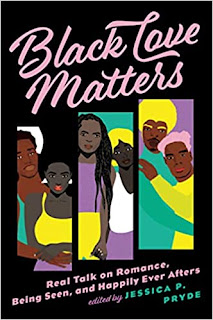
The essay collection Black Love Matters: Real Talk on Romance, Being Seen, and Happily Ever Afters, edited by Jessica P. Pryde is now available. The essays are written by authors, readers, academics (the categories are not exclusive, of course).

A discussion with "with special guests editor and librarian Jessica Pryde, best-selling author Beverly Jenkins, and host of Romance Ever After Allie Parker" is being held on 22 February.

More details here: https://us06web.zoom.us/webinar/register/WN_rCsTiAqURGaKw93KtgxDug


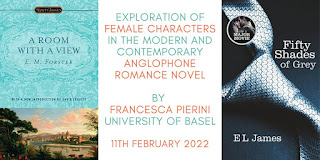
The image shows the covers of E M Forster's Room With a View and E L James's Fifty Shades of Grey, as well as the title of the talk

The Midlands Network of Popular Culture "are delighted that Dr Francesca Pierini will be joining us from the University of Basel on the 11th February to give a presentation on 'Female Characters in the Modern and Contemporary Anglophone Romance Novel'":

This presentation focuses on a reasoned discussion of the female protagonists of the popular romance narratives [...]. The main goal is familiarizing students with the definitions, development, and cultural significance of popular romance fiction through a parallel exploration of the novels’ heroines. The talk will touch upon themes such as: the evolution of the female character in romance novels, educating students on the waves of scholarship on romance fiction, and exploring and problematizing the complex relationship between popular literature and literary scholarship.  

More details here.

Friday, November 06, 2020

Thinking Outside the "Couple Norm"


The Tenacity of the Couple-Norm: Intimate Citizenship Regimes in a Changing Europe
by Sasha Roseneil, Isabel Crowhurst, Tone Hellesund, Ana Cristina Santos, and Mariya Stoilova (UCL Press, 2020) is a newly published (and freely available online for download as a pdf) book which raises an issue of relevance to popular romance fiction. The focus is on coupledom as a concept within society, which the authors refer to as the "couple-norm," defined as "the structure of affinity that is composed of an intimate/sexual dyad" (4) and the

book is about the ongoing strength of the couple-norm and the insidious grip it exerts on our lives as it defines what it is to be a citizen, a fully recognized and rights-bearing member of society. It exposes the construction of coupledom – the condition or state of living as a couple – as the normal, natural and superior way of being an adult. (3)

The book is not a rejection of coupledom, however. The authors argue that

coupledom is not in itself, necessarily, a social ill or a negative influence in people’s lives. Indeed, being part of [sic] couple can be one of the greatest sources of pleasure, fulfilment and security that life in a competitive, uncertain, fast-changing, sometimes dangerous, often precarious social world can offer. (232)

and they state that

There is a danger, identified by Biddy Martin (1996) and Robyn Wiegman (2012), that a relentless anti-normativity, such as that sometimes embraced within queer theory, can produce a somewhat superior, even contemptuous, hypercritical gaze that ‘fears ordinariness’ (Martin, 1996) and ‘names and shames’ ‘those normalities that are inhabited, desired and pursued within gay, lesbian, trans and queer discourses as well as outside them’ (Wiegman, 2012: 334), whilst idealizing practices that are regarded as transgressive of dominant norms. (26)

Rather, they are arguing that there is a need to examine the negative implications of the "couple norm" for those who do not form part of a couple:

The couple-form has historically been valorized and conventionalized, so that it is the very essence of ‘normal’. Whether a person is coupled or not is fundamental to their experience of social recognition and belonging: the good citizen is the coupled citizen, and the socially integrated, psychologically developed and well-functioning person is coupled. Being part of a couple is widely seen and felt to be an achievement, a stabilizing status characteristic of adulthood, indicative of moral responsibility and bestowing full membership of the community. To be outside the couple-form is, in many ways, to be outside, or at least on the margins of, society. (4)

Romances acknowledge the pressure exerted by the norm when protagonists complain about pressure from family to find a partner and, clearly, some popular romances already think outside the "couple norm." Could romance go further, however?

The authors of this book ask

What would it mean for an intimate citizenship regime to cease to promote coupledom and to work instead actively to attenuate the negative impacts of the couple-norm? (233)

What I ask is: what could romance fiction, as a genre, do, to normalise other forms of relationships in addition to coupledom, without abandoning the central love story and the happy ending?

I agree with Roseneil et al, that being in a "couple can be one of the greatest sources of pleasure, fulfilment and security that life in a competitive, uncertain, fast-changing, sometimes dangerous, often precarious social world can offer" (232) yet I feel that romance has room to expand in terms of the relationships it depicts. Indeed, romance has already been expanding, so that more individuals can see themselves and their lives reflected in the novels. The authors of the book found that their interviewees were

centring their lives around friendship, choosing to remain single, embracing solitude, forging non-cohabiting partnerships, sharing the raising of children outside the couple-form, resisting the romantic imperative, forming relationships with people from different backgrounds and defying monogamy. They were envisaging, and often finding, stability, security, love, intimacy, sex and domesticity in many different ways, outside the conventional couple-form. (233)

A choice to remain single would probably be a step too far for the romance, even if one could argue that, technically taking time to form a loving relationship with oneself could be the "central relationship" in a "love story" with an optimistic/happy ending. It is, though, already a possibility in chick-lit, I think. Non-monogamous relationships seem more easily adapted into the genre and, indeed, the genre already includes central sexual relationships involving more than two people and central couples who are not monogamous. What about "lives centred around close friendships" and "non-cohabiting partnerships"?

Thursday, September 13, 2018

News Round-up and Calls for Papers


On 29 August the Journal of Popular Romance Studies was added to the European Reference Index for the Humanities and Social Sciences (ERIH PLUS). This is an indicator of the quality of the journal and increases its visibility:
The main aim of ERIH has been from its very beginnings to enhance global visibility of high quality research in the humanities published in academic journals in various European languages all over Europe. The index enables researchers to better understand and promote the national and international importance of their research. (About)
Entertainment Weekly report that
Bea and Leah Koch, the sister duo who founded and own Los Angeles’ romance bookstore The Ripped Bodice, have signed an overall deal with Sony Pictures Television [...]. The Koch sisters will partner with Sony to develop romance-focused projects for television based on their unique connection to romance readers and authors.
A symposium is being held at the University of Warwick on 28th September, on the topic of "Imagining ‘We’ in the Age of ‘I’: Romance and Social Bonding in Contemporary Culture". Speakers include:
  • Abhija Ghosh (Jawaharlal Nehru University, New Delhi) on ‘Orchestrating Romance: Nineties Romance Genre, Film Song and Bollywood’
  • Diana Holmes (University of Leeds), on ‘Plaisirs d’amour: love and popular fiction in contemporary France’ 
  • Lucy Sheerman (independent researcher) on ‘Reader I Mirrored Him: the recasting of romance tropes in Jane Eyre fanfiction'
If that makes you want to write a paper about love, then the call for papers for "Love, etc", A conference sponsored by the “Uses of Literature” Research Project at the University of Southern Denmark, October 3-4, 2019 might be of interest. The closing date for submissions is November 15 2018.

Alternatively, there are still a few days left before the closing date for submissions to the ACLA Book Lovers seminar: "Book Lovers welcomes abstracts that touch on any aspect of love". Abstracts must be received by Thursday, September 20, 2018 at 9 a.m. EST. The American Comparative Literature Association's 2019 Annual Meeting will take place at Georgetown University in Washington, DC, March 7th-10th, 2019.

There's also been a call for papers for a panel on Muslim Popular Culture in Asia: Aesthetics and Politics at the German Association for Asian Studies’ (DGA)'s biannual Conference on Contemporary Asia, which will be held in April 3–5, 2019 in Würzburg, Germany. The deadline for all paper proposal submissions is October 7, 2018, 6:00pm (CET).


Kate Cuthbert's keynote address to the 2018 Romance Writers of Australia conference, on "the romance novel and representations of sexuality after #MeToo" is now available online. It discusses hope, and how romance has a history of growing and changing.

In August a team from the Surgery and Emotion project introduced visitors to the Science Museum to Mills & Boon romances:
One participant said it was ‘such a fun station’ and that they’d ‘learnt a lot about Mills & Boon books’. Another commented it was ‘so fun’, ‘a good idea for an activity’, and that it encouraged her to think about ‘the cultural impact of medical fiction’. One attendee described it as an ‘awesome stall’, explaining that they ‘didn’t know anything about Mills & Boon before, it’s really made me think’. Finally, one visitor remarked that it was a ‘super enjoyable’ activity, and that they’d ‘learnt a lot about how the novels were ahead of their time, regarding females’ roles in a medical setting’.
More details here.

Sourcebooks is releasing new editions "of 11 of Heyer’s Regency romances as part of the Georgette Heyer Signature Collection" (Keira Soleore). The books in the "Georgette Heyer Signature Collection" include
praise from scores of bestselling authors, sharing their love of Heyer and why she’s such a gem. Each book includes a fun glossary of Regency slang, plus an Afterword by Heyer’s official biographer Jennifer Kloester, with fascinating insights about what Heyer thought about her own books and what was going on in her life at the time she was writing them. A Reading Group Guide helps readers delve into discussion of Heyer’s time and ours, and why the more things change, the more they stay the same (human nature for sure!).
Keira Soleore has interviewed Jennifer Kloester.


Saturday, September 01, 2018

New to the Romance Wiki: Emotions, Ethnocentrism, Evangelicals, Parody, Readers, Robin Hood, Translations

This is a long list: I should have posted an update earlier.

Capps, Stephanie Carol, 2017. 
"What You Read and What You Believe: Genre Exposure and Beliefs about Relationships". Master of Science thesis. University of Oklahoma, Norman, Oklahoma, 2017. Pdf [This seems similar to the article below by Stern et al. I wonder if Capps changed surname between 2017 and 2018, as the first name and second initial are identical, as is the title of the paper.]
Jackson, Cia, 2017. 
"Harlequin Romance: The Power of Parody and Subversion." The Ascendance of Harley Quinn: Essays on DC's Enigmatic Villain. Ed. Shelley E. Barba and Joy M. Perrin. Jefferson, North Carolina: McFarland, 2017. 16-??. Excerpt [This is about how the DC comics parody romance novel conventions via the figure of Harley Quinn.]
 
Johnson, Valerie B., 2018. 
"What a Canon Wants: Robin Hood, Romance Novels, and Carrie Lofty’s What a Scoundrel Wants", Robin Hood and the Outlaw/ed Literary Canon, ed. Lesley Coote and Alexander L. Kaufman. ???: Routledge, 2018. 184-??? Excerpt
Lee, Zi-Ying and Min-Hsiu Liao, 2018. 
'The “Second” Bride: The Retranslation of Romance Novels'. Babel. Published online first 27 August 2018. Abstract and full pre-publication version
 
McAlister, Jodi, 2018. 
‘ “Feelings Like the Women in Books”: Declarations of Love in Australian Romance Novels, 1859–1891’, Emotions: History, Culture, Society 2.1: 91-112. Abstract
 
Neal, Lynn S., 2013.
‘Evangelical Love Stories: The Triumphs and Temptations of Romantic Fiction,’ in Evangelical Christians and Popular Culture: Pop Goes the Gospel, ed. Robert H. Woods, Jr, vol. 2 (Santa Barbara: Praeger): 1–20. Excerpt.
Olivarez, Omar, Ryan Hardie, and Kate G. Blackburn, 2018.
“The Language of Romance: An Open Vocabulary Analysis of the Highest Rated Words Used in Romance Novels.” Journal of Language and Social Psychology. First Published August 18, 2018. Abstract
Pérez‐Gil, María del Mar, 2018. 
"Exoticism, Ethnocentrism, and Englishness in Popular Romance Fiction: Constructing the European Other". Journal of Popular Culture. Published online first 19 July 2018. [Focuses on the Spanish "Other" in the English imagination.] Excerpt
Popova, Milena, 2018.
"Rewriting the Romance: Emotion Work and Consent in Arranged Marriage Fanfiction". Journal of Popular Romance Studies 7.
Stern, Stephanie C., Brianne Robbins, Jessica E. Black and Jennifer L. Barnes, 2018. 
"What You Read and What You Believe: Genre Exposure and Beliefs About Relationships." Psychology of Aesthetics, Creativity, and the Arts. Advance online publication. Abstract and a short summary I posted at my personal blog, focused on the findings about romance readers.

In other sections I've added:

Hall, Cailey. 
"The Consolation of Genre: On Reading Romance Novels", Los Angeles Review of Books, 27 August 2018.
Liu, S.-h, 2012. 
"The Translation/Mutation of Romantic Love: An Exploration of the Translation History of Modern Romances in Taiwan after 1960". PhD Thesis, National Taiwan Normal University. Abstract
 
Sebastian, Cat.
"Romance, Compassion, and Inclusivity (Or: How Romance Will Save the World)", Los Angeles Review of Books, 29 August 2018. [This also appeared in the LARB Print Quarterly Journal: No. 19,  Romance]


Monday, July 02, 2018

PopCAANZ 2018: Byron, Disenchantment, FBI, Feminism, Gender, Italy, "Magical Negroes", Names, South-East Asia, Telenovelas, Twitter, YA

Details are available for the PopCAANZ conference which is currently taking place at Auckland University of Technology. This year there are lots of papers on romance and I'll include excerpts from their abstracts. The conference continues tomorrow, and I'll add links to Twitter threads as they appear.

Donna Maree Hanson - Popular romance fiction: flirting with feminism
popular romance fiction regularly depicts feminist social issues. In this sense, the concept of Pierre Bourdieu’s ‘habitus’ applies — ‘this partly unconscious “taking in” of rules, values and dispositions...’ (Webb, Schirato, & Dahanher, 2002, p. 44). Contemporary popular romance novels are set in the everyday context and as such cannot but help portray the world in which the authors and their characters exist, including social issues present in the mind of the author, whether consciously or unconsciously. Throughout the 1970s and 1980s and since, the woman’s movement has been politically active and concepts of feminism have entered into everyday discourse. [...] research indicates that writers as well as readers of popular romance fiction have no issue reconciling their concept of feminism with writing and reading in the genre.
Lucy Sheerman - “Exempt from all affection and from all contempt”: necessary evil and the figure of the Byronic hero in romance novels
Two hundred years since his first appearance in print, the Byronic anti-hero - ‘that man of loneliness and mystery, / Scarce seen to smile, and seldom heard to sigh’ - is a figure who continues to define representations of the hero in romance novels.

The influence of this angry and defiant fallen angel on the writing of the Brontës has been well documented. In my paper I will consider four Governess novels, published by Mills & Boon in 2016 as a homage to Charlotte Brontë’s iconic romance novel Jane Eyre, and the Byronic traces of the heroes who feature in them.

The romance novel’s continued preoccupation with the Byronic anti-hero is central to the genre’s staged encounters with otherness and its exploration of emotional affect. The literary device of the anti-hero shaped the development of romance tropes such as plot, conflict and point of view, and also (as I will argue) gave rise to the Byronic anti-heroine.
Kathrina Haji Mohd Daud - Cross-cultural romance, feminism and femininity in Southeast Asian fiction
In this paper, I explore how the negotiation of cross-cultural romance also elicits a particular Southeast Asian feminism in three texts: Zen Cho’s The Perilous Life of Jade Yeo (2012, Malaysian), Cheryl Lu-Lien Tan’s Sarong Party Girls (2016, Singaporean) and Ayisha Malik’s Jewel (2017, Bruneian). [...] I argue in this paper that these novels construct a feminist femininity that allows the heroines to remain connected to and sanctioned by their individually patriarchal heritages, while also allowing them to critique and expand existing expectations of feminine identity through the negotiation of cross-cultural relationships.
Jodi McAlister's tweeted a thread on Hanson, Sheerman and Daud's papers.

Ellen Carter - What’s in a romance hero/ine’s name? a corpus study of gay and straight romance character names
The first names parents give to their female versus male children have different phonological (sound) characteristics. My work extends this from the real to the fictional world, studying names given by authors to their romance heroes – gay and straight – as well as to straight heroines. My corpus contains 2,536 contemporary romance novels: 1,668 with a male/female pairing and 868 with a male/male couple, resulting in 3,404 heroes (1,668 straight; 1,736 gay) and 1,668 (straight) heroines. My results demonstrate that the phonological characteristics of names given to gay heroes are statistically significantly less masculine/more feminine than the names of straight heroes. Given that gay romance is a fast-growing romance sub-genre predominantly written and read by straight women, I explore possible cultural implications of this finding and how it may feed stereotypes and shape perceptions within (straight and queer) societies.

Eden French - Loving invisible bodies: transgender representation in popular romance
The few novels that do feature trans heroines and heroes — niche even in small LGBTQ presses — are hailed as daring simply for permitting trans protagonists to be plausible subjects of love and desire. [...] romance’s historically heteronormative politics of gender has constrained writers and even scholars from treating transgender themes; mainstream discussion around trans bodies still manifests routinely in fetishistic and dehumanising ways. Moreover questions of embodiment (for example, the politics of gender-affirming surgery) remain contested even in the trans community. Speaking as a scholar and writer, I will discuss existing examples of trans embodiment in romance, and outline possible reconciliations for the challenge of bringing trans love into the mainstream.

Francesca Pierini - “He looks like he’s stepped out of a painting”: The idealization and appropriation of Italian timelessness through the experience of romantic love
Marina Fiorato’s The Glassblower of Murano (2008) tells the story of Eleonora, a young woman who travels to Venice in search of her genealogical past and existential roots. Coming from London, Eleonora incarnates a “modern” outlook on what she assumes to be the timeless life and culture of Venice. At one point in the novel, admiring the old houses on the Canal Grande, Eleonora is “on fire with enthusiasm for this culture where the houses and the people kept their genetic essence so pure for millennia that they look the same now as in the Renaissance” (2008, 15). [...] Within narratives centred on this notion, “falling in love in Italy” occasions the appropriation of a privileged relation with history and the past, often contrasted with the displacement and rootlessness that seem to characterize the modern places, people and lifestyles of England and North America. Through a discussion of two Anglo-American historical popular novels set in Italy, this paper proposes an exploration of the notion of romantic love as a force reconnecting displaced and fragmented souls with a supposedly timeless and unbroken society; a society perceived as holding a privileged relation with ancient traditions and the past.
Pierini has a paper freely available online which is quite similar, though lacking the focus on romantic love.

Jodi McAlister's tweeted a thread about Carter, French and Pierini's papers.

Maria Ramos-Garcia - This is not a romance novel but a telenovela”: metafiction and bilingualism in Jane the Virgin
Jane the Virgin, based on a Venezuelan telenovela, is at the same time a parody and an homage to the popular Latin American television genre. Among the many unusual features that contribute to the originality and success of this TV series are an omniscient narrator, a metafictional discourse, a bilingual and bicultural setting and an unapologetic, unabashed, and explicit use and abuse of the conventions of the soap-opera, with a touch of Latin American magical realism. [...] This paper will provide an overview of the series, concentrating both on the Latino socio-cultural aspects that rarely make it into mainstream US television, and on the metafictional discussions of the telenovela and the romance novel — both as genres and as philosophies of love — that permeate the narrative.
Angela Hart - Combating the romance genre stigma: reading romance in the digital age
Avid readers of the romance genre can find their voices in the online sphere using social media platforms such as Twitter, utilizing the hashtags #amreadingromance and #romancelandia. Romance readers utilize the technological affordances of the platform to form groups, post about novels, and find relevant information on their specific genre. By using anonymous user login information, unidentifiable profile pictures, and unique hashtags, romance readers are turning to Twitter.
Jodi McAlister tweeted a thread about Ramos-Garcia and Hart's papers before stopping so she could present her own.

Jodi McAlister - Not quite YA, not yet adult: the short but complex history of “New Adult” fiction
This paper will trace the history of the new adult genre category, using the notion of the “genre world,” as theorised by Lisa Fletcher, Beth Driscoll, and Kim Wilkins (2018). [...] this paper will explore the generic roots of new adult fiction in young adult fiction, popular romance fiction, and fan fiction, and how these parent genres have given shape to popular forms and structures of the new adult category. It will provide a much-needed scholarly framework for understanding this emergent genre category, its gradual formation, and its complex place at the borders of several different genre worlds.
Eric Selinger - Disenchantment and its discontents: Weber, Illouz, and popular romance fiction
Modernity and romantic love make uncomfortable bedfellows. As Max Weber explains, modernity is marked by “disenchantment,” not just of the natural world, but also of the inner life and of interpersonal relations. Building on Weber, Eva Illouz argues that we now live in an “ironic structure of romantic feeling, which marks the move from an ‘enchanted’ to a disenchanted cultural definition of love” (Why Love Hurts). This talk will look at how several contemporary authors negotiate and resist “disenchantment.” Of particular interest will be Ayisha Malik’s Sofia Khan is Not Obliged and The Other Side of Happiness, a pair of “hijabi chick-lit” novels that take both sides in this great debate, Courtney Milan’s Hold Me, which casts a cool, modern eye on romantic love without yielding to the irony that Illouz describes, and/or Alexis Hall’s Glitterland, which deploys religious discourse to redeem both love and popular media culture.
Nattie Golubov - The surveillant gaze in FBI romance
This paper is my first effort at thinking through several issues recurrent in the subgenre of the romance police procedural: the configuration of the spaces of home, homeland and nation as domestic territories, besieged not by a foreign but a home grown threat that violates the integrity of the boundaries between private and public, interior and exterior; the role of individual trauma as a mark of the vulnerability of the self and the foundation of an affective investment in the protection of national territory; the "Americanness" of the values and practices that govern social dynamics in the workplace, the self-chosen family and the couple. National character is defined in opposition to the rendering of the criminalised enemy and, together with collective, institutional agency and cooperation, is also the best safeguard against social disorder. Eventually I intend to show that this romance subgenre mediates and manages social fears and anxieties by highlighting the strengths of a systemic framework and ignoring the negative aspects of surveillance: anxiety and fear lie at the heart of romantic relationships and the novels offer a means of managing them with the emotional investment in family and trust in law enforcement.
Jodi McAlister's tweeted a thread about Selinger and Golubov's papers.

Kecia Ali - Writing while white: black martyrs as “Magical Negroes” in Nora Roberts’ novels
Roberts’ heroes and heroines are nearly always white; occasional Black characters are typically what Ikard (2017:94) describes as “magical negroes ... whose raison d’être in white redemption narratives is to support/heal/enlighten/inspire the white character(s) in crisis.” This paper explores four Roberts’ novels in which the violent murder of a Black character serves as the catalyst for vital emotional developments between a white couple or among a team of white characters [...] the single-title adventure romance Hot Ice (1987), the category romance Convincing Alex (1994), the stand-alone mystical romance Three Fates (2002), and Morrigan’s Cross (2006), the first installment of a paranormal romance trilogy.

Monday, September 11, 2017

New to the Romance Wiki Bibliography: Feminism, Love, Heyer and Orientalism

Arvanitaki, Eirini, 2017. 
"Postmillennial femininities in the popular romance novel." Journal of Gender Studies. Published online: 28 Aug 2017. Abstract
McAlister, Jodi, and Hsu-Ming Teo, 2017. 
"Love in Australian Romance Novels." The Popular Culture of Romantic Love in Australia. Ed. Hsu-Ming Teo. North Melbourne, VIC: Australian Scholarly Publishing, pp.194-222.
McLeod, Dion, 2017. 
"'Try-error-try-it': Love, loss, and the subversion(?) of the heteronormative romance story in Will Grayson, Will Grayson." Papers: Explorations into Children's Literature 25.1: 73-94. Abstract

And in the section of the Romance Wiki bibliography for items in languages other than English:
Bianchi, Diana, 2017. 
"I gentiluomini si prendono per la gola: cibo e identità nei romanzi di Georgette Heyer". Lingua, Traduzione, Letteratura 1: 75-89. [Diana wrote to me to notify me of the publication of this article and her translation of the title is: "The way to a gentleman's heart is through his stomach: food and identity in Georgette Heyer's novels."]

林芳玫/Lin, Fang-mei. 
"性別化東方主義:女性沙漠羅曼史的重層東方想像/Gendering Orientalism: Women's Desert Romance and the Multiplicity of Oriental Imagination." Journal of Modern Literature in Chinese, vol. 13, no. 1-2, 2016, pp. 174-200. [There is an abstract in English, even though the paper is not.]

Sunday, May 28, 2017

Food for Thought: Romance Readers More Moral, a Philosophical Romance and more


According to some new research on popular fiction
the more Romance [...] authors participants recognized, the fewer morally dubious [...] scenarios they believed permissible [...]. In fact, once Moral Purity concerns - a measure of the importance people place on purity or sanctity when making moral decisions - was controlled for, Romance was the only variable besides Science Fiction that was clearly related to Moral judgment.(22)
The authors do note that "the correlational nature of this study limits any causal inference: it could [...] be the case that when it comes to choosing novels, people pick stories that will enforce their existing beliefs and desires" (23) but perhaps
reading romance novels, in which clearly identified heroes and heroines achieve an "optimistic, emotionally satisfying" ending [...], may encourage readers to view the world in black and white terms. That romance novels tend to end with a "happily ever after" may be particularly relevant given prior research showing a relationship between fiction exposure and Just World beliefs. (24)
The paper by Jessica E. Black, Stephanie C. Capps and Jennifer L. Barnes can be found here. Please note, though that this is a pre-print version and the final version of "Fiction, Genre Exposure, and Moral Reality" may differ a little from the version in Psychology of Aesthetics, Creativity, and the Arts.

-----
Sydney E. Thorp, an Honours Philosophy student at Hamline University, has written their honours project in the form of a romance novella, complete with a central love story and happy ending. The protagonists do briefly discuss popular romance fiction, too: Eva, our philosopher heroine, comments
"You want another example of how women and romantic love are easily dismissed?" Ava asked, frustrated. "Two words: romance novels. Even though the romance novel industry is an enormous, billion-dollar-a-year industry, almost entirely dominated by women - female authors, editors, publishers, et cetera - no one takes romance novels seriously as a genre of fiction. And why? Most likely, because it is connected with women." (15)
 The story
follows two people as they try to determine what romantic love is, and why it was a neglected or minimized philosophical object for centuries. As the characters converse, they develop the concept of philosophy described above, discuss the place of women, passion, and reason in philosophy, and determine – to the extent they are able – that romantic love is something people do, rather than a feeling or state of being, and is based on an unjustifiable attraction to another person and Aristotle's concept of friendship, specifically philia.

The idea of romantic love being a practice, rather than an emotion or a state of being, seems to be uncommon in philosophical work on the topic. It seems just as rare, especially historically, to think of romantic love as being between equals, who mutually care for each other and commit equally to the relationship.
You can read the abstract and download the whole of Entangled: Romantic Love and Philosophy as a pdf from here.

-----
Still on the topic of love, Olivia Waite argues that, in romance novels, love isn't "a prize you earn for doing everything correctly" but, rather, "It would be far more accurate to say not that romance novel characters are looking to get love, but that love is looking to get them" and that, in terms of the plot and what the characters are hoping to achieve, "The real villain of any romance novel is love itself."

[Photo by Wolfgang Moroder and taken from Wikimedia Commons. It is not in the public domain.]


---- 

What's food for love? Food! At least according to Jennifer Crusie, who argues that:

1) "The kind of food makes a difference because it characterizes the people eating it."

2) "food doesn’t just build romances, it builds all relationships."

3) "The person who controls the table, controls the interaction."

4) "food also says a lot about place."
 
----

In the context of "place," another reminder that the next IASPR conference is all about place:
Space, place, and romantic love are intimately entwined. Popular culture depicts particular locations and environments as “romantic”; romantic fantasies can be “escapist” or involve the “boy / girl / beloved next door”; and romantic relationships play out in a complex mix of physical and virtual settings.
and
We’ve pushed the due date for IASPR conference proposals back by two weeks, to September 15, 2017. The conference will be in beautiful Sydney, Australia, just a 15 minute walk from the Opera House and the Harbor Bridge; it runs from June 27-29, 2018. The full CFP is here. Please feel free to repost and distribute it!
-----

Still on academic matters Amy Burge has written about the status of the "independent scholar" and I've been thinking about some gaps in the history of popular romance.

Friday, April 14, 2017

New Issue of the Journal of Popular Romance Studies

Eric Selinger writes:

Now that we've switched to a rolling publication format in JPRS, new pieces will appear both individually and in thematic or "special issue" groups. Today, we begin rolling out Volume 6 of the journal with a new Special Issue on Critical Love Studies, edited by Amy Burge and Michael Gratzke. The table of contents is below, and you can find the whole issue here: http://jprstudies.org/issues/volume-6. 

Enjoy! And spread the word!

E

Monday, December 05, 2016

Deadline Extended: Francis Award ($250 USD + Publication)

The International Association for the Study of Popular Romance (IASPR) is has extended the deadline for the Conseula Francis Award for the best unpublished essay on popular romance media and / or the logics, institutions, and social practices of romantic love in global popular culture. Submissions must now be received by Friday, January 6, 2017.  The winning essay will receive a $250 USD cash prize and be published in the peer-reviewed Journal of Popular Romance Studies, pending any needed revision according to the judges’ comments.

Essays submitted for the Francis Award may focus on work in any medium (e.g., fiction, film, TV, music, comics, or advice literature) or on topics related to real-world courtship, dating, relationships, and love. Conseula Francis’s work on popular romance fiction focused on African American authors and representations of Black love, and priority for the Francis Award will be given to manuscripts that address the diversity of, and diversities within, popular romance and romantic love culture: e.g., diversity of race, ethnicity, gender, religion, class, sexuality, disability, or age.

All submissions should be sent to Erin Young, Managing Editor of the Journal of Popular Romance Studies, at managing.editor@jprstudies.org. Please put “Francis Award” in your subject line. All submissions must be Microsoft Word documents, with citations in MLA format; in keeping with JPRS publication guidelines we will consider essays of 5000 to ~10,000 words in length. Please remove your name or the name of any co-authors from the submitted manuscript; in your cover-letter email, please provide your contact information (address, phone number, e-mail address) and a 150-200 word abstract of the submission.

The judges for the Francis Award will be a mix of established and emerging scholars in the field of Popular Romance Studies, chosen by IASPR. The award winner will be announced in April, 2017; each year’s winner will be invited to join the panel of judges for the following year.

Thursday, July 16, 2015

Theory in Love: International Comparative Literature Association, 2016

Organisers: Brendon Wocke (Université de Perpignan), Francesca Manzari (Université d’Aix-Marseille), Apostolos Lampropoulos (Université de Bordeaux III)
International Comparative Literature Association
XXIst Congress: “The Many Languages of Comparative Literature” July 21 – July 27, 2016,
University of Vienna, Austria
http://icla2016.univie.ac.at

This panel concerns theory speaking in terms of love, seeking to establish the relationship between “l’amour” and theory.
In The Politics of Friendship Derrida reflects on the question of the indecidable possibility, the “peut-être,” of love, of friendship, and of desire: “‘Je t'aime entends- tu?’; cette déclaration d'aimance hyperbolique ne pourrait donner sa chance à une politique de l'amitié que soumise à l'épreuve du peut-être, de l'indécidable” How then can we express a refusal, a no, without listening, without hearing? How can one express the divergent and differential possibilities opened by this phrase? And yet Derrida already has, in Envois, where he explores, theorizes and dramatizes a love affair, tracing the course of its refusal in the various postcards and letters which remain unsent, forever awaiting their destination.
What Derrida performs in Envois is effectively echoed by Lacan who, in Seminar XX, says: “people have done nothing but speak of love in analytic discourse. [...] What analytic discourse contributes - and perhaps that is, after all, the reason for its emergence at a certain point in scientific discourse - is that to speak of love is in itself a jouissance.”
If, as Lacan says, the troubadours understood that love is nothing other than form, we could perhaps establish a relationship between love’s discourse and theoretical discourse as bridging the gap between philosophy and literature.
Does love function as a theoretical paradigm? Or should we think of theory as an act of love? Or even as born out of love? Can one think of a polyamorous theory? And what would such a theory consist of, in the writhing phrases which intertwine like the honeysuckle of Tristan and Iseult.
We welcome contributions on the subject of love and its relation to theoretical writing.
Please submit your abstract online by August 31, 2015 via the conference website http://icla2016.univie.ac.at/abstract-submission/
You will need to create an account with the website and enter the seminar number 17327 into the “topic” field on the “add abstract” screen. The participants will be informed of their inclusion no later than December 31, 2015.
For further information contact brendon.wocke@gmail.com 
Papers in either English or French will be accepted. 

Thursday, April 02, 2015

Romance X: Love Theory, Romance Practice

Romance X: Love Theory, Romance Practice


This Modern Love: representations of romantic love in historical romance

(Jodi McAlister, Macquarie University)

Historical romance is one of the most popular and recognisable sub-genres of the romance novel. The period setting is key to the construction of the romance: historical heroines often find themselves bound by more restrictive social rules than their contemporary sisters, particularly when it comes to appropriate female sexual behaviour.

This rather Foucauldian notion of a repressive society has an interesting effect on the portrayal of romantic love. While historical heroines often break the rules of their own societies, I contend that they regularly follow recommended contemporary patterns for romance, especially when it comes to the relationship between love and sex. The picture of romantic love offered by the historical romance is distinctly modern, despite the effort authors make to create historically accurate backdrops for their novels. In this paper, I will draw on the history of romantic love and several key texts to discuss the ways in which the historical romance regularly portrays romantic love as transhistorical and universal, as well as how this has changed over the genre’s history. I will explore the scripts for love and sex followed by several historical heroines, and will ultimately attempt to draw some conclusions as to the appeal of modern love in a period setting.


Outsmarting the Universe: Precocious Love in John Green’s Fault in Our Stars

(Susan Leary, University of Miami, English Department )

John Green’s 2012 bestselling young adult novel, Fault in Our Stars, introduces teenage cancer patients, Hazel Grace Lancaster and Augustus Waters, who fall in love over the shared experience of knowing they are going to die.  There are all the elements of the cloying sweet, love-turned-tragic archetypal romance, yet the intellectual backdrop and smart wit of the characters transforms this love into one that resists such categorization: Hazel and Augustus bond over a deep fascination with Hazel’s favorite book, Imperial Affliction; they correspond sophisticatedly with its sardonic and cerebral author; they speak in metaphor, converse routinely with philosophical language, and kiss passionately in the midst of their touring the Anne Frank House.  Yet, Hazel and Augustus are not standard nerds, nor are they the sympathetically-viewed cancer kids.  Their intelligence in fact protects them from these labels.  The universe, however, is believed to be an ordered system.  As Hazel’s father says: “I believe the universe wants to be noticed.  I think the universe is improbably biased toward consciousness, that it rewards intelligence in part because the universe enjoys its elegance being observed.”  Love, cast as an intellectualized experience, is this consciousness.  I call this precocious love because it is a love ahead of its own image; it only approximates love as it contains no elements of the artificiality we read into the idea and potential of it to organize experience.  In this way, Hazel and Augustus succeed in outsmarting the universe as how they feel about one another is archetype-less, lens-less, unqualified, and unprecedented—unprecedented being Augustus’s most frequent descriptor of Hazel.  The universe’s elegance is therefore an illusion of perfect order; even in his eulogy for Hazel, Augustus equates his love for her to “stars he cannot fathom into constellations.”  It is this intellectuality that makes love a simultaneous maker and unmaker of the universe.


Redeeming (M/M) Love: Christian Romance and Erotic Faith in Alex Beecroft's False Colors and Alexis Hall's Glitterland

(Eric Selinger, DePaul University)

As Catherine Roach, Simon May, and other scholars have argued, popular romance culture draws on a long post-Christian tradition of thought about romantic love as a source of transcendent meaning, purpose, and value in life: an “erotic faith,” in Robert Polhemus’s phrase, that true love unites sacred and secular desires, erotic and matrimonial relationships, and, fundamentally, body and soul.  Some queer romance novels engage with this faith tradition in particularly self-conscious and artful ways, whether by asserting the power of “erotic faith” to trump social and Biblical injunctions against same-sex romantic love or by reasserting the value of "erotic faith" in the face of the postmodern intellectual turn that characterises romantic love--especially with a happy ending--as a banal or déclassé ideal.  This presentation will look closely at the ways two m/m romance novels think through ideas about love and erotic faith, often in explicitly theological terms:  Alex Beecroft’s progressive Christian m/m romance, False Colors; and Alexis Hall’s ostensibly secular m/m novel Glitterland, whose self-conscious, self-doubting narrator invokes both Christian tropes and the critical work of Roland Barthes as he struggles to accept his own romantic redemption, at once redeemed by and redeeming love.


The Matter of Romantic Love Matters

(Morgan Klarich, Texas Woman's University)

Romance novels are made up of matter and can become an actant in the reader’s own narrative as they navigate their own fantasy and inter/intra-action with matter. Western philosophies (like materialism) tend to ignore romantic love as an ontologically relevant philosophical space. Romantic love is considered an emotion, and not relevant to the philosophical discourse of classical materialism. However, using new materialism I wish to challenge that and critically interrogate the validity of romantic love’s exclusion in this discourse. Using romance novels as a crucial point in my interrogation, my paper explores the possibility that romantic love is matter, an independent complicated product of physical matters intra-action. Among others, I utilize discourse from new materialists and romance novel scholars. I conclude that the old opinions towards matter cannot apply to the modern way of thinking. There is little room for absolutes when so much is clearly unknown about what matter actually is. Romantic love is that unknown, unseen, and uncharted territory of philosophical discourse that can and will be considered, not only a product of matter, but matter itself.

Friday, February 13, 2015

Romance in Influential Places


Eric's promised to post some comments/reflections on the recent conference held at the Library of Congress but in the meantime Margaret Locke's report can be found here and Kiersten Hallie Krum's collection of [all the?] tweets sent from the conference is here. [Edited to add: Jessica Matthews has just tweeted a link to an article about the conference, in the Washington Post. A shorter collection of tweets, featuring pretty much only those sent by Smart Bitch Sarah can be found here.]

Jayashree Kamble has an article in Oklahoma Humanities (the magazine of the Oklahoma Humanities Council): "What's Love Got to Do with It? - In Romance Novels, Everything!" Other articles in the same issue which may be of interest are:


Fount of the Heart -- The Edna Crockett Valentines
The art and heart of exchanging valentines.

     By Nancy Rosin

Matchmaking: The Second-Oldest Profession
A centuries-old tradition.

     By Meghan Laslocky

The Movie Lover's Guide to Kissing
Tips and clips for reel romance.

     By Mary Brodnax

"Pointed Boots Are Just Bad News"
Love lessons from contemporary female poets.

     By Jessica Glover


Last, but not least, at the Journal of Popular Romance Studies Lisa Fletcher is
seeking new submissions for the section focused on any aspect of the teaching and learning of popular romance studies. My editorial in issue 3.2 of the journal, “The Scholarship of Teaching and Learning Popular Romance Studies: What is it, and why does it matter,” introduces the section as a “trading zone” for the open exchange of ideas, research findings, and tools for enriching the experience of teachers and, most importantly, students in courses which examine the meaning and significance of romantic love in global popular culture. JPRS offers the only peer-reviewed forum devoted to the teaching and learning of popular culture: please feel welcome to email me with suggestions for, or questions about, the section [...]. 

I am interested in theoretical and empirical contributions from all relevant disciplines, as well as interdisciplinary approaches. Possible topics may include, but are not limited to:
• Key issues in the teaching and learning of popular romance studies
• The research / teaching nexus and popular romance
• Curriculum design for teaching popular romance
• Practical case studies of teaching key texts and/or topics
• Assessment models for teaching popular romance
• Teaching and learning popular romance in the digital age
• Student responses to studying representations of romantic love
• Popular romance fans as teachers and students
• Postgraduate students and popular romance studies

Articles submitted should be no longer than 10,000 words. Submissions should be Microsoft Word documents, with citations in MLA format. Do not include your name or the name of any co-authors in the submitted manuscript, since the piece will be sent out for blind peer review. In your cover-letter email, please provide your complete contact information (address, phone number, e-mail address) and a 150-200-word abstract of the submission. You are welcome to suggest appropriate peer reviewers. For further information about the submission process consult the journal (http://jprstudies.org/submissions/).

Saturday, December 13, 2014

Jo Beverley interviews Catherine Roach


If you haven't already seen it, you might like to take a look at Jo Beverley's interview with "Dr. Catherine Roach [...] Professor of Gender and Cultural Studies at the University of Alabama." They discuss feminism, defining features of the romance genre, historical romance and more.

Here's an excerpt:
Catherine, your next point is "Romance entails faith in love as a positive force for the good in many people's lives. In this sense, love functions as religion." I'll confess that I'm not comfortable with the word '"religion." Could it be stated as hope?

Catherine: Yes, you could rephrase to say that romantic love offers hope. My point is that the romance story believes there is an answer to existential problems of loneliness and suffering and that the answer is love. Romance is a hopeful and optimistic form of fiction that stakes its claim on the belief that the world is a good place. Despite all of life’s injustice, both love and love stories make the world a better place. The genre is life affirming.

I see. Yes, there is a necessary belief, and I have it. It's one reason I write romance.
(Reader -- are you a believer? Is it part of why you love to read romance?)
 You can read the rest over at The Word Wenches blog.