The International Association for the Study of Popular Romance (IASPR) is has extended the deadline for the Conseula Francis Award for the best unpublished essay on popular romance media and / or the logics, institutions, and social practices of romantic love in global popular culture. Submissions must now be received by Friday, January 6, 2017. The winning essay will receive a $250 USD cash prize and be published in the peer-reviewed Journal of Popular Romance Studies, pending any needed revision according to the judges’ comments.
Essays submitted for the Francis Award may focus on work in any medium (e.g., fiction, film, TV, music, comics, or advice literature) or on topics related to real-world courtship, dating, relationships, and love.
Conseula Francis’s work on popular romance fiction focused on African American authors and representations of Black love, and priority for the Francis Award will be given to manuscripts that address the diversity of, and diversities within, popular romance and romantic love culture: e.g., diversity of race, ethnicity, gender, religion, class, sexuality, disability, or age.
All submissions should be sent to Erin Young, Managing Editor of the Journal of Popular Romance Studies, at managing.editor@jprstudies.org. Please put “Francis Award” in your subject line. All submissions must be Microsoft Word documents, with citations in MLA format; in keeping with JPRS publication guidelines we will consider essays of 5000 to ~10,000 words in length. Please remove your name or the name of any co-authors from the submitted manuscript; in your cover-letter email, please provide your contact information (address, phone number, e-mail address) and a 150-200 word abstract of the submission.
The judges for the Francis Award will be a mix of established and emerging scholars in the field of Popular Romance Studies, chosen by IASPR. The award winner will be announced in April, 2017; each year’s winner will be invited to join the panel of judges for the following year.
Showing posts with label ageism. Show all posts
Showing posts with label ageism. Show all posts
Monday, December 05, 2016

Friday, May 20, 2016
Romance Miscellany: Online, In the Media, In Journals/Academic Volumes
On the Internet:
Bornschein, Anne N. 'The Stars (and bars): race and racism in Susan Elizabeth Phillips’s Chicago Stars series'.
Horne, Jackie C. reviews Catherine M. Roach's Happily Ever After: The Romance Story in Popular Culture. Part 1, Part 2, Part 3.
Linda. Review of Rita-nominated Toward the Sunrise by Elizabeth Camden at Smart Bitches Trashy Books ["unfortunately, underneath the charming plot ... was a backbone of unremitting Orientalism and historical revisionism."]
In the Media:
Anonymous, 2016. 'Roberta Gellis (1927-2016): Obituary'.
Roberta Gellis (1927 - 2016)
Obituary
Roberta Gellis (1927 - 2016)
Obituary
Roberta Gellis (1927 - 2016)
Obituary
Roberta Gellis (1927 - 2016)
Obituary
Bilde, Marie, 2016. 'It’s Springtime for Romance in Denmark', Publishing Perspectives, April 25, 2016. ["Romantic fiction in Copenhagen has mainly lived in kiosks alongside magazines — until now. As April smiles on Denmark, new imprints are bringing romance into the open."]
Owen, Jonathan, 2016. 'Gransnet jumps into bed with racy publisher Mills & Boon for content partnership', Campaign, May 03, 2016. ['Romantic publisher Mills & Boon and the website Gransnet have announced what they call a "budding romance", and will begin working together to capitalise on the interest of older women in sex and romance.']
Sanusi, Isa, 2016. 'A hunger for romance in northern Nigeria', BBC, 4 May 2016.
Academic Articles:
- Hess, Jonathan M., 2010.
- Middlebrow Literature and the Making of German-Jewish Identity.
Stanford, California: Stanford University Press. [See Chapter 3:
"Middlebrow Culture in Pursuit of Romance: Love, Fiction, and the
Virtues of Marrying In"] Excerpt
- Salmon, Catherine, 2016.
- "What Do Romance Novels, Pro Wrestling, and Mack Bolan Have in Common?: Consilience and the Pop Culture of Storytelling." Darwin's Bridge: Uniting the Humanities and Sciences. Ed. Joseph Carroll, Dan P. McAdams and Edward O. Wilson. New York, NY: Oxford University Press, 2016. 167-182. Excerpt
- Tidwell, Christy, 2016.
- "“A Little Wildness”: Negotiating Relationships between Human and Nonhuman in Historical Romance", Creatural Fictions: Human-Animal Relationships in Twentieth- and Twenty-First-Century Literature, Ed. David Herman, Palgrave Studies in Animals and Literature (Houndmills, Basingstoke: Palgrave Macmillan). 151-171. Excerpt Abstract [Focuses on Bertrice Small's Sky O'Malley and Patricia Gaffney's Wild at Heart]
Saturday, April 30, 2016
University of Love Conference Agenda

- Cliteracy: Women and Sexual Pleasure in the Romance Novel
- Presented by: Dr. Catherine Roach, New College, University of Alabama - Love and Listening: The Erotics of Talk in the Popular Romance Novel
- Presented by: Dr. Jodi McAlister - The Genre World of Romance in the Twenty-First Century
- Presented by: Dr. Lisa Fletcher, University of Tasmania; Dr. Beth Driscoll, University of Melbourne; Dr. Kim Wilkins, University of Queensland - Defying Decorative Objectification: The Appeal of the Heroine in Historical Western Romance Fiction.
- Presented by: Dr. Amy Matthews, Flinders University - Representations of Single Mothers in Contemporary American Romance Fiction
- Presented by: Ms. Michelle Douglas, University of Newcastle - The (Saggy) Bottom Line: Women of a “Certain Age” and Romance Fiction
- Presented by: Dr. Sandra Barletta
Full details of all the papers and activities can be found here.
Thursday, April 21, 2016
Keira Soleore reports back on the PCA/ACA conference
Keira Soleore has posted summaries of papers presented on romance at the recent PCA/ACA conference:
The Popular Culture Association and American Culture Association's national conference was on Tuesday, March 22 in Seattle. I attended five of the seven sessions in the Romance Area, which was chaired by Eric Selinger of DePaul University.Keira's first post summarises
"Novel" Representations of Female Sexuality in Popular Fiction Across Cultures by Claire Watson
Aspirational Labor in the Creative Industries: Becoming a “Real” Romance Writer by Jen Lois
Analyzing Dan Savage's "Monogamish" Claim by Shaun Miller
Keira's second post summarises
Poldark As Anti-Antihero: Rebooting Romantic Masculinity for an Age of Crisis by Kyle Sclabach
All Around Great Guys, Mostly: The Evolving Romantic Hero in Literary Webseries by Margaret Selinger
Alpha, Beta, and the Ambiguous Omega: The Diversity of Heroes by Veera Mäkelä
Constructing Black Masculinities in Romance Fiction by Julie Moody-Freeman
Keira's third post summarises
"Lifting as We Climb": Iola LeRoy and the Early African-American Romance by Pamela Regis
Making It American: Epic Romance and the National Myth by Maryan Wherry
You Say Anal Like It's A Bad Thing by Meagan Gacke
Muslim Love American Style: Islamic-American Hybrid Culture and Romance in Muslim Fiction by Layla Abdullah-Poulos
Keira's fourth post summarises
Session Four, on Diversity in Historical Romance
and
Lady Catherine's Descendents: Examples of the Older Other Woman in Romance Fiction by Olivia Waite
A Short Inquiry into the Gothic Romance by Angela Toscano
Friday, July 04, 2014
New PhD Thesis: Roles, Representations of Age, and the Non-traditional Romance Heroine

In one chapter she states that
romance publishing is profit-focused and wary of undertaking anything that challenges its revenue. The chapter reveals through interviews conducted with various romance publishing editors [...] that there is an inherent conservatism at work in the industry that makes it less willing to take risks with publications valorising older women in the role of romance heroine. These editors consider Women’s Fiction as the ‘proper’ home for female protagonists of a certain age. While publishing profits play a large role in limiting the role and story for older women, there is also an industry resistance to the idea of a sexually active older women [sic] who is beyond childbearing age. (53)Therefore,
For the author who wants to take risks in presenting older women as worthy participants in the romance paradigm, there are considerable obstacles to negotiate in a largely risk-averse industry. (57)Sandra would, however, appear to have negotiated them successfully as
during the course of my research, I had two romance novels accepted for publication by Harlequin Escape. In no way does this suggest this outcome was not a long and frustrating enterprise. In the four years it took me to be offered a publishing contract, vast changes occurred within the publishing industry. The demise of brick and mortar book stores, the ongoing rise of Amazon, and the explosion of e-books, are all indications of a shift away from traditional models of publishing, and an accompanying shift in thinking among readers, authors and publishers. (57)Her A Basic Renovation and For Your Eyes Only were published in 2013 as e-books by Escape Publishing (an imprint of Harlequin Enterprises Australia).
----------
Barletta, Sandra A. Cougars, Grannies, Evil Stepmothers, and Menopausal Hot Flashers: Roles, Representations of Age, and the Non-traditional Romance Heroine. PhD thesis in Creative Writing and Literary Studies, Queensland University of Technology, 2014.
Saturday, March 23, 2013
Love and Romance in American Culture
The Journal of American Culture's special issue on Love and Romance in American Culture, guest edited by Maryan Wherry, is now out. Here's a list of the articles:
Wherry, Maryan. "Introduction: Love and Romance in American Culture." Journal of American Culture 36.1 (2013): 1-5. [Excerpt]
Maryan writes that
Perhaps the most recognizable media form of romance is the popular romance novel which exploded on to the scene in the 1970s. The romance novel is so pervasive that it has its own genre with several subgenres and dominates the publishing field. Popular romance writers explore the vagaries of romance, the meaning of love and the intricacies of personal relationships, yet the genre is frequently considered to be subliterary. (2)Although, as Maryan acknowledges, her "collection of articles is by no means comprehensive or complete. Media notably missing are popular music and love songs, radio, television, and the popular romance novel" (4), I nonetheless, think it could be of interest to romance scholars for comparative purposes.
Møllegaard, Kirsten. "Cold Love: Silence and Otherness on the Northern Frontier." Journal of American Culture 36.1 (2013): 6-15. [Excerpt]
Møllegaard contrasts Kathryn Harrison’s novel The Seal Wife with Leslie
Marmon Silko’s short story “Storyteller” and concludes that
the very absence of romantic love in “Storyteller” [...] exposes the Eurocentric fabric upon which The Seal Wife’s romantic representation with the Aleut as silent other is based. Reading these two stories back to back invites a consideration of what Rey Chow refers to as the West’s “fascination with the native, the oppressed, the savage, and all such figures” as “a desire to hold onto an unchanging certainty” about the self-other dichotomy. (13)Has popular romance demonstrated a similar "fascination with the native," albeit the "native" has tended to be cast as the hero rather than the heroine?
Gardner, Jeanne Emerson. "She Got Her Man, But Could She Keep Him? Love and Marriage in American Romance Comics, 1947–1954." Journal of American Culture 36.1 (2013): 16–24. [Excerpt]
Jeanne Emerson Gardner has written a short article about these comics for the Popular Romance Project. Here she goes into more detail. I can see some parallels between the suspicions that exist concerning romance novels, and those expressed about romance comics:
romance comics manifested a fundamentally conservative attitude towards premarital sexual activity. This attitude was necessary in the early 1950s as a generation of adults “worried about propaganda, ‘brainwashing,’ and un-American activities” scrutinized with growing concern the “children’s fare” being marketed by comic publishers with very little regulation or oversight (Gilbert 97). [...] While romance comics’ gory contemporaries, the true crime and horror comics, attracted the most criticism, romances were scrutinized for sexual suggestiveness (Gabilliet 33). As tame as the romance comics may seem to today’s eyes, after Young Romance #1 was released, Simon reported that comic publisher Martin Goodman expressed his fear that “a love comic book for kids” would “do irreparable harm to the field” because it “borders on pornography” (Simon and Simon 125). (19)
Dunak, Karen. " 'Heed Your Creed, Fall in Love and Get Married': New Left Ideology and Romantic Relationships." Journal of American Culture 36.1 (2013): 25–31. [Excerpt]
There's been quite a lot of discussion this week about romance and feminism. Dunak doesn't look at romance novels, but she explores another area in which the personal can be political, arguing that in the 1960s
While the politics of women’s liberation might have appeared at odds with the celebration of a wedding, and as some activists declared, at odds with marriage altogether, the belief that the personal was political allowed women to shape their relationships and their weddings—personal, but also public events—to express their political views.
As women liberationists identified the private domain as the starting point of women’s political oppression, the reclaiming of the wedding as a political site allowed feminists to celebrate their unions without betraying their political principles. (27)
Abbott, Traci B. "The Trans/Romance Dilemma in Transamerica and Other Films." Journal of American Culture 36.1 (2013): 32–41. [Excerpt]
Rainbow Romance Writers is the chapter of the RWA which "is the home of professional authors of gay, lesbian, bisexual and transgender romances" but as far as I'm aware, there are far more m/m and lesbian romances than transgender ones. Perhaps that's because of the strength and nature of existing narratives about transpeople:
As porn stars and prostitutes [...] transwomen are seen as unequivocally sexual deviants who display an easily accessible—and easily dismissible—eroticism as their central defining characteristic.
In contrast to these highly sexualized images, when popular Hollywood films focus on transwomen or male cross-dressers as protagonists, they usually dismiss their eroticism through farce, allowing the mainstream audience to deflect the trans character’s romantic allure with derision and mockery. [...]
This comedic resolution [...] resolves what some trans activists argue is the most prominent transgender scenario in popular culture: “a straight man tricked by a beautiful woman who turns out to be ‘really’ a man” (Spade and Wahng 247). Anxiety over such sexual or romantic deception appears in a variety of media, from Hollywood films [...] and television shows [...] to legal and journalistic accounts of transphobic violence which cast the usually MTF victim as a willful antagonist who, “used lies and deceptions to trick [her male attackers] into having sex” (Bettcher 44). This theme of romantic deception has been a constant in another popular forum for trans visibility, television talk shows [...]. In our transphobic and homophobic culture, in other words, romantic or sexual attraction to a transperson is, at its most benign, a comic misunderstanding, or, at its worst, an abhorrent deception that can justify murder. (34)
Hobbs, Alex. "Romancing the Crone: Hollywood's Recent Mature Love Stories." Journal of American Culture 36.1 (2013): 42–51. [Excerpt]
Romances featuring older protagonists aren't that common either, and here Hollywood would seem to be ahead of popular romance, though even there
the dual romantic lead has been rather unusual until the last decade. Of course, America is an aging society and with scientists reporting that the majority of Americans will live longer, it makes sense that Hollywood should take advantage of what is known as the gray dollar and provide films that reflect an older audience. Equally influential in this decision might be the older actors, writers, and directors working in the industry (42-43)And yet, there are plenty of older romance readers, authors and editors, so what's holding back popular romance in this area?
Tuesday, May 01, 2012
JPRS 2.2: Special Forum on Jennifer Crusie

As Eric writes, "This feature was first imagined, many years ago, as a book of critical essays, to be edited by Laura Vivanco and myself." We sent out the first call for papers in July 2006 and a subsequent one, for additional papers, in January 2008. In the end, we never did get enough essays to fill a whole volume. Perhaps it was all for the best; now these six essays (and a detailed introduction) are freely available to everyone with an internet connection.
"Nothing But Good Times Ahead" - an introduction, by Eric Selinger
I would not be editor of this journal—in fact, the journal itself might not exist—had I not encountered Crusie’s novels and essays in the early 2000s. They made me want to be a romance scholar, and since 2006, when I began to teach courses on popular romance, a novel and / or essay by Crusie has appeared on every one of my twenty-plus syllabi. [...] To hear Crusie’s characters debate the nature of stories or watch them read the material world around them, from clothing to china to paintings to home decor, is to learn how to read, better and deeper, in the broadest sense of the verb.
"Jennifer Crusie's Literary Lingerie" - by Laura Vivanco
in Crusie’s fiction even the flimsiest piece of lingerie can be “heavy with meaning” (“Romancing” 86). This meaning is only partially encoded in the fabrics, styles and colours chosen: it is also dependent on the context in which a particular item is worn or discarded. In one situation, therefore, lingerie can function as an instrument of patriarchal oppression while in another it may serve as a weapon in the feminist struggle; it can be used to signal sexual interest and boost a woman’s confidence but may also reinforce her feelings of inadequacy about her body; it can cause her physical discomfort or give sensual pleasure; although it can indicate a lack of openness and truth, female intimacy is promoted as women discuss their lingerie and via such discussions give each other emotional support that complements the physical uplift of underwiring and padding. Crusie’s literary lingerie reflects the complexity of women’s relationships with their bodies, their desires, their sexual partners and their friends.
"Crusie and the Con" - by Christina A. Valeo
My consideration of the con in Crusie’s work, and my argument that the exchange between romance writer and romance reader itself resembles a con, focuses on the agency of the reader in the exchange, on her willing participation in this literary shell game. If we extend the conversation beyond the moral debate, the author’s intent, or the text’s effect, we can consider more completely the reader’s role in constructing the meaning and negotiating the impact of the text.
"Tell Me Lies: Lying, Storytelling and the Romance Novel as Feminist Fiction" - by Patricia Zakreski
In discussions concerning lying, many contemporary philosophers, psychologists, and sociologists agree that different cultures, and even individuals within the same culture, have varying ideas about what does and does not count as a lie. Opinion over the social impact of lying is also divided. Whether seen as immoral and self-serving or as a necessary social skill, lying is a difficult concept to define. Crusie, however, offers her own definition in The Cinderella Deal that highlights the transformative potential of fictions of romance. While Linc thinks that telling the faculty at Prescott that he is engaged is a lie, Daisy offers a different perspective [...]. Daisy’s idea of a lie is something that attempts to alter the facts of the past, while a story presents a vision of a desired present and future—something Linc wants rather than something he’s done. Presenting a version of reality as he would like it to be is therefore not a lie, but is instead a possible preview of coming truths, a story he created, which, though fictional, can be made real.
"Getting Laid, Getting Old, and Getting Fed: The Cultural Resistance of Jennifer Crusie's Romance Heroines" - by Kyra Kramer
One of the ways in which Crusie contests “a lot of the ‘truths’ that the different societal ideologies have foisted on” her heroines is through her depiction of their bodies. In several of her novels, her heroines find a satisfying romance in spite of the fact they transgress in some way the modern cultural conceptualisation of what is a “desirable” or “beautiful” woman, thereby contesting the cultural ideal of “feminine beauty.” Although there are several other areas in which the bodies of her heroines are consistent with culturally ascribed definition of what is normal or what is beautiful—in that they are white, middle-class heroines who are not transgendered, homosexual, disabled, or disfigured, among other variables—there is at least an attempt by Crusie to stretch the narrow definition of what kind of woman is ‘allowed’ to live happily ever after within the cultural narrative.
"The Heroine as Reader, the Reader as Heroine: Jennifer Crusie's Welcome to Temptation" - by Kate Moore and Eric Selinger
Crusie does not deny that individuals can confuse fantasy and reality, but rather suggests that confusion about boundaries between the two realms is not specific to women or to one form of fantasy, the romance, but rather arises in the vanity and egocentrism of the person experiencing the fantasy. To make her case, Crusie opens the novel by locating her heroine’s imaginative experience as a reader and writer in the larger context of accepted imaginative experience in American popular culture. She then juxtaposes her heroine’s fantasy experience against the experiences of a cast of secondary characters, both male and female, whose participation in popularly accepted forms of fantasy, those not subject to critical derision for association with women, leads them into moral error.
"Gossip, Liminality, and Erotic Display: Jennifer Crusie's Links to Eighteenth-Century Amatory Fiction" - by Kimberly Baldus
Tell Me Lies and the novels that followed in the next two years, Crazy for You and Welcome to Temptation, increasingly linger on moments where eroticism develops in the liminal space between private intimacy and public exposure. Crusie constructs scenes where her female characters explore the liberating possibilities of turning their private sexual encounters into public spectacles, offering themselves as objects of a voyeuristic gaze which readers are invited to share. [...] In the links she develops between liminality, gossip and erotic display, Crusie’s modern romance draws upon territory first developed in the genre of the novel designated as “amatory fiction” (Ballaster). These texts, appearing in the early eighteenth century in England, played a crucial role in shaping the emerging genre of the novel. [...] The notion of the liminal as a realm that inspires creativity and invites new possibilities underpins a model of authorship that playfully invites readers to participate in the communal act of making meaning from the textual details of their novels.
Thursday, August 20, 2009
Stranger than Fiction?

Sometimes a true story will make me wonder if it's stranger than fiction, and that was particularly so in this case, because I'd only just read a fictional version of a very similar situation, written by Jenna Bayley-Burke and posted online in 2007 at The Long and the Short of It.
[They've got a lot of short stories in their archives (from 2007, 2008 and 2009.) As I was reading through them, I came across a couple which reminded me of Sarah's tweets (you'll have to scroll down a bit to read them) about Sandra Barletta's paper at the 2009 IASPR conference, on “A First Kiss is Still A First Kiss: Ageism, Romance Heroines and the Mid-Life Romance Reader.”]
The picture of the one ring came from Wikimedia Commons.
Friday, September 19, 2008
Institutionalised Discrimination
In Sarah Mayberry's Cruise Control there's a secondary romance between the heroine's brother, Danny, and his co-worker, Ben, who enter into a committed relationship. As a result Danny finds the courage to come out to his father and his work colleagues about his sexual orientation:
So, if authors are inadvertently sending a particular message (and the genre's been accused of perpetuating racism and ageism as well as heterosexism, and no doubt a few other forms of discrimination) with which they don't actually agree, why is this happening?
Maybe it would be helpful to follow Herek by looking more closely at the concept of "institutional racism." Sir William Macpherson's report on the Stephen Lawrence Inquiry was focussed on a discussion of racism within a police force, and it might therefore seem to have little or nothing to do with romance novels. Nonetheless, here is Macpherson's definition:
I may be overly optimistic, and I'm certainly basing my opinion on a very small sample of the huge total of romances published, but I think over the decades there has been some progress towards ending discrimination in the genre. As Hsu-Ming Teo has observed, "Between 1890 and 1945, an astonishing number of novels were published in Britain dealing with the theme of romance in India or exploring the possibilities and perils of interracial love" and
Ebooks seem to be the place where the dominance of heterosexuality seems most likely to be challenged at the moment, but I also wonder if there's been a trend towards including more secondary couples who are not heterosexual (and not merely the "gay best friend") in paper-published romances. The most well-known recent romance of this kind is probably Suzanne Brockmann's Force of Nature (spoilers about the relationship here), but I know there are others, including Jennifer Crusie's Bet Me (2004), Louise Allen's The Dangerous Mr Ryder (2008), Anita Bunkley's Suite Temptation (2008), Ellen Hartman's His Secret Past (2008) and, of course, Sarah Mayberry's Cruise Control (2006) with which I started this post.1
Can you think of other examples? Do you think the depiction of non-heterosexual secondary couples in mainstream romances is a signal that in time they'll one day take centre stage, or do you think they're likely to stay in second place for a long time to come? Does the emergence of an Indian Harlequin Presents hero strike you as an exciting new development, or do you think he's a type that won't differ much from the existing sheiks, Greek tycoons, Spanish aristocrats and Italian billionaires?
The photo of many different colours of pencils is from Wikimedia Commons.
1 Crusie includes a lesbian friend of the hero's who finds her own happy ending; Allen (writing a Regency includes a scene in which the hero's sister tells the heroine about their (the hero and his sister's) half-brother, a duke who

"I'm twenty-eight. I'm sick of pretending to be something I'm not. Ben and I told the people at work yesterday [...]."Danny's not so sure, and here's how he breaks the news to his father:
Danny's tone was light, but his hands were shaking as he put the lid back on the pot.
"I think it's great," she said gently. [...] "Dad loves you, Danny. He would never reject you," Anna said. (231)
"You know how all these years you keep asking me when I'm going to settle down with one girl and stop playing the field?"Danny's father didn't mean to cause his child pain, but he nonetheless causes him "anguish" due to his heterosexist assumptions. Gregory M. Herek writes of heterosexism that,
Their father frowned. "Yeah?" Then his face cleared. "Danny - you're not going to tell me you've got some girl pregnant?" he asked.
Anna bit her lip. Danny looked anguished.
"No. I haven't got a girl pregnant. The thing is, Dad. All these years ... I'm not really into girls, if you know what I mean." (237-38)
Like institutional racism and sexism, heterosexism pervades societal customs and institutions. It operates through a dual process of invisibility and attack. Homosexuality usually remains culturally invisibleOne could perhaps think of the romance genre as being similar to Danny's father (and sometimes it's been even less caring). Jessica (a romance reader) commented that
I have GLB or T friends who would claim that since 90% or more of the genre upholds the idea that monogamous romantic relations between women and men are the moral norm, it is quite problematicIt's quite obviously the case that the vast majority of romances are about heterosexual couples and, regardless of whether or not individual authors wish to do so or not (and I'm certain that many would be horrified to think this might be the message that others might take from reading their works), they may cumulatively give the impression that "romantic relations between women and men are the moral norm."
So, if authors are inadvertently sending a particular message (and the genre's been accused of perpetuating racism and ageism as well as heterosexism, and no doubt a few other forms of discrimination) with which they don't actually agree, why is this happening?
Maybe it would be helpful to follow Herek by looking more closely at the concept of "institutional racism." Sir William Macpherson's report on the Stephen Lawrence Inquiry was focussed on a discussion of racism within a police force, and it might therefore seem to have little or nothing to do with romance novels. Nonetheless, here is Macpherson's definition:
For the purposes of our Inquiry the concept of institutional racism which we apply consists of:It seems to me that romance may, at times, have failed to provide the same "service" to all its potential readers. It may often have done so unwittingly but it is clear that some groups have felt excluded by the mainstream of the genre and its portrayal of romantic relationships between predominantly young, white, heterosexual protagonists. Of course, the genre does not exist "in isolation" from society. Its readers and authors form part of society, and few editors would choose to publish a romance which they believe would not attract readers, and would thus fail to make a profit.
The collective failure of an organisation to provide an appropriate and professional service to people because of their colour, culture, or ethnic origin. It can be seen or detected in processes, attitudes and behaviour which amount to discrimination through unwitting prejudice, ignorance, thoughtlessness and racist stereotyping which disadvantage minority ethnic people.
It persists because of the failure of the organisation openly and adequately to recognise and address its existence and causes by policy, example and leadership. Without recognition and action to eliminate such racism it can prevail as part of the ethos or culture of the organisation. It is a corrosive disease.
As Dr Oakely points out, the disease cannot be attacked by the organisation involved in isolation.
I may be overly optimistic, and I'm certainly basing my opinion on a very small sample of the huge total of romances published, but I think over the decades there has been some progress towards ending discrimination in the genre. As Hsu-Ming Teo has observed, "Between 1890 and 1945, an astonishing number of novels were published in Britain dealing with the theme of romance in India or exploring the possibilities and perils of interracial love" and
these novels legitimized British imperialism. Romances naturalized the colonial order by normalizing the Raj as an exotic background to British love, telling the love story in such a way that the local Indian population, which vastly outnumbered the British, was marginalized and written out of its own landscape and history.In this context I was very interested to read recently that Harlequin Mills & Boon, as part of its expansion into India,
wants to expand its roster of romantic heroes.Penny Jordan has written about "pushing the boundaries" in this direction because her "first ever book set in India, with an Indian hero, is due out in North America." The first chapter of Virgin for the Billionaire's Taking is available here (there are arrows at the top of the page so that you can scroll forwards in the text). Maybe this is the start of a new trend and we'll eventually find Indian heroes written by Indian authors making their presence felt in the Harlequin Presents line. I do wonder whether or not they'd (a) be non-stereotyped depictions and/or (b) whether such heroes would almost always end up paired with white women, much as HP sheiks usually are.
"We are also looking at the Indian prince idea. He is a clear extension of the alpha male and we are looking at launching this next year," says Ms Somerville.
It is also running a competition to find new local authors in India.
Ebooks seem to be the place where the dominance of heterosexuality seems most likely to be challenged at the moment, but I also wonder if there's been a trend towards including more secondary couples who are not heterosexual (and not merely the "gay best friend") in paper-published romances. The most well-known recent romance of this kind is probably Suzanne Brockmann's Force of Nature (spoilers about the relationship here), but I know there are others, including Jennifer Crusie's Bet Me (2004), Louise Allen's The Dangerous Mr Ryder (2008), Anita Bunkley's Suite Temptation (2008), Ellen Hartman's His Secret Past (2008) and, of course, Sarah Mayberry's Cruise Control (2006) with which I started this post.1
Can you think of other examples? Do you think the depiction of non-heterosexual secondary couples in mainstream romances is a signal that in time they'll one day take centre stage, or do you think they're likely to stay in second place for a long time to come? Does the emergence of an Indian Harlequin Presents hero strike you as an exciting new development, or do you think he's a type that won't differ much from the existing sheiks, Greek tycoons, Spanish aristocrats and Italian billionaires?
- Allen, Louise. The Dangerous Mr Ryder. Richmond, Surrey: Harlequin Mills & Boon, 2008.
- Mayberry, Sarah. Cruise Control. 2006. Richmond, Surrey: Harlequin Mills & Boon, 2007.
- Teo, Hsu-Ming. "Romancing the Raj: Interracial Relations in Anglo-Indian Romance Novels." History of Intellectual Culture 4.1 (2004).
The photo of many different colours of pencils is from Wikimedia Commons.
1 Crusie includes a lesbian friend of the hero's who finds her own happy ending; Allen (writing a Regency includes a scene in which the hero's sister tells the heroine about their (the hero and his sister's) half-brother, a duke who
does not find women attractive. Not sexually attractive. Do you understand me?Dear Author recently reviewed Anita Bunkley's Suite Temptation and Jane reports that the hero has an employee who is gay and "his live in partner was Todd"; Hartman's heroine has a brother who's already found his "Mr Right." I've not yet read the novels by either Bunkley or Hartman, so it may be that the gay couples don't end the novel as happily as they begin it, but I've not yet read anything in the reviews that indicates this is the case, so I've included them in my list.
'Oh. Yes.' One came across it, of course, although Louis had had to explain it to her. 'But is that not illegal?'
'Yes. You see how I trust you. [...] Charles has lived, secluded on his Northumberland estate, for eight years, very happily with his lover who, as far as the rest of the world is concerned, is his steward.' (254-55)
Saturday, August 23, 2008
Charlotte Lamb, Hot Blood, and Acting One's Age

Charlotte Lamb was the "author of more than 150 romances and thrillers" and her oeuvre is certainly varied. SB Sarah described her "last novel, The Boss’s Virgin" as "cracktastic, sudzy, over the top, silly and utterly insane fizzy candy, and I cannot put it the hell down. It’s a horrible turn-the-page omg-what-next experience, reading this book. What is IN this book?" but Sandra's review of Lamb's Vampire Lover gives an insight into another type of novel that Lamb is known for, namely romances which pushed at the boundaries of what was taboo. As Sandra quoted from the Harlequin website:
Charlotte was a true revolutionary in the field of romance writing. One of the first writers to explore the boundaries of sexual desire, her novels often reflected the forefront of the "sexual revolution" of the 1970s. Her books touched on then-taboo subjects such as child abuse and rape, and she created sexually confident—even dominant—heroines. She was also one of the first to create a modern romantic heroine: independent, imperfect, and perfectly capable of initiating a sexual or romantic relationship.The most recent boundary-pushing novel of Lamb's that I've read is Hot Blood (1996). It wasn't just that Lamb set up a love triangle which kept me puzzled until very close to the end of the novel because I really didn't know which man the heroine would end up with, it was also that this heroine, who was being pursued by two very eligible men, was a 52-year-old grandmother. I doubt that heroines of that age were common when Lamb wrote the novel, and they're still uncommon in the romance genre today. This is perhaps because of the prejudices that still exist about older women:
Historically, women in mid and later life have been characterised as losing interest in sexuality and the expression of sexual desire. The Victorians preferred to view women in general as asexual creatures. Progressively, throughout the 20th century, this view has been revised thanks to the pioneering work of Freud, Ellis, Kinsey, Masters and Johnson and Hite. As views about sexuality have changed[,] the recognition that ageing might include continuing sexual activity [...] has been slowly gaining ground. [...]
Even so, many people both young and old, still regard the menopause as a cut off point in the sexual life of women reflecting Havelock Ellis’s view in the early 20th century that " there is a frequent well marked tendency in women at the menopause to an eruption of sexual desire, which may easily take on a morbid form". In a 1969 publication entitled Everything You Wanted to Know about Sex, Reuben claimed that ‘as estrogen is shut off, a woman becomes as close as she can to being a man’. ‘… decline of breasts and female genitalia all contribute to a masculine appearance.’ ‘Having outlived their ovaries, they have outlived their usefulness as human beings’. Even in 1997 this view was echoed in the Pennell Report where one quoted author reported that ‘the removal of a monthly event (menstruation) [is] central to the perception of femininity and fertility’ ‘age [causes] fear of the loss of sexual attractiveness due to a decline in beauty…’ (Vincent, Shmueli, and Ridell)
 At first Lamb only hints at her heroine's age by referring to her "silvery hair" (5) so at first a reader might assume the hair is simply a very pale shade of blonde, since this is how she is depicted on the cover. The back-cover copy omits to mention her age either. What Lamb does do right from the start is subtly underscore the value of older things through the heroine's love of them:
 She felt stupid, sitting here in floods of tears over an old black and white movie made before most of the audience had even been born!It is only after proof of the heroine's sexual attractiveness has been offered to the reader in the form of Joe's attentions towards her that her age is revealed.
Kit was a film buff, obsessed with the cinema and with the techniques of filming [...]. She particularly loved old black and white films. They had so much more atmosphere; a tension and power that films shot in colour simply didn't have. (5)
Although Kit is aware of the sexual double-standard regarding beauty and ageing, she cannot help but be affected by it:
he looks good for his age. Men always did - that annoyed her whenever she thought about it. It was so unfair. [...]The problem is not necessarily that time ages women unfairly quickly, but that female beauty is so closely associated with youth:
Along with all the other advantages they had, men aged slower than women. They didn't live as long, of course. Women tended to outlive them, but life did not compensate by letting women keep their looks into old age.
Time started in on you once you were in your forties, pencilling wrinkles in around your eyes and mouth, especially if you had ever smiled a lot, which seemed doubly unfair. (10)
Youth and (until recently) virginity have been "beautiful" in women since they stand for experiential and sexual ignorance. Aging in women is "unbeautiful" since women grow more powerful with time [...] Most urgently, women's identity must be premised upon our "beauty" so that we will remain vulnerable to outside approval, carrying the vital sensitive organ of self-esteem exposed to the air. (Wolf 14)With two potential love interests, though, one of whom is ten years her junior, the novel suggests that Kit's assessment of herself isn't entirely accurate. And although Kit muses that "Everything has its season [...] - being born, growing up, falling in love, having children, growing old" (147) the novel demonstrates that falling in love may happen after having children and after a person begins to grow old. Kit herself mentions the "natural round of the seasons of the human race - we begin, we end, and in between we do the best we can" (147), a concept given visual form in Titian's painting of The Three Ages of Man (c1513) with which I began this post. As explained on the website of the National Gallery of Scotland
This early work depicts the three stages of life: infancy, adulthood and old age. Cupid clambers over the sleeping babies who may grow up to be like the young lovers on the right. Their intense and intimate relationship will eventually be interrupted by death, symbolised by two skulls which the old man contemplates.Lamb's novel suggests that we need to place older lovers alongside the younger ones, because the ending of youth does not signal the end of either life or of opportunities for forming romantic relationships.
Whatever the reasons for the general scarcity of middle-aged and older heroines in the genre, authors themselves do age and this may affect their depiction of supposedly youthful heroines. RfP at Readers Gab observes that many young heroines appear more like older women in disguise or young women trapped in a time-warp:
What decade do you think most contemporary romances are set in? I mean romances ostensibly set today—when would you place them, relative to real people in the present day? Do novels published in 2005 ever strike you as more like 1985? I have the impression most heroes and heroines are described as between 20 and 35, but how old do they seem?RfP's not alone in asking these questions. Last year Robin Uncapher at AAR asked "When was the last time you read a contemporary romance novel where the characters, hero or heroine, really sounded young?" and she added "here’s my suggestion to romance publishers: if you want younger readers romance publishers, its time to write heroines who really seem to be young themselves."
Every so often I run across a romance in which the hero and heroine act older than they’re supposed to be. Not necessarily more mature, but as if their attitudes and concerns (and sometimes fashion sense) were shaped a decade or more earlier than the setting of the novel.
Harlequin seems ready to take up the challenge with its Modern Heat romances which are described in the guidelines for the line as featuring "the kind of relationships that women between the ages of 18-35 aspire to. Young characters in affluent urban settings". As reported at the Pink Heart Society blog the editor of the Modern Heat line,
To find new authors for the line Harlequin is currently holding a writing competition. The rules can be found here, and fuller descriptions of the Modern Heat line can be found here and here.Joanne Carr, describes Modern Heat as "a sassy, vibrant, new stream of editorial published in Harlequin Presents from aimed at a younger readership. Think of Modern Heat as Presents’ younger sister.
Sparky dialogue, urban settings and smouldering sensuality combined with original author voices - these are upbeat contemporary romances at their best! The heroines are your twenty-something girls-about-town [...]. We are on the look-out for new authors that can convey that young urban feel with 21st century characters.


- Lamb, Charlotte. Hot Blood. Richmond, Surrey: Harlequin Mills & Boon, 1996.
- Vincent, Chris, Avi Shmueli, and Jenny Ridell. "Sexuality and Older Women – Setting the Scene." Tavistock Marital Studies Institute, 2001.
- Wolf, Naomi. The Beauty Myth: How Images of Beauty Are Used Against Women. 1990. London: Vintage, 1991.

I found the photo of the UK cover of Hot Blood via Amazon. The back-cover copy and a photo of the US version of the cover (using the same cover art) can be found here. There's also a rather negative, one-star review of the novel at Romantic Times where Shannon Short states that "Although story development is poorly structured and the characters not particularly sympathetic, Charlotte Lamb comes up with an interesting premise for readers." I wonder if this reviewer has an antipathy to love triangles and/or to divorced older women who have affairs, because I didn't notice anything wrong with the plot or anything particularly unsympathetic about the characters.
Sunday, July 29, 2007
Rosy Thornton - More Than Love Letters

Rosy Thornton's More Than Love Letters isn't exactly a typical romance, either in form or in content, though it does have "a central love story and an emotionally satisfying and optimistic ending" (Romance Writers of America's definition of a romance novel). Rosy herself describes it as "romantic comedy" but as the reviewer at Trashionista observed, it "manages to balance serious issues with being the funniest book I’ve read for a while". The Amazon reviews highlight the ways in which the novel combines comedy and tragedy, multiple perspectives (from characters who span the generations) and
was completely unlike any other 'chick lit' I have ever read, by turns satirical yet warm-hearted, serious and also farcical in the best and original sense of the word. The central story focuses on the unlikely, yet touching, romance between an MP [Member of Parliament] and a young woman called Margaret. The story also tackles issues, great and small, from homelessness and asylum seekers to dog fouling and unfair taxes. (Liz)Over at AAR there's a thread about cultural differences, in which EllenB asked whether "romances accurately reflect the culture they're set in": this is a novel which felt very distinctively and realistically British to me. I also wrote recently about what readers bring to a novel and I was reminded of this when reading the reviews because although Margaret and her political activities seemed relatively normal to me, one reviewer felt that "I loved the heroine, Margaret, from the very beginning and although she might seem slightly bonkers, her passion and enthusiasm make her totally loveable". As a 24-year-old who regularly contacts her MP to raise issues with him she is a little unusual: according to a recent GfK NOP survey, "Only 11 per cent of 16-24 year olds have contacted their MP about an issue that concerns them. By contrast a third of 45-54 year olds (33 per cent) have contacted theirs". Climate change, however, one of the issues raised by Margaret, is an issue which concerns the vast majority of her age-group: "Over two thirds of the adult population (69 %), and three quarters (75 %) of 16-24 year olds think a climate law should be introduced that requires UK carbon dioxide emissions to be cut every year". She also campaigns on some very local issues (e.g. dog fouling in a local park) and some more unusual ones, such as VAT on sanitary products. As the Women's Environmental Network note, "Until comparatively recently sanitary protection was classified as a luxury item and taxed at the full VAT rate of 17.5%. Since January 2001 however, the tax on these products has been cut to a fairer 5%. They cannot be zero-rated due to a European agreement not to extend zero-rating to any products other than those already in place at the end of 1975" (WEN, pdf document). Margaret's view is that "they should be zero-rated" because "the charging of any VAT on sanitary towels and tampons is an unarguable example of sex discrimination" (1).
Of course, the fact that I know these things may be one reason why Margaret didn't seem particularly "bonkers" to me. Then again, as I'm a sandal-wearing, vegetarian Guardian reader, who regularly writes to her MP and knows plenty of people whose commitment to a variety of causes matches Margaret's, that reviewer might consider me just a little bit "bonkers" too. Which brings us back to the issue of reader perceptions and how they can differ from one individual to another. As this is an epistolary novel there is no narrator to shape the reader's perception, and so we must each fill the gaps between the texts in our own way, reaching our own conclusions about both the characters and the events which take place in the novel.
Rosy Thornton, a Bye-Fellow in Law at Emmanuel College, Cambridge, may write that "Lawyers are famous for being unimaginative thinkers. Law is one of those subjects where you dissect things" (EADT24), but this is a novel which sets the reader thinking, and not just because of the various issues raised in the course of the novel, but also because of its form: it's "written as a series of traditional letters and emails - plus the odd extract from the minutes of meetings of WITCH: Women of Ipswich Together Combating Homelessness" (EADT24) which span the period from the 14th of September 2004 to the 21st of December 2005. The various texts (which are, as the title of the novel suggests, "more than love letters") ask the reader to assume the lawyerly role of questioning the texts presented as evidence, in order to draw his or her own conclusions. Characters are also readers, reading and responding to some of the texts included in the novel, though none of them are privy to all of the texts in the way that we are. We can compare the differing linguistic registers in which Margaret writes to her grandmother, her friend Becs, and her local MP. The attention to words and texts is shared by many of the characters, some of whom enjoy wordplay and many of whom make intertextual references to a wide variety of novels and television programmes, including The West Wing, What Katy Did, and Cora's "eclectic mix [...] everything from the Brontës to Mills and Boon. We have lots of the same favourites - like Lord Peter Wimsey, and Frenchman's Creek, and those Margaret Forster family histories" (48). Cora herself suggests that references which might be familiar to people in her age-group will not be understood by those in another: "I didn't want her to hear 'Stand Down Margaret'! We really used to hate that name, didn't we. But she's so young, I don't suppose she thinks of that association" (111), and yet Thornton suggests that perhaps we should not make such assumptions too quickly. Margaret has, in fact, already said of her name that she doesn't like the shortened form
Maggie [...] for me the only image that conjures up is documentary footage on TV from the 1980s, CND demos, or striking miners on picket lines, and that inevitable angry chanting: 'Maggie, Maggie, Maggie - out, out, out' (80)Contemporary authors can still be inspired by novels written over a century ago (More than Love Letters is loosely based on Elizabeth Gaskell's North and South) and, conversely, the old, represented by Margaret's grandmother, may be in touch with contemporary popular culture:
What's 'The West Wing', by the way? Is it something I should watch, do you think? Would I understand it? I am so grateful that you started me off watching 'Friends'. I used to really look forward to my Friday evenings, and I was so pleased when Rachel decided not to go to Paris in the end. She and Ross make such a lovely couple, don't they? (26)In its form More Than Love Letters reminds me somewhat of the video for JXL's remix of Elvis's A Little Less Conversation. This, like Thornton's novel, is a reworking of an original text/song. The video also includes a frame, so that we become an external viewer, regarding a viewer within the frame who is himself watching various dancers and singers responding in their own ways to Elvis's original song. Thornton places us in the position of the viewer, interpreting others' interpretations. In the JXL remix the dancers and singers, from different social, ethnic and age groups, each have their own responses to the song in a way which is not dissimilar to the manner in which each character in More Than Love Letters has his or her own reactions and interpretations of events. The reader is thus presented with a variety of characters, each the main performer in his or her own drama. In addition the lyrics of the song seem an apt reflection of Margaret's feelings. In general she would like "A little less conversation, a little more action please" from her elected representatives, including, eventually, precisely that sort of "action" implied by Elvis.
The interpretation of texts and reported actions, and the ways in which they can be misleading is in fact a theme of the novel. Richard Slater is an MP in the post-Alastair Campbell and Peter Mandelson world of New Labour so he discusses with his friend how to maximise his media coverage and spin it to his advantage; images in newspapers can be misinterpreted; journalists may juxtapose quotations to misleading effect. More benign examples of deliberate lack of clarity can be found in the minutes of WITCH meetings, which allow the truth to be read through the lines:
Mrs Robertson from number 27 has complained again about noisy male visitors late at night. Emily and Pat T. have spoken to Lauren once more about telling the boys to keep the noise down, and explained how vital it is for the future of the project that no money should change hands. (6)Margaret's grandmother tells of the slight (and very well-meaning) deception she engages in with her home help:
Kirsty comes at nine o'clock, which is when she starts work, and that's fair enough, she has her own little ones to get up and fed and off to school first. But I feel so idle just sitting in bed until she comes, so sometimes I have a wash and a piece of toast before she arrives, and then hop back into bed when I hear the gate. Then I have to pretend to be hungry when she makes my breakfast later. (I can tell you, love, because I know you'd never say anything.) (25)She also recounts a story from Margaret's past which involved a verbal misunderstanding:
The very first day you started nursery school, I remember I went with Mum to meet you at three o'clock, and the first thing you said when you saw us was, 'I've got a new friend and she's called Horatio.' It took us three weeks to work out what her name really was - though your mum said Carnation wasn't much better than Horatio! (24)Misunderstandings and deliberate deceptions (which range from the benevolent white lie to the concealment of sexual abuse) abound and we, as readers, are at times amused and at times challenged by the mixture of truths and falsehoods.
- Thornton, Rosy. More Than Love Letters. 2006. London: Headline, 2007.
Friday, March 02, 2007
The Self, the Other and Love
For Valentine's Day the Romance Divas held an e-book challenge. Some of the resulting works were published online in the authors' blogs, so if a link takes you to an author's main blog page you might have to search for the entry on or around the 14th of February in order to find the free story.
I'd like to take a closer look at four of the stories that, in their very different ways, made me think a bit more about how love for oneself relates to love for the other. Should the lover be different from the self? Similar? A bit of both? The Biblical injunction 'thou shalt love thy neighbour as thyself (Leviticus 19:18) seems to imply that you should love yourself, because unless you do, you won't be able to love others as much as they need to be loved. The parable of the Good Samaritan (Luke 10: 25-37) explains who Jesus considered to be a 'neighbour' and it suggests that some differences are unimportant when it comes to loving others. Of course that's not precisely the sort of love described in these short stories, but the underlying insistence on the link between love for oneself and love for others, and the ways in which love helps to overcome initial impressions of difference are present in both the Bible and these texts.
It was Elisabeth Drake's In Dreams of Mine which really got me thinking about the theme of love for oneself. It's contains blasphemy, references to incest, frequent use of obscene language and some lesbian sex, so it may perhaps seem rather odd to juxtapose it with the Bible, but I think if one reads some aspects of it metaphorically then the thematic similarities become more apparent. Caryn has very low self-esteem and she doesn't love herself. She's been in an abusive relationship and she mourns the loss of her twin. Caryn's love for her twin, and what happen with the intruder are the parts I read metaphorically as being externalisations of her need to learn to love herself. And a metaphorical reading is textually justified, quite explicitly so in the case of the intruder.*
Set in Chicago in 1893, Eva Gale's The Seduction of Gabriel Stewart again deals with learning to love oneself in order to be able to fully love another, and this story includes explict descriptions of sex. In accordance with the Passionate Ink Chapter of RWA's definition of an erotic romance, which is the sub-genre that Gale writes, this is a story 'about the development of a romantic relationship through sexual interaction'. As the characters learn to love themselves by accepting their bodies and their sexuality, they are able to admit their deep love for each other. It also involves a challenge to Gabriel Stewart's understanding of his religion.** I seem to have got into the habit of giving warnings about the content of the free online reads, so here are some regarding this story: it includes fairly explicit descriptions of sex and quite a few typos. I know the latter can upset some people, but in this case I think one shouldn't look a gift horse in the mouth.
For reasons of space Grace Draven's Bathsheba's Lover has been split in two: Part 1 and Part 2. According to 'the Diva rating system, it's considered medium heat level and may not be appropriate for anyone under 18'. It's the story of how, 'On a sunny spring day Ann MacLeod celebrated her fiftieth birthday by getting divorced, going shopping and getting laid'. Again we have a character who doesn't believe that her body is attractive, certainly not to a younger man. But as the story develops we discover that they may have far, far more in common than she first thought. I've taken a quick look at ageism in romance in a previous post, so I won't repeat myself here, but I found it refreshing to come across this much older heroine. As in the story of King David and Bathsheba, David feels attraction at first sight; unlike the biblical Bathsheba, the newly-divorced Ann has no husband.
Imogen Howson's Meeting in Darkness is a paranormal, so the differences between hero and heroine go beyond even the social and economic. At first glance, they would appear to have nothing in common. Love, though, goes more than skin deep. And this story is chaste and won't even cause an adverse reaction in people who're allergic to felines.
----
* If I sound a little defensive about my metaphorical reading of this text it's because the last time I tried expounding on a metaphorical reading of sexual activities in romance novels both my husband and a friend of mine who'd come to visit looked at me incredulously, began to laugh, and variants on the phrase 'but if you look at it metaphorically' were forthcoming for the whole of the rest of the evening.
**The work is not anti-Christian. It is, however, against Gabriel's understanding of the role of sex within a Christian marriage. Nowadays there are Christian websites like this one, preachers like Jim Beam and a 'Vatican-sanctioned sex guide'. None of these were available to Gabriel. Portia, on the other hand, has reached the conclusion that 'she wasn’t doing anything wrong. She was a woman who loved her husband, and was trying to find a way to make their marriage better'.
Wednesday, October 11, 2006
Plato in Dialogue with the Romance Genre
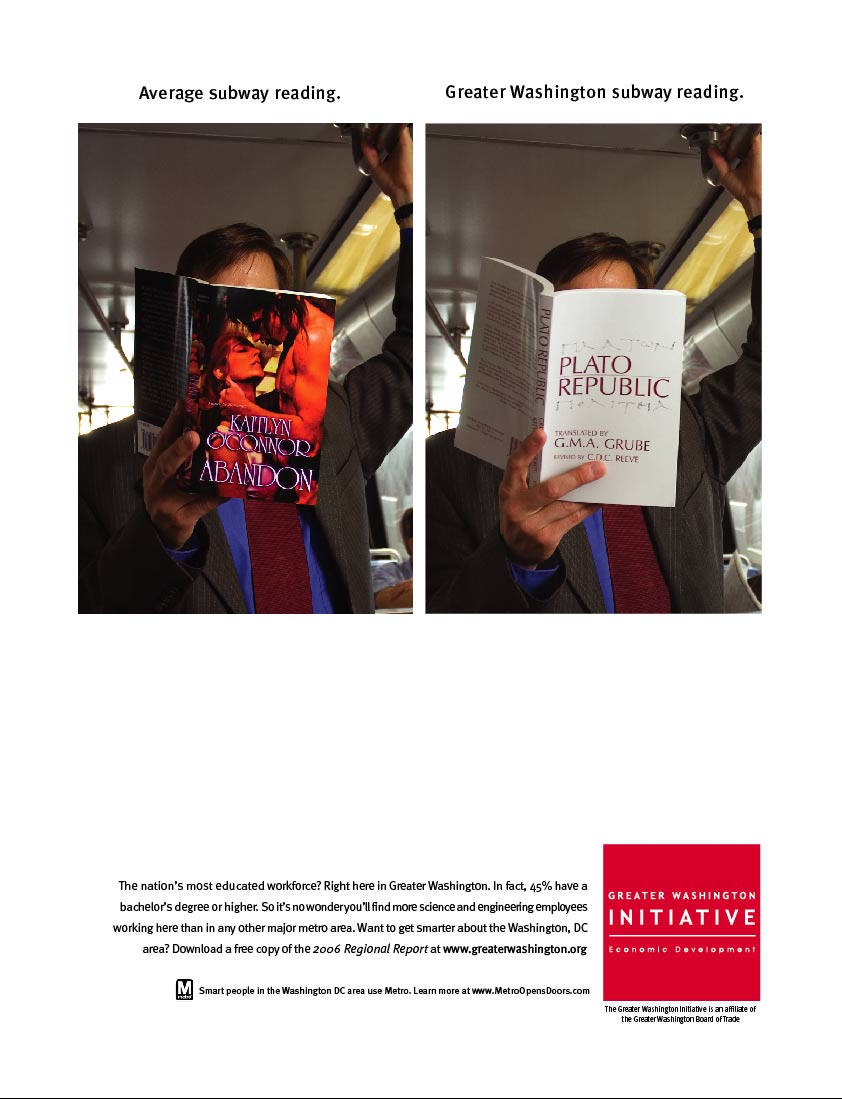
It all started out with an advert on the Washington DC Metro which was reported to the Smart Bitches. The resultant furore was reported by both The New York Times and The Washington Post, followed by comments on each article by the Smart Bitches and even more comments as the debate raged on. In the advert 'Greater Washington subway reading' material, epitomised by Plato's Republic, was being contrasted with 'average subway reading', represented by a romance novel. The implication was that Greater Washington's metro travellers, part of 'The nation's most educated workforce', of whom '45% have a bachelor's degree or higher', are well-educated people of the sort who read Plato, whereas less well-educated people read romance. For obvious reasons there were plenty of romance readers who took exception to this. For one thing, according to the RWA's statistics, 42% of romance readers 'have a bachelor's degree or higher'.
Inspired by all this controversy, I thought I'd take a look at the book which sparked all the outrage, namely Plato's Republic. It wasn't long before I came across an issue which, while dealt with only briefly in this passage from the Republic, is of vital importance to the romance genre. Cephalus, an elderly man, recalls
In Plato's Symposium it is explained that
Plato told stories, relating his ideas through the characters of Socrates and his interlocutors. Socrates is depicted using simple examples in order to approach philosophical truths, such as when he asks 'When horses are injured, are they improved or deteriorated?' during the dialogue regarding justice. It seems to me that this is not totally dissimilar to the way that romances, rather than discuss relationships or love in the abstract, ground their investigation into the causes and effects of love in a particular situation, so that it may be more easily understood by the reader.
I'd also like to take a closer look at old age, which was where we began when I quoted from the Republic. Do 'the passions relax their hold' in old age? And is this what is portrayed in the romance genre? I think it very often is, in the sense that the majority of romances portray young lovers. Sandy Oakes, for example, states that 'a romance works best when the experience is new—the younger hero and heroine falling in love for the first time'. But passion at an older age is not simply an issue affecting the characters within novels: it is also an issue which affects the perception of the romance readers, as explored in a recent At the Back Fence column at AAR, where Robin Uncapher commented that 'It’s not only younger people who find the idea of an older reader disconcerting. It’s all of us, including those of us who have passed that 40th birthday'. Michelle Buonfiglio articulated the unease that older readers can feel when they realise that they are feeling an attraction to a character who is much younger than they are: 'is it just plain creepy to think guys who are 10, 15, 20 years younger than I are sexy as hell?'. And although many romances only show passionate, romantic love between younger characters, there are some which feature older characters. Michelle mentions Candice Hern's Just One of Those Flings" which has as its hero 'an alpha younger man who's crazy about an older woman. Our heroine's got to convince herself that his attraction to her is real, not some fetish; that her desirablity transcends her age'. Age is also an issue in Jessica Hart’s Contracted: Corporate Wife. The heroine is divorced, and the mother of a fourteen-year-old girl and an eleven-year-old boy:
Jennifer Crusie is another author who has written a romance about a heroine who is over forty. In Anyone But You, a forty-year-old heroine is paired with a thirty-year-old hero. The heroine's attempts to make her body into the ideal of female beauty are shown to be futile; this is not a novel in the high mimetic mode. Instead she realises that 'I wanted to give him a perfect body, and all he wanted was mine' (2006: 218).
Inspired by all this controversy, I thought I'd take a look at the book which sparked all the outrage, namely Plato's Republic. It wasn't long before I came across an issue which, while dealt with only briefly in this passage from the Republic, is of vital importance to the romance genre. Cephalus, an elderly man, recalls
the aged poet Sophocles, when in answer to the question, How does love suit with age, Sophocles, --are you still the man you were? Peace, he replied; most gladly have I escaped the thing of which you speak; I feel as if I had escaped from a mad and furious master. His words have often occurred to my mind since, and they seem as good to me now as at the time when he uttered them. For certainly old age has a great sense of calm and freedom; when the passions relax their hold. (Book I, Jowett translation)In both the classical period and in the Middle Ages, love was often seen as a form of madness:
The disease of love, according to medieval physicians, is a disorder of the mind and body, closely related to melancholia and potentially fatal if not treated. In their view, however, lovesickness did not afflict everyone alike: the sufferer was typically thought to be a noble man. (Wack 1990: xi)If lovesickness was generally thought to result in depression and melancholy in the Middle Ages,
that is not the way it is depicted in the majority of ancient literary texts. Lovesickness, displayed in a violent or manic fashion, receives descriptions in almost all of the periods of ancient literature.(Toohey 2004: 61)There were, however, believed to be different types of love - eros, philia and agape, and for a more detailed discussion of Plato's ideas on love see, for example, this entry from the Stanford Encyclopedia of Philosophy.
In Plato's Symposium it is explained that
love is always directed towards what is good, indeed that goodness itself is the only object of love. When we love something, we are really seeking to possess the goodness which is in it. Not temporarily of course, but permanently. And from there Plato gives his first definition of love: ‘Love is desire for the perpetual possession of the good.’ [...] But although all things love, and all men are in some sense lovers, few recognise the object of their love, that which motivates their striving, that which underlies their every desire, that which will ensure ‘perpetual possession’. This object Plato calls the Good or absolute beauty. (Amir 2001)We may recall that Frye wrote:
We may think of our romantic, high mimetic and low mimetic modes as a series of displaced myths, mythoi or plot-formulas progressively moving over towards the opposite pole of verisimilitudeAccording to Frye, romances in the high mimetic mode come in for criticism because 'the interest in this sort of displaced myth “tends toward abstraction in character-drawing, and if we know no other canons than low mimetic ones, we complain of this.”' Could it be, then, that romances of this type, which are criticised for having stereotypical, unrealistic characters and plots, are in fact exploring love as the pursuit of 'the Good or absolute beauty'? To take as an example an old but important novel in the development of the genre, E. M. Hull's The Sheik, we find that the heroine, Diana Mayo (her very name recalls that of a goddess) is referred to as 'The divinity' (page 4) and one of her admirers exclaims that 'Beauty like yours drives a man mad' (page 7). In romances of the high mimetic type, the lovers are usually extremely beautiful/physically attractive, and intensely possessed of particular virtues (courage, in the case of Diana Mayo, humility and self sacrifice in the case of many other heroines, bravery in the case of many heroes). They are personifications of aspects of 'the Good' or 'absolute beauty'. Romances in the low mimetic mode, i.e. romances where the characters are more 'realistic' perhaps show how love can be compatible with daily living, without the lovers falling into the dangerous madness warned about by classical and medieval physicians.
Plato told stories, relating his ideas through the characters of Socrates and his interlocutors. Socrates is depicted using simple examples in order to approach philosophical truths, such as when he asks 'When horses are injured, are they improved or deteriorated?' during the dialogue regarding justice. It seems to me that this is not totally dissimilar to the way that romances, rather than discuss relationships or love in the abstract, ground their investigation into the causes and effects of love in a particular situation, so that it may be more easily understood by the reader.
I'd also like to take a closer look at old age, which was where we began when I quoted from the Republic. Do 'the passions relax their hold' in old age? And is this what is portrayed in the romance genre? I think it very often is, in the sense that the majority of romances portray young lovers. Sandy Oakes, for example, states that 'a romance works best when the experience is new—the younger hero and heroine falling in love for the first time'. But passion at an older age is not simply an issue affecting the characters within novels: it is also an issue which affects the perception of the romance readers, as explored in a recent At the Back Fence column at AAR, where Robin Uncapher commented that 'It’s not only younger people who find the idea of an older reader disconcerting. It’s all of us, including those of us who have passed that 40th birthday'. Michelle Buonfiglio articulated the unease that older readers can feel when they realise that they are feeling an attraction to a character who is much younger than they are: 'is it just plain creepy to think guys who are 10, 15, 20 years younger than I are sexy as hell?'. And although many romances only show passionate, romantic love between younger characters, there are some which feature older characters. Michelle mentions Candice Hern's Just One of Those Flings" which has as its hero 'an alpha younger man who's crazy about an older woman. Our heroine's got to convince herself that his attraction to her is real, not some fetish; that her desirablity transcends her age'. Age is also an issue in Jessica Hart’s Contracted: Corporate Wife. The heroine is divorced, and the mother of a fourteen-year-old girl and an eleven-year-old boy:
She was attractive enough, but she had to be at least forty-five, and it showed in the lines around her eyes.Patrick, the character making these observations, is himself ‘in his late forties’ (2005: 10). His opinion of Lou begins to change when she smiles:
That cool, composed look had never done anything for him, anyway. He liked his women more feminine, more appealing, less in control. And younger. (2005: 6).
Lou smiled up at the barman as he materialised out of the gloom, and Patrick’s hand froze in mid-tap as he felt a jolt of surprise. He hadn’t realised that she could smile like that.The double standard, which generally leads people to consider an age-gap more appropriate if the man is the older of the couple, is directly challenged by Lou:
She never smiled at him like that. [...] Not the warm, friendly smile she was giving the barman now, lighting her face and making her seem all at once attractive and approachable. (2005: 10)
The boy was clearly trying to impress Lou, Patrick thought disapprovingly, watching his attempts at banter. She had only smiled at him, for heaven’s sake. Anyone would think that she was hot, instead of nearly old enough to be his mother. Just what they needed, a barman with a Mrs Robinson fixation. [...] Patrick glowered at the barman’s departing back. ‘Thank God he’s gone. [...]’As Lou observes, Patrick’s girlfriends ‘look a good twenty years younger’ than him (2005: 12). She also acknowledges that ‘She was a middle-aged woman and it was well known that you became invisible after forty’ (2005: 12). Of course, this being a romance, Patrick eventually loses his arrogance and after that evening he starts to think of Lou in a new way.
‘I thought he was charming,’ said Lou, picking up her glass.
She would.
‘Don’t tell me you’ve got a taste for toy boys!’
‘No – not that it would be any business of yours if I did.’ [...]
‘You don’t think it would be a bit inappropriate?’ he countered.
Lou stared at him for a moment, then sipped at her champagne. ‘That sounds to me like a prime case of pots and kettles,’ she said coolly. (2005: 11)
Jennifer Crusie is another author who has written a romance about a heroine who is over forty. In Anyone But You, a forty-year-old heroine is paired with a thirty-year-old hero. The heroine's attempts to make her body into the ideal of female beauty are shown to be futile; this is not a novel in the high mimetic mode. Instead she realises that 'I wanted to give him a perfect body, and all he wanted was mine' (2006: 218).
- Amir, Lydia, 2001. 'Plato’s Theory of Love: Rationality as Passion', Practical Philosophy, November 2001, Volume 4.3: 6-14.
- Crusie, Jennifer, 2006. Anyone But You (Richmond, Surrey: Harlequin Mills & Boon).
- Hart, Jessica, 2005. Contracted, Corporate Wife (Richmond, Surrey: Harlequin Mills & Boon).
- Toohey, Peter, 2004. Melancholy, Love, and Time: Boundaries of the Self in Ancient Literature (Ann Arbor: University of Michigan Press).
- Wack, Mary Frances, 1990. Lovesickness in the Middle Ages: The ‘Viaticum’ and its Commentaries, University of Pennsylvania Press, Middle Ages Series (Philadelphia: University of Pennsylvania).
Subscribe to:
Posts (Atom)