Showing posts with label fat studies. Show all posts

Sunday, June 02, 2024

New Publications: A History of the RWA; Fat in Contemporary Romance; Romance and Philosophy


In a rather weird coincidence, just days after the Romance Writers of America filed for bankruptcy (which, as explained elsewhere, does not mean it's going to cease to exist, because 

the RWA expects a “swift resolution” to its bankruptcy restructuring, which “will not impact its day-to-day operations” of providing training and other resources to its members. The group “is not going out of business, as some others have made it sound,” (Beckett, The Guardian)

Christine A Larson's Love in the Time of Self-Publishing: How Romance Writers Changed the Rules of Writing and Success is coming out with Princeton University Press. It could be considered a history of the RWA and romance publishing, though Larson emphasises the book's wider appeal to those interested in the topic of

self-organization and mutual aid in the digital economy. In Love in the Time of Self-Publishing, Christine Larson traces the forty-year history of Romancelandia, a sprawling network of romance authors, readers, editors, and others, who formed a unique community based on openness and collective support. Empowered by solidarity, American romance writers—once disparaged literary outcasts—became digital publishing’s most innovative and successful authors. Meanwhile, a new surge of social media activism called attention to Romancelandia’s historic exclusion of romance authors of color and LGBTQ+ writers, forcing a long-overdue cultural reckoning.

Drawing on the largest-known survey of any literary genre as well as interviews and archival research, Larson shows how romance writers became the only authors in America to make money from the rise of ebooks—increasing their median income by 73 percent while other authors’ plunged by 40 percent. The success of romance writers, Larson argues, demonstrates the power of alternative forms of organizing influenced by gendered working patterns. It also shows how networks of relationships can amplify—or mute—certain voices.

I've got excerpts and links in the Romance Scholarship Database entry.
 
Some other new publications are:
 
Cole, Lauryn (2023) Fat and Fabulous: The Power of Contemporary Romance as a Site of Anti-Oppression Work. Bachelor of Arts dissertation, University of Oregon. [This focuses on Bet Me by Jennifer Crusie and Take a Hint, Dani Brown by Talia Hibbert.]
 
Lancaster, Guy (2024) "'God loves you nearly as much as I do': Toward a Poetics of Natality in Maureen Bronson's Delta Pearl, a 1989 Harlequin Historical Romance.' Arkansas Review: A Journal of Delta Studies 55.1:27–39. [Abstract here.]

Thursday, May 19, 2022

New Issue of JPRS on Black Romance, and other new publications

Issue 11 of the Journal of Popular Romance Studies features a special issue on Black Romance, edited by Margo Hendricks and Julie Moody-Freeman. Among other items, it includes the following articles:

Other recent publications about romance are:

Abrahamsson, Elin (2022). "Rättvisemärkt romantik: Feelgood, flärd och feminism i samtida svensk romance." in  Speglingar av feelgood: Genre, etikett eller känsla? 185-230.

Bilodeau, Isabelle (2022). "How Romance Translators Write Themselves and Their Readers into Afterwords." Departmental Bulletin Paper 47:81-98.

Deng, Yiwei (2022). "The Aesthetic form of Childhood Sweetheart: I Love You, None of Your Business." Frontiers in Economics and Management 3.4: 625-629.

Larson, Christine and Elspeth Ready (2022). "Networking down: Networks, innovation, and relational labor in digital book publishing." New Media & Society. Online First. https://doi.org/10.1177/14614448221090195

Nankervis, Madison (2022). “Diversity in Romance Novels: Race, Sexuality, Neurodivergence, Disability, and Fat Representation.” Publishing Research Quarterly. Online First. https://doi.org/10.1007/s12109-022-09881-6

Tuesday, April 26, 2022

New Publications: Comics, Second Hand Bookshops, Islands, Hispanisms, Race, Young People, Fatness, Radway and Chinese Readers

Brunet, Peyton and Blair Davis (2022). Comic Book Women: Characters, Creators, and Culture in the Golden Age. Austin: University of Texas Press. [Chapter 8 is about romance comics: https://doi.org/10.7560/324110-010]

Farooqui, Javaria (2022). "Romance in an Old Bookshop." The Bridge Magazine 1:66-69. [This is available freely online. It discusses the distribution of second-hand romances in Pakistan and the connection with social class.]

Fresno-Calleja, Paloma (2022). “Repurposing Fantasy Island: Lani Wendt Young’s Telesā Series and the Politics of Postcolonial Romance.” Interventions: International Journal of Postcolonial Studies. https://doi.org/10.1080/1369801X.2022.2054011

González-Cruz, María-Isabel. 2022. Hispanicisms in Romance Fiction. An Annotated Glossary. Lewiston, New York: The Edwin Mellen Press. [Details from the publisher.]

Hendricks, Margo (2022). Race and Romance: Coloring the Past. Arizona State University. [This is available to read for free online. This includes discussion of two novels by Beverly Jenkins and also Margo Hendricks's own romance novels (written as Elysabeth Grace).]

Herrera, Carolina M. (2022). Examining the relation between media engagement and developmental outcomes in adolescents and emerging adults: an exploration of engagement with and impact of young adult literature media among youth. PhD thesis, Rutgers, the State University of New Jersey. [Discusses romance reading.]

McDavis-Conway, Shana (2022). “Self-conscious, unapologetic, and straight: fat protagonists in romantic fiction.” Fat Studies. https://doi.org/10.1080/21604851.2022.2047337

Stetson, Suzanne (2022). "Reconciling Reader Response and Feminism in Late Twentieth-Century Erotic Historical Romances." INCITE: Journal of Undergraduate Scholarship 13.

Tang, Ning (2022). "Reading Online Romance Novels Is Related To Chinese Readers' View of Love." Academic Journal of Humanities & Social Science 5.2:32-45.


Wednesday, December 29, 2021

New publications: topics covered include Lovecraft, sexual orientation, fatness, race, identity, and religion

This will be the last of my new publication lists for 2021. Articles about romance have been continuing to appear (see below). This has also been a busy year for academic books on romance, and two more have been published just before the end of 2021. Although I haven't read either of them yet, I've collaborated with many of the authors of the essay collection and read an earlier version of the other.


Discursos e Identidades en la Ficción Romántica:
Visiones Anglófonas de Madeira y Canarias / Discourses and Identities in Romance Fiction: Anglophone Visions from Madeira and the Canaries is a bilingual essay collection (the same essays appear first in Spanish and then in English) edited by María Isabel González-Cruz. There is also a section related to teaching romance fiction. A list of the contents, along with topic tags, can be found in the Romance Scholarship Database. Excerpts are available from Vernon Press and Google Books.


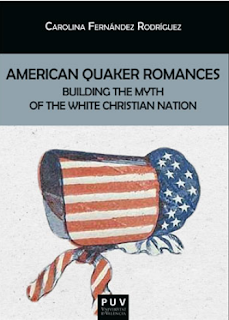
Fernández Rodríguez, Carolina (2021). American Quaker Romances: Building the Myth of the White Christian Nation. Valencia : Universidad de Valencia.

With the rise in recent years of the Christian romance market, dominated by American Evangelical companies, there has been a renewed interest in fictional Quakers. In the historical Quaker romances analyzed in this book, Quaker heroines often devote time to spiritual considerations, advocate the sanctity of marriage and promote traditional family values. However, their concern with social justice also leads them to engage in subversive behavior and to question the status quo, as illustrated by heroines who are active on the Underground Railroad or are seen organizing the Seneca Falls convention. Though relatively liberal in terms of gender, Quaker romances are considerably less progressive when it comes to race relations.

Thus, they reflect America's conflicted relationship with its history of race and gender abuse, and the country's tendency to both resist and advocate social change. Ultimately, Quaker romances reinforce the myth of America as a White and Christian nation, here embodied by the Quaker heroine, the all-powerful savior who rescues Native Americans, African Americans and Jews while conquering the hero's heart.

Here are links to: the publisher's website; an excerpt on Google Books; Amazon (ebook and paperback)


Hefner, Brooks E. (2021). Black Pulp: Genre Fiction in the Shadow of Jim Crow Minneapolis: University of Minnesota Press. [Excerpt available via Google Books. See in particular Chapter 2, "Romancing the Race: The Politics of Black Love Stories."]

Hernandez-Knight, Bianca (2021). "Race and Racism in Austen Spaces: Jane Austen and Regency Romance's Racist Legacy." ABO: Interactive Journal for Women in the Arts, 1640-1830 11.2.

Johnson, Brian (2022). "Weird Bedfellows: H. P. Lovecraft, m/m Romance, and the New Queer Families of Jordan L. Hawk's Whyborne & Griffin Series." Lovecraft in the 21st Century: Dead, But Still Dreaming. Ed. Antonio Alcala Gonzalez, Carl H. Sederholm. New York: Routledge. [Abstract]

Khumwongdee, Yanisa (2021). Reading and Rewriting Fat Romance: A Study of Twenty-First Century Thai and US Fat Romance Novels. PhD thesis, University of York. [Abstract] 

Moolla, F. Fiona (2021). "Her Heart Lies at the Feet of the Mother: Transformations of the Romance Plot in Leila Aboulela’s Minaret." African Journal of Gender and Religion 27.2:1-21.

Pierre, Zakiya (2021). Browsing in nuances: Using ethnographic research to design for the experience of browsing. Bachelor's thesis, Malmö University.

Pradhan, Anil (2021). "The literary field of queer cultural production in contemporary India: considering popular queer texts via Bourdieu." Runas: Journal of Education & Culture 2.4.

Weimer, Christopher (2021). "Romancing Weird Fiction: Lovecraftian Reinscriptions in Jordan L. Hawk's Whyborne and Griffin." Aeternum: The Journal of Contemporary Gothic Studies 8.1:61-76. [Download the whole issue.]


Tuesday, December 11, 2012

Weighing up Chick Lit vs. Romance

Laura Vivanco
 

I don't have the necessary expertise to comment on the methodology used in
Kaminski, Melissa J. and Robert G. Magee. "Does This Book Make Me Look Fat?: The Effect of Protagonist Body Weight and Body Esteem on Female Readers' Body Esteem." Body Image (2012).
However, since some of you do, and since it makes a change from the more common concerns about romance having a negative effect on women's relationships, I thought I'd post about it. The authors describe chick lit as "a new genre of romance novels" which "differs from traditional romance novels in its focus on women’s struggles with their weight, dating, and stressful careers." They later add that "Compared with chick lit, traditional romance novels might be less obsessed with women’s body size."

Here's the abstract:
Effects of visual representations of the thin ideal in the media have been widely explored, but textual representations of the thin ideal in novels have received scant attention. The chick literature genre has been criticized for depicting characters who worry about their body weight and who have poor body esteem. Excerpts from two chick lit novels were used to examine the effect of a protagonist’s body weight and body esteem on college women’s (N = 159) perceptions of their sexual attractiveness and weight concern. Two narratives were used to minimize the possibility that idiosyncratic characteristics of one excerpt might influence the study’s results. Underweight (vs. healthy weight) protagonists predicted readers’ lower perceived sexual attractiveness. Protagonists with low body esteem (vs. control) predicted readers’ increased weight concern. Scholars and health officials should be concerned about the effect chick lit novels might have on women’s body image.
The image is one I've cropped slightly, having found the original at Wikimedia Commons. It shows a scene in Berlin in 1947 and came from the German Federal Archive as part of a cooperation project.

Tuesday, May 01, 2012

JPRS 2.2: Special Forum on Jennifer Crusie


As Eric writes, "This feature was first imagined, many years ago, as a book of critical essays, to be edited by Laura Vivanco and myself." We sent out the first call for papers in July 2006 and a subsequent one, for additional papers, in January 2008. In the end, we never did get enough essays to fill a whole volume. Perhaps it was all for the best; now these six essays (and a detailed introduction) are freely available to everyone with an internet connection.

"Nothing But Good Times Ahead" -  an introduction, by Eric Selinger
I would not be editor of this journal—in fact, the journal itself might not exist—had I not encountered Crusie’s novels and essays in the early 2000s.  They made me want to be a romance scholar, and since 2006, when I began to teach courses on popular romance, a novel and / or essay by Crusie has appeared on every one of my twenty-plus syllabi. [...]  To hear Crusie’s characters debate the nature of stories or watch them read the material world around them, from clothing to china to paintings to home decor, is to learn how to read, better and deeper, in the broadest sense of the verb.

"Jennifer Crusie's Literary Lingerie" - by Laura Vivanco
in Crusie’s fiction even the flimsiest piece of lingerie can be “heavy with meaning” (“Romancing” 86). This meaning is only partially encoded in the fabrics, styles and colours chosen: it is also dependent on the context in which a particular item is worn or discarded. In one situation, therefore, lingerie can function as an instrument of patriarchal oppression while in another it may serve as a weapon in the feminist struggle; it can be used to signal sexual interest and boost a woman’s confidence but may also reinforce her feelings of inadequacy about her body; it can cause her physical discomfort or give sensual pleasure; although it can indicate a lack of openness and truth, female intimacy is promoted as women discuss their lingerie and via such discussions give each other emotional support that complements the physical uplift of underwiring and padding. Crusie’s literary lingerie reflects the complexity of women’s relationships with their bodies, their desires, their sexual partners and their friends.

"Crusie and the Con" - by Christina A. Valeo

My consideration of the con in Crusie’s work, and my argument that the exchange between romance writer and romance reader itself resembles a con, focuses on the agency of the reader in the exchange, on her willing participation in this literary shell game. If we extend the conversation beyond the moral debate, the author’s intent, or the text’s effect, we can consider more completely the reader’s role in constructing the meaning and negotiating the impact of the text.

"Tell Me Lies: Lying, Storytelling and the Romance Novel as Feminist Fiction" - by Patricia Zakreski
In discussions concerning lying, many contemporary philosophers, psychologists, and sociologists agree that different cultures, and even individuals within the same culture, have varying ideas about what does and does not count as a lie. Opinion over the social impact of lying is also divided. Whether seen as immoral and self-serving or as a necessary social skill, lying is a difficult concept to define. Crusie, however, offers her own definition in The Cinderella Deal that highlights the transformative potential of fictions of romance. While Linc thinks that telling the faculty at Prescott that he is engaged is a lie, Daisy offers a different perspective [...]. Daisy’s idea of a lie is something that attempts to alter the facts of the past, while a story presents a vision of a desired present and future—something Linc wants rather than something he’s done. Presenting a version of reality as he would like it to be is therefore not a lie, but is instead a possible preview of coming truths, a story he created, which, though fictional, can be made real.

"Getting Laid, Getting Old, and Getting Fed: The Cultural Resistance of Jennifer Crusie's Romance Heroines" - by Kyra Kramer
One of the ways in which Crusie contests “a lot of the ‘truths’ that the different societal ideologies have foisted on” her heroines is through her depiction of their bodies. In several of her novels, her heroines find a satisfying romance in spite of the fact they transgress in some way the modern cultural conceptualisation of what is a “desirable” or “beautiful” woman, thereby contesting the cultural ideal of “feminine beauty.” Although there are several other areas in which the bodies of her heroines are consistent with culturally ascribed definition of what is normal or what is beautiful—in that they are white, middle-class heroines who are not transgendered, homosexual, disabled, or disfigured, among other variables—there is at least an attempt by Crusie to stretch the narrow definition of what kind of woman is ‘allowed’ to live happily ever after within the cultural narrative.

"The Heroine as Reader, the Reader as Heroine: Jennifer Crusie's Welcome to Temptation" - by Kate Moore and Eric Selinger
Crusie does not deny that individuals can confuse fantasy and reality, but rather suggests that confusion about boundaries between the two realms is not specific to women or to one form of fantasy, the romance, but rather arises in the vanity and egocentrism of the person experiencing the fantasy. To make her case, Crusie opens the novel by locating her heroine’s imaginative experience as a reader and writer in the larger context of accepted imaginative experience in American popular culture. She then juxtaposes her heroine’s fantasy experience against the experiences of a cast of secondary characters, both male and female, whose participation in popularly accepted forms of fantasy, those not subject to critical derision for association with women, leads them into moral error.

"Gossip, Liminality, and Erotic Display: Jennifer Crusie's Links to Eighteenth-Century Amatory Fiction" - by Kimberly Baldus
Tell Me Lies and the novels that followed in the next two years, Crazy for You and Welcome to Temptation, increasingly linger on moments where eroticism develops in the liminal space between private intimacy and public exposure. Crusie constructs scenes where her female characters explore the liberating possibilities of turning their private sexual encounters into public spectacles, offering themselves as objects of a voyeuristic gaze which readers are invited to share. [...] In the links she develops between liminality, gossip and erotic display, Crusie’s modern romance draws upon territory first developed in the genre of the novel designated as “amatory fiction” (Ballaster). These texts, appearing in the early eighteenth century in England, played a crucial role in shaping the emerging genre of the novel. [...] The notion of the liminal as a realm that inspires creativity and invites new possibilities underpins a model of authorship that playfully invites readers to participate in the communal act of making meaning from the textual details of their novels.

Monday, July 05, 2010

CFP: Fat Studies Edited Anthology


Given some of the recent discussions here about larger heroines (beginning part way through this post, and continuing in the comments here) I thought there would be plenty of material to work with in the romance genre in response to the following call for papers which I came across via The F Word but which originally came from Obesity Timebomb. Interestingly, when I went to look at AAR's special title listings, I noticed that they have a page about "plus-sized heroines" but there isn't an equivalent page for romances with "plus-sized" heroes (although there is one "overweight" hero included on the "Beauty is in the Eye ..." list).

----------------------
CFP for fat studies edited anthology

Julia McCrossin and I were approached at the PCA/ACA Conference by a publisher and asked to put together a fat studies anthology. The result is the call for papers listed below. Please feel free to distribute far and wide with our thanks.

If you have any questions, please feel free to email either Julia or me. Our addresses are listed below. Huge thanks, and I look forward to hearing from many of you! :)

~Lesleigh Owen
------------------------

Call for Anthology Submissions

Tentative title: The Unbearable Fatness of Being: Enlarging Theories of Embodiment


Type: Edited anthology

Submission deadline: August 20, 2010

Contacts and editors: Julia McCrossin, jmccross@gwmail.gwu.edu;

Lesleigh Owen, Ph.D., lesleigh.owen@gmail.com

This edited collection seeks to publish recent scholarship that pushes at the boundaries of the existent scholarship on embodiment, from a Fat Studies perspective. As Fat Studies is an emerging field, there are copious amounts of terrain left to map out, and this collection will display the provocatively expansive ways that emergent Fat Studies scholars conceptualize the fat body and the cultural work the fat body does in various times, places, and societies. The purpose of this work includes pushing back at the “obesity epidemic” rhetorics in ways that are at once connected to affiliated work in fields like disability studies, queer studies, gender studies (to name a few), and yet uniquely their own. In conclusion, this edited collection will offer crucial new pathways for the generative field of Fat Studies, as well as offer an exciting look at the developing scholars in this field. Perhaps one might say that Fat Studies seeks to integrate within cultural studies and the academy in general a critical body of work on fatness, layering our current understandings of the material body along with metaphoric and/or immaterial ways that fatness saturates our (post) modern world.

Topics may include but are not limited to:

  • representations of fat people in literature, film, music, nonfiction, and the visual arts
  • cross-cultural or global constructions of fat bodies
  • cultural, historical, or philosophical meanings of fat and fat bodies
  • portrayals of fat individuals and groups in news, media, magazines
  • fatness as a social, political, personal, and/or performed identity
  • phenomenology of fat movement and be-ing in a variety of physical (and physiological) contexts
  • fat as queering sex, beauty, gender, and other embodied performances
  • negotiating fat within locations, space, and time
  • representing weighted embodiments in such creative or abstract forms as, for example, visual art, poetry, personal narratives, and literature
  • fat acceptance, activism, and/or pride movements and tactics
  • approaches to fat and body image in philosophy, psychology, religion, sociology
  • fat children in literature, media, and/or pedagogy
  • fat as it intersects with race, ethnicity, class, religion, ability, gender, nationality, and/or sexuality
  • functions of fatphobia or fat oppression in economic and political systems

Submissions are due August 20, 2010. We welcome traditional and non-traditional formats, including research articles, photographs, poetry, reports of performance art, and others. Articles and papers should range between 15 and 20 double-spaced pages. Please send submissions, along with a brief biographical sketch, directly to jmccross@gwmail.gwu.edu and/or lesleigh.owen@gmail.com.
----------------------

Lesleigh J. Owen's "Consuming Bodies: Fatness, Sexuality, and the Protestant Ethic" is available online via the University of California's eScholarship site.

Julia McCrossin,
an English professor and doctoral candidate at GW [George Washington University], first came across the idea of fat studies in 2003 during an introductory cultural anthropology course. Six years later, McCrossin is one of the few experts bringing the field into the national limelight.

McCrossin said the field of fat studies encompasses many aspects of society, from film, literature and popular culture, to anthropology and history. Her studies are often focused on literary characters and the impact that the characters' obesity has on the plot of the novel.

"I wanted to think about why some characters 'needed' to be fat and how that fatness affected the works in which they existed in," she said. (
Summaries of some of the papers presented at the 2010 PCA/ACA Conference's fat studies panels have been written by "withoutscene" and are available here.