Showing posts with label Carolina Fernández Rodríguez. Show all posts

Thursday, June 13, 2024

New book on historical romance and other new articles


Conflict and Colonialism in 21st Century Romantic Historical Fiction: Repairing the Past, Repurposing History, edited by Hsu-Ming Teo and Paloma Fresno-Calleja is out today (13 June) from Routledge. The introduction, "Conflict and Colonialism in 21st Century Romantic Historical Fiction: Repairing the Past, Repurposing History" is open access and can be downloaded from here.

The other essays about romance in the collection are:

The Australian Convict Prostitute Romance: Narrating Social and Sexual Justice for “Damned Whores” - Hsu-Ming Teo

Love in Victorian London: Immigrant Histories and Intersecting Diversities in K. J. Charles’s Sins of the Cities - Jayashree Kamblé 

Language, Sexuality and “Necessary” Anachronism in Lorraine Heath’s Neo-Victorian Popular Romance Series Scandalous Gentlemen of St. James - Carmen Pérez Ríu

Suffragette Historical Romances: Re-Purposing Women’s Suffrage in a Postfeminist Context - Mariana Ripoll-Fonollar

The US Civil War and its Aftermath in Historical Quaker Romances Hailing White Heroines as Builders and Healers of the Nation - Carolina Fernández Rodríguez 

Historical Reparation, Emotional Justice: The Navajo Long Walk in Evangeline Parsons Yazzie’s Her Land, Her Love - Silvia Martínez-Falquina

When a Jew Loves a Nazi: Problems with Repurposing the Holocaust for Reparative Romance - Hsu-Ming Teo

Abstracts for all of those can be found here.

---

Other recent publications are:

Austin, Allan W. (2024) "Courting Tragedy: Romance and the Liberal Redemption of Japanese American Mass Incarceration". Journal of Popular Romance Studies 13. [Of the two novels discussed, only one is a romance, by Danielle Steel.]

Lukas, Iwan, Muarifuddin, and Rahmawati Azi (2024). "Formula Romance dalam Roman Mes Amis Mes Amours Karya Marc Lévy." LE PARIS: Journal de Langue, Litterature, et Culture 5.1:15-3. [There's an abstract in English but the article itself is written in what I assume is Indonesian.]
 
Rimmer, Abi (2024). "Can I have a side hustle as a doctor?" BMJ 385. [Short article which includes quotes from Fearne Hill. Abstract here.]

Sanders, Lise Shapiro (2024). "Girls Growing Up: Reading ‘Erotic Bloods’ in Interwar Britain". The Edinburgh History of Children's Periodicals, edited by Kristine Moruzi, Beth Rodgers and Michelle Smith. Edinburgh: Edinburgh University Press: 93-111. https://doi.org/10.1515/9781399506663-009

Wednesday, December 29, 2021

New publications: topics covered include Lovecraft, sexual orientation, fatness, race, identity, and religion

This will be the last of my new publication lists for 2021. Articles about romance have been continuing to appear (see below). This has also been a busy year for academic books on romance, and two more have been published just before the end of 2021. Although I haven't read either of them yet, I've collaborated with many of the authors of the essay collection and read an earlier version of the other.


Discursos e Identidades en la Ficción Romántica:
Visiones Anglófonas de Madeira y Canarias / Discourses and Identities in Romance Fiction: Anglophone Visions from Madeira and the Canaries is a bilingual essay collection (the same essays appear first in Spanish and then in English) edited by María Isabel González-Cruz. There is also a section related to teaching romance fiction. A list of the contents, along with topic tags, can be found in the Romance Scholarship Database. Excerpts are available from Vernon Press and Google Books.


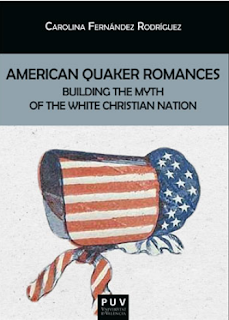
Fernández Rodríguez, Carolina (2021). American Quaker Romances: Building the Myth of the White Christian Nation. Valencia : Universidad de Valencia.

With the rise in recent years of the Christian romance market, dominated by American Evangelical companies, there has been a renewed interest in fictional Quakers. In the historical Quaker romances analyzed in this book, Quaker heroines often devote time to spiritual considerations, advocate the sanctity of marriage and promote traditional family values. However, their concern with social justice also leads them to engage in subversive behavior and to question the status quo, as illustrated by heroines who are active on the Underground Railroad or are seen organizing the Seneca Falls convention. Though relatively liberal in terms of gender, Quaker romances are considerably less progressive when it comes to race relations.

Thus, they reflect America's conflicted relationship with its history of race and gender abuse, and the country's tendency to both resist and advocate social change. Ultimately, Quaker romances reinforce the myth of America as a White and Christian nation, here embodied by the Quaker heroine, the all-powerful savior who rescues Native Americans, African Americans and Jews while conquering the hero's heart.

Here are links to: the publisher's website; an excerpt on Google Books; Amazon (ebook and paperback)


Hefner, Brooks E. (2021). Black Pulp: Genre Fiction in the Shadow of Jim Crow Minneapolis: University of Minnesota Press. [Excerpt available via Google Books. See in particular Chapter 2, "Romancing the Race: The Politics of Black Love Stories."]

Hernandez-Knight, Bianca (2021). "Race and Racism in Austen Spaces: Jane Austen and Regency Romance's Racist Legacy." ABO: Interactive Journal for Women in the Arts, 1640-1830 11.2.

Johnson, Brian (2022). "Weird Bedfellows: H. P. Lovecraft, m/m Romance, and the New Queer Families of Jordan L. Hawk's Whyborne & Griffin Series." Lovecraft in the 21st Century: Dead, But Still Dreaming. Ed. Antonio Alcala Gonzalez, Carl H. Sederholm. New York: Routledge. [Abstract]

Khumwongdee, Yanisa (2021). Reading and Rewriting Fat Romance: A Study of Twenty-First Century Thai and US Fat Romance Novels. PhD thesis, University of York. [Abstract

Moolla, F. Fiona (2021). "Her Heart Lies at the Feet of the Mother: Transformations of the Romance Plot in Leila Aboulela’s Minaret." African Journal of Gender and Religion 27.2:1-21.

Pierre, Zakiya (2021). Browsing in nuances: Using ethnographic research to design for the experience of browsing. Bachelor's thesis, Malmö University.

Pradhan, Anil (2021). "The literary field of queer cultural production in contemporary India: considering popular queer texts via Bourdieu." Runas: Journal of Education & Culture 2.4.

Weimer, Christopher (2021). "Romancing Weird Fiction: Lovecraftian Reinscriptions in Jordan L. Hawk's Whyborne and Griffin." Aeternum: The Journal of Contemporary Gothic Studies 8.1:61-76. [Download the whole issue.]


Friday, January 31, 2020

Roundup of Mostly 2019 Bibliography Entries

I'd been saving these items up in case the Romance Wiki came back online soon, but it hasn't, so I'm just going to post this list of new-ish items now.
Bazenga, Aline, 2019. 
'Turismo e Romance na Literatura Popular Cor-de-rosa Tendo por Cenário a Ilha da Madeira', Memoria e Identidade Insular: Religiosidade, Festividades e Turismo nos Arquipélagos da Madeira e Açores, Coordenação Duarte Nuno Chaves. Velas, S. Jorge: CHAM (Centro de Humanidades Santa Casa da Misericórdia das Velas), 323-335.
Cella, Laurie J. C., 2019. 
The Personal and the Political in American Working-Class Literature, 1850-1939: Defining the Radical Romance. (Lanham, Maryland: Lexington). Excerpt [Cella "make[s] the case that working-class women, in history and in literature, constructed romance narratives in which they were the heroines, reveled in the adventures created by Laura Jean Libbey, and celebrated their new entry in the working world" (5)]
 
Fernández Rodríguez, Carolina, 2019. 
"Chamorro WWII Romances: Combating Erasure with Tales of Survival and Vitality", Journal of Popular Romance Studies 8.
 
Gerlitz, Laura Michelle, 2019. 
"Judging a Book By Its Cover: Bringing the Digital Humanities into Reader’s Advisory", MA thesis, Digital Humanities and Library and Information Studies, University of Alberta. ["This study sets out to examine recurring themes found on book wrappers published by Harlequin in their first seventeen years [1949-1968] [...]. The resulting patterns will be connected to reader’s advisory as appeal factors in successful book selection by readers."]

Jarvis, Christine, 2006. 
"Using Fiction for Transformation." New Directions for Adult and Continuing Education 109: 69-77. Abstract
Legallois, Dominique, Thierry Charnois, and Thierry Poibeau, 2016. 
Repérer les clichés dans les romans sentimentaux grâce à la méthode des ‘motifs’.” Lidil. Revue de linguistique et de didactique des langues 53: 95–117.
 
Toscano, Angela, 2019. 
"The Idolatry of the Real: Form, Formula, and Happy Endings in Romance Literature", Chapter 8, Iconoclasm: The Breaking and Making of Images, edited by Rachel F. Stapleton and Antonio Viselli. Montreal & Kingston: McGill-Queen's University Press, pp. 173-192.
Valovirta, Elina, 2019. 
"No Ordinary Love: The Romantic Formula of Stepsibling Erotica". Thinking with the Familiar in Contemporary Literature and Culture 'Out of the Ordinary', Ed. Joel Kuortti, Kaisa Ilmonen, Elina Valovirta, Janne Korkka (Leiden: Brill Rodopi), pp. 161-??. Abstract
 
Veros, Vassiliki, 2019. 
"Metatextual Conversations: The Exclusion/Inclusion of Genre Fiction in Public Libraries and Social Media Book Groups", Journal of the Australian Library and Information Association. 254-267. Abstract
And Phraseology and Style in Subgenres of the Novel: A Synthesis of Corpus and Literary Perspectives, edited by Iva Novakova and Dirk Siepmann (Palgrave Macmillan, 2020) doesn't have a huge amount about romance, but there are some insights into the types of verbs used in fantasy, romance and crime fiction in French and English, as well as the discovery that people in romance novels "take a sip" a lot more than they do in other genres (full quote here).