Hall, Cailey (2025). “Redefining the Archive in Queer Historical
Romance Novels.” Unsettling Sexuality: Queer Horizons in the
Long Eighteenth Century. Ed. Jeremy Chow and Shelby Johnson.
Newark: University of Delaware Press. 95-108.
It focuses on Olivia Waite's The Lady's Guide to Celestial Mechanics (2019).
---
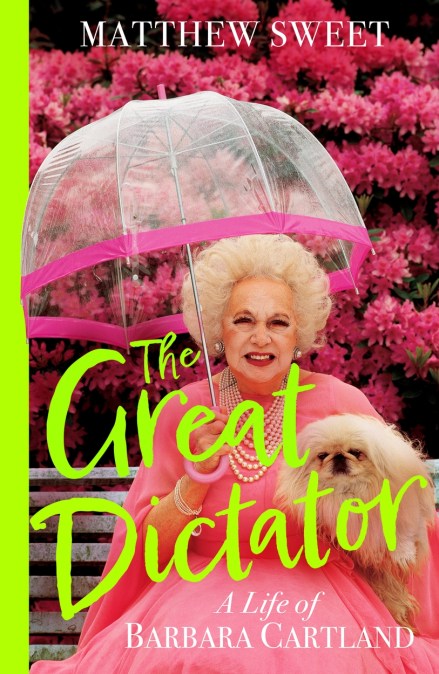
Recently published is a biography of Barbara Cartland, by Matthew Sweet. The entry in the RSDB includes links, including to earlier biographies and autobiographies. Sweet's The Great Dictator: A Life of Barbara Cartland has been reviewed by the BBC (and the article includes a quote from our own Dr Amy Burge).
--
And now on to the other new works:
Brown, Cheyenne (2026). I Read It for the Plot: Romance and Identity on BookTok.Master of Arts thesis,
The University of North Carolina at Charlotte. [Excerpt]
Florimond-Clerc, Adeline and Louis Gabrysiak, "New romance." Publictionnaire. Dictionnaire encyclopédique et critique des publics. Mis en ligne le 24 mars 2026.
Hunter, Kathryn M. (2026). “Desert Dreams: Valentino, Lawrence, and Sheik Fantasy in 1920s Australia.” Journal of the Royal Australian Historical Society 112: 56-76. [Link, abstract and some quotes.]
Jones, Bethan (2026). Sight
Loss and the Tethered Self in 21st Century Novels.
Cham: Palgrave Macmillan. [The chapter on romance is titled "Blind Love and the Will to Run in Romance Fiction by Eric Lindstrom and Lucy May Lennox". More details here.]
Kamblé, Jayashree (2026). "Race, religion, and the politics of desire in Talia Hibbert’s A Girl Like Her and Take a Hint, Dani Brown."
Literature, Critique, and Empire Today. Online First. [Abstract]
O’Connell, Mark Joseph (2026). “No More Martyrs: Heated Rivalry, Queer Romance and the End of Tragic Legitimacy.” Journal of Popular Television 14.2: 161–79. [This is mostly about the TV version of Heated Rivalry, but it does mention the novel and romance conventions. Abstract].
Ottaviani, Lauren (2026). "(Re)Defining Irish Womanhood: Serials and Short Stories in The Lady of the House (1890-1914)."
The Edinburgh Companion to Irish Literature and Periodical Culture. Ed. Elke D'hoker and Phyllis Boumans. Edinburgh: Edinburgh University Press. 143-158. [Excerpt]
Partzsch, Henriette, Päivi Lappalainen, Katja Mihurko, Viola
Parente-Čapková, Marie Nedregotten Sørbø, and Suzan van Dijk (2026). "One Woman Writer Everywhere: The Ubiquitous E. Marlitt". Redrawing Europe’s Literary Map. Ed. Henriette Partzsch and Viola Parente-Čapková. Leiden, The Netherlands: Brill.
I probably should have posted this list before it got so long, but more and more notifications kept arriving in my inbox and I kept thinking I'd post once I'd added all the news items to the RSDB and that took me longer than anticipated. Anyway, I'll begin with a couple of not-strictly academic pieces which are, nonetheless, quite academic:
In the Arkansas Democrat Gazette (June 8) Guy Lancaster (mentioned recently on this blog and who has a publication below) gives his backstory as a non-romance reader before exploring the societal implications of the denigration of romance:
For so long, we have regarded the consumption of Harlequin paperbacks as
nigh pathological on the part of women, when in fact, it was the
rejection of romance that typified the pathological condition beginning
to emerge in American culture at large. After all, these stories center
the phenomenon we call love. And as no less a thinker than G.W.F. Hegel,
perhaps the greatest philosopher of the 19th century, wrote in
"Elements of the Philosophy of Right" (1820): "Love means in general the
consciousness of my unity with another, so that I am not isolated on my
own, but gain my self-consciousness only through the renunciation of my
independent existence and through knowing myself as the unity of myself
with another and of the other with me." (https://www.arkansasonline.com/news/2025/jun/08/the-thrill-of-love/, archived here and also here)
And that's not entirely unrelated to Jessica Taylor's ponderings about the value of her research into romance now that she's outside academia, and how success is measured (in publishing and academia): "What is writing a romance for? What is this essay for? Is work all there is?" Jessica's PhD thesis, Write the Book of Your Heart: Career, Passion and Publishing in the Romance Writing Community (2013) can be downloaded here.
And the latest additions to the Romance Scholarship Database:
Ahmed, Iman and Michael-Zane Brose, Lara Dengs, Lucie Elfering, Elena
John, Mira Kalcker, Alice Kronenberg, Charmaine Küllenberg, Laura Le
Donne, Alican Nazik, Lena Neisen, Öznur Zeynep Özdal, Hanna
Schneemann, Antonia Steven, Julie Bøglund Strand (2025). A “Messy Complexity”? On Coming-Out, Identity Formation, and Community in Queer YA Romance Novels. Heinrich
Heine University Duesseldorf.
Burkes, Jordan (2025). The Love Hypothesis: Exploring the Consumption of Romance Novels.PhD,
Louisiana State University and Agricultural and Mechanical College. [Embargoed until 2032 but the abstract can be found here.]
Hodson,
Jane (2024). "The Significance of Stance in Fictional
Representations of Non-Standard Language and Prescriptivism".
New
Horizons in Prescriptivism Research,
edited by Nuria Yáñez-Bouza, María E. Rodríguez-Gil and Javier
Pérez-Guerra. Bristol, Blue Ridge Summit: Multilingual Matters:
103-119. [https://doi.org/10.21832/9781800416154-007 I was late in finding this, probably because it doesn't mention romance in the title or the text of the essay. It does, though, focus on the use of "non-standard" language in Georgette Heyer's The Unknown Ajax. Currently, most/all of this is visible via Google Books.]
Kamblé, Jayashree (2025). "The
Women Who Changed the American Mass-Market Romance Genre: BIPOC
Editors, Authors, and Category Romance Novels from 1980 to 1988."Contemporary Women's Writing
19. [Abstract available here and excerpts here.]
Lancaster, Guy (2025).
" ‘It had turned them all into voyeurs’: Celebrity as the Antithesis of Community in Molly O’Keefe’s Wild Child."Arkansas Review: A Journal of Delta Studies
56.1:25–36. [Details here.]
Raffloer, Gavin and Melanie Green (2025).
"Of Love & Lasers: Perceptions of Narratives by AI Versus Human Authors."
Computers in Human Behavior: Artificial Humans. [This is Online First, so does not yet have pagination. Also note that the paper discusses romance generated by AI versus romance written by humans, and I've written some comments on the methodology from the perspective of a romance scholar.]
Sutton, Denise H. (2025).
“Romance Publishing for a New Generation: The Case of Harlequin and
Mills & Boon In India.” Publishing History 89:7-27. [More details in the RSDB]
Valovirta, Elina (2025). "Romancing the Caribbean Sea: Size, Mobility and Sustainability in Cruise Ship Romance Fiction". Anglia 143.2: 382-397. https://doi.org/10.1515/ang-2025-0026
Wilder, Mims (2025). (Wo)Men in Love: An Analysis of Sexual
Scripts, Escapism, and Queer Explorations Among Woman Readers and
Authors of Male/Male Romance Novels. Doctor of Philosophy in
Human Sexuality, California Institute of Integral Studies.
[More details here.]
Conflict and Colonialism in 21st Century Romantic Historical Fiction: Repairing the Past, Repurposing History, edited by Hsu-Ming Teo and Paloma Fresno-Calleja is out today (13 June) from Routledge. The introduction, "Conflict and Colonialism in 21st Century Romantic Historical Fiction: Repairing the Past, Repurposing History" is open access and can be downloaded from here.
The other essays about romance in the collection are:
The Australian Convict Prostitute Romance: Narrating Social and Sexual Justice for “Damned Whores” - Hsu-Ming Teo
Love in Victorian London: Immigrant Histories and Intersecting Diversities in K. J. Charles’s Sins of the Cities - Jayashree Kamblé
Language, Sexuality and “Necessary” Anachronism in Lorraine
Heath’s Neo-Victorian Popular Romance Series Scandalous Gentlemen of St.
James - Carmen Pérez Ríu
Suffragette Historical Romances: Re-Purposing Women’s Suffrage in a Postfeminist Context - Mariana Ripoll-Fonollar
The US Civil War and its Aftermath in Historical Quaker
Romances Hailing White Heroines as Builders and Healers of the Nation - Carolina Fernández Rodríguez
Historical Reparation, Emotional Justice: The Navajo Long Walk in Evangeline Parsons Yazzie’s Her Land, Her Love - Silvia Martínez-Falquina
When a Jew Loves a Nazi: Problems with Repurposing the Holocaust for Reparative Romance - Hsu-Ming Teo
Lukas, Iwan, Muarifuddin, and Rahmawati Azi (2024).
"Formula Romance dalam Roman Mes Amis Mes Amours Karya Marc Lévy."LE PARIS: Journal de Langue, Litterature, et Culture
5.1:15-3. [There's an abstract in English but the article itself is written in what I assume is Indonesian.]
Rimmer, Abi (2024).
"Can I have a side hustle as a doctor?"BMJ
385. [Short article which includes quotes from Fearne Hill. Abstract here.]
Sanders, Lise Shapiro (2024). "Girls Growing Up: Reading ‘Erotic
Bloods’ in Interwar Britain". The Edinburgh History of
Children's Periodicals, edited by Kristine Moruzi, Beth Rodgers
and Michelle Smith. Edinburgh: Edinburgh University Press:
93-111. https://doi.org/10.1515/9781399506663-009
Maybe I've simplified things a little in the title of the post due to the allure of alliteration. But there's definitely a lot in these recent publications about race/ethnicity and racism.
As always, if there's a hyperlink in the title, that means it's freely accessible online.
----
Abdullah-Poulos, Layla
(2023)
"Sisters, Skanks, and Jezebels: American Muslim Fiction and the Other Woman."
The Bloomsbury Handbook of Muslims and Popular Culture. Ed. Hussein Rashid and Kristian Petersen. London: Bloomsbury.
205-214. [Excerpt here.]
Charlotte of Close Reading Romance has written a series of posts thinking through how
any HEA is, fundamentally, an act of inferring the future from
information about the past. In queer romance, though, doing so means
imagining optimism from not-always-hospitable spaces. It has also
sometimes meant thinking around certain concluding structures integral
to the genre – cohabitation, marriage, procreation – that haven’t always
been accessible to queer protagonists. So as I often do, I started
wondering about the particular prose demands of writing re-imagined
pasts and imagined futures. What kind of work is done by the last
sentences of queer love stories, the words that place a completed
narrative into the past while opening up towards imagined futures?
Over at JPRS, Jonathan A. Allan has been worrying about how to preserve romance texts for future scholars and I do think it's a big issue, especially for works which are ebook only. Eric Selinger says that if you have any answers to the questions/issues raised in Jonathan's note, please contact the journal to add a note of your own on this topic!
And here's a list of some new publications:
Ali, Kecia
(2023). "The End of the World as We Know It: Climate Catastrophe in Nalini Singh's Paranormal Romance Fiction."The Journal of the Core Curriculum: An Annual Literary and
Academic Anthology in the College of Arts and Sciences at Boston
University 32:81-86. [The link is to a pdf of the whole volume, which means you'll have to scroll down/do a search to find the article. It's free, though!]
Joshua Thorburn (2023). "Exiting the Manosphere. A Gendered Analysis of Radicalization, Diversion and Deradicalization Narratives from r/IncelExit and r/ExRedPill." Studies in Conflict & Terrorism.
Amusingly, one user on r/ExRedPill stated that his deradicalization journey was prompted by reading “soppy romance novels” targeted for women, while in concurrence, another replied that romantic poems and historical period dramas helped him question his red pill beliefs. Because this media focused on romance beyond sexual gratification alone, and the fact that it was either popular with women or targeted towards them, such materials again therefore challenged manosphere claims that women are exclusively driven by an innate desire for the physical attributes of so-called alpha-males. (17-18)
On the topic of men/masculinities, I missed Jonathan Allan's Men, Masculinities, and Infertilities when it first came out in 2022, but the good news is that it's also downloadable for free, from https://doi.org/10.4324/9781003010432 or https://library.oapen.org/handle/20.500.12657/57071 and includes a chapter each on LaVyrle Spencer's The Fulfillment and The Trouble with Joe by Emilie Richards.
Giovanni, Chiara
(2023).
"Hetero Ever After? Romance Novels, Race, and the Limits of Social Dreaming." Post45. ["Chiara Giovanni shows that popular romance novels by and about women of
color often indulge a positive orientation toward heterosexual desire.
Giovanni calls this orientation "heteroidealism" and sees it as an
adaptive strategy to forge solidarity between men and women along racial
lines."]
Heying, Sarah M. (2023). "Sealed With a Kiss on Your Artery": An Archive of Southern Lesbian Desire. PhD thesis, University of Mississippi. [This isn't specifically about romance but it does have a chapter on Ann Allen Shockley. More details here.]
Kamblé, Jayashree
(2023).
"The origins of U.S. mass-market category romance novels: Black editors and writers in the early 1980s."The Journal of American Culture. [This hasn't yet been added to a volume, so the pagination available now isn't as it will eventually appear, but it's available (albeit behind a paywall) from here. I've collected some key quotes here.]
Stobaugh, Rebecca
(2023).
Halfway-Sexual: Exploring Demisexuality in American Literature.
PhD,
Louisiana State University. [This is embargoed until 2030 but apparently discusses Fifty Shades of Grey and Jack Byrne’s Ace. The abstract can be found here.]
Creating Identity: The Popular Romance Heroine’s Journey to Selfhood and Self-Presentation
Both in person and via Zoom, on Friday, September 22, 2023 | 6pm to 7:30pm
In Creating Identity, Prof. Jayashree Kamblé examines the
romance genre, with its sensile flexibility in retaining what audiences
find desirable and discarding what is not, by asking an important
question: “Who is the romance heroine, and what does she want?” To find
the answer, Kamblé explores how heroines in ten novels reject societal
labels and instead remake themselves on their own terms with their own
agency. Using a truly intersectional approach, Kamblé combines gender
and sexuality, Marxism, critical race theory, and literary criticism to
survey various aspects of heroines’ identities, such as sexuality,
gender, work, citizenship, and race.
Ideal for readers interested in gender studies and literary criticism, Creating Identity
highlights a genre in which heroines do not accept that independence
and strong, loving relationships are mutually exclusive but instead
demand both, echoing the call from the very readers who have made this
genre so popular.
You have to register in advance in order to attend. The links to do so are here.
The IASPR conference starts tomorrow and the schedule (with abstracts of the papers to be presented) is available for download here: https://www.iaspr.org/conferences/schedule-romance-revitalised/ . The topics for the various panels include: Booktok, Black Romance, Historical Romance, Love Studies, Paranormal Romance, Queer Romance and much more!
The conference will also see the launch of Jayashree Kamblé's new book, Creating Identity The Popular Romance Heroine's Journey to Selfhood and Self-Presentation (which you can read more about here).
In addition, this week only, the ebook version of Publishing Romance Fiction in the Philippines by Jodi McAlister, Claire Parnell and Andrea Anne Trinidad, which was published earlier this year by Cambridge University Press, is available for free download here.
Here's a list of some other recent publications:
Ali, Kecia (2023). "The End of the World as We Know It: Climate Catastrophe in Nalini Singh's Paranormal Romance Fiction." The Journal of the Core Curriculum: An Annual Literary and Academic Anthology in the College of Arts and Sciences at Boston University 32:81-86. [At the time of adding this to the list, the 2023 volume of this journal wasn't yet available online.]
Burge, Amy
(2023).
"Romantic Love across Borders: Marriage Migration in Popular Romance Fiction."
Contemporary Love Studies in the Arts and Humanities: What's Love Got To Do With It?
Ed. Madalena Grobbelaar, Elizabeth Reid Boyd and Debra Dudek. Cham, Switzerland: Springer. 39-49. [Abstract]
Phipps, Catherine (2023). "‘The Machine for Showing Desire’: Desert Romance Fiction and Knowing Sexual Desire." Historical Research, Creative Writing, and the Past: Methods of Knowing. Ed. Kevin A. Morrison and Pälvi Rantala. New York: Routledge. [Abstract and Excerpt]
I've now left Twitter but I can still be contacted via my website, via responses to posts here, and I'm also on Mastodon as @lauravivanco@romancelandia.club .
I would say "Happy New Year!" but SmartBitchesTrashy Books is reporting that
It’s a bleak time in the professional world of media and book publishing.
The Harper Collins Union remains on strike after more than a month,
and HarperCollins is refusing to negotiate. Publishing shuts down at
Christmas, so it’s likely they’ll be on strike into next year. [...]
In October 2020, a post on indie romance author Susan Meachen’s Facebook page, allegedly written by her daughter, announced
that Meachen had tragically died by suicide a month earlier. This news
was followed by more posts from Meachen’s “daughter” (on Meachen’s
account) in the author’s private writers group, The Ward, suggesting her
mother took her own life because her peers in the online indie book
community bullied her.
In
light of this horrible news, authors and online friends helped fund
Meachen’s funeral, created an anti-bullying anthology in her memory, and
offered to help her daughter edit her mother’s final book, free of
charge. On Monday—over two years later—Meachen’s account posted
something new in The Ward. This time, it was Susan saying she’s actually
been alive this whole time.
On a happier note than redundancies and possible fraud, romance academic Dr. Amy Burge was quoted on the BBC website recommending romance-themed Christmas movies/books. She ended with a quick summary of what romance scholarship's about: "While many read [...] romance for comfort and entertainment, readers can also think more critically about the genre, questioning the way these books represent the dreams, desires, and values of a particular society." https://www.bbc.co.uk/bitesize/articles/zbrmp9q
This is evident in Jayashree Kamblé's Creating Identity: The Popular Romance Heroine's Journey to Selfhood and Self-Presentation forthcoming (due in the summer) new book, which is now available for pre-order. You can read an excerpt here. I've collected some of the key quotes from that excerpt, describing the contents, here.
I wanted to give advance notice of a new book which is due to be published next year: Kamblé, Jayashree
(2023).
Creating Identity: The Popular Romance Heroine's Journey to Selfhood and Self-Presentation.
Indiana University Press. More details can be found here.
---
I came across a footnote which was somewhat intriguing from a romance scholarship perspective:
I've blanked a couple of email addresses as they didn't seem necessary. But the rest of the text of the footnote is: "The impact of Brexit on relationships is mainly addressed in romance novels circulating on the internet, cf. e.g. Talbot, Carolin Elizabeth: Cloudfänger. Für immer jetzt, tolino media or Valerie Menton: Leaving Britain."
That's in Raß, M.N. (2022). "Crisis or Upheaval? Reflections on Brexit in Literature and Film: An Overview." Europe in Upheaval. Ed. M.N. Raß and K. Wolfinger. Palgrave Macmillan, Stuttgart. https://doi.org/10.1007/978-3-476-05883-6_13
I wonder if anyone else has noticed an impact of Brexit in romances.
----
And some new publications:
Allan, Jonathan A.
(2022)
"
‘Impossibly erotic things’: On men’s underwear in Brief Encounters by Suzanne Forster."Critical Studies in Men's Fashion
9.2:207-222. [Abstract]
Boussahba-Bravard, Myriam, "Le roman sentimental Regency, entre continuités et ruptures (2000-2020)," Le Temps des médias,
2021/2 (n° 37): 164-182. [Abstract]
Pierini, Francesca (2022). “Romance and Metagenre: A Response to Burkhard Niederhoff.” Connotations: A Journal for Critical Debate 31:100-111. [Available for free download from here.]
and thanks to Cruz-Bibb, I've found references to some older dissertations I hadn't come across before:
Ganapathy, Subha
(2002).
Who Is Afraid of Romance Novels?: Women Readers, Patriarchy and Popular Culture.
PhD thesis,
Mother Teresa Women’s University. [Details here.]
The
last two reach very different conclusions from each other about lesbian
romance. Brown argues that lesbian romances differ significantly from f/m ones, whereas Secrease finds that they're really very similar. Both Brown and Secrease base their conclusions on small samples, and it could
be argued that they're comparing the lesbian novels to at least some
generalisations about heterosexual romances which have now been
superseded (and may have even been a bit out of date by the time the
dissertations were written) but it's interesting nonetheless that they
disagree. I linked to the entries in the Romance Scholarship Database
since I've included quotes there which are possibly not available in the
excepts at ProQuest.
---
Another item I found in Cruz-Bibb's bibliography is:
what I have experiencedas"feministchanges"to the romance genre began appearing in the mid-1980s [...] In my experience, in all but the subgenreofhistorical romance, gender stereotypes were beginning to change. Male characters were no longer portrayed strictlyasbrooding, dark, and macho; heroines were given more independence and depth. There were also thematic changes: for example, writers were beginning to pay attention to contemporary social issues, suchassingle parenting, substance abuse, and child abuse. (14)
On the topic of changes which took place in the 1980s, Steve Ammidown tweets that:
The
first mainstream contemporary romance to include condoms that I know of
is Elda Minger’s Untamed Heart. The first contemporary to discuss
abortion that I’ve seen was Sandra Brown’s A Treasure Worth Seeking. The
acquiring editor for both? Vivian Stephens. https://t.co/7pjFZyukPU
Minger's novel was published in 1983. Steve's
careful wording here reminds me that it's hard to keep track of
"firsts" in the genre: since there are so many romances, and many of the
earlier novels are somewhat difficult to access, their plots may not be
known to current scholars. There has been some work done on earlier
romances of course, and clearly some of them had plots we might find
surprising. For example, jay Dixon's The Romance Fiction of Mills & Boon 1909-1990s, describes
a romance by Elizabeth Carfrae, from 1929, in which the married heroine
conceives a child with the hero, to whom she is not married and "Her
husband thinks the baby is his and raises her accordingly until his
death, when the hero and heroine meet up again and marry" (139). One
early romance involving abortion is described by Joseph McAleer in his Passion's Fortune: The Story of Mills & Boon:
In November 1939 a Mills & Boon novel, How Strong is Your Love?
by Barbara Hedworth, made the Irish Government's list of prohibited
books, on the grounds that it 'advocate[d] the unnatural prevention of
conception', a provision of the 1929 Censorship of Publications Act.
[....] Mills & Boon published this novel [...] over a year earlier,
in August 1938. Splashy advertising for this title billed it as 'an
absorbing romance' and 'a love story that will delight everybody'.
Apparently not: [...] the heroine's father, a village doctor, is an
abortionist. He decides to help Rose, unmarried but pregnant, by
performing 'an illegal operation'. The abortion (never called such by
name) is a success, but a blood clot kills Rose. To spare his family the
shame and scandal, Dr Vickers shoots himself. (168)
I
suspect that Steve was thinking more of novels in which abortion is
"called such by name" and despite the censors' concerns, clearly this
novel does not present abortion very favourably given that Rose dies,
but it's interesting that the topic was at least present here: later on
Mills & Boon's policy was to avoid the topic completely so as not to
have their publications censored.
Still on the topic of changes in the genre, in a recent article, Ana Quiring argues that "a new subgenre of queer Regency-era romance"
align[s] the lovers with the most marginalized in society. In consequence,
these novels imagine queer love and sex as always political. Rather
than repeating the Cinderella dream of marrying up, they invent a new
one, no less fantastic: romantic love as a conduit to solidarity.
And by "new subgenre" Quiring doesn't mean that it's only just appearing in 2022: one of the romances described in the article dates from 2014.
Still on the topic of queer/LGBTQ+ romance, I'm a bit less sure about the historical perspective of a recent article in the Guardian, which
refers to "the rise of LGBTQ+ romance fiction" and notes that readers
of one of the works discussed "praised the novel for being refreshingly
joyful and funny –
including a happy ending, which is not that common for a book with an
LGBTQ+ plot." Obviously, given the dissertations by Brown and Secrease mentioned above,
LGBTQ+ romance (which, by definition, includes a happy ending) isn't actually something new but perhaps what's
happening is that it's relatively recently broken through into the
awareness of mainstream media?
Also apparently breaking through is Black romance. Naomi Elias states that Bolu Babalola's "romance books—by design, not default—have become outliers in the
publishing industry, since they center Black women as romantic leads" and the sub-heading of the article adds that Babalola's work "normalizes seeing Black women being loved loudly." Given that mainstream romance publishing has tended to publish too few Black authors, the word "outlier" seems fair enough but I think whoever wrote the sub-heading (and it may well not have been Elias) is overlooking the work of many other Black romance authors who've been publishing for decades.
July 1994 saw two landmark debuts in romance- the publication of Night Song by @authorMsBev, and the launch of Kensington’s Arabesque line with titles by Frances Ray and Sandra Kitt. 1/ pic.twitter.com/T8junhhdwj
Jayashree Kamble, Professor of English Literature at La Guardia Community College
Shana McDavis-Conway, Co-Director for the Center for Story-Based Strategy and Staff Reviewer for Smart Bitches, Trashy Book
I'll end, though, with something that's been present in the genre for a very long time: historically inaccurate clothing on covers. Bernadette Banner has redrawn some historical romance covers (and the
cover of one work of historical fiction) to make the costumes more
accurately reflect clothing in the periods and places in which they're
set. The novels are: Kelly Bowen's Duke of My Heart;
Beverly Jenkins's Something Like Love; Olivia Waite's The Lady's Guide to Celestial Mechanics; Alyssa Cole's An Extraordinary Union; Gillian Bagwell's Venus in Winter;
Gayle Callen's Love with a Scottish Outlaw.
She
doesn't really explore the reasons why inaccurate outfits might be more
appealing to readers, and I'm not sure how much that's been discussed
by romance readers and scholars. Presumably the shirts that open in the
wrong way are more appealing due to the amount of bare chest they reveal
and I can see how some modern hairstyles might seem sexier than
accurate ones but is some of this due to which stock art was available? I
get the impression, though, that these were published by large
publishing companies who commission photo shoots specially for their
covers, so some of these choices don't make a lot of sense to me. Are
publishers making assumptions which aren't warranted about what will
appeal to readers? Or is the key thing just to give a general
"historical" feel so that the reader can easily identify which romance
subgenre the book's in?
On 17 September the Center for Black Diaspora at DePaul University is hosting
Black Romance: Past, Present, and Future
Moderator: Dr. Margo Hendricks
Four panelists:
Dr. Piper Huguley,
Dr. Katrina (Nicole) Jackson,
Tatianna Richardson,
Dr. Yakini Etheridge,
This round-table brings together romance writers, scholars, editors,
readers, and podcasters to discuss their views on the past, present, and
future of Black Romance in the United States.
Sponsoring Institutions:
Center for Black Diaspora, DePaul University
Center for Contemporary Literature and Culture, University of Birmingham
International Association for the Study of Popular Romance.
Call for Papers: Concepts in Popular Genre Fiction
Deakin University, 6-8 December 2021
Convenors: Dr Jodi McAlister and Dr Helen Young
This virtual symposium, to be held 6-8 December through Deakin
University as part of the Literature and its Readers research network,
seeks to open up different sorts of questions, in order to consider
other ways of examining, analysing, and utilising popular genre fiction.
Specifically, we seek papers exploring concepts, ideas, and motifs, and
the role that they play in popular genre/s.
The first of our keynote speakers will be Farah Mendlesohn (@effjayem). Farah is the author of several acclaimed books on popular genre fiction, including Rhetorics of Fantasy and Children’s Fantasy Literature: An Introduction. Our second keynote speaker will be Jayashree Kamble (@prof_romance). Jayashree is currently the vice-president of@IASPR and the author of Making Meaning in Popular Romance Fiction: An Epistemology. And finally, we will host a keynote panel by the research team from the Genre Worlds project, Lisa Fletcher (@lmfletcher72), Beth Driscoll (@Beth_driscoll) and Kim Wilkins. This fascinating project explores genre in 21st century Australian popular fiction.
Mary Lynne Nielsen interviewed veteran romance cover artist James Griffin about his work and changes in the industry. The interview can be found here and also at AAR.
KJ Charles wrote a post about obstacles in romance, illustrated with references to Alexis Hall's For Real:
But there’s a lot more obstacles than the obvious headliners.
Power imbalance is a big one. Where there’s any sort of
difference between the characters there’s probably some sort of power
imbalance, which can lead to uncertainty, insecurity, misunderstanding,
resentment. Obvious areas for power imbalance are gender-related
(including in queer relationships), and disparities in wealth, health,
professional status, class, sexual experience, age, perceived
attractiveness, perceived value as a person. It’s always worth thinking
about these.
(For an entire book about power imbalance–across age, wealth, education, status, sexual experience, and class–Alexis Hall’s For Real
traces a relationship between an older, authoritative, wealthy sub and a
young, less secure, broke dom. It’s a masterclass in power imbalances
going both ways, and the complexities of how they shift and seesaw.)
ACLS is thrilled to name 28 new @MellonFdn / ACLS Community College Faculty Fellows for 2021, recognizing exceptional faculty at community colleges and their contributions to scholarship, teaching, and their communities: https://t.co/wzIkYvjidFpic.twitter.com/kGTnkDRL6h
It's just been announced that Jayashree Kamblé has been awarded one of the Mellon/ACLS Community College Faculty Fellowships for 2021 for this exciting project:
BIPOC Writers, Editors, and Novels: The Missing Chapters in the Story of Mass-Market Romance
The
contributions of BIPOC authors and editors of mass-market romance have
often existed on the fringes of the genre’s scholarship. This project
centers these sidelined histories through archival research on
interviews, reviews, and industry newsletters, as well as close readings
of romance novels starring BIPOC, and authored and edited by BIPOC. The
project identifies BIPOC progenitors of romance novels in the United
States in the twentieth and twenty-first centuries through two foci:
African American editor Vivian Stephens, who sought out and nurtured
Black romance, and publishers who either marginalized non-white romance
writing or made it visible. Retrieving these biographies and novels
fleshes out the history on BIPOC romance and disrupts this popular
form’s seeming whiteness. As the genre now confronts its lack of
diversity and role in normalizing bigotry, documenting BIPOC romance
history shows how the industry contributed to our contemporary
reactionary zeitgeist but also how it can combat it.
Jayashree is one of only "28 scholars [who] will each receive up to $40,000 to advance their respective
projects, which significantly expand humanistic study and knowledge" (ACLS).
Dr Sam Hirst and Tanagra on "Horror, Race and Romance: Love Doesn't Conquer All."
We'll be talking Black British and US history and looking at fictional representations in romance and horror.
We'll be looking at love in horror, love as horror and horror in love!
Discussing Bridgerton, Candyman and Get Out.
Katrina Jan "brings you 'Fifty Shades of the Ripper' & why the 19th-century serial killer is being reimagined as ‘sexy’ in the 21st-century contemporary novel."
Thursday 25th February - 4 to 5.30 pm Eastern US time
Professor Jayashree Kamblé on "Whose London? Migration and Multiple Identities in K.J. Charles’s Queer Historical Romance Novels." This is
about London's racial geography in romance novels (focusing on @kj_charles An Unseen Attraction) on Feb. 25 (4:00 p.m. ET). Seems timely in light of conversations on race in the genre & #Bridgerton in particular
I had the pleasure of enjoying a version of this talk and it’s VERY relevant to contextualizing POC in London in the 19th century, from a geographical and social perspective. For anyone interested in actual recorded history of POC at the time (even if not dukes or rich).
María Ramos-García
Transatlantic Definitions of Whiteness in Louise Bergstrom’s Gothic Romances in the Canary Islands (1971-72)
Heather Schell
Love in a White Climate: Category Romance and the Anglosphere
Angela Toscano
Big Girls Don’t Cry or Get the Guy: Representations of Fatness in Romance Andrea Anne I. Trinidad
“Kilig to the Bones!”: Kilig as the backbone of the Filipino Romance Experience