Hall, Cailey (2025). “Redefining the Archive in Queer Historical
Romance Novels.” Unsettling Sexuality: Queer Horizons in the
Long Eighteenth Century. Ed. Jeremy Chow and Shelby Johnson.
Newark: University of Delaware Press. 95-108.
It focuses on Olivia Waite's The Lady's Guide to Celestial Mechanics (2019).
---
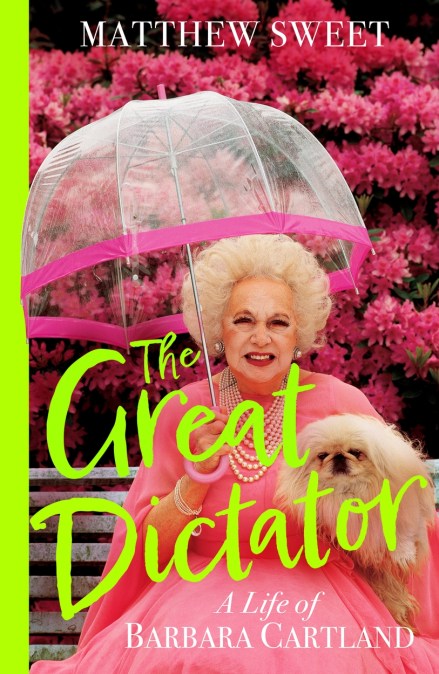
Recently published is a biography of Barbara Cartland, by Matthew Sweet. The entry in the RSDB includes links, including to earlier biographies and autobiographies. Sweet's The Great Dictator: A Life of Barbara Cartland has been reviewed by the BBC (and the article includes a quote from our own Dr Amy Burge).
--
And now on to the other new works:
Brown, Cheyenne (2026). I Read It for the Plot: Romance and Identity on BookTok.Master of Arts thesis,
The University of North Carolina at Charlotte. [Excerpt]
Florimond-Clerc, Adeline and Louis Gabrysiak, "New romance." Publictionnaire. Dictionnaire encyclopédique et critique des publics. Mis en ligne le 24 mars 2026.
Hunter, Kathryn M. (2026). “Desert Dreams: Valentino, Lawrence, and Sheik Fantasy in 1920s Australia.” Journal of the Royal Australian Historical Society 112: 56-76. [Link, abstract and some quotes.]
Jones, Bethan (2026). Sight
Loss and the Tethered Self in 21st Century Novels.
Cham: Palgrave Macmillan. [The chapter on romance is titled "Blind Love and the Will to Run in Romance Fiction by Eric Lindstrom and Lucy May Lennox". More details here.]
Kamblé, Jayashree (2026). "Race, religion, and the politics of desire in Talia Hibbert’s A Girl Like Her and Take a Hint, Dani Brown."
Literature, Critique, and Empire Today. Online First. [Abstract]
O’Connell, Mark Joseph (2026). “No More Martyrs: Heated Rivalry, Queer Romance and the End of Tragic Legitimacy.” Journal of Popular Television 14.2: 161–79. [This is mostly about the TV version of Heated Rivalry, but it does mention the novel and romance conventions. Abstract].
Ottaviani, Lauren (2026). "(Re)Defining Irish Womanhood: Serials and Short Stories in The Lady of the House (1890-1914)."
The Edinburgh Companion to Irish Literature and Periodical Culture. Ed. Elke D'hoker and Phyllis Boumans. Edinburgh: Edinburgh University Press. 143-158. [Excerpt]
Partzsch, Henriette, Päivi Lappalainen, Katja Mihurko, Viola
Parente-Čapková, Marie Nedregotten Sørbø, and Suzan van Dijk (2026). "One Woman Writer Everywhere: The Ubiquitous E. Marlitt". Redrawing Europe’s Literary Map. Ed. Henriette Partzsch and Viola Parente-Čapková. Leiden, The Netherlands: Brill.
Moore, Jeania Ree V. (2026). Literature of Hope: Reading Romance in the Religious Lives of Black Women. PhD thesis, Yale University. [Links to abstract, and selected quotations]
Lucynka Starron has found an article from 1934 giving advice to would-be romance authors targetting the romance pulps.
---
Balle, Mary, Danny Valdez, and Tori Sciara. 2026. “Adeline’s Desire:
Conversation between Paranoid and Reparative Readings of Eroticism,
Relationships, and Sexual Behaviours in the Dark Romance Haunting Adeline.” Porn Studies. [Abstract here.]
Noriega Palmero, Jessica Alejandra. 2026. «¿Del quiosco a la revolución amorosa? Un análisis genológico y estructural de tres novelas rosas anarquistas de Federica Montseny». Literatura popular: lecturas y público en la Edad de Plata. Ed. Emilio José Ocampos Palomar and Guadalupe Nieto Caballero. Berlin: Peter Lang Verlag. [Details for the volume at https://doi.org/10.3726/b23272. Excerpts from the article here.]
Tomas, Marina (2026). "Truhelkin Plein air: feministička romansa?"Kroatologija : časopis za hrvatsku kulturu Fakulteta hrvatskih studija Sveučilišta u Zagrebu
17.1: 7-24.
Allan, Jonathan A. (2026). "Men’s Dress in Popular Romance Novels."
The Intellect Handbook of Men’s Fashion. Ed. Ben Barry, Andrew Reilly and José Blanco F. Intellect Books. [This is due to be published on 10 April, 2026. More details about the volume can be found here.]
Bhatta, H. (2026). "To what extent does age-gap romanticization in modern
BookTok romance fiction normalize predatory dynamics?. Sudurpaschim Spectrum, 3(1-2), 90–102. [I am not going to provide a direct link to this because I was upset to discover that some of the works cited do not exist/do not exist as cited. I did not check all the works, because I felt I had done enough work to engender doubts about the quality of the research. Details can be found in the entry at the RSDB.]
Clasen, Tricia (2026)
"Changing the Scripts: An Overview of Gender and Romance in Young Adult Literature
"
The Oxford Handbook of Young Adult Literature, Ed. Victor Malo-Juvera and Crag Hill. Oxford: Oxford University Press. 99-112. [Excerpt available here.]
Evans, Anne-Marie (2026). "Romancing the First Lady
"
The First Lady in Contemporary Popular Culture, ed. Anne-Marie Evans and Sarah Trott. New York: Bloomsbury. 113-128. [Links here.]
Kamblé, Jayashree (2026). "Recolouring the romcom: humor, respectability, and race in a 1986 American category romance novel." Comedy Studies. Online First. [Abstract here.]
I probably should have posted this list before it got so long, but more and more notifications kept arriving in my inbox and I kept thinking I'd post once I'd added all the news items to the RSDB and that took me longer than anticipated. Anyway, I'll begin with a couple of not-strictly academic pieces which are, nonetheless, quite academic:
In the Arkansas Democrat Gazette (June 8) Guy Lancaster (mentioned recently on this blog and who has a publication below) gives his backstory as a non-romance reader before exploring the societal implications of the denigration of romance:
For so long, we have regarded the consumption of Harlequin paperbacks as
nigh pathological on the part of women, when in fact, it was the
rejection of romance that typified the pathological condition beginning
to emerge in American culture at large. After all, these stories center
the phenomenon we call love. And as no less a thinker than G.W.F. Hegel,
perhaps the greatest philosopher of the 19th century, wrote in
"Elements of the Philosophy of Right" (1820): "Love means in general the
consciousness of my unity with another, so that I am not isolated on my
own, but gain my self-consciousness only through the renunciation of my
independent existence and through knowing myself as the unity of myself
with another and of the other with me." (https://www.arkansasonline.com/news/2025/jun/08/the-thrill-of-love/, archived here and also here)
And that's not entirely unrelated to Jessica Taylor's ponderings about the value of her research into romance now that she's outside academia, and how success is measured (in publishing and academia): "What is writing a romance for? What is this essay for? Is work all there is?" Jessica's PhD thesis, Write the Book of Your Heart: Career, Passion and Publishing in the Romance Writing Community (2013) can be downloaded here.
And the latest additions to the Romance Scholarship Database:
Ahmed, Iman and Michael-Zane Brose, Lara Dengs, Lucie Elfering, Elena
John, Mira Kalcker, Alice Kronenberg, Charmaine Küllenberg, Laura Le
Donne, Alican Nazik, Lena Neisen, Öznur Zeynep Özdal, Hanna
Schneemann, Antonia Steven, Julie Bøglund Strand (2025). A “Messy Complexity”? On Coming-Out, Identity Formation, and Community in Queer YA Romance Novels. Heinrich
Heine University Duesseldorf.
Burkes, Jordan (2025). The Love Hypothesis: Exploring the Consumption of Romance Novels.PhD,
Louisiana State University and Agricultural and Mechanical College. [Embargoed until 2032 but the abstract can be found here.]
Hodson,
Jane (2024). "The Significance of Stance in Fictional
Representations of Non-Standard Language and Prescriptivism".
New
Horizons in Prescriptivism Research,
edited by Nuria Yáñez-Bouza, María E. Rodríguez-Gil and Javier
Pérez-Guerra. Bristol, Blue Ridge Summit: Multilingual Matters:
103-119. [https://doi.org/10.21832/9781800416154-007 I was late in finding this, probably because it doesn't mention romance in the title or the text of the essay. It does, though, focus on the use of "non-standard" language in Georgette Heyer's The Unknown Ajax. Currently, most/all of this is visible via Google Books.]
Kamblé, Jayashree (2025). "The
Women Who Changed the American Mass-Market Romance Genre: BIPOC
Editors, Authors, and Category Romance Novels from 1980 to 1988."Contemporary Women's Writing
19. [Abstract available here and excerpts here.]
Lancaster, Guy (2025).
" ‘It had turned them all into voyeurs’: Celebrity as the Antithesis of Community in Molly O’Keefe’s Wild Child."Arkansas Review: A Journal of Delta Studies
56.1:25–36. [Details here.]
Raffloer, Gavin and Melanie Green (2025).
"Of Love & Lasers: Perceptions of Narratives by AI Versus Human Authors."
Computers in Human Behavior: Artificial Humans. [This is Online First, so does not yet have pagination. Also note that the paper discusses romance generated by AI versus romance written by humans, and I've written some comments on the methodology from the perspective of a romance scholar.]
Sutton, Denise H. (2025).
“Romance Publishing for a New Generation: The Case of Harlequin and
Mills & Boon In India.” Publishing History 89:7-27. [More details in the RSDB]
Valovirta, Elina (2025). "Romancing the Caribbean Sea: Size, Mobility and Sustainability in Cruise Ship Romance Fiction". Anglia 143.2: 382-397. https://doi.org/10.1515/ang-2025-0026
Wilder, Mims (2025). (Wo)Men in Love: An Analysis of Sexual
Scripts, Escapism, and Queer Explorations Among Woman Readers and
Authors of Male/Male Romance Novels. Doctor of Philosophy in
Human Sexuality, California Institute of Integral Studies.
[More details here.]
Deosun, Ceri (2025).
"The Bible in Inspirational Fiction: The Case of Bathsheba."
The Hebrew Bible in Contemporary Fiction and Poetry. Ed. Lena-Sofia Tiemeyer. Oxon, Abingdon: Routledge.
348-363. [Excerpts available from Google Books and Routledge's page about the volume can be found here.]
Garber, Linda (2025). “The Present in Our Past: Reading Lesbian Historical Fiction.” Women’s Historical Fiction Across the Globe. Ed. Catherine Barbour and Karunika Kardak. Palgrave Studies in Contemporary Women’s Writing. Palgrave Macmillan, Cham. 59-75. [Abstract here.]
Luneau, Marie-Pier and Jean-Philippe Warren (2025). “Exoticism Without Cosmopolitanism: The Quebec Romance Novel of the 1940s and 1950s.” Contemporary French and Francophone Studies 29.1: 154-166. [Abstract]
The closing date for early-bird registration for the IASPR conference is 31 March. There's a hybrid as well as an in-person option.
The BBC has published an article with the annoying premise that, as the most formulaic genre of popular fiction, romance is presumably the most at risk of being produced by artificial intelligence. However, the article does also mention that
Last year, sales of romantic fiction in the US shot up by 52.4%, compared with an increase of just 8.5% for adult fiction overall.
Sexual fantasy and wish fulfillment is all over the place in romance.
But while wish fulfillment and smoothing out rough edges (I mean, is
douching sexy? Apparently not, because—while showers are prolific—these
guys never do it.) is one indisputable component of genre romance, it
also often contributes to certain groups of readers feeling invisible.
Fantasy is great and all, but sometimes it would be nice also to stop
the barrage of input that maybe something’s broken because one hasn’t
met one’s perfect Romance Novel Partner yet, and that’s why one
struggles to orgasm / doesn’t enjoy penetration / doesn’t enjoy sex at
all / fill in the blank.
And on the topic of inaccuracies/fantasies, Scientific American offers a reminder that wolves generally do not behave the way that shifter/werewolf romances imply they do: "The idea that wolf packs are led by a merciless dictator, or alpha wolf,
comes from old studies of captive wolves. In the wild, wolf packs are
simply families."
This year's issue of the Journal of Popular Romance Studies has begun to appear online, and includes:
McDade, Monique
(2023).
California Dreams and American Contradictions: Women Writers and the Western Ideal.
Lincoln:
University of Nebraska Press. [There is a chapter on Eva Rutland, and though the focus is not on her romance novels, this is the first significant academic work about her. See the RSDB for more details.]
and thanks to Cruz-Bibb, I've found references to some older dissertations I hadn't come across before:
Ganapathy, Subha
(2002).
Who Is Afraid of Romance Novels?: Women Readers, Patriarchy and Popular Culture.
PhD thesis,
Mother Teresa Women’s University. [Details here.]
The
last two reach very different conclusions from each other about lesbian
romance. Brown argues that lesbian romances differ significantly from f/m ones, whereas Secrease finds that they're really very similar. Both Brown and Secrease base their conclusions on small samples, and it could
be argued that they're comparing the lesbian novels to at least some
generalisations about heterosexual romances which have now been
superseded (and may have even been a bit out of date by the time the
dissertations were written) but it's interesting nonetheless that they
disagree. I linked to the entries in the Romance Scholarship Database
since I've included quotes there which are possibly not available in the
excepts at ProQuest.
---
Another item I found in Cruz-Bibb's bibliography is:
what I have experiencedas"feministchanges"to the romance genre began appearing in the mid-1980s [...] In my experience, in all but the subgenreofhistorical romance, gender stereotypes were beginning to change. Male characters were no longer portrayed strictlyasbrooding, dark, and macho; heroines were given more independence and depth. There were also thematic changes: for example, writers were beginning to pay attention to contemporary social issues, suchassingle parenting, substance abuse, and child abuse. (14)
On the topic of changes which took place in the 1980s, Steve Ammidown tweets that:
The
first mainstream contemporary romance to include condoms that I know of
is Elda Minger’s Untamed Heart. The first contemporary to discuss
abortion that I’ve seen was Sandra Brown’s A Treasure Worth Seeking. The
acquiring editor for both? Vivian Stephens. https://t.co/7pjFZyukPU
Minger's novel was published in 1983. Steve's
careful wording here reminds me that it's hard to keep track of
"firsts" in the genre: since there are so many romances, and many of the
earlier novels are somewhat difficult to access, their plots may not be
known to current scholars. There has been some work done on earlier
romances of course, and clearly some of them had plots we might find
surprising. For example, jay Dixon's The Romance Fiction of Mills & Boon 1909-1990s, describes
a romance by Elizabeth Carfrae, from 1929, in which the married heroine
conceives a child with the hero, to whom she is not married and "Her
husband thinks the baby is his and raises her accordingly until his
death, when the hero and heroine meet up again and marry" (139). One
early romance involving abortion is described by Joseph McAleer in his Passion's Fortune: The Story of Mills & Boon:
In November 1939 a Mills & Boon novel, How Strong is Your Love?
by Barbara Hedworth, made the Irish Government's list of prohibited
books, on the grounds that it 'advocate[d] the unnatural prevention of
conception', a provision of the 1929 Censorship of Publications Act.
[....] Mills & Boon published this novel [...] over a year earlier,
in August 1938. Splashy advertising for this title billed it as 'an
absorbing romance' and 'a love story that will delight everybody'.
Apparently not: [...] the heroine's father, a village doctor, is an
abortionist. He decides to help Rose, unmarried but pregnant, by
performing 'an illegal operation'. The abortion (never called such by
name) is a success, but a blood clot kills Rose. To spare his family the
shame and scandal, Dr Vickers shoots himself. (168)
I
suspect that Steve was thinking more of novels in which abortion is
"called such by name" and despite the censors' concerns, clearly this
novel does not present abortion very favourably given that Rose dies,
but it's interesting that the topic was at least present here: later on
Mills & Boon's policy was to avoid the topic completely so as not to
have their publications censored.
Still on the topic of changes in the genre, in a recent article, Ana Quiring argues that "a new subgenre of queer Regency-era romance"
align[s] the lovers with the most marginalized in society. In consequence,
these novels imagine queer love and sex as always political. Rather
than repeating the Cinderella dream of marrying up, they invent a new
one, no less fantastic: romantic love as a conduit to solidarity.
And by "new subgenre" Quiring doesn't mean that it's only just appearing in 2022: one of the romances described in the article dates from 2014.
Still on the topic of queer/LGBTQ+ romance, I'm a bit less sure about the historical perspective of a recent article in the Guardian, which
refers to "the rise of LGBTQ+ romance fiction" and notes that readers
of one of the works discussed "praised the novel for being refreshingly
joyful and funny –
including a happy ending, which is not that common for a book with an
LGBTQ+ plot." Obviously, given the dissertations by Brown and Secrease mentioned above,
LGBTQ+ romance (which, by definition, includes a happy ending) isn't actually something new but perhaps what's
happening is that it's relatively recently broken through into the
awareness of mainstream media?
Also apparently breaking through is Black romance. Naomi Elias states that Bolu Babalola's "romance books—by design, not default—have become outliers in the
publishing industry, since they center Black women as romantic leads" and the sub-heading of the article adds that Babalola's work "normalizes seeing Black women being loved loudly." Given that mainstream romance publishing has tended to publish too few Black authors, the word "outlier" seems fair enough but I think whoever wrote the sub-heading (and it may well not have been Elias) is overlooking the work of many other Black romance authors who've been publishing for decades.
July 1994 saw two landmark debuts in romance- the publication of Night Song by @authorMsBev, and the launch of Kensington’s Arabesque line with titles by Frances Ray and Sandra Kitt. 1/ pic.twitter.com/T8junhhdwj
Jayashree Kamble, Professor of English Literature at La Guardia Community College
Shana McDavis-Conway, Co-Director for the Center for Story-Based Strategy and Staff Reviewer for Smart Bitches, Trashy Book
I'll end, though, with something that's been present in the genre for a very long time: historically inaccurate clothing on covers. Bernadette Banner has redrawn some historical romance covers (and the
cover of one work of historical fiction) to make the costumes more
accurately reflect clothing in the periods and places in which they're
set. The novels are: Kelly Bowen's Duke of My Heart;
Beverly Jenkins's Something Like Love; Olivia Waite's The Lady's Guide to Celestial Mechanics; Alyssa Cole's An Extraordinary Union; Gillian Bagwell's Venus in Winter;
Gayle Callen's Love with a Scottish Outlaw.
She
doesn't really explore the reasons why inaccurate outfits might be more
appealing to readers, and I'm not sure how much that's been discussed
by romance readers and scholars. Presumably the shirts that open in the
wrong way are more appealing due to the amount of bare chest they reveal
and I can see how some modern hairstyles might seem sexier than
accurate ones but is some of this due to which stock art was available? I
get the impression, though, that these were published by large
publishing companies who commission photo shoots specially for their
covers, so some of these choices don't make a lot of sense to me. Are
publishers making assumptions which aren't warranted about what will
appeal to readers? Or is the key thing just to give a general
"historical" feel so that the reader can easily identify which romance
subgenre the book's in?
— Shelf Love: Romantic Love Stories in Pop Culture (@ShelfLovePod) June 7, 2022
In other news, Angela Toscano has joined forces with Molly Keran (a PhD student) and Candy Tan (who I think is the same Candy who used to be half of Smart Bitches Trashy Books) and in this first episode they're discussing bodice rippers:
Holy alabaster orbs, Batman! We've released our first episode, and you can listen to it here: https://t.co/N9kPQZyF1t. Give it a listen to learn (perhaps more than you ever wanted to know) about what bodice rippers are, where they came from, and why they matter.
— Let the Bodice Hit the Floor (@bodicehitsfloor) June 14, 2022
New Frontiers in Popular Romance: Essays on the Genre in the 21st Century, edited by Susan Fanetti, appears to be available now as an ebook but is still forthcoming in the print version. It includes:
"Healing Toxic Masculinity in Sweatpants Season by Danielle Allen" - Jonathan A. Allan
"From Darcy to Dickheads: Why Do Women Love the Bad Boy?" - Ashleigh Taylor Sullivan
"Tingles and Shivers: First Kisses and Intimate Civility in Eliza Redgold’s Historical Harlequin Romances Pre–and Post-#MeToo" - Debra Dudek, Elizabeth Reid Boyd, Madalena Grobbelaar, and Rose Williams
"I Thought You’d Never Ask: Consent in Contemporary Romance" - Courtney Watson
"“Say, could that lass be I?” Outlander, Transmedial Time-Travel, and Women’s Historical Fantasy" - Ashley Elizabeth Christensen
"“Place the glass before you, and draw in chalk your own picture”: The Recasting of Jane Eyre" - Lucy Sheerman
"“The Realness” in Jasmine Guillory’s Sista Lit Rom Com Novels" - Camille S. Alexander
"Eating Disorders and Romance" - Ellen Carter
"The “Grandly and Inhospitably Strange” World of Autistic Heroines in Romance Fiction" - Wendy Wagner
"Women Policing Whiteness: Deviance and Surveillance in Contemporary Police Procedural Romance" - Nattie Golubov
"“I’m a mehfil, I’m a gathering to which everyone is invited”: Reading
“Outcast” Romances in Arundhati Roy’s Fiction" - Lucky Issar
"The System That Loves Me: The State of Human Existence in Web-Based Romantic Fiction from Post-Socialist China" - Jin Feng
"Original Slash, Romance, and C.S. Pacat’s Captive Prince" - Maria Albert
You can find an excerpt here and the publisher's page about the book is here.
Frederick, Rhonda D.
(2022).
Evidence of Things Not Seen: Fantastical Blackness in Genre Fictions.
Rutgers University Press. [One of the chapters reads Colin Channer's Waiting in Vain as a romance.]
As always, I've added the details about all these new items to the Romance Scholarship Database. I thought I should just mention that I do also sometimes find and add items which are new to me but which are older, and I don't usually post about those here at Teach Me Tonight.
The 2022 volume of the Journal of Popular Romance Studies is now being published (articles etc. are published throughout the year). At the moment, there is only one article available (by Bonnie White, see below) but there are also some book reviews.
Here's my round-up of recent publications:
Allan, Jonathan A. (2022). “ ‘A Most Unlikely Hero’: Disability, Masculinity, and Sexuality in Harlequin Superromance Novels.” The Male Body in Representation: Returning to Matter. Ed. Carmen Dexl and Silvia Gerlsbeck. Cham: Palgrave Macmillan. 215-235. [Abstract here]
Garber, Linda
(2021).
Novel Approaches to Lesbian History.
Cham, Switzerland:
Palgrave Macmillan. [This is not just about lesbian historical romance, but there is a discussion which is particularly focussed on romance in the chapter titled "Everything You Always Wanted to Know About Lesbian Sex* *But Only In Historical Fiction." An excerpt can be found here.]
Ivanski, Chantelle, Marta M.Maslej and Raymond A. Mar (2022). "Empirical Approaches to Studying Emotion in Literature: The Case of Gender." The Routledge Companion to Literature and Emotion, Ed. Patrick Colm Hogan, Bradley J. Irish and Lalita Pandit Hogan. London: Routledge. [See https://rsdb.vivanco.me.uk/bibliography/empirical-approaches-studying-emotion-literature-case-gender for links. At the time of writing, the chapter was available in full via Google Books.]
Lecercle, Jean-Jacques
(2022).
"Interpellation and Counter-Interpellation in the Novel."
The Rhetoric of Literary Communication: From Classical English Novels to Contemporary Digital Fiction. New York: Routledge. [Excerpt here.]
Pierini, Francesca
(2021).
"
“Sharing the Same Soil:” Sally Rooney’s Normal People and the Coming-of-Age Romance."Prospero. Rivista di letterature e culture straniere
:141-166. [It argues "for the importance and validity of a genre and the field of
expertise attached to it – scholarship of the (popular) romance – that
has developed, during the last decades, and especially since the
beginning of the current century, important analytical tools for reading
and understanding the representation of love in literary as well as
popular narratives. Despite the undeniable revitalisation generic forms
of literature are currently undergoing, the romance – and its critics –
tend to remain excluded from academic debates concerning such revival."
]
van Halteren, Hans
(2022).
"Automatic Authorship Investigation."
Language as Evidence: Doing Forensic Linguistics.
Ed. Victoria Guillén-Nieto and Dieter Stein. Palgrave Macmillan. 219-255.
There's a new volume of essays out about Greece in British Women's Literary Imagination, 1913–2013 which includes two essays I've added to the Romance Scholarship Bibliography. I'm not just drawing attention to the volume because one of the items was written by me: I'd also like to note that there's a third article I've not included in the bibliography because it's about a work which is probably better classified as "romantic fiction" than "romance" but which might nonetheless be of interest. It's Keli Daskala's "Victoria Hislop’s The Island (2005): The Reception and Impact of a Publishing Phenomenon in Greece" which discusses the depiction of leprosy in that novel.
Dyhouse, Carol, 2017.
Hearthrobs: A History of Women and Desire. Oxford: Oxford UP. Excerpt
Gifford, James, 2017.
“Mary Stewart’s Greek Novels: Hellenism, Orientalism and the Cultural Politics of Pulp Presentation.” Greece in British Women’s Literary Imagination, 1913-2013. Ed. Eleni Papargyriou, Semele Assinder and David Holton. New York: Peter Lang, 2017. 99-118. Excerpt
"Women and the 'War Machine' in the Desert Romances of E. M. Hull and Rosita Forbes." Women's Writing 24.1 (2017): 109-122. Abstract
Vivanco, Laura, 2017.
"'A Place We All Dream About': Greece in Mills & Boon Romances." Greece in British Women’s Literary Imagination, 1913-2013. Ed. Eleni Papargyriou, Semele Assinder and David Holton. New York: Peter Lang, 2017. 81-98. Abstract
Wilt, Judith, 2014.
Women Writers and the Hero of Romance. Houndmills,
Basingstoke: Palgrave Macmillan. [See in particular the chapter on
"Exotic Romance: The Doubled Hero in The Scarlet Pimpernel and The
Sheik."]
I've also added a new item to the Rom-Com bibliography (because it seems to mostly focus on romantic films/movies):
Romancing the Zombie.
Romancing the Zombie: Essays on the Undead as Significant "Other". Ed. Ashley Szanter and Jessica K. Richards. Jefferson, North Carolina: McFarland, 2017. Excerpt
I've just put up a blog post at my own website about romance and the ways in which it's been used to explore issues including racism. One of the books under discussion is Meljean Brook's Riveted. I don't usually cross-post but given the success of Riveted I thought it might be of interest to readers of TMT who don't usually visit my personal blog.