The open access journal TEXT dedicated a special issue to romance/romantic fiction, under the subtitle "Trope Actually – Popular Romance" but it wasn't just about romances in the 'central romantic relationship +HEA' sense: there were pieces of short fiction as well as an article on bonkbusters and another on historical fiction. You can find the whole issue here.
Here, though, is a list of the articles in it which focus on romance:
Matthews, Amy, Justina Ashman, Millie Heffernan, Payton Hogan, Abby Guy,
Harrison Stewart, Kathleen Stanley, Alex Cothren, and Elizabeth
Duffield. 2025. “Editorial: Degrees of Love and Trope Actually.” TEXT 29 (Special 75): 1–7.
García-Aguilar, Alberto (2023). "De la novela rosa a la comedia romántica: Mi
marido es usted (1938), de Mercedes Ballesteros, y el guion de Volver a
soñar (1942), de Claudio de la Torre y José López Rubio." Ogigia. Revista Electrónica De Estudios Hispánicos 33: 97–118. [I know this one isn't very new, but it describes (in Spanish) a plot with a secret baby, in a novel from 1938, and I thought that was worth noting. I've come across an early Mary Burchell with a secret baby too (another one where the protagonists were married at the point the baby was conceived). Anyway, thought that might be of interest if anyone, at some point, decides to look into the history of various types of romance plot.]
Keran, Molly (2025). "Generic Guarantees." Mid Theory Collective. [This was looking at Hoover's It Ends with Us (and contrasting it with Jennifer Crusie's Crazy for You).]
Larson, Christine (2025). The labor of love: romance authors and platform solidarity.Journal of Communication. [Abstract available here.]
Martín Coloma, Ricardo, 2025. “On Activist Mothers and Gentrifying Lovers: From the Legacy of the Civil Rights Movement to the Model-Minority Myth in the Caribbean Romance Novel.” Journal of American Studies. [Abstract here, though as I mention in my entry for this in the RSDB, I think maybe only one of the two novels looked at has a happy ending for a romantic relationship.]
McAlister, Jodi and Kate Cuthbert (2025). "Romantasy: An overview and a history."Synergy
23.2. [Abstract]
Pradhan, Anil, 2025. "Return to Nature, Love: The Queer Potential of
Rural Spaces and Travels in Contemporary Indian Gay Romance Fiction." Non-Western Approaches in Environmental Humanities.
Ed. Gabriela Jarzębowska-Lipińska, Aleksandra Ross and Krzysztof
Skonieczny. Göttingen: V&R unipress. 183-199. [It is open access and
should be available as a pdf from https://www.vr-elibrary.de/doi/pdf/10.14220/9783737018791 (the first page is blank, so keep scrolling!) and/or https://doi.org/10.14220/9783737018791.183 I haven't given it a separate entry in the database because it seems to be based on a chapter of the author's PhD thesis, and also many of the works discussed do not have happy endings, so are "romantic fiction" and not "romance". There are synopses in the thesis but not in this chapter.]
van Peer, Willie and Anna Chesnokova (2025). "Love in Literature: Why Read About It?". International Handbook of Love: Transcultural and Transdisciplinary Perspectives (2nd edition). Ed. Claude-Hélène Mayer and Elisabeth Vanderheiden. Springer, Cham.
Over the last four years, many in the romance community, sometimes known
as romancelandia, have thrown themselves into activism. Fated Mates,
the podcast that compelled Lee to run for office, operates a
phone-banking campaign called Fated States, which has logged more than
900,000 calls in support of Democratic candidates and causes since 2020.
Separately, a group of authors who write under the names Alyssa Cole,
Kit Rocha and Courtney Milan started an organization called Romancing
the Vote, which has since 2020 raised more than $1m for voting rights
groups.[...]
many popular romance writers today – such as Casey McQuiston, Alexis Hall and Helen Hoang, to name just a few – take
a more progressive view of gender roles, portraying marriage and babies
as options rather than necessities. Between 2022 and 2023, booksellers
alsosold more than 1m LGBTQ+ romance novels – a 40% spike over the previous year, according to Circana. [...]
Novels by Sarah J Maas, who writes bestselling “romantasy” novels, are
among the most-banned books in the US. Schools have also banned books by
McQuiston and Hall, as well as those by popular romance writers like
Ali Hazelwood, Emily Henry and Colleen Hoover.
Pérez-Gil, María del Mar (2025).
"Tourists not welcome: perceptions of tourism in popular romance novels."Journal of Tourism and Cultural Change. https://doi.org/10.1080/14766825.2024.2448189
Velasquez, Diane L. and Jennifer Campbell-Meier, Jennifer (2024).
"Romance Genre and Collection Management in Australia and New Zealand Public Libraries."Journal of the Australian Library and Information Association. [Online first. Abstract here, with the article itself available only with a login.]
This will be the last of my new publication lists for 2021. Articles about romance have been continuing to appear (see below). This has also been a busy year for academic books on romance, and two more have been published just before the end of 2021. Although I haven't read either of them yet, I've collaborated with many of the authors of the essay collection and read an earlier version of the other.
Discursos
e Identidades en la Ficción Romántica: Visiones Anglófonas de Madeira y Canarias / Discourses and Identities in
Romance Fiction: Anglophone Visions from Madeira and the Canariesis a bilingual essay collection (the same essays appear first in Spanish and then in English) edited by María
Isabel González-Cruz. There is also a section related to teaching
romance fiction. A list of the contents, along with topic tags, can be
found in the Romance Scholarship Database. Excerpts are available from Vernon Press and Google Books.
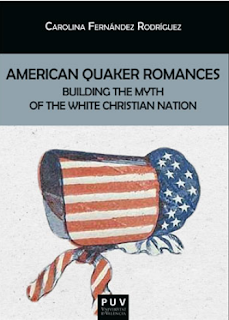
Fernández Rodríguez, Carolina (2021). American Quaker Romances: Building
the Myth of the White Christian Nation. Valencia : Universidad de
Valencia.
With the rise in recent years of the Christian romance market,
dominated by American Evangelical companies, there has been a renewed
interest in fictional Quakers. In the historical Quaker romances
analyzed in this book, Quaker heroines often devote time to spiritual
considerations, advocate the sanctity of marriage and promote
traditional family values. However, their concern with social justice
also leads them to engage in subversive behavior and to question the
status quo, as illustrated by heroines who are active on the Underground
Railroad or are seen organizing the Seneca Falls convention. Though
relatively liberal in terms of gender, Quaker romances are considerably
less progressive when it comes to race relations.
Thus, they
reflect America's conflicted relationship with its history of race and
gender abuse, and the country's tendency to both resist and advocate
social change. Ultimately, Quaker romances reinforce the myth of America
as a White and Christian nation, here embodied by the Quaker heroine,
the all-powerful savior who rescues Native Americans, African Americans
and Jews while conquering the hero's heart.
Hefner, Brooks E.
(2021).
Black Pulp: Genre Fiction in the Shadow of Jim Crow
Minneapolis:
University of Minnesota Press. [Excerpt available via Google Books. See in particular Chapter 2, "Romancing the Race: The Politics of Black Love Stories."]
Johnson, Brian (2022). "Weird Bedfellows: H. P. Lovecraft, m/m Romance,
and the New Queer Families of Jordan L. Hawk's Whyborne & Griffin
Series." Lovecraft in the 21st Century: Dead, But Still Dreaming. Ed.
Antonio Alcala Gonzalez, Carl H. Sederholm. New York: Routledge. [Abstract]
Khumwongdee, Yanisa
(2021).
Reading and Rewriting Fat Romance: A Study of Twenty-First Century Thai and US Fat Romance Novels.
PhD thesis, University of York. [Abstract]
Weimer, Christopher
(2021). "Romancing Weird Fiction: Lovecraftian Reinscriptions in Jordan L. Hawk's Whyborne and Griffin."Aeternum: The Journal of Contemporary Gothic Studies8.1:61-76. [Download the whole issue.]
Farooqui, Javaria
(2022).
"Romance, Austen, and English-Medium Schooling in Pakistan
"
Language, Education, and Identity: Medium in South Asia. Ed. Chaise LaDousa, Christina P. Davis. Routledge. [Excerpt available via Google Books.]
Kołodziej, Gaja (2021). "Unforgettably in love: uses of the amnesia trope in contemporary romance." PhD thesis in creative writing, Massey University. [Embargoed until 2023 but the abstract is available.]
Leetsch, Jennifer
(2021).
Love and Space in Contemporary African Diasporic Women’s Writing: Making Love, Making Worlds. Cham:
Palgrave Macmillan. [See the chapter on "Routes of Desire: Chimamanda Ngozi Adichie" (details here).]
Ngoshi, Hazel Tafadzwa
(2021).
"Repression, Literary Dissent and the Paradox of Censorship in Zimbabwe."Journal of Southern African Studies. Online first. [Abstract and excerpt here.]
Zibrak, Arielle (2021). Avidly Reads Guilty Pleasures. New York: New York University Press. [The first chapter is about bodice-rippers, shame/guilt and "the dark hero." Excerpt available via Google Books.]
We wanted to recognize the historic evening and RWA’s first two black
author winners – M. Malone and Kennedy Ryan – and first South Asian
author winner, Nisha Sharma. Their wins were far too long in coming.
That delay only highlights the impressive nature of what they
accomplished.
This was the first year in which the final round judging panel for each
category included at least one judge from outside RWA. We also required
that the final round judging panels be more diverse and reflective of
our membership. It is our belief that these changes resulted in a fairer
and more inclusive contest final, allowing members who might have been
shut out of winning in the past to shine.
There will be more changes coming to the RITA Award in the 2019-2020 award season.
I was really happy to discover that Ohio State University Press make many of their texts free five years after publication. This includes some interesting work on popular romance fiction.
Kapila, Shuchi, 2010.
Educating Seeta: The Anglo-Indian Family Romance and the Poetics of Indirect Rule (Columbus, Ohio: Ohio State UP). ["Educating Seeta makes the case that representations of [...] inter-racial relationships in the tropes of domestic fiction create a fantasy of liberal colonial rule in nineteenth-century British India. British colonials in India were preoccupied with appearing as a benevolent, civilizing power to their British and colonial subjects" and although we see "The death of the Indian woman in many of these romances, signaling that interracial love is not socially viable [...] There are, of course, exceptions to this rule, for instance in the Orientalist idealization of the Indian woman in Maud Diver’s Lilamani, in which interracial marriage between Neville Sinclair and Lilamani heralds a new understanding between cultures with the ultimate goal of “civilizing” other cultures into European ways of life." See in particular pages 54-77.]
Consuming Fantasies: Labor, Leisure, and the London Shopgirl, 1880-1920. Columbus: Ohio State University Press.
[See Chapters 3 and 4 on "The Failures of the Romance: Boredom and the
Production of Consuming Desires" and "Imagining Alternatives to the
Romance: Absorption and Distraction as Modes of Reading."]
Tatlock, Lynne, 2012.
German Writing, American Reading: Women and the Import of Fiction, 1866-1917
(Columbus: Ohio State UP). ["Chapter 4 examines German novels as American reading from the perspective of the happy ending, an international signature of romance novels and of nearly all of the German novels by women in my dataset. The chapter uncovers and analyzes variations in plotting ritual death and recovery to a state of freedom that characterize these German novels and that appealed to American readers by offering them the vicarious experience of a multiplicity of female subjectivities and female-determined male subjectivities while cautiously expanding the boundaries of home in a place called Germany."]
The IASPR 2018 conference now has its programme online but prior to that appearing there was a lot of very thorough tweeting by a number of attendees, using #iaspr18. Since Kat (@BookThingo) has really comprehensive threads, I've used the threadreaderapp to bundle her tweets together and I'm linking to them below.
Session 1 - Romancing Australia, with papers by Amy T. Matthews and Amy Mead (Flinders University), Kate Cuthbert and Jodi McAlister (Deakin University) SEE THREAD
There's more about changes affecting cover art, as discussed by Kate Cuthbert, here, from Claire Parnell via the @PopFicDoctors: Coverart and here's a podcast interview with Jodi McAlister in which she discusses her paper: Podcast. In addition, Renée Dahlia has written a blog post about the session.
Session 2 - Gender and Sexuality, with papers by Ellen Carter (University of Strasbourg), Christina Vogels (AUT New Zealand) and Andrea Anne Trinidad (Ateneo de Manila University, Philippines) SEE THREAD
Renée Dahlia's written a blog post about this session.
Here's a podcast from New Zealand Radio with Christina Vogels about her PhD thesis, titled It's a masculinity sort of thing: Young men talk about the rules of (hetero)romantic relationships.
Session 3 - Places and Spaces of Love, with papers by Kecia Ali (Boston University), Jacqueline Jones (LaGuardia CC, City University of New York) and Vassiliki Veros (University of Technology, Sydney) SEE THREAD
A similar presentation by Vassiliki Veros on "Exploring library metadata and how it can marginalise romance fiction" is up on YouTube.
Session 4 - Keynote Panel on “Romancing Popular Fiction Studies: A Theory of Genre Worlds” by Beth Driscoll (University of Melbourne), Lisa Fletcher (University of Tasmania) and Kim Wilkins (University of Queensland) SEE THREAD and, from Jodi McAlister, with more graphics: See thread
There's also a podcast recorded with the presenters in advance of this panel: Podcast
Session 5 - History and Romance, with papers by Stephanie Russo (Macquarie University), Jennifer Wallace and Francesca Pierini (Academia Sinica, Taiwan).
Kat had to miss most of this session, so the thread is by Jodi McAlister: SEE THREAD
Philippa B's summary of Stephanie Russo's paper on "Georgette Heyer’s Unruly Eighteenth Century" can be found here.
Phillipa B's summary of Pierini's presentation about "Italian timelessness" can be found here.
Jennifer Wallace writes romance as Jennifer Hallock and she's put her paper up on her website in two parts. Part one looks at how the bestsellers in historical romance are
disproportionately: (1) set in Great Britain; (2) overpopulated with
nobles; and (3) selective in their historical accuracy. Part two looks at how the aggregate impact of these chronotopes can be
harmful to our understanding of history, to the romance market as a
whole, and particularly to authors of diverse books. For links to more graphics and a way to help Jennifer crowdsource historical romances which differ from the chronotope she identified, go here and scroll to the end of the post.
Phillipa B's summary of Jennifer Wallace's "History Ever After: Fabricated historical chronotopes in romance genre fictions" can be found here.
Session 6 - Power and Patriarchy, with papers by Heather Schell (George Washington University), Nattie Golubov (Centro de Investigaciones sobre América del Norte, Universidad Nacional Autónoma de México), Therese Dryden (University of Newcastle) and Jayashree Kamblé (LaGuardia CC, City University of New York) SEE THREAD
Philippa B's post about Heather Schell's "The Soft Power of Popular Romance" can be found here.
Philippa B's post about Nattie Golubov's "Dangerous loves endangered: nationalism, violence and territoralization in US paramilitary romance fiction" is here.
Philippa B's summary of Therese Dryden/Michelle Douglas's "The Single Mother and the Law: Romance novels making room for female voices in patriarchal spaces" is here.
And details of Jayashree Kamblé's “One of the Guys? Eve Dallas as a Masculine Worker Heroine in J.D. Robb’s In Death series", also by Philippa B.
Session 7 - 19th Century Legacies, with papers by Sarah Ficke (Marymount University), Steven Gil and Lucy Sheerman SEE THREAD
See Renée Dahlia's blog post about the session.
Details here about Sarah Ficke's “House, Home, and Husband in Historical Romance Fiction", from Philippa B.
Steven Gil's "Beloved Monstrosity: Romance and Romanticism in Frankenstein" has been summarised by Philippa B.
Philippa B has summarised Lucy Sheerman's “Reader, I mirrored him: the recasting of romance tropes in Jane Eyre fanfiction" here.
Session 8 - Muslim and Middle Eastern Romance, with papers by Kathrina Daud (University of Brunei), Claire Parnell (University of Melbourne), Javaria Farooqui (University of Tasmania) and Amy Burge (University of Birmingham) SEE THREAD
See Renée Dahlia's blog post about the session.
Philippa B's posted about Kathrina Daud's "Muslims reading romance: Bruneian considerations of “Halal” and romance novels" here.
The abstract of Claire Parnell's “Reading and Writing Muslim Romance Online” and notes on the session by Philippa B can be found here.
Philippa B's post on Javaria Farooqui's “The Kitchen and Beyond: Romantic Chronotope of Pakistani Popular Fiction" is here.
Amy Burge's “Girls of Riyadh and Desperate in Dubai: Reading and writing romance in the Middle East" is summarised here by Philippa B.
Session 9 - Romancing Chinese Worlds, with papers by Fang-Mei Lin (National Taiwan Normal University), Huike Wen (Willamette University), Jin Feng (Grinnell College) and Erin S. Young (SUNY Empire State College) SEE THREAD (by Jodi McAlister)
See Renée Dahlia's blog post about the session.
The abstract of Huike Wen's “On the Way to a Better Life: Countryside themed romance in recent Chinese Television" and some additional comments from the paper are provided by Philippa B here.
Philippa B also provides these for Jin Feng's “Life Is Elsewhere: The Economy of Food and Sex in Chinese Web Romance”
and for “Romance in Chinatown: The Love Stories of Edith Maude Eaton” by Erin S. Young.
Session 10 - South/South-East Asian Romance Communities with a paper by Meghna Bohidar (University of Delhi)
Bohidar: young romantic couples are less concerned with caste and religious differences, however they still shape subjectivity e.g. through taste. #IASPR18pic.twitter.com/QrvvM5tZFt
For those who can't read the text in that photo, it contains a definition of an important term used in Bohidar's paper: "Habitus is a set of microbehaviors consisting of a matrix of perceptions, appreciations, and actions that are unconsciously ingrained based on one's class position"
SEE THREAD and Philippa B's summary of Meghna Bohidar's “Negotiating Romantic Love in India: Family, Public Space, and Popular Cinema"
The session then moved on to Kat Mayo's interview of/conversation with Mina V. Esguerra
Session 11 - Subversions of Race, Culture and History with papers by Eric Murphy Selinger (DePaul University), Mallory Jagodzinski (Indiana University South Bend) and Johanna Hoorenman (Utrecht University) SEE THREAD and, from Jodi McAlister, A SUPPLEMENTARY THREAD
The abstract of, supplemented by notes by Philippa B on, Eric Murphy Selinger's “The Wild Heart of the Continent: Love and Place in Sherry Thomas’s Silk Road Romance Novels”
The same, but for Mallory Jagodzinski's “Love is (Color) Blind: Race, Belonging, and Nation in 21st Century Historical Romance Fiction" is here.
Again, an abstract followed by comments by Philippa B, this time on “‘You stayed’: Love, law and the reservation in Jenna Kernan’s Apache Protectors series" by Johanna Hoorenman.
Session 12 - Love in Other Worlds with papers by Donna Hanson (University of Canberra), María T. Ramos-García (South Dakota State University), Athena Bellas (University of Melbourne) and Kristin Noone (Irvine Valley College) SEE THREAD and coverage of the FINAL PAPERS in this thread by Jodi McAlister.
Philippa B's post about Donna Hanson's “Love in Outer Space: Science fiction romance
—
the ideal place to explore gender and
love” can be found here.
María T. Ramos-García's “Representations of Otherness in Paranormal Romance: Nalini Singh and J.R. Ward” is summarised by Philippa B here.
I've now come across a couple of reports on the recent Georgette Heyer conference. Sophie Weston mentions that
A terrific paper from Vanda Wilcox made
the point that, however precise Heyer’s grasp of strategic issues at
Waterloo might have been, her officers “embody World War I values and
leadership style”. At the same time Heyer’s other ranks (gorgeous Gideon
Ware’s straight-talking soldier servant, for instance) are basically
WWI Tommies in red coats, rather than Wellington’s rapists and
pillagers. Convinced me completely.
Her full report can be found here. The evening discussion session is described here by Nicola Cornick.
On 29 June, at the Gendered Emotions in History conference held at the University of Sheffield there was a paper on romance, presented by:
Agnes Arnold-Forster (QMUL) - Gender, Emotions, and Professional Identity in Twentieth Century Medical Mills and Boon Novels
The EUPOP2018 conference will be held from July 24th – 26th, 2018. One of the keynote speeches is by
Professor Petr A. Bilek (Charles University, Prague)
Distant Encounters of the Third Kind: Why Is Popular Culture Not Popular within Central European University Curricula?
Here are the new entries, recently added by Christina Martinez and me.
Leonzini, Alexandra, 2018.
‘“All the Better to Eat You With”: The Eroticization of the Werewolf and the Rise of Monster Porn in the Digital Age.’ Exploring the Fantastic: Genre, Ideology, and Popular Culture.
Ed. Ina Batzke, Eric C. Erbacher, Linda M. Heß, Corinna Lenhardt.
Bielefeld: transcript. 269-294. [“Starting her analysis with
19th-century horror fiction before moving to 20th-century films and
21-century romance and erotic literature, Leonzini traces the changes in
the construction of the gendered and sexualized body of the figure of
the werewolf” (12) and there is therefore quite a lot of reference to
romance, which is deemed to have laid the groundwork for modern monster
porn. Excerpt.]
Lowery, Karalyne, 2018.
"The Militarized Shapeshifter: Authorized Violence and Military Connections as an Antidote to Monstrosity." University of Toronto Quarterly 87.1: 196-213. Abstract.
O'Mahony, Lauren. 2017.
"Death and the Australian Rural Romance Novel." TEXT: Journal of Writing and Writing Courses, vol. (Supplement 45), Oct. 2017, pp. 1-14. [Full text]
Salvador Miguel, Nicasio, 1995.
¿Hay precedentes de la novela rosa? Letras de la España contemporánea. Homenaje a José Luis Varela, ed. N. Salvador Miguel (Alcalá de Henares: Centro de Estudios Cervantinos): 319-327. [Full text]
Suman [Sigroha], 2018.
"Gendered Migrations and Literary Narratives: Writing Communities in South Asian Diaspora." Millennial Asia 9.1: 93-108.[Full text]
[On "educated skilled women from South Asia who migrate as ‘trailing
spouses’" and turn to romance-writing as an alternative, portable
career.]
Turner, Katherine. 2017.
"Daphne Du Maurier's Mary Anne: Rewriting the Regency Romance as Feminist History." University of Toronto Quarterly: A Canadian Journal of the Humanities, vol. 86, no. 4, pp. 54-77. [Abstract]
Vitackova, Martina, 2018.
"Representation of racial and sexual ‘others’ in Afrikaans popular romantic fiction by Sophia Kapp." Tydskrif vir letterkunde 55.1. 122-133. Abstract and link to pdf
More details about the conference, which is being held on April 13-14, can be found here and you can follow events as they happen on Twitter, via #bgsuromcon18 and some can also be found on #BGSURomCom18 .
The guest of honor for the conference will be 2017 RWA Nora Roberts Lifetime Achievement Award Recipient Beverly Jenkins,
who has published more than 30 novels and is well-known for the level
of detailed research she puts into each of her books – making her the
perfect guest for this conference. She will be speaking and signing
books Saturday afternoon at the Wood County District Public Library.
On the Friday there are presentations on a range of academic topics, including pedagogy, librarianship, masculinity, horror, feminism, research, race/ethnicity/nationality and history:
Romancelandia on Twitter: Designing a Digital Humanities Research Assignment for First-Year Writing Students
Heather M. Schell, George Washington University Ann K. G. Brown, George Washington University
In Heather’s first-year writing class, Love and American Culture, in the
primary goal is to introduce students to academic writing and research.
Part of this entails helping students experience the excitement of
writing a research paper when the topic is new and the questions are
motivated by genuine interest. Heather has been collaborating with Ann, a
research librarian, to develop an assignment sequence around original
research on romance authors’ public social networks. The project uses
Social Feed Manager and textual analysis tools to give students the
opportunity to shape their own research questions and study the Twitter
feed of the romance author of their choice.
The Category Romance Project: First-year Students Researching Romance Jen Wofford, Ithaca College
“Vintage” category romances – commercial romance novels published
twenty years old and older – can provide a fascinating data set for
“community inquiry” (CoI), and a novel way to introduce students of
writing to textual analysis.
In its third iteration, my Ithaca College course Reading Popular Romance, is a writing-intensive first-year seminar taught using a Community of Inquiry (CoI) approach to instruction.
Where are all the Fun Books: Popular Romance and Science Fiction Novels in Academic Libraries Sarah Sheehan, Manhattan College
Academic libraries have an uneven record of collecting popular
contemporary literature (genre fiction). Due to this unevenness,
colleges and universities that offer courses about particular genres or
collect works devoted to the study of genre fiction may not actually own
the primary texts. This study examines the extent to which
award-winning novels in two popular genres—romance and science
fiction—are included in the libraries of 114 major research universities
(the Association of Research Libraries) and 80 prominent liberal arts
colleges (the Oberlin Group).
Fantasies of Black Manhood: Black Masculinities in Brenda Jackson’s Westmoreland Series
Kelly L. Choyke, Ohio University - Main Campus Kay-Anne P. Darlington PhD, University of Rio Grande
Popular romance is truly one of the few communities and forms of media
where the male point of view is not catered to. While the romance genre
is the most profitable and least respected literary genre, romance
novels have nevertheless become a safe space to explore marginalized
identities. Our study focuses on the representation of black
masculinities in Brenda Jackson’s Westmoreland Series, published as
category romances via Harlequin.
Happily Ever After …. And After: time travel, history and romance in the novels of Susanna Kearsley Sarah H. Ficke, Marymount University
[...] place often plays a central role in romance
fiction. A perfectly-decorated seaside cottage, like a gorgeous silk
gown, can be materialistic wish fulfillment for a reader who has neither
gown nor cottage. However, place can also be deeply emotional, creating
and shaping the conditions for relationships. In this presentation, I
will be exploring the intersection between romance, place, and history
in three novels by Susanna Kearsley: The Winter Sea, The Rose Garden, and Mariana.
[...] Although they range across time, each of these novels is
anchored by its setting, which plays a crucial role in the emotional
development of the characters and their relationships. [...] I will argue that these
novels provide a framework that can help us understand the simultaneous
specificity of romance – a series of intimate moments between people –
and our urge to view it as a timeless emotion.
True Love and Real Terror: Romance and Horror in Megan Hart’s The Darkest Embrace and Reawakened Passions David Aldrich, Bowling Green State University
The Darkest Embrace and Reawakened Passions are
romances that take place alongside a horror plot. Using Pamela Regis’s
outline of essential elements of the romance, I will chart how both
novellas fit the formula of a romance novel in a relatively short amount
of pages. I will also make comparisons between Hart’s work and other
short works of contemporary horror fiction produced online. This paper
will show that the romance genre can be combined with the horror genre
in a way that satisfies the expectations and conventions of both romance
and horror, all in a short fiction format for a online audience.
Finding the Fairy Tale in Popular Romance Linda J. Lee, University of Pennsylvania
Some novels retell specific well-known fairy tales, like “Cinderella” and “Beauty and the Beast” [...],
while others incorporate a variety of fairy tale motifs without
retelling a specific tale type [...]. Fairy tale intertextual references appear in just about every romance
novel sub-genre [...]. Despite the almost
ubiquity of fairy tale intertexts in romance, there are few scholarly
considerations of the relationship between these narrative forms. Part
of the difficulty is the misalignment between fairy tale theories and
methods and the form of the romance novel. Jennifer Crusie’s “This Is
Not Your Mother’s Cinderella: The Romance Novel as Feminist Fairy Tale”
demonstrates some of the difficulties encountered when applying fairy
tale theory to romance novels. Disciplinary boundaries and lack of
familiarity with discipline-specific research methodologies and tools is
another research challenge. In this paper proposes using Michael Dylan
Foster and Jeffrey Tolbert’s concept of “the folkloresque” as a way to
interrogate the use of fairy tales within popular romance novels.
Laboring for Love: Authorial Emotional Labor as Feminist Project in the Romance Novel Outlander Emma Elizabeth Niehaus, Bowling Green State University
I argue that the common reception of the romance novel is yet another
example of women’s emotional labor being regarded as frivolously
sentimental when in actuality it is impactful social excavation. My
project uses an analysis of emotional work to argue for the romance
genre as a feminist project. Though the romance novel has been widely
disputed as a viable feminist project, an in depth examination of the
emotional labor of characters and writer has been widely overlooked in
this argument. As example, I examine the romance novel Outlander, and the emotional labor performed by author Diana Gabaldon for the story’s heroine, Claire Randall.
Researching the Romance Writers' Research
Caryn Radick, Rutgers University - New Brunswick/Piscataway
In this presentation, an archivist discusses her outreach to romance
writers to learn more about their research behaviors, particularly their
interest in and use of archives for writing their works. The results of
this outreach led to the presenter’s article “Romance Writers’ Use of
Archives,” published in Archivaria in 2016. It also led the
presenter to invite two romance authors, Piper Huguley and Jennifer
McQuiston, to the Society of American Archivists 2016 annual meeting to
participate in a panel discussion on the role of research in their work.
The presenter will share data gathered as part of a survey of romance
writers about their research and discuss how the conversation at the
panel session provided insight on how archivists might better serve the
romance community and why it would be beneficial to do so.
Use Heart in Your (Re)Search: The Invitations of Popular Romance Eric Murphy Selinger, DePaul University
Romance writers do research—but what about romance readers? If they do,
what does their “research” look like? In this talk, I will explore the
kinds of learning that previous scholars have said (and, sometimes,
worried) might be inspired by romance fiction, with an eye to how these
relate to the teaching and learning at work in other popular genres.
(Thomas Roberts’s argument that all popular fiction invites us
to “Think With Tired Brains” about serious and interesting topics will
be central to this discussion; his Aesthetics of Junk Fiction has
been central to my romance pedagogy for the past four or five years.) I
will then compare these critical accounts with the actual learning and
research that my students and I engage in as we grapple with romance
novels in English courses at DePaul: both multi-author / subgenre
surveys and 10-week courses focused on individual texts. One of those
narrowly-focused seminars, on Sherry Thomas’s My Beautiful Enemy,
will be underway during the conference, and I will describe what we are
doing in it and why. (A clue from the heroine’s quest for ancient
treasure in that novel, “use heart in your search,” gives my talk its title.) Rather than ask what romance novels do or don’t teach readers in general,
I want to detail about what a few individual novels invite us to go and
learn, about how they extend those invitations, and about what we find
when we take up their offers, whether in or out of school.
History's Been Hijacked: How To Combat White Supremacy Through Popular Literature Elizabeth Kingston
At the 2017 rally in Charlottesville, white supremacists carried
banners covered in medieval heraldry alongside their Confederate flags,
laying claim to the Middle Ages as a white, Christian utopia. This
whitewashing of history and construction of a “white race” began during
the Age of Enlightenment, and continued through the 19th century – which just happens to be the most popular setting for Historical Romance.
Often seen as providing harmless escapism, the persistent fabrication
of an all-white, all-Christian universe has resulted in an ignorance so
extreme that many readers of Historical Romance reject the historical
validity of non-white characters, or question the possibility that any
non-white character could have a “happily ever after” in a
white-dominated world. While this attitude has a dismaying effect on the
genre, the wider implications of creating a popular fantasy world based
on white supremacist ideology – and presenting is as actual history –
are chilling.
For better or worse, our understanding of history largely comes from
portrayals in pop culture, from Game of Thrones to Downton Abbey.
Writers in the wildly popular genre of Romance have an opportunity to
shape the perceptions of readers to more closely match the historical
reality, and to prevent racially motivated hate groups from co-opting
centuries of European history for their own purposes.
Romance Novels for Feminists: What Does That Mean? Elizabeth Brownlow, Bowling Green State University
How do online spaces allow feminist romance readers to define and
negotiate feminism for themselves? How do these readers define which
romance novels are feminist, and which are not? In this case study, I
will look at the popular romance review blog, Romance Novels for
Feminists (RNFF). In 2009, Jackie C. Horne, a romance novelist, former
children’s book editor, and literary scholar, established RNFF to review
and comment on romance novels in all subgenres. RNFF does not
explicitly state criteria for book selection, only stating that it
“strives to review only books that in its opinion espouse and/or
encourage feminist value.” RNFF’s reviews of feminist romance novels are
based on a no-grading system intended to open up conversations about
feminism and fiction. The reviews on RNFF allow for dialogue amongst
readers, responding to both the books themselves and to Horne’s reading
of them. This paper will explore the traits that Horne homes in on for
her selection of “feminist romance” criteria as well as the traits that
blog responders find most important. I will focus particularly on claims
of sexist and feminist contradictions in these reviews. Moments of
agreement and disagreement between reviewer and responders suggest
romance readers are using online spaces such as RNFF to determine what
feminism means to them as well as to form and articulate opinions on
what does and does not count as feminist in the genre.
Romance Vs. Realism: How Critical Battles over Postwar Teen Romance
Novels Led to the Emergence of Canonical Young Adult Literature Amanda Allen, Eastern Michigan University
In 1942, Maureen Daly published Seventeenth Summer, the
wellspring text for a new genre of American romance novels aimed at a
freshly-minted teenage reading audience. Called the “junior novels,”
this genre was comprised of romance novels—often series texts— that
focused on a girl’s first love experience. Although they quickly became
the main stock of emerging teen library sections, the scholarship
surrounding them became a site of contention, polarized into two
opposing—and gendered—camps: (female) librarians, and (male) academics
housed in English and English Education departments.
This paper uses the lens of Pierre Bourdieu’s theories of cultural
production to examine not the junior novels themselves, but their
reception by critics—a reception based on early Cold War values
regarding what constituted “good” literature for girl readers (and, as a
corollary, what constituted “good girls”). Thus, although librarian
critics valued these romance novels for their use in girls’
socialization, most post-secondary academic critics opposed them,
placing value on their view of literary quality. This use versus quality
dichotomy, moreover, masked an underlying—and gendered—struggle over
defining “realism” as specifically antithetical to “romance.”
An examination of the junior novel critics’ scholarship thus
demonstrates a hidden, historical battle regarding who had the right—and
ability—to define what constituted “value” in literature for girls, and
illustrates how American postwar teen romance novels led to the
creation and sanctioning of canonical young adult literature.
Stigmatizing the Romance Genre: Reading Romance in the Digital Age Angela Hart, American University, Washington D.C.
The romance genre emerged as a counterpublic; a way for women to write
books about women for women. Originally, the romance genre was not
viewed as gender specific; but after World War II, and the return of men
from the battlefields, women went back to their traditional roles, i.e.
at home with their families. Romance novels have become a way to place
female protagonists at the center of a story. Heroines across the genre
are justified in their wants and desires, placing emphasis on the female
experience and viewpoint. Today, romance readers face stigmatization
due to their literary interests. Rather than celebrate a genre by women
for women, readers and writers face marginalization. Avid readers of the
romance genre find their voices in the online sphere; for instance,
posting reviews or blog articles anonymously. On one hand, the online
sphere should be commended for its ability to foster freedom of
expression. Yet, on the other hand, it should be noted that the stigma
surrounding the romance genre creates the need for ongoing anonymity.
While readers are able to vocalize their thoughts, they may only feel
comfortable doing so in an anonymous setting, unintentionally fostering
the ongoing stigma of romance. The growth, accessibility, and
affordability of e-books has also created a method for combating the
genre’s stigma. Readers can make their literary purchases in the privacy
of their own homes and privately read books on their electronic devices
without preying eyes on recognizable romance book covers. The digital
landscape is redefining romance and how readers discus the genre.
An Articulation of Modern Indian Values in the Romance of Sandhya Sridhar Kristen Rudisill, Bowling Green State University
In 2009, avid romance reader Sandhya Sridhar quit her job at a newspaper
in Chennai, India, and started her own company, Pageturn Publisher,
which included the Red Romance Series, to publish English-language
novels that she billed as “full blooded desi romance.” She
sensed a need for romance novels more relatable to Indian readers than
the imported Mills and Boons she grew up with. I argue elsewhere that
desi romance can be considered a subgenre of romance, with the novels
marked as Indian in a variety of ways that include language, content,
and cultural values. Sridhar has written three books in the series, two
in its first year (2010) and one in 2012. In this paper, I argue that
Sridhar’s books have functioned as yardsticks for other authors and
model the goals of this new subgenre. Through close readings of Heartbeats, Endless Time, and 31 Somnath Street, I
address questions about family involvement in romance, acceptable
erotic language, issues of consent, and an articulation of modern Indian
values regarding sex and marriage.These values include
respect for elders’ input, the inherent desirability of marriage and
children, the prioritizing of the family over the individual, the
importance of consent when it comes to intimate relationships, respect
for all women, and women’s control over their own bodies and sexuality.
These values reflect to readers Red’s ideas about of identity,
self-realization, and romance in a post-colonial world.
Bringing Sexy Back: Asian/Asian-American Men as Romantic Leads Trinidad Linares, Bowling Green State University
Although the image of an Asian/Asian-American woman has been a
hypersexualized one, the Asian/Asian-American man has been a
desexualized figure in American history. In contrast to Black or Latinx
men, Asian/Asian American men have been represented as asexual or gay.
They are the Other who does not pose a sexual threat to the white man
because they lack sexual power or prowess. These stereotypes have
created an imbalance in what minimal representations exist for
Asian/Asian Americans in American culture, including romance novels. As a
result, there are often more representations of Asian/Asian American
women in interracial relationships with white men than there are of
strictly Asian/Asian American couples. My presentation focuses on the
history behind the sexless Asian/Asian American man stereotype and how
trends in American popular culture towards Asian/Asian American men may
be changing perspectives of them, which may be impacting the romance
industry and could also be impacted by the romance industry. I will
provide examples of how author ethnicities and audience reaction to
Asian/Asian American men may be catapulting Asian/Asian American men to
lead roles in romance novels for the American market. These Asian/Asian
American leading men present a new option for masculinity, where sexual
attractiveness and ability are not reliant on the abuse of the power
dynamic between men and women because there are comparable oppressions
(interracial coupling between a white woman and an Asian/Asian American
man) or whiteness is decentralized (Asian/Asian American couple or an
Asian/Asian American man with a woman of color).
Outlandish romance: Fan and author navigation of romance genre boundaries
Spring Duvall, Salem College
When the first novel in the international bestselling Outlander
series debuted in 1991, it was marketed as a quintessential historical
romance - complete with a highly stylized cover - and shelved in the
romance genre sections of bookstores and libraries. Cementing its status
as a romance novel, Outlander won the Romance Writers of
America's RITA Award for Best Romance of 1991. Yet, even though author
Diana Gabaldon courted romance fans and accepted the community’s awards,
she also insisted that her novels were not just romance novels and struggled for years to have her books moved into general fiction sections and to be recognized as more than just a romance writer.
This in-depth critical analysis of Gabaldon’s body of work examines
her uneasy position within the romance genre and the tensions among her
critics and fans who seek to define her as a romance writer or establish
her as a general fiction writer. This presentation will discuss a
textual analysis of the Outlander books and the television
adaptation of the series, as well as a critical analysis of online fan
communities and media critics who review the books and television
series. In this research, I position myself as both a feminist media
scholar who studies and teaches scholarship on romance novels and as a
long-term fan of Gabaldon’s work who is deeply familiar with the Outlander fan community.
Paranormal Romance: A History Maria T. Ramos-Garcia, South Dakota State University
Paranormal Romance was a term coined in the 1990’s, but during that
decade, this subgenre was very marginal. The genre, which was all but
disappearing by the year 2000 started to take off at the beginning of
the 21st Century. September 11th triggered a new
interest in romances with paranormal elements that allowed both writers
and readers to delve on issues too painful or controversial to confront
directly at the time. In the early years after the attack there was a
preponderance of novels portraying the shock of discovering magical (and
menacing) elements irrupting in our everyday reality. Later on series
tended to develop fictional worlds in which the paranormal elements were
a given, abandoning the discovery narratives. They either reflect a
dystopian reality, or the realistic world becomes a backdrop for the
action, but not an essential element of it. Over time, the superficially
apolitical nature of the paranormal romance has been eroded with more
openly ideological discourses emerging often. This evolution parallels
the trajectory of other non-romance genres, especially urban fantasy.
This paper will offer an overview of the history of the genre,
emphasizing the connections between romance, culture, and history. While
romance as a reflection of the changing gender roles of women over time
has been frequently observed by critics, there is a scarcity of a more
systematic evaluation of romance as a dynamic genre intimately connected
with its historical moment. This paper will challenge this perspective
offering a new reading of this subgenre.
Christian Romance Novels through the Eyes of West African Women Philomena Archibong Offiong, Bowling Green State University
The romance novel has been a source of ridicule and criticism ever since
its inception and most especially due to its consumption by women.
Scholars such as Tania Modleski and Janice Radway arguing that it
actually empowers women of which African women are included. However,
there exists little or no scholarship on African Romance novels or even
Romance novels based on Africa. My paper, therefore, seeks to address
the scarcity of African romance novels which special attention to West
African women. It is interesting to find out that mostly Christian
authors have been able to combine these two powerful themes into a novel
that entertain while evangelizing to people. The West African woman
like every other in the Western world enjoy romance novels, however,
there exist very literature on African Romance novels. My paper seeks to
determine if the few African romance novels are written and published
by African press follow the romance formula and most importantly, do
these books be used by feminists to empower more women or are these
novels in tune with the African cultures and religious beliefs that
endorses patriarchal rule. My paper will use the use the novel of Unoma
Nwankwor’s “An Unexpected Blessing” and Lynn Neal’s “Romancing God”
since the novel falls under Christian romance and African women are
noted to be religious; thus shedding more light on the relevance of this
little-recognized issue.
Fantasies of Masculinity in Male/Male Popular Romance Jonathan Allan, Brandon University
In her book, Hard-Core Romance: Fifty Shades of Grey, Best-Sellers, and Society,
Eva Illouz asks: “why is traditional masculinity pleasurable in
fantasy?” (58) To answer this question, I focus on the rise of the
male/male popular romance novel, and think through why these novels are
pleasurable. To these ends, I draw on Lucy Neville’s work on gay
pornography, which she argues “subverts the patriarchal order by
challenging masculinist values, providing a protected space for
non-conformist, non-reproductive, non-familiar sexuality, and encourages
many sex-positive values” (204). While this may be true of gay
pornography, can we say the same is true of the male/male popular
romance? Does the male/male popular romance novel really subvert the
“patriarchal order”? Does it provide a space that “encourages many
sex-positive values”? As such, this paper attends to a close reading of
texts alongside theoretical work coming out of queer theory and the
critical study of men and masculinities. Ultimately, I argue that the
male/male popular romance novel remains an important site of analysis
for studies of masculinity, but that, at bottom, we are still left with
“traditional masculinity” as noted by Illouz, and, in many ways, the
“profoundly bourgeois" (207) values central to the romance narrative
that Pamela Regis noted in A Natural History of the Romance Novel. As such, I argue that these novels are not as subversive as we might hope for.
Queer Evolution: A Biocultural Investigation of Gay Romance Fiction Nicholas B. Clark, Bowling Green State University
Literary Darwinism and biocultural theories of literature have seemingly
ignored queer identities in their studies of literature, film, and
popular culture. This study attempts to begin the integration of
biocultural theories and queer theories by analyzing a collection of
stories from Japanese BL (boys love), bara manga, and Western
romance novels. These three unique genres are selected to give attention
to narratives written by both straight and gay writers. The
implications of generic format and the identities of the writers will be
discussed as well. By comparing and contrasting these genres, this
study seeks to establish the biocultural implications homosexual
identities function within these texts. Specific attention will be paid
to homosexual courtship and evolutionary theories of homosexuality, and
how these texts conform to or deny specific theories. In addition to the
traditional biocultural theories, attention will be given to the
specific Japanese understandings of homosexuality and same-sex
relationships and the country’s history of homosexuality and homosexual
identities. In doing so, this study hopes to begin understanding queer
identities within a Literary Darwinist framework, for just as fiction
has be used to explore philosophy, so to can fiction be used to explore
evolutionary psychology.
Revenge of the Romance: How romance novels transform the nerd stereotype Robin Hershkowitz, Bowling Green State University
The character of the ‘nerd’ has been prevalent in popular culture,
usually represented as a man whose intelligence and lack of social
skills keep him from achieving his ultimate desire: obtaining an
attractive girlfriend. Since the early 21st century, the
concept of the nerd has expanded to discussions of toxic masculinity and
entitlement, often seen in such arenas as the culture of the tech
industry and the Gamer Gate phenomenon. My paper addresses the central
question of how the modern romance genre includes these character
archetypes and incorporates them into the romance genre. Specifically,
in my paper, I will use the scholarship of Carol Thurston, Jennifer
Crusie-Smith, Lynn Coddington, and representations of masculinity to
analyze the nerd character in the contemporary romance novels Romancing the Nerd by Leah Rae Miller (2016) and Nerd in Shining Armor
by Vicki Lewis Thompson (2003). I will use these case studies to
illustrate how a feminist reading of romance novels interprets and
redefines the highly gendered concept of the nerd, how the genre
provides a space for character transformation, how these texts redefine
the concept of the ‘nerd’ in terms of the self, and to examine how the
nerd character is a product of gender performance.
"A Cosmopolitan National Romance: A Study of In Dependence by Sarah Ladipo Manyika." MA thesis, Faculty of Humanities, University of the Witwatersrand, Johannesburg. Pdf available. [About an African novel which it seems might or might not be a romance,
depending on how one defines "African romance" (since the author argues
that African romance is more expansive than the US definition).]
González Cruz, Maria Isabel, 2017.
'Exploring the dynamics of English/Spanish codeswitching in a written corpus', Alicante Journal of English Studies / Revista Alicantina de Estudios Ingleses 30: 331-355. Abstract and link to pdf
Lessard, Victoria, 2017.
'Marketing Desire: The "Normative/Other" Male Body and the "Pure" White Female Body on the Cover Art of Cassie Edwards' Savage Dream (1990), Savage Persuasion (1991), and Savage Mists (1992)', MA thesis, McGill University. Pdf available
Neville, Lucy, 2018.
Girls Who Like Boys Who Like Boys: Women and Gay Male Pornography and Erotica. Cham, Switzerland: Palgrave Macmillan. Excerpt
Pérez Casal, Inmaculada, 2016.
“Love in Times of Crisis: An Approach to Contemporary Romance Novels in Spain.” Journal of Artistic Creation and Literary Research 4.2: 62-70. Pdf available
Pérez Casal, Inmaculada, 2018.
“Mass-market romance and the question of genre: N. Sparks, E. L. James and D. Gabaldon.” Oceánide 10. Pdf available
Rudisill, Kristen, 2018.
“Full-Blooded Desi Romance: Contemporary English-Language Romance Novels in India.” Journal of Popular Culture. Online First. Excerpt
Taylor, Jessica, 2018.
'Animating Creative Selves: Pen Names as Property in the Careers of Canadian and American Romance Writers', American Ethnologist 45.1: 112-123. Abstract
You might be able to read that if you click on it but if not, here's a transcript of the abstract:
Post-Colonial Romance Reading and Writing in India
At the end of the 20th century, India was the "largest sales outlet in the world" for the Mills & Boon romance novels produced primarily in English. The post-colonial nation flirted with its own English-language romances in the mid-1990s, but Rupa's & Company's Indian romance line was considered "fake" and "unrealistic" by contemporary Indian women readers. Then in 2008, Mills & Boon opened an Indian office, which started soliciting manuscripts from Indian writers. In 2009, avid romance reader Sandhya Sridhar started Pageturn Publisher, with the label "Red," to publish English-language novels that she billed as "full blooded desi romance." This paper looks at the shifts in the Indian cultural imaginary that took place across that fifteen year period to think about why Red has been able to connect with India[n] readers while the Rupa novels flopped. This paper examines the idea of "desi romance" as a new sub-genre of romance novels, and explores the boundaries of the sub-genre as defined by Red. It also takes into consideration issues of representation, culture, and identity to argue that Red is filling a niche that exists in the Indian market in addition to those filled by Mills and Boon and regional-language romances.
----
Genre Worlds: Popular Fiction in the 21st Century
CALL FOR PAPERS
Academic Conference in association with GenreCon State Library of Queensland, Brisbane 10 November 2017 Abstract Deadline: 21 April 2017 Convenors: Dr Kim Wilkins, Dr Beth Driscoll, and Dr Lisa Fletcher
“All artistic work… involves the joint activity of a
number, often a large number, of people…. The work always shows signs of
that cooperation” – Howard S. Becker, Art Worlds.
Popular fiction is one of the most dynamic cultural and commercial
divisions of twenty-first century publishing. Internally, it is
organised along the lines of genres, creating what we call ‘genre
worlds.’ This conference will consider the ways that contemporary genre
worlds function as sectors of the publishing industry, as social and
cultural formations, and as bodies of texts. Who is publishing popular
fiction? Who is reading it? How do genre communities form, and how do
texts circulate within them? How are terms like popular fiction, genre
fiction, commercial fiction and trade publishing used, and what do they
suggest about the way that popular fiction is conceived of and valued,
by the industry and academy alike?
We invite abstracts for presentations on aspects of Australian and
international popular fiction genres, industries, markets and
communities. Submissions are welcome from scholars across the humanities
and social science disciplines, including those working in cultural
studies, publishing studies, sociology, cultural economics, literary
studies and creative writing.
Possible topics include:
Close and distant reading of works of contemporary popular fiction
Career trajectories and models of authorship in popular fiction, within and across genres
Social media and popular fiction
Distribution and routes to readers, including studies of booksellers, libraries, and the use of advanced reading copies
Popular fiction readers, reading practices, and fan cultures
Pleasure and popular fiction
The material formats of genre texts and paratexts, including studies of ebooks, print books, and audiobooks
Systems of value and gatekeeping in popular fiction, including
blogging, reviewing, booktubing, bestseller lists, prizes, festivals,
and events
Genre writing and reading groups, both online and offline
The spaces and places of popular fiction, including studies of book tourism
The economics of genre fiction: persistent and emergent business
models, including self-publishing, author services, marketing
strategies, and sales patterns
Plans for publications arising from the conference include a special issue of Australian Literary Studies. To be considered for inclusion, full papers of between 5,000 and 10,000 words will be due by 9 December 2017. 200-300 word abstracts should be sent to Kim Wilkins at the School of Communication & Arts, University of Queensland, at k.wilkins@uq.edu.au, by 21 April 2017.
No mention's made here of romance, but in case it's of interest:
Call for Proposals: 21st Century Genre Fiction
The Bloomsbury 21st Century Genre Fiction series seeks new titles
addressing innovative trends and development in contemporary genre
writing, considering the function of genre in both reflecting and
shaping sociopolitical and economic developments of the twenty-first
century. The series provides exciting and accessible introductions to
new genres in twenty-first-century fiction for fans and critics alike.
Exploring the history and uses of each genre to date each title in the
series analyses key examples of new genres since the year 2000.
And finally, new to the Romance Wiki bibliography is:
González-Cruz, Maria-Isabel, 2016.
"Discourse Types and Functions in Popular Romance Fiction Novels ("Work in Progress")." On the move: Glancing Backwards To Build a Future in English Studies Ed. Aitor Ibarrola-Armendariz and Jon Ortiz de Urbina Arruabarrena. Bilbao: Universidad de Deusto. 265-271.