Showing posts with label Austen. Show all posts

Thursday, January 16, 2025

Links and New Publications: Politics, Pakistan, Empire, Race, Tourism

From The Guardian (via Jodi McAlister):

Over the last four years, many in the romance community, sometimes known as romancelandia, have thrown themselves into activism. Fated Mates, the podcast that compelled Lee to run for office, operates a phone-banking campaign called Fated States, which has logged more than 900,000 calls in support of Democratic candidates and causes since 2020. Separately, a group of authors who write under the names Alyssa Cole, Kit Rocha and Courtney Milan started an organization called Romancing the Vote, which has since 2020 raised more than $1m for voting rights groups.[...]

many popular romance writers today such as Casey McQuiston, Alexis Hall and Helen Hoang, to name just a fewtake a more progressive view of gender roles, portraying marriage and babies as options rather than necessities. Between 2022 and 2023, booksellers also sold more than 1m LGBTQ+ romance novels – a 40% spike over the previous year, according to Circana.  [...]

Novels by Sarah J Maas, who writes bestselling “romantasy” novels, are among the most-banned books in the US. Schools have also banned books by McQuiston and Hall, as well as those by popular romance writers like Ali Hazelwood, Emily Henry and Colleen Hoover.

From Javaria Farooqui:
 
🎙️ Ever wondered about reader-fans in Pakistan? Here is a link for my chat with Dr Priyam Sinha about the fascinating world of Regency romance book clubs in South Asia! https://newbooksnetwork.com/romance-fandom-in-21st-century-pakistan
 
[Edited to add: Javaria later clarified "romance reading communities, not book clubs."] 
 
And on to the new publications:

Gopalakrishnan, Manasi (2024). "Nostalgia for the Empire: British nationalism in the spatial representation of colonial India in contemporary romantic novels." NEGOTIATIONS: An International Journal of Literary and Cultural Studies 6.1: 100-108.
 
Moussaoui, Abdelghani and Abdellah Benlamine (2024). "Gender, Identity, and the Politics of Difference in Popular Romance." Arab World English Journal for Translation & Literary Studies 8.3:78-89.
 
Moussaoui, Abdelghani and Abdellah Benlamine (2024). "Race as a 'Sign of Difference' in Romance Discourse." Journal of Applied Language and Culture Studies 7.2:114-128. 

Pérez-Gil, María del Mar (2025). "Tourists not welcome: perceptions of tourism in popular romance novels." Journal of Tourism and Cultural Change. https://doi.org/10.1080/14766825.2024.2448189

Simón Brumos, Ana (2024). Jane Austen’s Influence on Contemporary Romance Novels Honours Dissertation, Universidad de Zaragoza.

Zaini, Ahmad Zuhdi (2024). Personality structure of the main character Reid Buchanan in Susan Mallery's Sizzling. Undergraduate, Universitas Islam Negeri Maulana Malik Ibrahim.

Monday, December 31, 2018

New to the Wiki: Final List of 2018

I probably shouldn't have let this post grow for so long as it's rather long now.
Abdullah-Poulos, Layla, 2016. 
“Muslim Love American Style: Islamic-American Hybrid Culture and Native-Born American Black Muslim Romance.” MA thesis, SUNY Empire State College, 2016. Excerpt
Abdullah-Poulos, Layla, 2018. 
"The Stable Muslim Love Triangle - Triangular Desire in African American Muslim Romance Fiction." Journal of Popular Romance Studies 7.
Bhasin, Neeta, 2018. 
"Romancing the 'Illegal' Immigrant", Journal of Literature and Art Studies 8.10: 1459-1474. [Focuses on Serena Bell's Yours to Keep.]
 
Driscoll, Beth, Lisa Fletcher, Kim Wilkins and David Carter, 2018. 
"The Publishing Ecosystems of Contemporary Australian Genre Fiction." Creative Industries Journal 11.2: 203-221. Abstract
Fernández Rodríguez, Carolina, 2018. 
"Del cuento de hadas a la novela romántica: Una visión de la sub/literatura como gimnasio mental y laboratorio de sub/versión cultural", Repercusión de la lectura y otras formas de arte en nuestra vida y nuestra obra: Memorias del VII coloquio de LART, Centro Español de Manhattan, Nueva York, 26-28 de octubre de 2016. Ed. Paquita Suárez Coalla, Sonia Rivera Valdés, Ainoa Íñigo. West Hurley, NY: Editorial Campana, 2018. 69-95.
 
Fong, Katrina, Justin B. Mullin and Raymond A. Mar, 2013. 
"What You Read Matters: The Role of Fiction Genre in Predicting Interpersonal Sensitivity". Psychology of Aesthetics, Creativity, and the Arts 7.4 (2013): 370-376.
 
Gillis, Stacy, 2018. 
“Manners, Money, and Marriage: Austen, Heyer, and the Literary Genealogy of the Regency Romance”. After Austen: Reinventions, Rewritings, Revisitings. Ed. Lisa Hopkins. Cham, Switzerland: Palgrave Macmillan, 2018. 81-101. [This focuses on the "social and sexual precarity" of female characters, in particular in Heyer's Regency Buck.]
 
Glennemeier, Jaelyn, 2018. 
“And he was an Arab!:” Imperial Femininity and Pleasure in E. M. Hull's 1919 Desert Romance, The Sheik', Honors thesis, University of Kansas. Abstract and link to pdf [Bonnie Loshbaugh reports that this contains details of "a 1922 interview with [E. M.] Hull in Nash’s and Pall Mall Magazine, and implies that it includes a photograph of Hull in front of her home." With the centenary of the publication of The Sheik coming up, it might be nice if someone could put this online.]
Gunne, Sorcha. 
Gender, Genre and Modernity: Popular Romance Fiction in Ireland’, Handbook of Modern Irish Fiction, Ed. L Harte. Oxford: Oxford University Press [in press]. [I've added this to the section about chick lit, because that's what the content mostly seems to discuss.]
 
Hopkins, Lisa, 2018. 
"Georgette Heyer: What Austen Left Out". After Austen: Reinventions, Rewritings, Revisitings. Ed. Lisa Hopkins. Cham, Switzerland: Palgrave Macmillan, 2018. 61-79. [This chapter looks in detail at military metaphors/language used by Heyer, as well as her allusions to Austen.]
 
McAlister, Jodi, 2015. 
Breaking the Hard Limits: Romance, Pornography, and the Question of Genre in the Fifty Shades Trilogy.’ Analyses/Rereadings/Theories 3.2: 23-33.
 
McAlister, Jodi, 2018. 
Defining and Redefining Popular Genres: The Evolution of ‘New Adult’ Fiction.’ Australian Literary Studies 33.4 (2018).
 
Parnell, Claire, 2018. 
Models of Publishing and Opportunities for Change: Representations in Harlequin, Montlake and Self-Published Romance Novels.’ Australian Literary Studies 33.4.
 
Sanders, Lise Shapiro, 2018. 
"Making the Modern Girl: Fantasy, Consumption, and Desire in Romance Weeklies of the 1920s". Women's Periodicals and Print Culture in Britain, 1918-1939: The Interwar Period. Ed. Catherine Clay, Maria DiCenzo, Barbara Green, and Fiona Hackney. Edinburgh: Edinburgh University Press. 
Sewell Matter, Laura, 2007. 
“Pursuing the Great Bad Novelist”, The Georgia Review 61.3 (2007): 444-459.
 
Turner, Ellen, 2014. 
'The Sheik Returns: Imitations and Parodies of the Desert Romance', in Hype: Bestsellers and Literary Cultures, ed. Jon Helgason, Sara Kärrholm, and Ann Steiner (Lund, Sweden: Nordic Academic Press), pp. 185-202.
Vani, Christina, 2018. 
Immortal Words: The Language and Style of the Contemporary Italian Undead-Romance Novel. Ph.D. thesis. University of Toronto, 2018.
 
Williams, Elizabeth W., 2019. 
"Queering Settler Romance: The Reparative Eugenic Landscape in Nora Strange's Kenyan Novels", Archiving Settler Colonialism: Culture, Space and Race. Ed. Yu-ting Huang and Rebecca Weaver-Hightower. Abingdon: Routledge, 2019. 190-204 ??. ["Williams reads Nora Strange’s interwar romance novels as they archive settler preoccupation with white sexuality in a settled space. In Strange’s novels, a repressed and declining Britain needs the “Edenic paradise” of Kenya to let loose British sexual vitality. The Kenyan environment tests would-​be parents for their moral and physical fitness in producing good settler children and awakens healthy heterosexual desires to ready parents for reproductive duty."]
Happy reading and happy 2019!

Monday, June 18, 2018

Georgette Heyer Conference Tomorrow

The Nonesuch? Georgette Heyer and Her Historical Fiction Contemporaries

The Nonesuch? Georgette Heyer and Her Historical Fiction Contemporaries Tuesday 19 June 2018, 9.15am - 5.30pm 


The programme can be found here but in case that doesn't work and/or to preserve the details for posterity, here's a list of the papers and their authors:

Kim Sherwood (UWE Bristol) - "Pride and Prejudice: Metafiction and the Value of Historical Romance in Georgette Heyer"

Lisa Hopkins (Sheffield Hallam University) - "Shakespearean Echoes in Heyer’s Regency Novels"

Laura George (Eastern Michigan University) - "‘A little out of the way’: the dandy heroine in Regency Buck"

Kathleen Jennings (University of Queensland) - "Heyer... in Space! The Influence of Georgette Heyer on Science Fiction"

Vanda Wilcox (John Cabot University) - "Georgette Heyer, Wellington’s army and the First World War"

Geraldine Perriam (University of Glasgow) - "The Not-so-silly-ass: Freddy Standen, his Fictional contemporaries and Alternative Masculinity"

Tom Zille (Humboldt University) - "Georgette Heyer and the Language of the Historical Novel"

Deborah Longworth (University of Birmingham) - "From Almack’s to Astley’s: Regency World-building in the work of Georgette Heyer"

Sally Moore (University of Hertfordshire) - "Divorced, Beheaded, Died . . . The Problem with the Tudors in Romance Fiction"

Holly Hirst (Manchester Metropolitan University) - "Georgette Heyer and Redefining the Gothic Romance"

Stacy Gillis (Newcastle University) - "‘Ordinary People’: Austen and the Literary Genealogy of the Regency Romance"

jay Dixon (Independent Scholar) - "The Regency Novel under Heyer’s Influence"

Louise Allen (Independent Scholar) - "Writing in Heyer’s Shadow"

Roundtable discussion on Teaching Popular Historical Romance in the Literature Curriculum - Deborah Longworth, University of Birmingham

Lucie Dutton (Birkbeck, University of London) - "A Reluctant Movie"

Amy Street (Independent Scholar) - "Guilty Pleasures: Georgette Heyer"

Helen Davidge (Independent Scholar) - "Data Science, Georgette Heyer's Historical Novels and her Readers"

Roundtable discussion on Branding for the digital generation: Georgette Heyer’s book jackets as expressions of publishing contexts and fields - Mary Ann Kernan, City, University of London; Kim Wilkins, University of Queensland; Samantha Rayner, UCL

Plenary: Professor Kathryn Sutherland, Senior Research Fellow, St Anne's College Oxford, " 'Where history says little, fiction may say much': women writers and the historical novel"

Friday, April 08, 2016

New Pages (and Videos) on Love (and Romance Scholarship)


Documentary-maker Laurie Kahn invited Eric
to curate some “Resource Pages” of links relevant to topics raised in Love Between the Covers, the romance documentary, and they’re now live!  They’re designed to be of use both to teachers and curious readers.
The pages include links to video-clips, documents and other web-pages on the topics of

Over on the website of Kahn's production company, you can see videos taken at the Library of Congress during
What Is Love? Romance Fiction in the Digital Age [...] a two-day Popular Romance Project conference that brought romance authors, readers, publishers, and scholars in many disciplines together for four fascinating panel discussions.
The links below take you straight to the videos on Vimeo:

Panel 1 discussed "What Belongs in the Romance Canon?"

Panel 2 asked "What Do The Science and History of Romance Reveal?"

Panel 3 looked at "Community and the Romance Genre"

Panel 4 focused on what's "Trending Now: Where is Romance Fiction Heading in the Digital Age?"

Details about all of the panelists, panels and the introduction to the conference as well as all the videos can be found here.

Also out recently is a podcast featuring Lisa Fletcher,
one of the scholars working on a project called Genre worlds: Australian popular fiction in the 21st century (2016–2019). This project won an RWA (US) grant, followed by a very prestigious grant from the Australia Research Council. Lisa talks about the project’s goals and  methodology, as well as other themes and topics in popular fiction that pique her interest. She also talks about the challenges of teaching romance at university, and some of the books and techniques she uses in her classes.
The podcast can be found here.

Thursday, April 11, 2013

Call for Papers: The Long (British) 19th Century


Journal of Popular Romance Studies
CALL FOR PAPERS

Romancing the Long British 19th Century

The long British nineteenth century (1789-1914) appears to have the long global twentieth century (including the first decades of the twenty-first) in its thrall. Regency and Victorian settings proliferate in popular romance fiction, ranging from scenes of domestic life within the United Kingdom to British espionage in Europe and British colonial settlements. Retellings and “sequels” of Jane Austen’s novels line our (digital) bookshelves and fill fan-fiction websites, spilling over most recently into the YouTube sensation The Lizzie Bennet Diaries. Such adaptations of Austen’s novels, along with film and TV versions of the Brontë sisters’ Jane Eyre and Wuthering Heights, and Elizabeth Gaskell’s North and South, suggest that modern audiences cannot get enough of stories about Georgians, Victorians, and Edwardians in love.

The Journal of Popular Romance Studies seeks papers on this enduring love affair with 19th-century Britain. Why does a period that is historically associated with the establishment of the Industrial Revolution, the consolidation of the Empire, and the coalescing of middle-class mores now strike us as a particularly “romantic” era? How do popular and middlebrow media from around the world construct, interpret, and recast the world of 19th c. Britain, broadly construed? What do these interpretations say about our current moment and our modern (or postmodern) thoughts and feelings about romance?

We welcome submissions that explore these and related questions from any disciplinary or theoretical angle. We invite papers that cover different media, including (paper and digital) literature, film, TV, online content, and marketing.

This Special Issue of The Journal of Popular Romance Studies is guest edited by Jayashree Kamble and Pamela Regis. Please submit scholarly papers of no more than 10,000 words, including notes and bibliography, by March 1 2014, to An Goris, Managing Editor, at  managing.editor@jprstudies.org.  

Submissions should be Microsoft Word documents, with citations in MLA format. For more information on how to submit a paper, please visit http://jprstudies.org/submissions/

Monday, February 06, 2012

The Popular Romance Project


The Popular Romance Project's website includes posts from contributors to Teach Me Tonight but before I list them, here's a bit more information about the project itself:
The Popular Romance Project will explore the fascinating, often contradictory origins and influences of popular romance as told in novels, films, comics, advice books, songs, and internet fan fiction, taking a global perspective—while looking back across time as far as the ancient Greeks.

The Popular Romance Project will include four ambitious, high-profile, carefully integrated programs:
  • a feature-length documentary (working title: Love Between the Covers) for international television broadcast, focusing on the global community of romance readers, writers, and publishers
  • an interactive, content-rich website created by the Roy Rosenzweig Center for History and New Media, allowing the website’s users to see romance novels in a broad context across time and place
  • an academic symposium on the past and future of the romance novel hosted by the Library of Congress Center for the Book, and
  • a nationwide series of library programs dealing with the past, present, and future of the romance novel, plus a traveling exhibit, organized by the American Library Association.
The documentary is being made by Laurie Kahn and there are some "behind the scenes" posts on the website about the making of the documentary.

In addition, there are currently three interviews, with Beverly Jenkins, Jayne Ann Krentz, and Sarah Wendell.

The "talking about romance" section of the website features posts from romance scholars. So far there are posts by
To get forthcoming posts from the Popular Romance Project, you can subscribe to the site's RSS feed.

Saturday, September 17, 2011

Reworking Classics: Powerful? Pure?


Liz Mc2 writes that
Several years ago I taught a first-year Major Themes in Literature course I called “Transformations.” All the readings had transformations of various kinds in them, and I paired “classic” texts with later “transformations” by other writers. [...] A modern re-imagining can shine new light on a classic and vice versa, and the pairings help students find a way in to reading analytically. [...]
Taking on a beloved classic is an enterprise fraught with peril, and though Kate Hewitt says in an interview with CataRomance that she “leapt at the chance” to rewrite Emma for a Harlequin Presents series paying homage to romantic classics, she is also frank about the difficulties. The Matchmaker Bride didn’t work for me as well as The Man Who Could Never Love for two reasons: a) Austen’s tart, ironic narrative style isn’t a good match for Hewitt’s sweet sincerity (that sounds belittling, but I like that about Hewitt); b) Emma–and Austen’s Augustan restraint generally–isn’t a good fit for Harlequin Presents, a line characterized by angsty, over the top emotion. Moreover, although it ends with a slew of marriages, Emma is far less shaped by the plot conventions of romance than Pride and Prejudice or Persuasion. It’s a comedy of manners about the heroine’s education. Matchmaker Bride felt caught between the conflicting demands of its source and its Harlequin category.
Tomorrow I'll be posting an interview with Kate Walker about her contribution to the mini-series Hewitt was contributing to. As Kate Walker has explained elsewhere, it's a
four book mini-series, The Powerful and the Pure. These books are by four different Modern authors, myself, Sharon Kendrick, Kate Hewitt, Cathy Williams, and the series description was on the ‘concept page’ in the books:
The Powerful and The Pure
When Beauty Tames the Brooding Beast
From Mr Darcy to Heathcliff, the best romantic heroes have always been tall, dark, and dangerously irresistible.

Sunday, August 21, 2011

Change We Need


Change is key to the development of a romance. You can't have a romance without a "Central Love Story," that love story "centers around two individuals falling in love and struggling to make the relationship work" (RWA), and so, by definition, the relationship changes over the course of the novel. That kind of change, to borrow one of President Obama's campaign slogans, is the "Change We Need."

That may not, however, be the only kind of change some readers need. When SmartBitch Sarah recently gave Georgette Heyer's The Grand Sophy a "D" grade I wasn't at all surprised that this was partly due to the anti-Semitic portrayal of Goldhanger, the Jewish moneylender. We have, after all, discussed that before here at TMT. I was, however, surprised by the following criticism of the novel:
Sophy doesn’t change or grow or evolve. She gets her way, and everyone around her is probably better off for her involvement, and they’re all happy, but Sophy doesn’t develop. She achieves through her own machinations, which, while entertaining, was not as satisfying as having her develop or grow as a character.
Although I had noticed that, in many romances, both the hero and heroine are greatly altered by the end of the novel, it had never occurred to me that change in the protagonists was necessary to any readers' enjoyment of romances. With this revelation still in the back of my mind, I came across the following:
When our immigrant ancestors arrived on America's shores they hit the ground running, some to homestead on the Great Plains, others to claw their way up the socio-economic ladder in coastal ghettos. Upward mobility, westward migration, Sunbelt relocation - the wisdom in America is that people don't, can't, mustn't end up where they begin. This belief has the moral force of religious doctrine. Thus the American identity is ordered around the psychological experience of forsaking or losing the past for the opportunity of reinventing oneself in the future. (Engle 337)
While there are likely to be plenty of non-American readers who have a preference for protagonists who change a lot, I wonder if the romance genre, as it has developed in North America, does tend to reflect the belief "that people don't, can't, mustn't end up where they begin."

Virginia Kantra, for example, states that
At the center of every story is a protagonist who wants to do, accomplish or change...something. In pursuit of his goals, our protagonist must struggle, learn and grow to become a more self-realized, self-reliant, autonomous character. This is the character arc.

But as readers and writers of romance, we expect, we celebrate, the development of the pair bond from attraction through exploration to emotional intimacy and sex. This is the romance arc. [...]

As romance writers, our job is to develop all three arcs, the hero's, the heroine's, and the relationship's, in an emotionally satisfying way.
Jennifer Crusie found the genre powerful and important because it
gave me female protagonists in stories that promised that if a woman fought for what she believed in and searched for the truth, she could strip away the old lies about her life and emerge re-born, transformed with that new sense of self that’s the prize at the end of any quest. And when the heroine emerges transformed from the romance story, so do I. So do all romance readers.
Leslie Wainger, author of Writing a Romance Novel for Dummies and Harlequin editor believes that
Static characters are boring: Your heroine (and yes, your hero, too) can't remain static over the course of the book. As the plot progresses, you need to make your heroine develop, change, grow, and discover things about herself and her abilities — especially how to love and live with her hero. If your heroine starts out perfect, she has nowhere to go. But if she has insecurities, past failures to put to rest, doubts about herself and her abilities, or an out-and-out bad habit — maybe a quick temper, or impatience that leads to rash, unwise decisions — she has room for progress, and readers will want to see how she masters the challenges of the plot and the romantic relationship.
I'm still not convinced, though. If the characters are intrinsically interesting, why do they need to change? Isn't it enough to see how their relationship develops? In Heyer's The Nonesuch, for example, neither the heroine nor the hero become "more self-realized, self-reliant." They don't change their personalities; what changes is how they feel about each other. And, as Sunita recently said,
For readers who enjoy context and setting, this novel has a lot to offer. There isn’t much in the way of plot: Ancilla and Sir Waldo slowly fall in love; Linden’s initial adoration of Tiffany dissipates and he moves on to a deep, long-lasting love for a more appropriate object of his affection; and Tiffany eventually gets her comeuppance, in a way that engenders some sympathy from the reader.
One of my favourite romances (as I've said many times) is Austen's Persuasion in which, when Captain Wentworth observes that
"You were not formerly, I know. You did not use to like cards; but time makes many changes."
"I am not yet so much changed," cried Anne, and stopped, fearing she hardly knew what misconstruction. After waiting a few moments he said - and as if it were the result of immediate feeling - "It is a period, indeed! Eight years and a half is a period!" (Chapter 22)
The years have made Anne more confident in her own judgments but in the essentials of their personalities, she and Wentworth remain basically unchanged:
they exchanged again those feelings and those promises which had once before seemed to secure everything, but which had been followed by so many, many years of division and estrangement. There they returned again into the past, more exquisitely happy, perhaps, in their reunion, than when it had been first projected; more tender, more tried, more fixed in a knowledge of each other's character, truth, and attachment; more equal to act, more justified in acting. (Chapter 23)
The changes in their circumstances which make it possible for them to marry are more than enough change for me, and what change there has been in their personalities is the sort of gradual change I can believe in.

What kind(s) of change do you need in a romance and what makes it change you can believe in?


The first photo, of "Change We Need" was taken by snowmentality and downloaded from Flickr under a Creative Commons licence. The second image, of "Change We Can Believe In," came from Wikimedia Commons.

Sunday, July 24, 2011

Dancing with Metaphors

As Lakoff and Turner observe, all of us use metaphors, but some of us use them better than others:
great poets, as master craftsmen, use basically the same tools we use; what makes them different is their talent for using these tools, and their skill in using them, which they acquire from sustained attention, study, and practice.
Metaphor is a tool so ordinary that we use it unconsciously and automatically, with so little effort that we hardly notice it. It is omnipresent: metaphor suffuses our thoughts, no matter what we are thinking about. [...] Great poets can speak to us because they use the modes of thought we all possess. Using the capacities we all share, poets can illuminate our experience, explore the consequences of our beliefs, challenge the ways we think, and criticize our ideologies. (xi)
In romance novels metaphors often make an appearance during sex scenes. According to Laurie Gold, "What comes to mind immediately are these phrases: ‘the dance as old as time,’ ‘filling her tight sheath,’ and ‘impaling himself into her femininity.’" Here's an example of the dance metaphor from Cathy Maxwell's Because of You. As the villagers of Sproule are gathered in the village inn to celebrate Sam's wedding to Yale, upstairs she "felt his body slide into hers" (131). The couple consummate their union as
The fiddler played a sprightly jig. The sound of it seemed to come up through the walls and Yale caught himself moving to the rhythm of the music.
They were dancing, an intimate dance as old as time. He watched the changing expressions of her face, awed by her fresh, unguarded response to him. The music faded as Yale lost himself in the magic of her body. (135)
In comparison with the more aggressive, militaristic metaphors of the woman as a “sheath” for the man's weapon, or an object impaled on the hero’s mighty phallic rod, the metaphor of dance is one which suggests cooperation, the couple moving literally and metaphorically in harmony: "She set the pace now, rising eagerly to meet his thrusts" (135).

The reuse or reworking of metaphors such as that of the "dance as old as time" is not limited to the romance genre:
General conceptual metaphors are [...] not the unique creation of individual poets but are rather part of the way members of a culture have of conceptualizing their experience. Poets, as members of their cultures, naturally make use of these basic conceptual metaphors to communicate with other members, their audience. (Lakoff and Turner 9)
Jane Austen, for example,
choreographs courtship literally by employing dancing as both a metaphor and a model for marriage, as dance partners become marriage partners [...]. She employs the same terminology for dancing as for marriage: a man “offers his hand,” “engaging” the woman as his “partner” in the parlance of the period, suggesting that this mating dance may be a prelude to matrimony. (Stovel)
Indeed, taken out of context, the sentence
When those dances were over she returned to Charlotte Lucas, and was in conversation with her, when she found herself suddenly addressed by Mr. Darcy, who took her so much by surprise in his application for her hand, that, without knowing what she did, she accepted him. (Pride and Prejudice, Chapter 18)
might easily be assumed to be about the acceptance of an offer of marriage, rather than about a woman agreeing to dance with a man. Austen, then, draws on her culture's way of "conceptualizing their experience" but she also makes the metaphor of dance her own. In Northanger Abbey Henry Tilney states that
I consider a country–dance as an emblem of marriage. Fidelity and complaisance are the principal duties of both; and those men who do not choose to dance or marry themselves, have no business with the partners or wives of their neighbours. [...] You will allow, that in both, man has the advantage of choice, woman only the power of refusal; that in both, it is an engagement between man and woman, formed for the advantage of each; and that when once entered into, they belong exclusively to each other till the moment of its dissolution; that it is their duty, each to endeavour to give the other no cause for wishing that he or she had bestowed themselves elsewhere, and their best interest to keep their own imaginations from wandering towards the perfections of their neighbours, or fancying that they should have been better off with anyone else. (Northanger Abbey, Chapter 10)
Although there are times when we can "get nothing [...] serious from" (Chapter 14) Henry and it is not entirely clear how serious he is being on this occasion,
This extended simile, Johnsonian in its amplitude and in its precise use of abstract words and significant in being one of the few fully developed figures of speech in Jane Austen's works, defines a major theme of the six finished novels. (Elsbree 114)
Segal and Handler agree with Henry that there are parallels between dancing and marriage. They “interpret the etiquette of dancing as a complex metaphorical prefigurement of marriage” (323) and note that because
dance is a metaphor not simply of marriage but a metaphor for creating it, [...] married women often provide the music that allows everyone else to dance. Similarly, Anne Eliot’s sad slide into spinsterhood is signalled by the fact that her friends have come to depend on her ‘services’ as a musician for their dances; and when Captain Wentworth, newly reacquainted with her, inquires about her status as a dancing partner, he is told that 'she has quite given up dancing. She had rather play.' (326).
Later in the novel, however, after
The reconciliation of Anne and Wentworth, [...] dancing figures prominently, and here it is used as a metaphor [...]. Charles Musgrove, Anne, and Wentworth have been walking together; Charles suddenly remembers a gun he wishes to look at and begs leave of the other two (all the italics are mine):
There could not be an objection. There could be only a most proper alacrity, a most obliging compliance for public view; and smiles reined in and spirits dancing in private rapture. (Elsbree 134)
Romance novels vary greatly in their styles: some authors choose to employ metaphors sparingly and subtly while others adopt a type of writing which is quite distinctive in its use of metaphors. Linda Barlow and Jayne Ann Krentz argue that this "language of romance is more lushly symbolic and metaphorical than ordinary discourse" (22) and they acknowledge that it
is frequently denounced by critics as being overly florid. But effusive imagery has a purpose. As we have already noted, the primary task of the romance writer is to create for her readers a vision of an alternative world and to give mythical dimension to its landscape and characters. Piling on the detail by means of a generous use of the romance codes is an effective way to achieve this goal. Lush use of symbols, metaphors, and allusion is emotionally powerful as well as mythologically evocative. (23-24)
Metaphors can indeed be evocative and emotionally powerful, but when they go wrong they can seem ridiculous.


I recently came across the following rather problematic metaphor: "when [...] she'd wafted into view his lungs had gone into cardiac arrest" (Cleary 26). I know "cardiac arrest" can also be referred to as "cardiopulmonary arrest" and the "pulmonary" bit refers to the lungs while the "cardio" part refers to the heart, but I still have some difficulty with the idea that, even metaphorically, a set of lungs could have a "cardiac arrest." Instead of conveying deep emotion, this metaphor sent me off on an anatomical tangent. Smart Bitch Sarah is "not one to shrink away from a metaphor" and earlier this year she commented on a striking assemblage of metaphor and simile:
Honey would sometimes think of Dusty, and it was like she twisted a dial and opened a steel door to a safe in her heart where she kept her grandest jewels—bittersweet memories, surrounded by a poignant moat. Some were vivid as fallen red bougainvillea petals, while others drifted by aimlessly, as vague and faded as old photographs in a dark flooded cellar.
I feel like I’m watching one of those informercials about educational programs guaranteed to improve your memory. Safe! Jewels! Poignant moat! Petals! Photographs! Flooded cellar! French drains! Homeowner’s Insurance! Flood Policy! (Wendell)
Given that metaphors when misused or overused can be distracting at best, and unintentionally hilarious at worst, it's perhaps not surprising that Leslie Wainger, in her Writing a Romance Novel for Dummies, advises authors to
Use metaphors in moderation. Incorporating a lot of metaphors in your descriptions can be tempting, because they give you a chance to be creative and stretch your skills. Do your best to resist the temptation, though. Too many metaphors - just like too many adjectives - get in the way of your real goal: involving the reader in your characters' relationship. When used sparingly, metaphors add to a description; so each time you're tempted to add one, make sure that it contributes to the overall impact of your story. If you're just showcasing your own skills, cut it. (143)
----
  • Austen, Jane. Northanger Abbey. The Republic of Pemberley.
  • Austen, Jane. Persuasion. The Republic of Pemberley.
  • Austen, Jane. Pride and Prejudice. The Republic of Pemberley.
  • Barlow, Linda and Jayne Ann Krentz. "Beneath the Surface: The Hidden Codes of Romance." Dangerous Men and Adventurous Women: Romance Writers on the Appeal of the Romance. Ed. Jayne Ann Krentz. Philadelphia: U of Pennsylvania Press, 1992. 15-29.
  • Cleary, Anna. Do Not Disturb. Richmond, Surrey: Harlequin Mills & Boon, 2011.
  • Elsbree, Langdon. “Jane Austen and the Dance of Fidelity and Complaisance.” Nineteenth-Century Fiction 15.2 (1960): 113-36.
  • Gold, Laurie. “Laurie’s News & Views: Issue #62.” All About Romance.com.
  • Lakoff, George, and Mark Turner. More Than Cool Reason: A Field Guide to Poetic Metaphor. Chicago: U of Chicago P., 1989.
  • Maxwell, Cathy. Because of You. 1999. London: HarperCollins: 2005.
  • Segal, Daniel A., and Richard Handler. “Serious Play: Creative Dance and Dramatic Sensibility in Jane Austen, Ethnographer.” Man ns 24.2. (1989): 322-39.
  • Stovel, Nora. "An Invitation to the Dance and a Proposal of Marriage: Jane Austen’s Emma and Two Film Adaptations." Persuasions 28.1 (2007).
  • Wainger, Leslie. Writing a Romance Novel for Dummies. Hoboken, NJ: Wiley, 2004.
  • Wendell, Sarah. "Walkin’ Dusty Roads of Metaphor." Smart Bitches Trashy Books.

The first image, created by Carlos Luque, is of "Sabrina y Hector" dancing the tango. I downloaded it from Wikimedia Commons under the terms of a Creative Commons Attribution 2.5 Generic license. The second image is a "Drawing from Punch magazine humorously depicting couple dancing the tango." It too came from Wikimedia Commons .

Friday, June 10, 2011

Sex and Sentimentality: On Women Writers

VS Naipaul, [...] winner of the Nobel prize for literature [...], who has been described as the "greatest living writer of English prose", was asked if he considered any woman writer his literary match. He replied: "I don't think so." Of Austen he said he "couldn't possibly share her sentimental ambitions, her sentimental sense of the world".

He felt that women writers were "quite different". He said: "I read a piece of writing and within a paragraph or two I know whether it is by a woman or not. I think [it is] unequal to me." The author [...] said this was because of women's "sentimentality, the narrow view of the world". (Fallon)
When Naipaul made these comments last week I contacted Smart Bitch Sarah to pass on some information about a response to them and elaine mueller then left a comment containing a quotation from Dale Spender's The Writing or the Sex? or Why You Don’t Have to Read Women’s Writing to Know It’s No Good. I was intrigued and wanted to find out more about Spender's views. Here are some quotes from her Mothers of the Novel: 100 Good Women Writers Before Jane Austen which demonstrate that Naipaul's comments are just the latest in a long line of attempts to denigrate women writers by casting them and their writing as sentimental and limited:
That Jane Austen, Maria Edgeworth, Fanny Burney and many more good women novelists wrote 'love stories' is not in dispute. What is at issue is the way in which the love stories of women have been devalued. For it is not that male novelists from Samuel Richardson to D. H. Lawrence have not written love stories, but that when they have done so they are called by a different name - and are accorded a more deferential status. D. H. Lawrence is not labelled as a writer of romantic fiction: his reputation would be eroded if he were.

That women writers have had their mobility constrained and their access to certain areas of life reduced, is not at issue. But so too have men. And what is at issue is that the partial experience of half the population - that of women - is judged to be narrow, second rate, specialised, while the partial experience of the other half - that of men - is held to be supremely significant and universal. Such a value judgment which is associated with the status of the sex and not the quality of the experience leads to the absurd situation where Jane Austen is patronised as a prisoner of the country parsonage while the parameters of T. S. Eliot's office pass without critical comment.

Even if it were the case that women writers were unable to directly participate in the more turbulent and treacherous ebb and flow of life (and to assume that male experience is more turbulent, treacherous and 'alive' than that of women is questionable indeed) there is no evidence that direct participation in the entire gamut of human involvements and emotions is necessary in order to portray them convincingly in writing. (163)
The reception of the novel Mary Barton demonstrates the extent to which the presumed sex of the author, rather than the subject or style of the writing itself, can shape the reception of a text:
When it was believed that Mary Barton was written by a man, the Athenaeum (1848) was full of praise for the author's grasp of politics and the fair and forcible portrayal of the working classes [...]. But when known to be written by a woman, the whole tenor of the criticism changed. It is not the political acumen of Elizabeth Gaskell but her ability to promote sympathy which becomes the focal point. Her emotionalism, her lack of objectivity are soon 'discovered' and the broad canvas of class politics is reduced - by the critics - to a 'sweet and fragrant' love story. The literary records are tampered with and rewritten to the extent that Elizabeth Gaskell's 'mental palate fed always as it was on the fruit and frothing milk of her nursery days, kept a nursery simplicity and gusto. And in consequence her whole picture of life is touched with a peculiar dewy freshness, shimmers with a unifying, softening light' [...].

This is the woman writer who not only provided a fair and forcible account of class politics but who, in Victorian times, dared to write about prostitution, unmarried mothers and dominated wives - from a woman's point of view. (164-65)
Of particular relevance to this blog and its readers is one of the conclusions Spender reaches about the consequences of these sexist attitudes towards women authors:
The terms 'women's novels' and 'romance' are often used interchangeably and to signify deprecation. Whether this is the result of the low status of women being transferred to 'romance', or the low status of 'romance' being transferred to women, is not possible to determine. But as there is little justification for the wholesale devaluation of women, so too is there little justification for the wholesale devaluation of 'romance'. As Margaret Jensen (1984) has pointed out, such dismissal generally occurs before and not after an examination of the facts. [...]

Now anyone who has defied convention and actually studied women's writing would not want to contend that all women writers are excellent and all romances works of art. But most would want to suggest that it is nonsense to lump together all women's novels and to call them 'romance' [...]. Not only is this practice unjustified in terms of the diversity of the writing: it is unjustified in terms of the bad name it gives to romance.

For there is nothing inherently inferior or deficient about romance. When it is the substance of men's writing it can become an exploration of human relationships and provide an insight into the human condition. And to think that the status of the woman writer could be improved by the repudiation of romance is just as misguided as thinking it could be improved by the repudiation of sex. The derisory connotations of woman and romance are equally undeserved and there are good grounds for seeking to reclaim both woman and romance, instead of subscribing to the inferiority of either. (166-67)
----
----

I chose the image because of a comment made by Jane Austen in a letter dated
December 16th 1816, to James Edward Austen

This comment to her nephew has been famous (or infamous) since its publication in her brother Henry's "Biographical Notice" in 1817, even though it is probably one of the most facetious of all her proclamations, in its way:

"What should I do with your strong, manly, spirited Sketches, full of Variety and Glow? -- How could I join them on to the little bit (two Inches wide) of Ivory on which I work with so fine a Brush, as produces little effect after much labour?" (Pemberley.com)
The dimensions of the portrait, painted in watercolour on ivory, are 2 1/2 x 2 in. It was, however, probably painted by a man: "Portrait of Mrs. Franklin Haven (Sarah Ann Curtis); about 1830. Attributed to: Thomas Edwards, American, 1795–1869." I downloaded it from Wikimedia Commons.

Friday, April 15, 2011

Minerva Press Novels and the Modern Romance Genre


Jessica from Read React Review recently co-presented a paper on “Re-Reading Authorial Intention and Imagination over Two Centuries: the Romantic-Era’s Minerva Press Novels and Today’s Popular Romances.” As Jessica notes, although Minerva Press novels "were not technically romances" they "definitely have elements that make them comparable to romance." If you've read Jane Austen's Northanger Abbey you'll have encountered the titles of some Minerva Press novels.
John Lane, the proprietor of the Minerva Press, was both the leading publisher of gothic fiction in England and the principal wholesaler of complete, packaged circulating libraries to new entrepreneurs. Consider the seven gothic novels on the list that Isabella Thorpe gave Catherine [in Chapter 6], for example: Mrs. Eliza Parsons's Castle of Wolfenbach (1793) and her Mysterious Warning (1796), Regina Maria Roche's Clermont (1798), Peter Teuthold's translation of Lawrence Flammenberg's Necromancer of the Black Forest (1794), Francis Lathom's Midnight Bell (1798), Eleanor Sleath's Orphan of the Rhine (1798), and Peter Will's translation of the Marquis of Grosse's Horrid Mysteries (1796). The Minerva Press issued all of them with the exception of the novel by Lathom, who later published several novels with the press. [...]
Many people opposed circulating libraries and especially their encouragement of young women in reading novels. In Northanger Abbey, Austen notes that even novelists had joined "with their greatest enemies in bestowing the harshest epithets on such works, and scarcely ever permitting them to be read by their own heroine, who, if she accidentally take up a novel, is sure to turn over its insipid pages with disgust" (5:37). (Erickson 582-83)
Austen also offers a defence of novels:
Let us leave it to the reviewers to abuse such effusions of fancy at their leisure, and over every new novel to talk in threadbare strains of the trash with which the press now groans. Let us not desert one another; we are an injured body. Although our productions have afforded more extensive and unaffected pleasure than those of any other literary corporation in the world, no species of composition has been so much decried. From pride, ignorance, or fashion, our foes are almost as many as our readers. And while the abilities of the nine–hundredth abridger of the History of England, or of the man who collects and publishes in a volume some dozen lines of Milton, Pope, and Prior, with a paper from the Spectator, and a chapter from Sterne, are eulogized by a thousand pens — there seems almost a general wish of decrying the capacity and undervaluing the labour of the novelist, and of slighting the performances which have only genius, wit, and taste to recommend them. “I am no novel–reader — I seldom look into novels — Do not imagine that I often read novels — It is really very well for a novel.” Such is the common cant. “And what are you reading, Miss — ?” “Oh! It is only a novel!” replies the young lady, while she lays down her book with affected indifference, or momentary shame. “It is only Cecilia, or Camilla, or Belinda”; or, in short, only some work in which the greatest powers of the mind are displayed, in which the most thorough knowledge of human nature, the happiest delineation of its varieties, the liveliest effusions of wit and humour, are conveyed to the world in the best–chosen language. (Chapter 5)
Jessica and her co-presenter explored "some of the commonalities between Minerva press novels themselves, their production, their authorship, and their readership, and contemporary romance novels." You can read Jessica's summary of the talk, including the slides she used, over at her blog. My favourite quotes from the summary are:
Both Minerva Press novels and romance novels are subject to a bizarre juxtaposition, of being repetitive and boring, yet somehow at the same time, too exciting and salacious.
and
I discussed the import, from a feminist point of view, of not viewing romance novels as books. If they are not books, the 26 million women who read them regularly are not readers. This is not just constructing romance readers as passive. It is effacing them.
I'd encourage you to go and read the whole post.
----
  • Austen, Jane. Northanger Abbey. Pemberley.com.
  • Erickson, Lee. "The Economy of Novel Reading: Jane Austen and the Circulating Library." Studies in English Literature, 1500-1900 30.4 (1990): 573-590.

I found the image at the Historical Romance UK blog.

Tuesday, February 22, 2011

High and Low


I was reminded of Mills & Boon's current "The Powerful and The Pure" mini-series when I saw the following call for papers, for a conference to be held in Dundee on the 8th and 9th of June:
Call for Papers: Ninth Annual English Postgraduate Conference
High and Low: Cultural Levels in Word and Image

High and Low is the ninth annual Postgraduate Conference held by the English Programme, University of Dundee, and runs in conjunction with the Scottish Word and Image Group annual conference. It will address configurations of high and low in literature and visual media and is particularly interested in the perceived distinction between highbrow art and lowbrow entertainment, and the ways in which middlebrow texts, and other amalgamations of these two categories, are able to negotiate the apparent gulf between them. Of particular relevance to this dichotomy are texts that have been subject to critical re-evaluations over time, works that mix the sacred and the profane, and artistically sophisticated products of trash culture.
Full details are available here. So, back to "The Powerful and The Pure." Kate Walker has written a novel for this mini-series which contains
reworkings of classic romantic stories from literature. The other books in the series are by Sharon Kendrick - The Forbidden Innocent (Jane Eyre), Cathy Williams - In Want of A Wife? (Pride and Prejudice) and Kate Hewitt — Mr & Mischief (Emma) My own story is a reworking of one of my favourite novels of all time - Wuthering Heights — and it will be called The Return of The Stranger.
Here's the cover of the first in the series (and hopefully I've copied the html properly, so that if you click on the cover, it'll take you to an excerpt):


Since the conference is interested in images as well as texts, here are some covers for Jane Eyre itself. All three come from Penguin's website: the first seems to me to position the novel as a "high" novel, the second looks as though it's trying to appeal to a different market segment (maybe Young Adult?), and the third cover is from a Signet edition.


Here's the cover of the Mills & Boon reworking of Pride and Prejudice alongside two covers for the original novel (the first is from Penguin, the second from Headline). The layout of the M&B cover and the Penguin one are rather similar, while the Headline version looks as though it's hoping to convince readers that Austen is chick lit.


Stirling University's The Gothic Imagination blog gives another example of interesting relationships between "high" and "low":
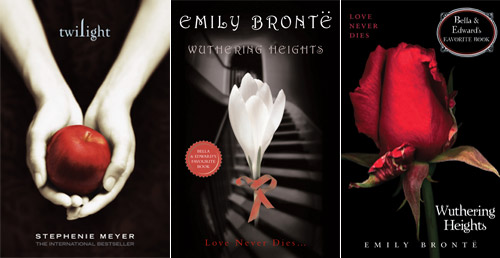
The Twilight books are vaguely inspired by 3 novels: Wuthering Heights, Pride and Prejudice, and Romeo and Juliet. You’ll no doubt have seen the Harper Collins reissue of Wuthering Heights in 2009.

As well as being branded with the Twilight colours, Wuthering Heights is given its celebrity endorsement; it is, we are assured, ‘Bella and Edward’s favourite book’. There’s a quite fascinating process of framing going on here as a result of branding. Wuthering Heights, appropriated by Meyers in her series, is retrospectively reframed by that to which it gave issue, and constituted in a different way, for a different (and particular) readership.
----

Thursday, November 25, 2010

Growth Matters


Jessica at Read, React, Review has been
asking why romance heroes are so well endowed. If some aspect of romance is sexual fantasy, it may seem obvious. But real women don’t seem to care too much about this sort of thing.
so then Jessica asked
But what about the heroine’s reaction to The Big Reveal? It’s often fear, nervousness, shock, or awe. Perhaps a lot of that reaction can be attributed to the fact that so many romance heroines are virgins. But think about it: why does it make sense that a penis — even a big one — should be terrifying to anyone, ever? And, besides, even experienced often heroines have the same reaction.
While I was still pondering those questions, I happened to read a post about:
the relentless pursuit of growth, measured in monetary terms, which takes no account of finite natural capital or people’s well-being. To illustrate the fundamental points: we would need three planets to allow all nations to grow equally, and despite massive GDP growth we appear to be no happier than we were thirty years ago.
I spot a some common themes here: worries about growth in the context of finite natural resources, and a threat to the happily-ever-after of the protagonists.

Before you all decide that this is a case of a poor, innocent metaphor being stretched to breaking point, I'd like to observe that a very high proportion of romance heroes are well endowed both physically and financially. Indeed, Jan Cohn has observed that
It is a commonplace of romance that the heroine will marry well, a given that the hero will be rich. [...] Romance fiction offers a fantasy of female success, specifically economic success, the aggressive nature of which it thoroughly masks under the heroine's extreme economic innocence. [...] This strategy, basic to the romance formula, attempts to disguise both the heroine's real goal and the profound association between sexual and economic power that lies at the heart of romance, as realized in the figure of the romance hero. Economic success becomes a condition of the hero of romance. It is not simply a matter of the hero's wealth as an added-on value; his wealth, his property and economic power, are basic attributes of his masculinity, a principal source of his virile attractiveness. (127)
It is, after all "a truth universally acknowledged, that a single man in possession of a good fortune, must be in want of a wife" (Austen 51). And if a man's "good fortune" is a "basic attribute of his masculinity," isn't it equally possible that the most obvious "basic attribute of his masculinity" might symbolise his "good fortune"? And, given the ruthless nature of both rakes and unregulated capitalism, is it really surprising that the heroine should have some concerns when she realises just how very large his "good fortune" is?

It seems something worth pondering, although (a) I'm sure there is a strong element of purely sexual fantasy in such scenes and (b) I would be extremely surprised if any of the authors of this type of scene had intended there to be any economic symbolism.

Having now lived up (or down) to the expectations of those who "believe all college professors are radical Marxists," I'll leave you with a video about the value of a PhD in English:

-----
  • Austen, Jane. Pride and Prejudice. Ed. Tony Tanner. London: Penguin, 1985.
  • Cohn, Jan. Romance and the Erotics of Property: Mass-Market Fiction for Women. Durham: Duke UP, 1988.

Friday, September 03, 2010

Pam Rosenthal's Paper at the 2010 IASPR Conference


At the recent IASPR conference, Pam Rosenthal gave a paper on "The Queer Theory of Eve Sedgwick at the Edges of the Popular Romance Genre." She's now put up a summary of the paper at the History Hoydens' blog. Here are a couple of quotes from it:
Brussels sounded like a great opportunity to think hard about something I've been wanting to understand better for a while now: the hot new trend of male/male or male/male/female romance -- written by women for women. [...] I took on this project because I wanted to understand more specifically how this new development of male/male love works in individual texts, and most particularly in Ann Herendeen's recent tour de force, Pride/Prejudice.
and
In the centuries since Austen, the romance novel (and sometimes the literary novel as well) hinged upon a simple, but incendiary, paradox: that a man occupies a primacy of position in the public world, but the power of the female subjectivity cannot be denied.

Until the 20th century, perhaps -- when in romance this changed again. when male power began to be understood as a fraught and painful thing -- with, I think, the tortured heroes of the 70s to the 90s. My own untested theory is that this occurred in a parallel development to Second Wave Feminism. We started seeing tortured lonely hero subjectivities in deep third person (Dr. Sarah Frantz of the International Association for the Study of Popular Romance has often written and spoken on this, and I was delighted that she and I were on the same panel in Belgium).
To read more and/or join in the discussion, please head over to the History Hoydens' blog.

Monday, December 21, 2009

Romance Seminar at Yale

Michelle Buonfiglio has news that Cara Elliott and Lauren Willig will be presenting a seminar on “Reading the Historical Romance Novel,” at Yale University:
Beginning with Jane Austen’s Northanger Abbey, Elliott and Willig plan to examine some of the tropes and changes which are unique to the Regency romance, and those which, according to Willig, “mirror developments in the romance community as a whole.” From Austen, the course moves through Georgette Heyer and Kathleen E. Woodiwiss, looks at changing attitudes towards sexuality and heroism in a variety of authors over a thirty-year time span, then continues through Regency paranormals to chick lit.
More details are available at Michelle Buonfiglio's blog and she also discusses the news at her Barnes & Noble blog.

Those at the university can apply to attend the seminar, which will take place in Saybrook in spring term 2010. They might also find it useful to know the following:
CSSY 222b (DC), Hu, "The Historical Romance Novel" Andrea DaRif and Lauren Willig, historical novelists. Lecturers in Yale College. Approved for elective credit to the major in English; not approved for credit toward the pre-1900 requirement.

Meetings: M 2:30–4:30
SY: Lyceum

The Regency romance tradition from the works of Jane Austen to modern permutations of the genre. Discussion of novels in textual, historical, and sociological context through examination of changing tropes and themes.


The illustration is from Wikipedia. These particular shades of Dianthus caryophyllus seemed appropriate in the circumstances (the flowers on that cover are certainly the right colour, but I suspect they might not be the right species. The book is by Cara Elliott's alter ego).

Wednesday, December 16, 2009

Sarah Frantz on "Darcy’s Vampiric Descendants"


I am very pleased to be able to announce that Sarah S. G. Frantz's "Darcy’s Vampiric Descendants: Austen’s Perfect Romance Hero and J. R. Ward’s Black Dagger Brotherhood" is now online in volume 30.1 (Winter 2009) of Persuasions On-line, a publication of the Jane Austen Society of North America.

The juxtapositioning of Darcy and vampires in the title of the essay reminded me of the existence of Vampire Darcy’s Desire: A Pride and Prejudice Adaptation by Regina Jeffers and Mr. Darcy, Vampyre by Amanda Grange, but Sarah Frantz's essay is not about such very direct vampiric descendants. Indeed, the fact that J. R. Ward's heroes are vampires is relatively unimportant to her discussion, except inasmuch as it is the cause of their "hypermasculinity."

Frantz argues that
the proof of the power and appeal of the hero’s confession, and of Austen’s genius in creating it in the first place, can be found in the modern romance reader’s continued desire for similar masculine confession and emotion in modern romance heroes. Indeed, the most significant change in popular romance over the last thirty years is the increase in the reader’s access to the thoughts and emotions of the romance hero. [...] From the perspective of popular romance narratives, then, Austen’s achievement was to locate the emotional climax of the novel in Darcy’s narration of his maturing emotional state, even though it was constructed primarily from the exterior through dialogue. Modern popular romances expand and exploit the power and appeal of Darcy’s confession by providing continuous access to the interior perspective of the romance hero as he realizes and admits that his heroine has become indispensible to his happiness.
It could, perhaps, be argued that the hero's confession was not created by Austen. In Diego de San Pedro's late fifteenth-century Spanish sentimental romance, Cárcel de Amor, for example, it is initially made through an intermediary. However, the hero's pains are also depicted via his apparent imprisonment in a prison of love, where he is chained, and crowned with metal spikes. He eventually dies of love, but his sufferings and their depiction suggest that there has been a very long and varied tradition of depicting heroes' immense emotional suffering caused by love. Even if one only goes as far back as Samuel Richardson's Pamela (1740) we can find a hero making a confession of love. Mr B.'s letter to Pamela, in which he opens with the words "In vain, my Pamela, do I find it to struggle against my Affection for you" (250) even contains the same words, "In vain" and "struggle," which are used by Mr Darcy: "In vain have I struggled. It will not do. My feelings will not be repressed. You must allow me to tell you how ardently I admire and love you" (Chapter 34). Mr B's love also appears to make him fall ill and he tells Pamela from his sickbed that:
Life is no Life without you! If you had refused me, and yet I had hardly Hopes you would oblige me, I should have had a severe Fit of it, I believe; for I was taken very oddly, and knew not what to make of myself: But now I shall be well instantly. (255-56)
Compared to some earlier heroes and the sometimes very dramatic manifestations of their lovesickness, Mr Darcy's outburst may indeed seem "relatively mild." Frantz argues that is the insights which modern romances provide into "the interior perspective of the romance hero" which have led to an intensification in the type of evidence provided of the hero's emotions:
Darcy’s relatively mild words to Elizabeth in both the first and second proposal scenes are meaningful because the lack of narrative access to his internal perspective makes the directly expressed words a powerful representation of the barriers he has overcome in order to be able to express them at all. But when access to the hero’s thoughts is granted by the narrative, the emotional power of the hero’s confession of his feelings for and his education by the heroine must be attained through other the narrative strategies, resulting not only in supernatural heroes whose inhuman abilities redefine the limits of the merely human hero, but also in a narrative insistence on locating the emotional climax of the novel in the hero’s tears. Stereotypically in modern popular romance, the more masculine the hero, the more emotionless he is, and the larger the barrier that must be overcome to achieve access to his emotions.
Frantz focuses on heroes' tears:
In order for these superhuman men to prove that they have broken through the barrier of their masculine emotionlessness enough to fall in love with and appreciate the changes wrought by the heroine, the narratives invariably depict them crying. Masculine tears are something modern women are taught to long for as demonstrating the depths of a man’s emotions, precisely because our culture paradoxically teaches boys and men that, in order to be “real” men, they should never cry.
Of course, not all modern romances feature "superhuman men," and not all "modern women are taught to long for" masculine tears. Furthermore, not all readers of the essay will share the same "culture." Given that Frantz's essay moves from analysis of an early nineteenth-century English tex to several early twenty-first-century American ones, it might have been useful to have been told a little bit more about differences between the cultures in which they were both produced. Perhaps differences in culture, as well as differences in the degree of access the author grants the reader into the heroes' thoughts, have affected the depiction of "the hero’s confession of his feelings." In addition, although Ward's novels "invariably depict them [the heroes] crying," not all modern romance heroes cry.

In fact, Frantz seems to acknowledge this last point when she writes that "The current trend in the hero-focused popular romance means that the more alpha the hero, the more likely he is to cry to prove his love for the heroine." She has therefore chosen to study the tears shed by the heroes of J. R. Ward's Black Dagger Brotherhood series and she concludes that
As campy as they are, Ward’s hypermasculine vampires are Darcy’s ultimate heirs. Darcy not only must mature because of his love for Elizabeth, but he must also recognize and welcome the change his heroine has wrought in him. Superhuman, nearly immortal, cursed, and emotionless, Wrath, Rhage, Zsadist, Butch, Vishous, and later Phury and Rhevenge, represent the hyperbolic extreme of Darcy’s attractiveness, power, and pride. Their tears of love, acceptance, and despair break through strong taboos of masculinity and represent the inevitable physical embodiment of Darcy’s verbal expression of his emotional maturation. The stunning popularity of the Black Dagger Brotherhood series indicates that modern romance readers—just like Darcy’s first fans—appreciate the opportunity to plumb the true emotional depths of the romance hero. The more masculine the man and the more devastating to his own emotional control is his admission of the importance of love to his very existence, the more powerful and precious that admission is to the reader. Pamela Regis, after claiming Pride and Prejudice as the Ur-text of popular romance fiction, argues that “Ordering society is now an issue of taming or healing the hero. . . . Untamed or unhealed, the hero will not truly appreciate the role of the heroine in his life; he will not engage with her emotionally” (114). The spectacle of masculine tears in the popular romance both tames and heals the hero and allows him to accept, appreciate, and verbalize the necessity of his love for his heroine. But Darcy led the way two hundred years ago.
You can read the whole article at the Persuasions On-line website.

I do wonder where this analysis leaves Austen's other novels, and non-alpha romance heroes. Is Northanger Abbey the "Ur-text" of the modern romance beta hero, for example?

---
Austen, Jane. Pride and Prejudice. The Republic of Pemberley's online edition.
Richardson, Samuel. Pamela. Ed. Thomas Keymer and Alice Wakely. Oxford: Oxford UP, 2001.


The photo of the "Title page from the first edition of Pride and Prejudice" came from Wikipedia. The photo of the cover of J. R. Ward's Dark Lover came from J. R. Ward's website.