Teach Me Tonight

Musings on Romance Fiction from an Academic Perspective

Showing posts with label canon. Show all posts

Friday, December 02, 2022

New Publications and Blog Update: Definitions, Canons and more (but probably less in future)

Twitter's been an important source of information for me in finding links and keeping up with what's been happening in the romance world, but with all the upheaval there, I've decided it's time to leave. Unfortunately, that means I'll lose an important source of content for this blog and there will probably be far fewer, maybe even no, notifications of calls for papers. I'll still be posting updates about items added to the Romance Scholarship Database, though.

The last thing I've been present for in online "Romancelandia" is a heated debate about the definition of "romance." I'm not the arbiter of that: my work's about romance as it has been defined, not as it will be. But I am the arbiter of what I add to the database, and so I've added an "About page" to give a brief explanation. I'm using the definition of "romance" given by the editors of The Routledge Research Companion to Popular Romance Fiction. [Incidentally one of the new items listed below takes a very interesting, in-depth look at debates about the definition of romance - see Michelson.]

Another contentious topic (which has not, as far as I know, been provoking controversy recently online), is that of a "canon." There's a trio of short articles about the "romance canon" (would it be helpful? is the concept intrinsically flawed?) in the Journal of Popular Romance Studies:

  • Cant and Canonicity
    Eric Murphy Selinger
  • Response to Eric Selinger’s “Cant and Canonicity”
    Julie E. Moody-Freeman
  • Isn’t It Iconic: Canonical Logics and the Romance Genre
    Jodi McAlister

Other new publications are:

Burge, Amy (2022). "Beyond Outlander: Annie S. Swan and the Scottish popular romance novel." Scottish Literary Review. [This is still forthcoming, but a pre-print is available for free via the University of Birmingham.]

Grinnell, Natalie (2022). "The Challenge to Dominance Theory in Patricia Brigg's and Carrie Vaughn's Paranormal Romance Novels." Femspec 22.2:40-65. [Abstract]

Hua, Shaoqi and Chengli Xiao (2023). "What shapes a parasocial relationship in RVGs? The effects of avatar images, avatar identification, and romantic jealousy among potential, casual, and core players." Computers in Human Behavior 139. [Abstract and excerpt]

Konle, Leonard and Fotis Jannidis (2022). "Modeling Plots of Narrative Texts as Temporal Graphs." CHR 2022: Computational Humanities Research Conference, December 12 – 14, 2022, Antwerp, Belgium :318-336.

Michelson, Anna (2022). Redefining the Romance: Classification and Community in a Popular Fiction Genre. PhD thesis, Northwestern University. https://doi.org/10.21985/n2-4tj1-6567

Sharma, Vishal, Kirsten E. Bray, Neha Kumar, Rebecca E. Grinter (2022). “Romancing the Algorithm: Navigating Constantly, Frequently, and Silently Changing Algorithms for Digital Work.” Proceedings of the Association for Computing Machinery on Human-Computer Interaction.Volume 6, Issue CSCW:1–29. https://doi.org/10.1145/3555651

One last item, which I'm not adding to the database because it only mentions romance in passing, is a thesis by Leon Kooijmans titled "Christianity after the Death of God: Christian Atheism and the Materiality of Absence." In it Kooijmans observes that, "Since the 1990s, an increasing amount of (post-)evangelical Christians in North America and Europe sought to form communities in creative and innovative ways [...]. One notable group associated with this Emerging Church Movement is called ‘Ikon’, a small collective of artists and disillusioned Christians, agnostics and atheists located in Belfast, Northern Ireland that was active from 2001 to 2013." The connection with romance is that at one of their first meetings (on the topic of the prodigal son), "Around the room dozens of Mills and Boon novels that we had purchased in a second-hand bookshop have been scattered around the various surfaces" (18) and "As the service draws to a close everyone is invited to take away a Mills and Boon book as a reminder of the evening’s theme" (21).

Posted by Laura Vivanco at Friday, December 02, 2022 0 comments
Email ThisBlogThis!Share to XShare to FacebookShare to Pinterest
Labels: Amy Burge, canon, genre definition, paranormals, publishing, readers, religion

Thursday, April 27, 2017

CFP: Women’s Writing in the 21st Century - Sheffield, 8-9 September 2017

From the Postgraduate Contemporary Women's Writing Network (UK)

Fast Forward: Women’s Writing in the 21st Century

“The past is always tense, the future perfect.“ (Zadie Smith)

Zadie Smith’s debut novel White Teeth was published in the January of 2000 and marked the beginning of a new millennium of women’s writing. Considering that this and other texts released around the turn of the century are soon to be the same age as current undergraduates, it seems timely to move on from well-worn discussions of literature produced in the 1970s onwards and focus on women’s writing in the twenty first century.
The contemporary, as a liminal temporal space, marks the transition between past and future and as such is not only notoriously hard to frame but its fluid and ephemeral nature continues to present a challenge in literary studies and beyond. Contemporary literature, in many ways simultaneously ‘with the time’ and then quickly outdated, presents a curious and exciting paradox to think through questions of literary form, the literary market place, the role of authors as public intellectuals and contemporary readers. The need to focus on the present and contemporary state of women’s literature seems particularly poignant in a post-Brexit and Trump era in which laws and ideas surrounding the future state of gender, race, and class politics are ever more obscure and uncertain.
Join us on the 8th and 9th September 2017 as we seek to position the most recent work (post 2000) of established authors alongside the field’s newer voices in order to facilitate a conversation about the present state – and possible futures – of women’s writing.
Possible conference themes:
  • the resurgence of women’s confessional writing
  • the recent rise in popularity of erotic and romantic fiction
  • the emergence of genres such as autofiction and autotheory in women’s writing
  • writing at the intersection of creative and critical/writing across genres
  • writers as public intellectuals and agents of change
  • new directions in writing by canonised authors
Please send abstracts of 250 words and a short bionote to conference@pgcwwn.org until 30th June, 2017.


---
Details from here.
Posted by Laura Vivanco at Thursday, April 27, 2017 0 comments
Email ThisBlogThis!Share to XShare to FacebookShare to Pinterest
Labels: canon, CFP, women

Friday, April 08, 2016

New Pages (and Videos) on Love (and Romance Scholarship)

Laura Vivanco

Documentary-maker Laurie Kahn invited Eric
to curate some “Resource Pages” of links relevant to topics raised in Love Between the Covers, the romance documentary, and they’re now live!  They’re designed to be of use both to teachers and curious readers.
The pages include links to video-clips, documents and other web-pages on the topics of
  • The Happily Ever After -- and the Tragic Ending
  • Race and Romance
  • Love Across Cultures
  • Jane Austen and the Romance Revolution
  • Romance in the Digital Age

Over on the website of Kahn's production company, you can see videos taken at the Library of Congress during
What Is Love? Romance Fiction in the Digital Age [...] a two-day Popular Romance Project conference that brought romance authors, readers, publishers, and scholars in many disciplines together for four fascinating panel discussions.
The links below take you straight to the videos on Vimeo:

Panel 1 discussed "What Belongs in the Romance Canon?"

Panel 2 asked "What Do The Science and History of Romance Reveal?"

Panel 3 looked at "Community and the Romance Genre"

Panel 4 focused on what's "Trending Now: Where is Romance Fiction Heading in the Digital Age?"

Details about all of the panelists, panels and the introduction to the conference as well as all the videos can be found here.

Also out recently is a podcast featuring Lisa Fletcher,
one of the scholars working on a project called Genre worlds: Australian popular fiction in the 21st century (2016–2019). This project won an RWA (US) grant, followed by a very prestigious grant from the Australia Research Council. Lisa talks about the project’s goals and  methodology, as well as other themes and topics in popular fiction that pique her interest. She also talks about the challenges of teaching romance at university, and some of the books and techniques she uses in her classes.
The podcast can be found here.
Posted by Laura Vivanco at Friday, April 08, 2016 0 comments
Email ThisBlogThis!Share to XShare to FacebookShare to Pinterest
Labels: Austen, canon, community, e-books, happy endings, history, Laurie Kahn, Lisa Fletcher, publishing, race, science, teaching romance fiction

Tuesday, April 21, 2015

Links and Call For Papers

Laura Vivanco

Thanks to Twitter, I've got a lot of links to share:

In "History in Color: A Black American Romance Roundtable"
Kianna Alexander (author of two multicultural historical romance series), Piper Huguley (author of inspirational historical romances), Lena Hart (writer of sensual to steamy interracial romances), and [...] Alyssa Cole [...] discuss our personal experiences as romance writers, the current state of multicultural historical romance, and our thoughts on the future of historicals that feature people of color as the heroes and heroines.
USA Today's Christyna Hunter attended the recent
What Is Love? Romance Fiction in the Digital Age Symposium. [...] One of the panels that I found interesting was the one discussing the romance canon. If you are anything like me, a definition had to be researched before the full effect of the panel could be appreciated. According to Merriam-Webster, a canon is "a sanctioned or accepted group or body of related works." The term is mostly a phrase for academics, and that was largely the case for this panel, which included two authors and three professors. Notably missing: librarians. In fact, there were no librarians on any of that day's panels, though the occasion was held in one of the many buildings of our national library.

So here's my chance to add insight to the conversation from a couple of librarians. I'd like to introduce Wendy Crutcher and Kristin Ramsdell.
She does so in "Love in the Stacks: Which books should be part of the romance canon?" and "Love in the Stacks: Romance canon as librarian tool?"

Jodi McAlister has written up her observations on "Reproductive Futurism and Cruel Optimism: Romance at PCA, Day 1" and "Race, Libraries, and the Academic Heroine: Romance at PCA, Day 2".


CFP: EUPOP 2015
Humboldt University of Berlin, July 29th – 31st 2015 Deadline: Monday, April 27th, 2015

Individual paper and panel contributions are welcomed for the fourth annual international conference of the European Popular Culture Association (EPCA), to be held at the Humboldt University of Berlin (Hauptgebäude, Unter den Linden 6, Berlin) from July 29th – 31st 2015.

EUPOP 2015 will explore European popular culture in all its various forms. [More information here.]


Call for Presentations: Gender and Love/The Gender and Love Project
Mansfield College, Oxford, UK, 20th September – 22nd September 2015
Deadline: Friday 1st May 2015

The “Gender and Love” project calls for reflections on the interaction between gender and love and how this nexus of ideas pertains to self-perception, (dis-)ability, ethics, religion, kinship, bonding, nationality, globalization, environment, etc.  The project welcomes elaborations on gender and love in all forms, styles, and media, past or present. [More information here.]


CALL FOR PAPERS: New York Metro American Studies Association
Guttman Community College, NY, Saturday, November 14, 2015
Deadline: June 1, 2015

The New York Metro American Studies Association (NYMASA) has chosen the theme of “Love” for our 2015 annual conference. We invite papers, presentations, performances, and exhibitions that explore the cross-disciplinary, transnational, and trans-historical possibilities embedded in the concept of love. [More information here.]
Posted by Laura Vivanco at Tuesday, April 21, 2015 0 comments
Email ThisBlogThis!Share to XShare to FacebookShare to Pinterest
Labels: African-Americans, canon, CFP, Conferences, Historical Romance

Sunday, February 15, 2015

Eric's Symposium Remarks


--Eric Selinger

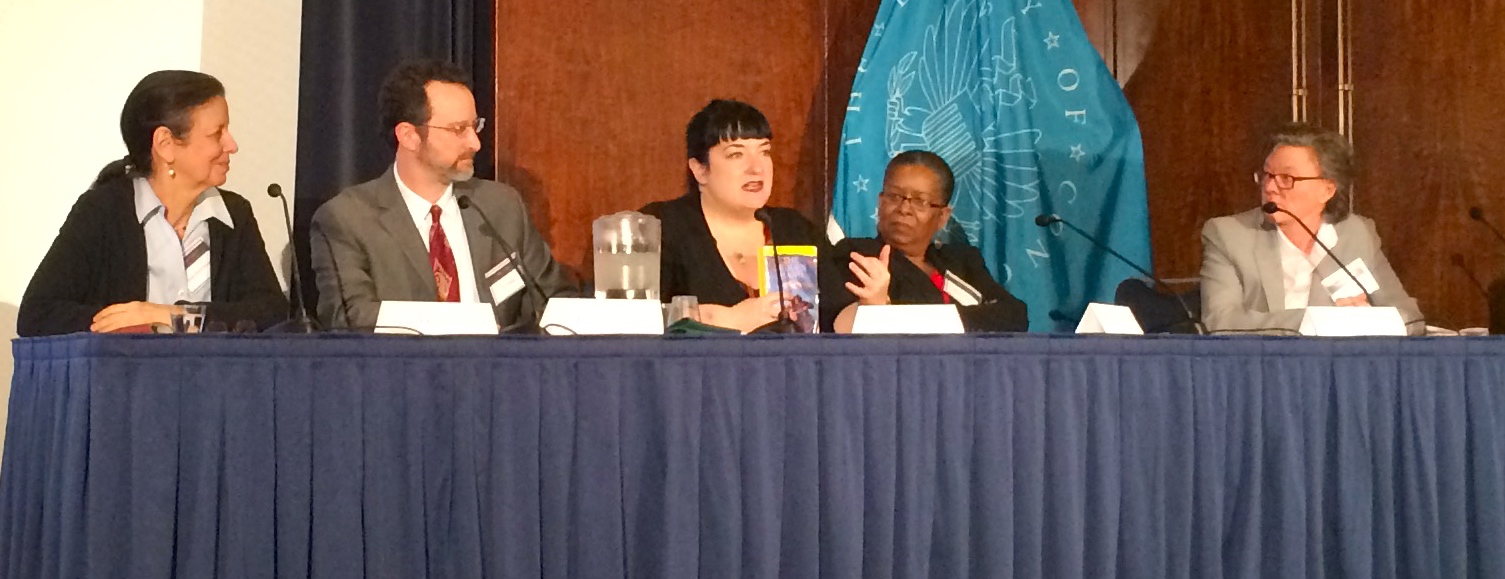
Last week the Library of Congress hosted a day-long conference on romance fiction (and related topics) in the digital age.  Along with Len Barot, Beverly Jenkins, Nicole Peeler, and Susan Ostrov Weisser--see above, in the photo by Margaret Locke--I was was on the first panel, which was supposed to focus on the question "What Belongs in the Romance Canon?"  A number of other ancillary questions were posed by the moderator, Pamela Regis, including how broadly defined "romance" and its canon should be.

Each of us on the panel got to make a three-minute opening statement, and I spent a sleepless night trying to decide what I ought to say in my slot, what I should save for the Q and A to follow, and so on.  In the end, here's what I wrote out and said:
The last thing that popular romance needs is a man in a suit explaining--mansplaining--what belongs in the romance canon.
I can tell you who's been on my romance syllabi.  As your program notes, I've taught upwards of thirty courses exclusively devoted to the genre at DePaul, from historical surveys to thematic courses to ten-week seminars on individual romance novels.  But every book and author I've taught is there because of the expertise and enthusiasm of some blogger, reviewer, scholars, reader, librarian, or author who loved that book, put that book on a list, or put that book in my hand, saying "this is awesome, this was influential, this would teach really well; I don't get to teach this class, and you do, so put this in it."
It's worth nothing, I think, that so far every one of those bloggers, reviewers, scholars, readers, authors, and librarians has been a woman.
Now, I don't always end up teaching the particular novel they suggest.  Sarah Frantz Lyons has been after me for years to teach It Had to Be You by Susan Elizabeth Phillips, and my wife loves Match Me if you Can, but Natural Born Charmer is my jam:  it teaches perfectly, for me.  
This leads me to a second point about the romance canon, one made last spring by a young Australian scholar, Jodi McAlister.  In the romance world, Jodi wrote in a blog post called "Boom Goes the Canon," there are certainly iconic books, authors, publishing lines, but they don't function the way a traditional literary canon does--to establish authority, to separate wheat from chaff, sheep from goats, the gospel of the lord from Bible fan-fic.  Romance readers, she writes, are quite comfortable with the ideas of subjective pleasure and continent value.  What works for me won't work for you; what works for me might work for some reason other than "objective artistic merit" or some other demonstrable reason for canonicity.
There are, we might say, many fish in the sea, or a lid for every pot:  a lesson from within the novels that romance readers seem able to map onto the literary field of the novels themselves.
The romance community is quite comfortable with what Barbara Herrnstein Smith once called "Contingencies of Value."  And  as a scholar, my inclination is less to weigh in on what belongs in the romance canon, or what the boundaries of that canon should be, then to try to learn what the romance world can teach me about why we ask those questions, and about what's at stake in how we answer them.
In the Q & A that followed, I mentioned Noah Berlatsky's canon piece in Salon and Wendy the SuperLibrarian's response (and the comments from her readers that followed).  But I wanted to take the opportunity of the 3-minute formal address to do something Sunita mentioned in a comment last spring when that whole canon business was getting talked about:  that is, to draw my audience's attention to the women whose expertise I've relied on all these years, rather than pretending to an expertise of my own.  (I do have some expertise of my own, I hope, but it's not about what's in or should be in the romance canon!)  Jodi's piece has been on my mind for nearly a year, and that seemed like the one to flag most immediately--and I figured I would have plenty of chances to plump for particular novels, etc., as soon as the discussion started.


Posted by E. M. Selinger at Sunday, February 15, 2015 3 comments
Email ThisBlogThis!Share to XShare to FacebookShare to Pinterest
Labels: canon, Conferences, Eric Selinger, Jodi McAlister

Thursday, November 01, 2012

All I've Taught So Far...

--Eric Selinger

All this talk of a romance canon--"Canon to the left of us! / Canon to the right of us!"--has me thinking, rather wistfully, about just how few romance novels I've actually taught so far.  Since I'm one of the luckiest folks in the business, with plenty of course opportunities, I should have done more, and writing up the list has been a little embarrassing.  Still, for what it's worth, here it is, organized two ways:


  • First, a list of the "background" novels I teach (1919-1972), followed by an alphabetical list of romance novelists and novels that I've taught from the 1980s onward.  I haven't put in dates, in the interests of time, but honestly, though, there aren't many from the 1980s.  When I teach chronological courses, I tend to focus the 1980s on romance criticism, and then teach novels that in some way respond to that critical discourse about the genre.  So it's really a list from the 1990s onward, as you'll see if you check them out.
  • Second, a list of the same novels and novelists, categorized in some well-known subgenres.  When a novel fits into more than one category, I've put it in both; I've left out categories like "metatextual romance" and "highly allusive romance" and "explicitly feminist romance," although I sometimes think in those terms.  A few times I've put "sort of" after a novel, to indicate that it "sort of" fits into that category, but there's another one in the list where it fits better.
If you're one of my students, and you don't see a book that we read, let me know and I'll add it!  I tried to be complete, but when a book was presented by a student but not read by everyone--or when I supervised an independent study, but didn't teach the book myself--I left it off.

Romance Novels Eric Has Taught (So Far)

Background for the Genre (pre-1980s), More or Less Chronologically Organized
E. M. Hull, The Sheik
Georgette Heyer, Devil’s Cub, The Grand Sophy
Mary Stewart, Madam, Will You Talk
Victoria Holt, Mistress of Mellyn
Kathleen Woodiwiss, The Flame and the Flower

More Recent Books (1980s-present)
Mary Balogh, Slightly Dangerous 
Alex Beecroft, False Colors
Sarah Bird, The Boyfriend School
Gwyneth Bolton, Sweet Sensation 
Suzanne Brockmann, Unsung Hero
Loretta Chase, Lord of Scoundrels, Mr. Impossible
Kresley Cole, A Hunger Like No Other
Jennifer Crusie, Manhunting, Anyone But You, Crazy for You, Welcome to Temptation, Fast Women, Bet Me
Victoria Dahl, Talk Me Down, Start Me Up, Real Men Will
Ann Herendeen, Phyllida and the Brotherhood of Philander
Joey Hill, Natural Law
Emma Holly, Hunting Midnight
Linda Howard, Mr. Perfect
Eloisa James, The Duke is Mine
Beverly Jenkins, Something Like Love, Topaz, Captured
Laura Kinsale, Prince of Midnight, Flowers from the Storm
Karyn Langhorne, A Personal Matter
Beth Patillo, Heavens to Betsy
Susan Elizabeth Phillips, Natural Born Charmer
Julia Quinn, The Viscount Who Loved Me
Francine Rivers, Redeeming Love
Nora Roberts, Irish Thoroughbred, Irish Rose, Midnight Bayou, Montana Sky 
Nell Stark, Homecoming
J. R. Ward, Dark Lover

NOVELS BY CATEGORY / SUB-GENRE

African American Romance
Gwyneth Bolton, Sweet Sensation 
Beverly Jenkins, Something Like Love, Topaz, Captured
Karyn Langhorne, A Personal Matter
  
“Blockbuster Historical Romance” (1970s-80s)
Kathleen Woodiwiss, The Flame and the Flower

Category Romance
Nora Roberts, Irish Thoroughbred, Irish Rose
Jennifer Crusie, Manhunting, Anyone But You 

Christian / Inspirational Romance
Beth Patillo, Heavens to Betsy
Francine Rivers, Redeeming Love

Contemporary Romance
Sarah Bird, The Boyfriend School
Gwyneth Bolton, Sweet Sensation 
Suzanne Brockmann, Unsung Hero
Jennifer Crusie, Manhunting, Anyone But You, Crazy for You, Welcome to Temptation, Fast Women, Bet Me
Victoria Dahl, Talk Me Down, Start Me Up, Real Men Will
Joey Hill, Natural Law
Linda Howard, Mr. Perfect
Susan Elizabeth Phillips, Natural Born Charmer
Nora Roberts, Irish Thoroughbred, Irish Rose, Midnight Bayou, Montana Sky 
Nell Stark, Homecoming

Erotic Romance
Joey Hill, Natural Law (BDSM, femdom, m/f)
Emma Holly, Hunting Midnight (paranormal)

Gothic Romance
Victoria Holt, Mistress of Mellyn
Nora Roberts, Midnight Bayou (sort of)

Historical Romance
Georgette Heyer, Devil’s Cub, The Grand Sophy
Kathleen Woodiwiss, The Flame and the Flower
Mary Balogh, Slightly Dangerous
Alex Beecroft, False Colors
Loretta Chase, Lord of Scoundrels, Mr. Impossible
Ann Herendeen, Phyllida and the Brotherhood of Philander
Eloisa James, The Duke is Mine
Beverly Jenkins, Something Like Love, Topaz, Captured
Laura Kinsale, Prince of Midnight, Flowers from the Storm
Julia Quinn, The Viscount Who Loved Me
Francine Rivers, Redeeming Love

Interracial Romance
Karyn Langhorne, A Personal Matter (Black / White)
Nell Stark, Homecoming (Asian / White, but it’s not a central plot element)

LGBTQ Romance
Alex Beecroft, False Colors (m/m)
Ann Herendeen, Phyllida and the Brotherhood of Philander (bisexual, m/m/f)
Nell Stark, Homecoming (f/f)

Military Romance
Suzanne Brockmann, Unsung Hero

Paranormal Romance
Kresley Cole, A Hunger Like No Other
Emma Holly, Hunting Midnight
J. R. Ward, Dark Lover

Romantic Suspense
Mary Stewart, Madam, Will You Talk
Linda Howard, Mr. Perfect
Nora Roberts, Midnight Bayou (sort of?)
Joey Hill, Natural Law (sort of)

Sheikh Romance
E. M. Hull, The Sheik


Posted by E. M. Selinger at Thursday, November 01, 2012 6 comments
Email ThisBlogThis!Share to XShare to FacebookShare to Pinterest
Labels: canon, Eric Selinger, teaching romance fiction

Wednesday, October 31, 2012

Popular Romance Studies and the Politics of Canon

Jonathan A. Allan

I have been following Eric’s posts on syllabi and his emails to the listserv, and this has me wondering about the politics of canon, or less canon and more literary history. One of the central challenges that popular romance studies must attend to – I think – is a lack of canon.

So many fields of study, and I believe that we hope to make popular romance a field, have lists of required readings. These need not be the “best” texts, but rather texts that were important in the development of that field. As much as scholars may wish to stop reading Janice Radway’s Reading the Romance, the text remains important precisely because it is cited and read by many, and it has informed so much of the criticism on popular romance. The point is not to reify texts or authors, but to recognize their influence or importance for the field.

As problematic as any canon surely is, it is also remarkably useful insofar as it allows scholars to have an understanding of the essential texts. Yes, texts will be missing. But I don’t think that is reason enough to discard any discussion of canon. Yes, some authors will be over-represented, while others will be under-represented (what happened to Northrop Frye?). And yes, the canon will be imperfect. But, again, is this reason to avoid the discussion altogether?

However, aren’t most of the reasons for not having a canon already true in popular romance studies? Do we not all agree that The Flame and the Flower was a turning point for American romance? Do we also not all agree that Nora Roberts is essential to the history of the American romance? I think I’ve heard on a couple of occasions someone ask a question about the place of Danielle Steele in popular romance; she is noticeably absent for these questioners. The critiques of canon are important precisely because the politics of canon are already at play in the field.

I cannot pretend to offer a canon here of the central texts of romance fiction that all scholars of popular romance should have read, but I do think it is an important discussion that perhaps we ought to have. The future of the field, if it is to become a field, requires that we establish its parameters, its histories, and its central texts.

I admit that the canon will not be perfect, but let’s take that as a given. Let’s draft a canon (or we can use another word), let’s admit its imperfections, and let’s welcome changes to the canon (we can think about it as a work in progress). But, let’s not give up on this task because it might get messy. In very practical terms, with so few PhD-granting institutions focussing on popular romance (indeed, few have even a single faculty member writing on popular romance), how can PhD students be evaluated in terms of the field? Or, how can graduate students present “popular romance” as a field, if the field has yet to define its key texts? (My field exam on “Genre: Romance” included: Pride and Prejudice, Ivanhoe, The Last of the Mohicans, Maurice, Passage to India, Atala, Lord Jim, Adolphe, Daniel Deronda, Sentimental Education, Paul et Virginie, to name but a few “Romances.” I managed to slip Twilight in the reading list. I’m not against what I ultimately studied, I think it was an important education in the genre, but it wasn’t “popular.”)

I’m not certain that I have a solution to any of this, and thus am very open to suggestions on how we might do this. Eric’s courses remind us that a canon is being developed, and moreover that it is a challenge worth considering. Perhaps there is a JPRS issue to be organized around the pedagogical and practical questions of romance. Or perhaps, we can crowd-source a canon, a reading list, a field, and see what happens. Or maybe I'm completely wrong and we don't need any of this. But this discussion has come up often enough at conferences, usually over dinner or drinks, that it seems worth considering.
Posted by Jonathan at Wednesday, October 31, 2012 16 comments
Email ThisBlogThis!Share to XShare to FacebookShare to Pinterest
Labels: canon, essential texts, literary history, pedagogy, teaching romance fiction
Older Posts Home
View mobile version
Subscribe to: Posts (Atom)

Pages

  • Home
  • Forthcoming Conferences
  • Forthcoming and Published Books (2015-2026)
  • What is romance?
  • Journals of Popular Culture and Other Relevant Subjects
  • Race and Romance: A Bibliography
  • Teaching Popular Romance

About Us

  • Pamela Regis
  • Eric M. Selinger
  • Laura Vivanco

Search This Blog

Romance Scholarship Database

Romance Scholarship Database

The Routledge Research Companion to Popular Romance Fiction

The Routledge Research Companion to Popular Romance Fiction
Ed. Jayashree Kamblé, Eric Murphy Selinger, Hsu-Ming Teo, 2021

Faith, Love, Hope and Popular Romance Fiction

Faith, Love, Hope and Popular Romance Fiction
by Laura Vivanco, 2020

Love, Language, Place, and Identity in Popular Culture: Romancing the Other

Love, Language, Place, and Identity in Popular Culture: Romancing the Other
Ed. MarĂ­a Ramos-GarcĂ­a and Laura Vivanco, 2020

Romance Fiction and American Culture: Love as the Practice of Freedom?

Romance Fiction and American Culture: Love as the Practice of Freedom?
Ed. William A. Gleason and Eric Murphy Selinger, 2016

Pursuing Happiness: Reading American Romance as Political Fiction

Pursuing Happiness: Reading American Romance as Political Fiction
Laura Vivanco, 2016

New Approaches to Popular Romance Fiction: Critical Essays

New Approaches to Popular Romance Fiction: Critical Essays
Ed. Sarah S. G. Frantz and Eric Murphy Selinger, 2012

For Love and Money: The Literary Art of the Harlequin Mills & Boon Romance

For Love and Money: The Literary Art of the Harlequin Mills & Boon Romance
Laura Vivanco, 2011

A Natural History of the Romance Novel

A Natural History of the Romance Novel
Pamela Regis, 2003

Academic Links

  • International Association for the Study of Popular Romance (IASPR)
  • Journal of Popular Romance Studies (JPRS)
  • Romance Scholarship Database
  • Popular Culture Association/American Culture Association
  • The European Popular Culture Association

Academic Libraries with Romance Collections

  • African Studies Centre University of Leiden
  • BGSU's Browne Popular Culture Library
  • Indiana University's Lilly Library acquired an entire romance collection
  • McDaniel College Hoover Library Nora Roberts Collection
  • University of Calgary
  • University of Chicago Alfred Willis Collection of African-American Popular Fiction 1958-2016
  • University of Dayton
  • University of Melbourne
  • University of Reading
  • University of Wisconsin-Milwaukee

Specialist Romance Blogs

  • An Introduction To the Romance Pulps
  • Close Reading Romance (an academic does close readings of romance)
  • Cold War girl/adolescent romances - Amanda K. Allen
  • Haunted Hearts (vintage gothic romance)
  • Romance Has a History (an archivist explores the history of romance)
  • Romance in Color (review site "focused on African-American romance")
  • Sequential Crush (vintage romance comic books)
  • The Good Bad Book (1920-30s US romances)

Other Romance Resources

  • A Black Romance Author Timeline
  • A guide to category romance series 1965-1989
  • Black Romance Podcast
  • De l'amour Ă  10¢: Le roman sentimental en fascicules au QuĂ©bec de 1940 Ă  1965
  • Love for Sale: Dime Novels in Quebec from 1940 to 1965
  • Research Archive of Romance Websites
  • Romance Wiki
  • Romancing the Bard
  • The Disability and Romance Project
  • Unsuitable (blog of 'students and instructors of “Publishing & Marketing Popular Fiction: A Case Study of the Romance Novel” course at Duke University')
  • Why Read Mills & Boon Romances?

Romance/Romantic Authors' Associations

  • Romance Writers of America
  • Romance Writers of Australia
  • Romance Writers of New Zealand
  • Romance Writers Organisation of SA
  • Romantic Novelists' Association

Blog Archive

  • ▼  2026 (10)
    • ▼  September (2)
      • New Publications: Barbara Cartland, Olivia Waite, ...
      • Call for Papers: PCA/ACA 2027
    • ►  July (2)
    • ►  May (2)
    • ►  March (1)
    • ►  February (3)
  • ►  2025 (24)
    • ►  December (3)
    • ►  November (2)
    • ►  October (2)
    • ►  September (2)
    • ►  August (2)
    • ►  July (1)
    • ►  June (2)
    • ►  May (5)
    • ►  March (2)
    • ►  February (2)
    • ►  January (1)
  • ►  2024 (28)
    • ►  December (4)
    • ►  November (3)
    • ►  October (2)
    • ►  September (4)
    • ►  August (2)
    • ►  July (1)
    • ►  June (3)
    • ►  May (3)
    • ►  March (2)
    • ►  February (2)
    • ►  January (2)
  • ►  2023 (25)
    • ►  December (1)
    • ►  November (2)
    • ►  October (1)
    • ►  September (2)
    • ►  August (3)
    • ►  July (4)
    • ►  June (1)
    • ►  May (2)
    • ►  April (3)
    • ►  March (1)
    • ►  February (2)
    • ►  January (3)
  • ►  2022 (25)
    • ►  December (1)
    • ►  November (2)
    • ►  October (4)
    • ►  September (1)
    • ►  August (1)
    • ►  July (3)
    • ►  June (2)
    • ►  May (2)
    • ►  April (3)
    • ►  March (2)
    • ►  February (3)
    • ►  January (1)
  • ►  2021 (34)
    • ►  December (2)
    • ►  November (3)
    • ►  October (4)
    • ►  August (6)
    • ►  July (4)
    • ►  June (3)
    • ►  May (2)
    • ►  April (2)
    • ►  March (2)
    • ►  February (4)
    • ►  January (2)
  • ►  2020 (27)
    • ►  December (2)
    • ►  November (2)
    • ►  October (1)
    • ►  September (2)
    • ►  August (3)
    • ►  July (4)
    • ►  June (1)
    • ►  May (1)
    • ►  April (3)
    • ►  March (2)
    • ►  February (2)
    • ►  January (4)
  • ►  2019 (34)
    • ►  December (6)
    • ►  November (3)
    • ►  September (4)
    • ►  August (4)
    • ►  July (6)
    • ►  June (2)
    • ►  May (2)
    • ►  April (2)
    • ►  March (2)
    • ►  February (2)
    • ►  January (1)
  • ►  2018 (30)
    • ►  December (2)
    • ►  November (1)
    • ►  October (2)
    • ►  September (2)
    • ►  August (1)
    • ►  July (7)
    • ►  June (4)
    • ►  May (2)
    • ►  April (3)
    • ►  March (3)
    • ►  February (2)
    • ►  January (1)
  • ►  2017 (34)
    • ►  December (1)
    • ►  November (2)
    • ►  October (3)
    • ►  September (5)
    • ►  August (2)
    • ►  July (3)
    • ►  May (3)
    • ►  April (7)
    • ►  March (2)
    • ►  February (2)
    • ►  January (4)
  • ►  2016 (38)
    • ►  December (3)
    • ►  November (1)
    • ►  October (4)
    • ►  September (2)
    • ►  August (3)
    • ►  July (3)
    • ►  June (2)
    • ►  May (3)
    • ►  April (3)
    • ►  March (5)
    • ►  February (5)
    • ►  January (4)
  • ►  2015 (64)
    • ►  December (3)
    • ►  November (2)
    • ►  October (4)
    • ►  September (9)
    • ►  August (7)
    • ►  July (4)
    • ►  June (6)
    • ►  May (2)
    • ►  April (17)
    • ►  March (4)
    • ►  February (4)
    • ►  January (2)
  • ►  2014 (50)
    • ►  December (3)
    • ►  November (3)
    • ►  October (8)
    • ►  September (2)
    • ►  August (2)
    • ►  July (2)
    • ►  June (5)
    • ►  May (5)
    • ►  April (9)
    • ►  March (3)
    • ►  February (2)
    • ►  January (6)
  • ►  2013 (80)
    • ►  December (3)
    • ►  November (4)
    • ►  October (5)
    • ►  September (6)
    • ►  August (7)
    • ►  July (11)
    • ►  June (5)
    • ►  May (8)
    • ►  April (8)
    • ►  March (8)
    • ►  February (8)
    • ►  January (7)
  • ►  2012 (124)
    • ►  December (8)
    • ►  November (16)
    • ►  October (13)
    • ►  September (8)
    • ►  August (6)
    • ►  July (11)
    • ►  June (7)
    • ►  May (9)
    • ►  April (11)
    • ►  March (15)
    • ►  February (12)
    • ►  January (8)
  • ►  2011 (102)
    • ►  December (12)
    • ►  November (10)
    • ►  October (9)
    • ►  September (10)
    • ►  August (8)
    • ►  July (7)
    • ►  June (8)
    • ►  May (9)
    • ►  April (7)
    • ►  March (9)
    • ►  February (7)
    • ►  January (6)
  • ►  2010 (86)
    • ►  December (6)
    • ►  November (6)
    • ►  October (7)
    • ►  September (7)
    • ►  August (9)
    • ►  July (6)
    • ►  June (7)
    • ►  May (4)
    • ►  April (15)
    • ►  March (7)
    • ►  February (5)
    • ►  January (7)
  • ►  2009 (118)
    • ►  December (6)
    • ►  November (17)
    • ►  October (7)
    • ►  September (9)
    • ►  August (10)
    • ►  July (8)
    • ►  June (9)
    • ►  May (8)
    • ►  April (17)
    • ►  March (9)
    • ►  February (10)
    • ►  January (8)
  • ►  2008 (98)
    • ►  December (7)
    • ►  November (8)
    • ►  October (8)
    • ►  September (8)
    • ►  August (6)
    • ►  July (8)
    • ►  June (7)
    • ►  May (6)
    • ►  April (10)
    • ►  March (11)
    • ►  February (7)
    • ►  January (12)
  • ►  2007 (124)
    • ►  December (13)
    • ►  November (6)
    • ►  October (9)
    • ►  September (8)
    • ►  August (10)
    • ►  July (10)
    • ►  June (10)
    • ►  May (8)
    • ►  April (15)
    • ►  March (11)
    • ►  February (9)
    • ►  January (15)
  • ►  2006 (88)
    • ►  December (8)
    • ►  November (11)
    • ►  October (11)
    • ►  September (14)
    • ►  August (16)
    • ►  July (22)
    • ►  June (6)
Powered by Blogger.