Showing posts with label Jo Beverley. Show all posts

Saturday, July 02, 2016

News Roundup: CFP, items added to the Romance Wiki and more


I haven't posted links for a while so this is a very, very long post. It covers a lot of areas, including items I've added to the Romance Wiki and calls for papers.

Romance readings:

Amy Burge will be at the Edinburgh Fringe (16 August) leading a session about romance writing.

Ali Williams has launched the CatRom Project, "an exploration of the way in which category romances address and engages with social issues. Its primary objective is to create a collection of analysis of individual novels, as well as interviews with authors and editors within the genre on the subject of issues within category romance."

Evangeline Holland has posted a paper on "Pistols and Petticoats: How Women Write the West", which is a reading of Western focused on Jezebel by Katherine Sutcliffe (1997), Fair Is the Rose by Meagan McKinney (1993), and Fall From Grace by Megan Chance (1997). She finds that
In the Western romance, as presented by female writers for a primarily female audience, the frontier myth is strong, particularly Turner’s thesis that the West was “‘free land’ into which the pioneers moved [and] was available for the taking, and that American progress began with a regenerative retreat to the primitive, followed by a recapitulation of the stages of civilization.” (White) All three novels end in some degree on a farm, with little interrogation as to how it is be acquired, but with the implication that it—domesticity through landownership and homesteading—is necessary for a believable romantic ending.
Romance Documentary update:

"LOVE BETWEEN THE COVERS was selected as the #1 choice of all 2015 videos by the American Library Association's Booklist Review".

Calls for Papers:
  • Black Love: A Symposium The 80th Anniversary of Zora Neale Hurston’s Their Eyes Were Watching God. University of Kansas, September 14-16, 2017. The organisers "invite scholars, writers, and artists to reflect upon Black Love—its history, its reiterations, and its futurity—at a symposium to be held at the University of Kansas" and the "Symposium presentations may cover, but are not limited to, the following topics" of which the first is "Romance novels". More details here.
  • Lesbian Lives Conference 2017: Lesbian Love/s. University of Brighton, UK, 24-25 February 2017. Dr Olu Jenzen (University of Brighton) specially forwarded details of the conference to romance scholars so it's clear that our participation would be welcome. More details here.
  • The Society for the Philosophy of Sex and Love, 12-15 April 2017, at the Westin Hotel in Seattle. Panel session for SPSL, to be held as part of the group meeting program of the Pacific Division of the American Philosophical Association. Papers on any topic related to the philosophy of sex and love are welcome. More details here.

Jo Beverley (in memoriam):

News of Jo Beverley's death on 23 May was met with great sadness by members of the romance community, including the Romance Writers of America, her colleagues and readers at the Word Wenches blog, and individual authors such as Lynne Connolly.

Academic articles:
Morton, Leith, 2016. 
"The reinvention of romance: The rewriting, reception and censorship of 'ninjobon' in modern Japan." Journal of the Oriental Society of Australia 47: 85-115. Abstract
Radick, Caryn, 2016. 
"Romance Writers’ Use of Archives." Archivaria, the Journal of the Association of Canadian Archivists 81: 45-73. Abstract

Tanner, David, 2016. 
“Literary Success and Popular Romantic Fiction: Ethel M. Dell, a Case Study.” The Book World: Selling and Distributing British Literature, 1900-1940. Ed. Nicola Wilson. Leiden: Brill, 2016. 83-94. Excerpt
Thierauf, Doreen, 2016. 
“Forever After: Desire in the 21st-Century Romance Blockbuster.” Journal of Popular Culture 49.3: 604-26. Excerpt. [As I've mentioned before, I don't tend to add items about Fifty and Twilight to the Romance Wiki. They're kind of a phenomenon in their own right, though obviously they do have a romance at their centres. This article really disappointed me because it only looks at Twilight, Fifty Shades and a Pride and Prejudice fan fic but nonetheless draws sweeping conclusions about popular romance fiction, such as "Romance’s generic requirement that the hero should be volatile in his affections and sexually intimidating is brought to its logical conclusion in these series" (618). This is not a "generic requirement" of romance: the author would have done better to limit their conclusions to Twilight and Fifty.]
Dissertation/thesis:

Morrissey, Katherine, "Romance Networks: Aspiration & Desire in Today’s Digital Culture" (2016). Theses and Dissertations. Paper 1179. University of Wisconsin, Milwaukee.

In the media:

Lee, Jenny, 2016. 'Ballymena Mills & Boone author on the world of romance', The Irish News, 13 June 2016. [About Lynne Graham, whose 100th Mills & Boon was published this year] 

Mumford, Tracy, 2016. 'Who is reading romance novels?', MPR News, 13 June 2016. [Nielson statistics on romance readers in 2014/15] 

Thurston, Robert W., 2016. 'Ordinary People Learn History from Teachers, Movies, and This', History News Network, 12 June 2016. [About the historical content in historical romances]

Thursday, April 02, 2015

Romance VI: Risky Business: Love, Abuse, and Violence

Romance VI: Risky Business: Love, Abuse, and Violence


Domestic Abuse and Violence in the Works of Nora Roberts

(Pavla Stefanska, Masaryk University)
Love overcomes everything. Everything is fair in love and war. There is a fine line between love and hate. These and similar sayings may evoke an impression that there is a close connection between love and violence. Apart from that, they also represent some of the beliefs which permeate western culture’s ideas of love and relationships. As people have the tendency to accept these sayings at their face value and rarely question where these ideas come from and how they affect their behavior, they seldom realize that these beliefs pose a potential threat to their intimate relationships.

Based on the article by Julia T. Wood “The Normalization of Violence in Heterosexual Relationships: Women’s Narratives of Love and Violence” in which she cites western gender and romance narratives as responsible for the high number of women who stay with abusive partners, this paper examines several novels by Nora Roberts, one of the most popular romance writers of our time, in which the author uses domestic abuse in hero’s or heroine’s past as a barrier which stands in the way of their HEA. The paper explores whether Roberts’ portrayal of the domestic violence corresponds to the narrative categories proposed by Wood, and is looking in more detail at the ways in which the after effects of the trauma caused by the abuse are dealt with in terms of reclaiming one’s own identity and re-establishing oneself not only within the narrative of a successful romantic relationship, but also within the much wider narrative of one’s place in community and society, to show that are differences at Roberts’ descriptions which mirror the changing trends in society and the de-tabooing of the issue of domestic abuse in the last thirty years. 


“It Felt Like A Kiss”: Violence and Violations in Jo Beverley’s An Unwilling Bride

(Angela Toscano, University of Iowa)

The title of this paper is taken from The Crystals’ 1962 single, “He Hit Me (And It Felt Like A Kiss).” This was a song that was not popular even in its own time, and it garnered criticism for its supposed endorsement of spousal abuse. Yet, the song is not simply an unthinking approval of domestic violence. Rather, it reveals something—both in its tonality and its lyrics—about how love and violence intertwine and tangle until one becomes the metonymic stand in for the other. Similarly, discussions of Jo Beverley’s 1992 novel, An Unwilling Bride, question whether the book simply endorses violence as being synonymous with love.

Somewhere, someone once called An Unwilling Bride a novel that puts “the alpha male on trial.” Yet, it this what is being tried? What Beverley’s novel tries are the boundaries between love and violence, passion and anger, anger and abuse. These terms are alternately collapsed and separated throughout the course of the novel. What distinguishes an act of violence from an act of abuse? What is abuse? How are both related to passion? While romance community discussions of the novel have focused on either the acceptability of the hero’s actions or the believability of the novel’s HEA, my paper will argue that the novel plays out the logic of violent love in order to untie that metonymic bond between the two terms.


The Witch Must Die---- Gaze, Female Transgression and Misogyny in Linda Howard’s Dream Man

(Adam Tang, Springly Seasons International Publishers)

Linda Howard’s Dream Man, published in 1994, highlights the issue of misogyny toward female transgression through a combination of thrillers and popular romances. The story focuses on a number of female victims whose occasionally ill manners offend the male serial killer and thus are doomed to death as punishment. Howard explicitly depicts the bloody murder scenes as well as the irrational gender-specific hatred, which is rarely specified in popular romantic narratives.

Death and murder has long been a part of romantic narrative since Charlotte Brontë’s Jane Eyre. Unlike the detectives or mystery, however, popular romances focus on the relationship development between the heroine and the hero rather than the process or motives of the murder itself. Mostly, murder in popular romances is never the center of romance readers’ gaze, functioning only as the story background or plot stimulation. The purpose of death and murder in romance narrative serves for the protagonists to recognize their love for each other as well as for the readers to contrast the expected happy ending. Hence, the murder depicted in popular romances is usually personally motivated. The cause of death is comprehensible and definite, lest the uncanny death threat should shadow the happily ever-after.

Yet Howard’s Dream Man portrays an irrational serial killer whose victims have little personal involvement with him. Through the heroine’s psychic sight/ gaze, the readers are presented with detailed bloody processes of murders. The murders become the center of romance readers’ gaze and none of the deaths is out of personal causes but of misogyny. This essay aims to elaborate the treatment of murder and misogyny in Linda Howard’s Dream Man and how it celebrates the female strength through a modern version of witch hunting.


Fifty Shades of Anti-Feminism: The Distortion of the Fetish and the Romance Novel in Post-Feminist Culture

(Kalauren McMillan, Winthrop University)

Fifty Shades of Gray, an erotic novel by E.L. James, tells the story of Ana Steele, who is forced via her attraction and dynamic position into an abusive, pseudo-BDSM relationship with Christian Gray. In my paper, I argue that the novel promotes a harmful trend of disempowerment of women through distorting the BDSM lifestyle, glorifying an oppressed heroine, and textually placing Ana in forceful passivity to Christian.

I start my presentation by surveying how romance novels are traditionally seen as anti-feminist. However, scholars have proven that this is not a requirement of the genre. Romance novels may contain feminist facets. I argue that James does not incorporate feminist literary techniques, but has shaped aspects of the novel toward oppression. The BDSM aspect of the novel does not conform to the tenets of the lifestyle and distorts the subculture into a mode of abuse and feminine disempowerment. In addition, Ana has no defense against the aforementioned factors due to her naivety and lack of self.

I conclude that the impetus of this novel is the post-feminist movement. The rise of post-feminism has allowed James’ novel to gain popularity with many female readers. These women, as a result, exalt the characteristics that allow and encourage Ana’s oppression via Christian. In light of Ana idolizing Christian for aesthetic beauty and perceived perfection and ameliorating his abusive and non-consensual sexual tendencies, I conclude female readers of the novel now see this portrayal of the “ideal” man as a potential romantic partner. Seeing Christian as the height of sexual and relationship pleasure, women are encouraged through the novel to seek oppression and disempowerment as “happiness” and “liberation.”

Saturday, December 13, 2014

Jo Beverley interviews Catherine Roach


If you haven't already seen it, you might like to take a look at Jo Beverley's interview with "Dr. Catherine Roach [...] Professor of Gender and Cultural Studies at the University of Alabama." They discuss feminism, defining features of the romance genre, historical romance and more.

Here's an excerpt:
Catherine, your next point is "Romance entails faith in love as a positive force for the good in many people's lives. In this sense, love functions as religion." I'll confess that I'm not comfortable with the word '"religion." Could it be stated as hope?

Catherine: Yes, you could rephrase to say that romantic love offers hope. My point is that the romance story believes there is an answer to existential problems of loneliness and suffering and that the answer is love. Romance is a hopeful and optimistic form of fiction that stakes its claim on the belief that the world is a good place. Despite all of life’s injustice, both love and love stories make the world a better place. The genre is life affirming.

I see. Yes, there is a necessary belief, and I have it. It's one reason I write romance.
(Reader -- are you a believer? Is it part of why you love to read romance?)
 You can read the rest over at The Word Wenches blog.

Monday, March 12, 2012

Quick Quotes: Faith, Hope and Love


When writing her 2010 article for the Journal of Popular Romance Studies, Catherine Roach took as her
jumping off point [...] Robert Polhemus’s powerful study of nineteenth-century British novels of love and romance, Erotic Faith: Being in Love from Jane Austen to D.H. Lawrence (1990). In his analysis of these novels that stand as high literary precursors to twentieth-century popular romance fiction, his key concept of “erotic faith” provides a reading of the emotional dynamic that the romance narrative then turns into story. Erotic faith, he writes, is “an emotional conviction, ultimately religious in nature, that meaning, value, hope, and even transcendence can be found through love—erotically focused love” (1). Erotic faith is the belief “that people complete themselves and fulfill their destinies only with another … that in the quest for lasting love and the experience of being in love men and women find their real worth and character” (27). John Keats, for example, in a recent movie dramatization, proclaims, “There is a holiness to the heart’s affection” (Bright Star 2009). Polhemus’s point is that we have faith in love, a reverence for it. Starting in the late eighteenth century with the growth of secularism springing from the Enlightenment, in the art and in the marriages of  western Europe and North America, people increasingly fell in love with the idea of being in love. This faith in love has become a new form of faith, to “augment or substitute for orthodox religious visions” (4), but with such close psychological functionality between the two forms of faith that “religious feeling and eroticism run close together” (10) and “love and theology may be surrogates for each other” (19).
I was reminded of this while reading Jo Beverley's The Stanforth Secrets:
"Do you know how dreadful it is, my darling, to lie in my bed at night and know you are so close? A few steps to heaven. It is sacrilegious to ignore what we have here."
[...] "That is a highly irreligious statement."
He kissed the tip of her nose. "You are my religion, my goddess."
Chloe used all her willpower. "Profanity too," she said, moving out of his arms.
[...] "Not in my religion," he said lightly [...]. "There, the only sin is denial of love." (255-56)
-------

Thursday, September 08, 2011

The Pleasures and Possibilities of History


Writing in The Telegraph Sarah Gristwood recently asked "why have we fallen in love with historical fiction – and why are more authors writing it?" and came up with a variety of answers. The first of these was that
Readers can readily justify this sort of fiction because they believe it’s respectable, almost intellectually improving – after all, they reason, the plot’s based on real events (or most of it is). There’s a faint extra frisson of self-satisfaction at the thought we’re not just wasting our time – we’re learning something. Most of us would not necessarily be picking up the same tale from the non-fiction history section.
Historical romances are perhaps less closely "based on real events" than many other kinds of "historical fiction" because romances generally don't feature real historical figures as their protagonists. Nonetheless, in the course of a heated discussion about "mistorical" romances taking place at Dear Author, Jane argues
that the average reader thinks that the historical is accurate. I know that I did. I had no idea that Julie Garwood’s depictions of Scottish highlanders were so very wrong. I’m glad I know now that they aren’t accurate and I don’t enjoy them any less. But I’ve heard many a reader exclaim that they learned x, y, z from a historical romance book they’ve read.
Jane's expectation of historical accuracy matches that of Janice Radway's "Smithton" romance readers:
All of the Smithton women cited the educational value of romances in discussion as other readers apparently have when questioned by researchers for Harlequin, Fawcett, and Silhouette. Romance editors are all very aware of the romance reader's penchant for geographical and historical accuracy. (108)
and if we go back to the nineteenth century and its historical fictions, it has been suggested that they
were often taken by their audience to be representing an historical reality. Charles Dickens' novels, such as [...] A Tale of Two Cities, came to be seen as valid representations of the conditions of life and social injustice in Victorian Britain; Leo Tolstoy found the constraints of historical enquiry devoid of the human condition so, in War and Peace, produced an epic tale of tragedy and conflict that depicts individual experience and emotion; Walter Scott's Waverley and Rob Roy revived an interest in Scottish history; and Victor Hugo's The Hunchback of Notre Dame is believed to have encouraged a cultural heritage society to protect Parisian monuments. Historical fiction was lauded for generating a popular interest in social and national history, namely because it was more accessible than biography or "proper" history. (Young 3)
Gristwood's second explanation for the popularity of historical fiction is that,
aside from smug self-improvement, we read historical fiction because it’s wonderfully exotic and simultaneously comfortingly predictable. Predictable, because we have a vague idea of what happens – but that doesn’t stop the race to the conclusion being as heart-in-the-mouth as other dramatic novels. Exotica comes in the fact that the past is another country: they did things differently there.
Historical romances may not be "wonderfully exotic and simultaneously comfortingly predictable" in precisely the same way as historical fictions based on known historical events, but they nonetheless combine the exotic and the predictable. The profusion of Dukes, elegant gowns, and tight breeches provide a touch of the exotic while predictability is assured in part through the dominance of the English-set Regency historical and perhaps also because of the way in which that period of history is presented. Jane Aiken Hodge, for example, writing about Georgette Heyer's fiction, states that "it is comfortable to find oneself in a world where the rules are so clearly established, where privilege and duty go hand in hand, and a terrible mockery awaits anyone who takes advantage of position" (41-42).

Lillian S. Robinson argues that although women's historical fiction has the potential to offer the reader an "image [...] of social forces, their effect on large historical developments, and the influence of both on the lives of actual or imaginary women" (206) in practice that image is often
limited to aspects of life that remain the major feminine preoccupations, even as professional and political opportunities for women have increased in our own times; in this sense, they provide affirmation of present experience rather than the vicarious experience they are often dismissed for offering. Moreover, since historical fiction almost invariably takes the position that progress is desirable and that which in character, taste, or judgment most resembles present Western civilization is best of all, the context is created for a melioristic approach to historical process. At the same time, human personality tends to be portrayed as static, in that the most admirable and heroic characters have a modern view of themselves and what happens to them. The general impression one comes away with is that things used to be different (harder) for women way back then [...], but that women themselves were precisely the same. (206-07)
I think there's plenty to argue with in Robinson's statement (and it should be noted that her article was published in 1978, so reflects her view of the historical fiction available at that time). There may be, for instance, a fair amount of nostalgic historical fiction which "takes the position that progress" has led to the loss of important values etc. Pamela Morsi, for example, who found "the two decades before the Great War [...] a fascinating and fertile period for romance" (150) acknowledges that "The golden age of small town America is full of myth and nostalgia" (150).

Nonetheless, Robinson draws attention both to the way in which history is filtered through the perceptions and values of the author and to the way in which certain issues are prioritised while others are generally left under-explored. Georgette Heyer, who is often cited in discussions about historical accuracy in romance, does indeed provide a fair amount of "accurate and factual information" (Kloester xv) but
Religion as a mainspring of human behaviour simply did not exist for her. When Harold swears on the reliquaries and then breaks his oath, the question is of man's betrayal of man; God does not enter into it. Religion and the part it plays in human affairs was one of the things Georgette Heyer chose to leave out of her books. (Aiken Hodge 26)
and although she does mention the plight of the urban poor she does so only extremely briefly and only in relatively few of her novels. As Aiken Hodge observes,
Her Regency world is a very carefully selected, highly artificial one. Reading her books, one remembers with surprise that the post-Waterloo years in which many of them are set were ones of appalling depression and poverty in England, with ex-servicemen begging in the streets and a very real danger of revolution. (87-88)
It should be noted here that selectiveness and biases don't just affect novelists:
many scholars now discuss how history can be a construction reliant on the ideological perspective of the historian, as much as the documents she selects and those she ignores. This is a paradox that exists at the heart of the argument between traditional historians and writers of fiction who believe they are constructing historical realities. (Young 8)
Finally, Gristwood suggests that
Historical fiction also gives fresh life to well-worn ploys that had begun to look a little weary. Take unresolved sexual tension – or ''UST” as television scriptwriters used to call it. Hard to pull off in today’s free and easy society. But in any age before the sexual revolution, there was a good reason why a state of delicious distance should be prolonged almost indefinitely.
The suggestion that historical settings may appeal  to authors because of the plot and characterisation possibilities they offer rings true to me. Candice Proctor states that
Whether we like it or not, modern genre fiction typically fails or succeeds commercially not so much because of the "quality" of its writing (by which I mean vivid characterizations, graceful use of prose, avoidance of clichés, etc) but because of the extent to which it plugs into reader fantasies. (18)
History can certainly be used to facilitate or plug into certain "reader fantasies." Gristwood mentions the benefits of a historical setting when creating "unresolved sexual tension"; marriages of convenience and guardian/ward plots can be found in contemporaries but they fit much more easily into historical settings. That said, the plot and characterisation possibilities opened up by a historical setting are certainly not limited to those which appeal to "reader fantasies" of a sexual nature. Jo Beverley, for example, has stated that
One of the appeals of the medieval setting is the power of honor in those times, often seen as conflict between the social honor of feudalism and the personal honor of Christianity. (35)
Can you think of any other pleasures or possibilities offered by historical romances and their settings?
------
  • Aiken Hodge, Jane. The Private World of Georgette Heyer. 1984. London: Arrow, 2006.
  • Beverley, Jo. "An Honorable Profession: The Romance Writer and Her Characters." North American Romance Writers. Ed. Kay Mussell and Johanna Tuñón. Lanham, Maryland: Scarecrow, 1999. 32-36.
  • Gristwood, Sarah. "Historical fiction: Our new literary guilty pleasure when buying books." The Telegraph. 30 Aug 2011.
  • Kloester, Jennifer. Georgette Heyer's Regency World. 2005. London: Arrow, 2008.
  • Morsi, Pamela. "A Working Class Romance." North American Romance Writers. Ed. Kay Mussell and Johanna Tuñón. Lanham, Maryland: Scarecrow, 1999. 149-52.
  • Proctor, Candice. "The Romance Genre Blues or Why We Don't Get No Respect." Empowerment versus Oppression: Twenty-First Century Views of Popular Romance Novels. Ed. Sally Goade. Newcastle: Cambridge Scholars, 2007. 12-19.
  • Radway, Janice A. Reading the Romance: Women, Patriarchy, and Popular Literature. 1984. Chapel Hill: U of North Carolina P, 1991.
  • Robinson, Lilian S. "On Reading Trash." Sex, Class, & Culture. 1978. New York: Methuen, 1986. 200-22.
  • Young, Samantha. Based on a True Story: Contemporary Historical Fiction and Historiographical Theory. Otherness: Essays & Studies 2.1 (2011).
-----
The image, which I downloaded from Wikimedia Commons, is "History, mosaic by Frederick Dielman. House Members Room, Library of Congress Thomas Jefferson Building, Washington, D.C." and "Photographed 2007 by Carol Highsmith (1946–), who explicitly placed the photograph in the public domain." In the mosaic
The figure of History, in the mosaic's center, holds a pen and book. On both sides of her, there are tablets mounted in a marble wall with benches on either side of the tablets. The tablets contain the names of great historians: Herodotus, Thucydides, Polybius, Livy, Tacitus, Baeda, Comines, Hume, Gibbon, Niebuhr, Guizot, Ranke, and the Americans, Bancroft, and Motley. [...]
The female figure on one side of History is Mythology. As the symbol of the theories of the universe, she holds a globe of the earth in her left hand. [...] Tradition, the aged woman seated on the other side of History, represents medieval legend and folk tales. She is shown in the midst of relating her old wives' tales to the young boy seated before her.

Thursday, January 13, 2011

Characters Who Reflect Our Values?


Kate Hewitt left an interesting comment in response to my last post:
the bottom line seems, to me, to be that we want the characters in our fiction to reflect our own values and when they don't we find it frustrating or disappointing [...] every author is going to bring his or her own value system to his/her books, whether intentional or not. It's up to the reader to decide if he/she can accept the morals/values of the book he/she is reading and then enjoy it as fiction.
Her comment raises so many questions about the values of romance readers, romance authors and of the genre itself, that I decided it was time to create a new space in which to discuss them.

The Romance Genre

According to Pamela Regis, every romance includes some degree of judgement about the society which forms the background to the lovers' struggle:
Near the beginning of the novel, the society that the heroine and hero will confront in their courtship is defined for the reader. This society is in some way flawed; it may be incomplete, superannuated, or corrupt. It always oppresses the hero and heroine. (31)
Although the societies depicted in romances vary, one thing which does not is the high value placed on romantic love. According to the Romance Writers of America, it is essential for a romance to have
An Emotionally-Satisfying and Optimistic Ending: In a romance, the lovers who risk and struggle for each other and their relationship are rewarded with emotional justice and unconditional love.
What, though, does "emotional justice" mean? Some romance protagonists are "rewarded with [...] unconditional love" even though they have behaved towards other people in ways that they themselves later acknowledge to have been unjust.

Romance Authors

Kate, in her initial comment, states that "every author is going to bring his or her own value system to his/her books, whether intentional or not" and Jo Beverley has written that "An honest writer must include her own philosophies in her work" (33). Readers should, however, be careful before making assumptions about authors' values. After all, characters may express opinions which are not shared by the author. In addition, Leslie Wainger's advice to romance authors raises the possibility that some romance authors are writing with their readers' (real or imagined) values in mind:
basic expectations that every romance reader shares and that you, as an author, implicitly promise to fulfill are simple and leave you a lot of room for creativity:
A sympathetic heroine: The heroine is the key to every romance. The reader’s sense of identification with the heroine draws the reader into the book and keeps her reading. Your heroine needs to be sympathetic – strong without being hard, vulnerable without being weak, intelligent, ethical, interesting, capable (but not perfect), beautiful (but not unreal) – in short, a surrogate for your reader as she wants to see herself. [...]
A strong, irresistible hero: Both your heroine and your reader need to fall in love with the hero. He has to be strong without being overbearing (or borderline abusive), yet vulnerable enough to need the heroine; as intelligent, ethical, and capable as she is; fascinating; and, of course, good-looking (and good in bed, even if the reader never sees his skills). (19, emphasis added)
Wainger's advice does seem somewhat problematic. Readers' relationship with heroines may be rather more varied than Wainger seems to be suggesting here and she doesn't define what "ethical" behaviour actually is. I wonder if she realised that there isn't a single standard of "ethical" behaviour and decided it would be far too difficult to try to define a single standard which would be acceptable to all readers.

Romance Readers

Bridget Fowler has observed that
most readers do not confuse the genre with realism. Moreover, the development of the romance suggests its readers are not passive. Its paradises change, along with women's new material experiences and their greater exposure to the arenas of modernity. Such readers are still active and critical thinkers who repudiate writers too removed from their own image of society. [...] I have shown that in Scotland certain writers are repudiated. For example, the link between Barbara Cartland's world-view and that of Thatcherism is both transparent to popular readers and the cause of Cartland's low reputation. The world of the dominant class she depicts is either seen as too alien to their experience or as the source of the poverty and social problems that harass them. (174)
Readers, then, distinguish between fiction and reality. We know that the societies depicted in romances are not real and it seems to me that many romance readers tolerate a great deal which does not "reflect our own values." One reason for this may be the distance between fiction and reality. Another may be that romances tend to be written in a way which "draws the reader into the book" and encourages the reader to sympathise with the characters. Readers may also feel that the emotional benefits they derive from elements such as a high level of conflict, sexual tension and an "Emotionally-Satisfying and Optimistic Ending" are sufficient to outweigh the discomfort felt when characters don't "reflect our own values." Or we may in fact read partly in order to encounter new perspectives, and different values.

Robin, responding to Kate, says that while she
cannot speak for other readers, [...] I definitely am not looking for characters to reflect my own values. In fact, I often love most those characters whose values are very different from my own. Discussing SEP's Ain't She Sweet with people this past week always brings this up for me, because Sugar Beth is a character I could not relate to *personally* but loved and rooted for and wanted to see her happy. In fact, SEP is one of those authors whose books alternately delight and horrify me, but whose skills as a storyteller and writer can take me places I might not otherwise want to go. And what a delightful experience it is to be taken to those new places, even when they're not places I'd ever want to go in real life.
Clearly, though, some readers do have "hot buttons" which will stop them reading a book, and some of those "hot button" issues may relate to "values."

So, do you want the characters in romance novels to reflect your values? How often do they reflect your values? How much deviation from your values are you willing to tolerate? And what aspects of a novel are likely to increase your tolerance for characters who don't share your values?

-------
  • Beverley, Jo. "An Honorable Profession: The Romance Writer and Her Characters." North American Romance Writers. Ed. Kay Mussell and Johanna Tuñón. Lanham, Maryland: The Scarecrow P., 1999. 32-36.
  • Fowler, Bridget. The Alienated Reader: Women and Romantic Literature in the Twentieth Century. Hemel Hempstead, Hertfordshire: Harvester Wheatsheaf, 1991.
  • Regis, Pamela. A Natural History of the Romance Novel. Philadelphia: U of Pennsylvania P., 2003.
  • Wainger, Leslie. Writing a Romance Novel for Dummies. Hoboken, NJ: Wiley, 2004.

Saturday, May 17, 2008

Sampler of Short Stories in Several Sub-genres

Laura Vivanco


Over at the Smart Bitches, someone's got an unusual request:
The course I'm designing is primarily on the *rhetoric* of the romance (and just plain romance itself)--how it's talked about, portrayed in the media, presented in bookstores, used in advertisting, etc. However, in order to give my students a better sense of the genre as a whole, I'd like to give them reading assignments from the primary source material.

[...] Are there anthologies of diverse short romance fiction out there? Anthologies that have samples from paranormal, suspense, regency, contemporary, even inpsirational? Are there anthologies that incorporate multi-ethnic, interracial, or basically anything other than all-white, all the time romances? If not, can the Bitchery recommend some short stories that I might build into a coursepack for my students? I'd like a diverse sampling from across the genres.
I'm a little concerned about copyright issues, but it occurred to me that problem could be avoided if the students were introduced to a range of online short romance stories. So far I've come up with the following list, some of which I've discussed on this blog previously, but quite a few of which I haven't:

Jo Beverly's The Christmas Wedding Gambit (historical with white, English, heterosexual, aristocratic protagonists)

Jennifer Crusie's Meeting Harold's Father (contemporary, American, heterosexual protagonists)

Lynn Emery's A Darker Shade of Midnight (contemporary romantic suspense paranormal with African-American, heterosexual protagonists)

Eva Gale's The Seduction of Gabriel Stewart (historical erotic inspirational romance, heterosexual white American protagonists)

Matthew Haldeman-Time's Ten Weird Things (contemporary with white gay male American protagonists)

Georgette Heyer's The Black Moth (full-length historical romance with aristocratic, heterosexual, English protagonists)

Monica Jackson's The Choice (paranormal contemporary with heterosexual African-American protagonists)

Jayne Ann Krentz's Congratulations, You've Just Won (contemporary, heterosexual protagonists)

Mercedes Lackey's Balance and its sequel, Dragon's Teeth (fantasy, heterosexual protagonists)

Bettie Sharpe's Ember (erotic romance reworking of a fairytale, paranormal, with heterosexual protagonists)

Linnea Sinclair's Silent Run (which she describes as "futuristic", with heterosexual protagonists) and Tales from the Second Chance Saloon: Macawley's List (science fiction with heterosexual protagonists)

Deborah Smith's Sweet Hope (contemporary, white American heterosexual protagonists)

I think this list includes stories from most of the major romance sub-genres, and includes a variety of different kinds of protagonists. Do you know of any others you'd add to the list? Or if you can think of a print anthology, maybe you could add your suggestion to the comments at the SB's site.


The sampler is from the Museo Vasco, Bilbao and the photo of it can be found at Wikimedia Commons.

Wednesday, July 18, 2007

History, Her-story, and the Historical Romance


On the RWA's conference blog Roxanne St. Clair wrote that
It’s true, it’s true: the historical romance novel is alive and selling! In the words of a buyer from one of the major chains, historicals are “trending up” for the first time in a while. This is especially true of the bestselling authors of historical romance, and booksellers are closely watching the numbers of new and midlist authors in this sub genre, because increased sales from those authors is the sign that the trend is real and lasting. Terrific news for the hundreds of writers and millions of readers of the beloved historical.1
I've written about history in historicals before, but I just came across the current issue of Working Papers on the Web (Volume 9, December 2006), on the topic of Historicising the Historical Novel and apart from being interesting in its own right in its analysis of historical fiction, it also raised some issues which are equally relevant to historical romances. According to Chris Hopkins "for both authors and critics, the form of the historical novel seems unavoidably caught up in doubts, assumptions and debates about the nature and status of history and of fiction, about relationships between past and present". Gillian Polack questioned a number of authors of historical fiction and concluded that
writers who use the Middle Ages in their fiction are more likely to have an emotive link with the period or to consider it as a tool to enhance their fiction than to have a purely empirical approach. The 'facts' of the past are subsets of a dedication to bringing a higher truth to the public or to telling a story or to exploring a personal love for a place a time or a person.
This, and the fact that the novels are published by "publishers supposedly interested more in marketability than in the subjective emotive value of a texts [...] possibly gives the fiction writers' Middle Ages a stronger claim to being the mainstream Middle Ages in wider cultural terms than the scholarly Middle Ages". There are bound to be exceptions, of course, and Sharan E. Newman was one scholar who, irritated by the "wide gap between what scholars learn and teach about the Middle Ages and what the average person believes [...] decided to take another tack in presenting my research to the world: I wrote it into fiction".2

For the literary critic who wishes to analyse historical novels, it may be difficult to determine which historical inaccuracies are deliberate, intended to facilitate the plot, heighten the readers' enjoyment, make a point about contemporary society, or highlight a character's exceptional nature, and which are simply the result of a connection with the "mainstream" of popular knowledge/perceptions of the historical period in which her novels are set.

Carol Thurston studied "Fifty-six titles published between 1964 and 1981 by twelve publishers, of which approximately 87 per cent were published from 1976 to 1980" (37) all of which were what she termed "erotic historical romance novels" ( i.e. novels such as Kathleen Woodiwiss' 1972 The Flame and the Flower and Bertrice Small's 1980 Skye O'Malley). She found that
Most heroines have more education than other females of their time; more than two-thirds experience sexual intercourse before marriage and with more than one man (the range was 2-7 different men), and more than half were raped. One out of three became pregnant before marriage, married more than once, and posed as a man or boy at some time during the story. (37)

erotic historical romance heroines could be characterized as feisty women of integrity fighting for independence, equality and respect in a "man's world". [...] They show a strong determination to be accepted as individuals in their own right, not defined by marriage or family lineage [...]. In addition, heroines recognize that they have sexual needs as strong as those of their lovers and are not ashamed to seek satisfaction of those needs. (41)
Thurston notes that there is "strong evidence that changing social values in today's society have been imposed on these historical settings" (43) but she was not concerned with "the question of what the creator may have intended" because "ultimately the impression the reader is left with - what the reader thought was said and done, and by what kind of people - may be the more significant information" (35-36).3

Authors can certainly use history to make points about contemporary society and politics. Lisa Hopkins' paper on Dorothy Dunnett explores the ways in which
during the course of the novels she develops a vision of the historical novel as neither Scottian nor nostalgic but a manifesto for the future of Scotland, in which it is seen not as a small and geographically isolated northern country but as a lively and thriving part of a wider European culture.
Yet it is also true that, as Alison Light observed of the historical romances she read as a teenager,
The class politics of many of these novels are often difficult to tease out. Even if we wanted to, they cannot merely be read off from content, not least because many of the settings deliberately pre-date modern class references or terminology and are thereby mystified. (66)

The study of popular fictions will always founder on the rock of ideological purity, clung to in political desperation. Not least because the identifications which all literary texts offer are multiple and conflictual, even irreconciliable. [...] What's clear is that the capacity to fantasize which novels encourage, is notoriously unbiddable, and that for those of us who judge novels by their messages, moral, social or political this has always been a mixed blessing. (69-70)
Nonetheless, Light observed that there was a special focus on women's lives:
historical novels gave me a history I could appreciate. The focus within them is ultimately upon individuals, but especially upon femininities, upon women's lives and loves, their families and their feelings. What the novels manage is to give the concerns of the so-called private sphere the status and interest of history. (59)
In most historical romances the politics of a historical period are rarely foregrounded,4 and this often makes it still more difficult to "tease out" the class politics. Nonetheless, as was the case with the novels read by Light, women and their concerns and interests are placed at the centre of historical romances and, as Thurston found, they may use the historical context to present on a magnified scale some of the challenges which face modern women.

Medieval settings are perhaps more overtly threatening to a heroine, because she may be married off against her will by her father, or abducted by an enemy knight. The armed power of the male characters may present a very clear threat, but it is one which the heroine can be shown to overcome, perhaps through her own mastery of "masculine" skills and/or through courage, intelligence and lateral thinking. In Isolde Martyn's short free online story, Heart of Gold, the Demoiselle Madeleine de Bellegarde-sur-Cher demonstrates all these qualities and abilities. The story shows us a couple who are well-matched, both in archery and in their mental abilities (both are described as "too clever"), and the archery takes on a symbolic as well as a literal meaning.

We can contrast this medieval story with another by Isolde Martyn, A Loving Matter, set in a very much later historical period (it's very short, so I'm not sure if it's set in the Victorian period or slightly earlier). I wonder if the associations readers have of this period, at least in part due to reading "trad Regencies" is that this was a time of strict social conventions. Women in this period run the risk of becoming inspid or spiteful, and in the face of the challenges posed to her autonomy and success the heroine tends to respond with intelligence, witty repartee and a willingness to bend the rules at least a little. Both in the Regency, where the rules governing entry to Almack's were determined by an all-female committee, and in the Victorian period, when Britain was once more ruled by a Queen, the social rules and the threat to an independent-minded heroine may come as much from women as from men. In Martyn's story their presence may only be inferred, but what is more than clear is that the hero himself poses no threat.

I'm aware that I'm generalising wildly about romances set in both these periods but I think it's fair to say that each historical period has a particular "flavour" for readers5 which allows authors and readers to explore issues related to women's roles, femininity, masculinity and male/female relationships in a different way.

Eloisa James, for example, has compared the Regency and Georgian periods:

The Regency period is great fun to write about in part because of the codes that governed the behavior of men and women regarding marriage, courtship, adultery, etc. It’s a challenge to create characters who are historically accurate (or reasonably so) and still engage the sympathy of thoroughly modern women. It’s also a challenge to design the courtship of two characters who are not supposed to be private together or even kiss.
I started thinking about the Georgian period because there were so many fewer strictures. Basically, society was a lot wilder.
Jo Beverley concurs with this characterisation of the Georgian period, describing it as "a bawdy, amoral age, especially for the rich. It seems inevitable, therefore, that my Georgian romances have erotic elements" and she contrasts this with the early Middle Ages, in which
They had the arts, yes...but most people, even the nobles, were working hard for food, shelter, and security. In my medieval books, therefore, sex is fairly simple. Gentle at times, even playful, but down-to-earth. I don't think most people had time or energy for decadence!
----1 According to Jane at Dear Author the situation may not be quite so promising: "Tommy Dreiling, the buyer for Barnes and Noble, [...] said that the trends are similar to those reported at Borders. [...] Historical romance sales were author driven, meaning that some authors like Sabrina Jeffries, were selling tremendously well but others were not".

2 Here is a list of some of the more common 'myths about the Middle Ages'.

3 There, are, of course, problems involved in determining what 'the reader' thinks or feels about a text given that reader perceptions differ.

4 I discussed politics in contemporary romance novels here, and an example of a historical romance which devotes considerable space to an exploration of the politics of the period is Carola Dunn's Crossed Quills.

5 Whether or not this "flavour" is historically accurate is an issue I'll have to leave to historians to determine.

----
  • Light, Alison. " 'Young Bess': Historical Novels and Growing up." Feminist Review 33 (1989): 57-71.
  • Thurston, Carol. "Popular Historical Romances: Agent for Social Change? An Exploration of Methodologies." Journal of Popular Culture 19.1 (1985): 35-45.

The paintings are both by Edmund Blair Leighton. The first is "Stitching the Standard" and the second is "A Favour", and both are from Wikimedia Commons. In 1897 Gleeson White, "a writer and journalist on art" wrote that Leighton's paintings were "the pictorial equivalent of light literature, of belles letters, of graceful novels".

Thursday, March 29, 2007

Regency Romances


The RITA finalists for 2007 have been announced and this year there will be no 'Best Regency Romance' awarded at the Romance Writers of America's RITA ceremony. The guidelines for this category were as follows:
Best Regency Romance
Romantic historical novels with primary settings during the Regency period, typically 1795-1840. The word count for these novels is 40,000-85,000 words.

Judging guidelines: The category includes comedy of manners as well as darker stories, and the books may contain a variety of story elements, such as sexual content, paranormal elements, mystery, suspense, adventure, and non-traditional settings. (RWA)
According to The Nonesuch, 'Signet had the longest running Regency series, beginning in the late 1970s and ending in February of 2006' and 'Zebra began publishing Regencies in the mid-1980s. [...] Zebra stopped its traditional Regency line in October 2005'. Given the disappearance of these print 'traditional Regency' lines it presumably seemed more practical to include any shorter regency novels in the 'Best Short Historical Romance' category since 'The word count for these novels is 40,000-95,000 words'.

The tone and content of Regency romances was summarised by Jo Beverley in a piece at AAR which focused on this sub-genre:
Beverley says that before the birth of the Regency historical,"It was a given that books set in Regency society were in that sub-genre 'Regency Romance.' This sub-genre was marked by storylines that were located within the English upper class (rarely if ever were the principals Scottish, Irish, or Welsh) and character behaviour that stayed within that society's rules, more or less. If characters behaved otherwise there were consequences, or at least the risk of consequences, so they had to be discreet. This led to there being very little explicit sex as most books were courtship books, but limited sex became a mark of the genre and I'm not sure why. I think it has to be because the roots were clearly Heyer and more distantly, the Austen angle on the Regency."
Jo Beverley's got some short stories on her website and although they're much shorter then a traditional Regency romance, they have a very 'trad Regency' feel to them. The Duke's Solution and The Christmas Wedding Gambit are both very Heyer-ish and both feature characters who are not quite what they first seem. Beverley's Jane Austen and the Mistletoe Kiss, as its name suggests, pays homage to Austen.

The traditional Regencies haven't vanished for ever, though. Many of the older Regency romances are being republished by Belgrave House in ebook format (they also offer a free novella, Lady Bountiful, by Laura Matthews, though you do need to email them an order before you can read it). Some new ones are still being published by Harlequin/Mills & Boon, while other new Regency romances are appearing in e-book format. Cerridwen Press has a small Regency line named Cotillion. Lesley-Anne McLeod has been published in ebook format by Awe-Struck E-Books and Uncial Press, and she has some free short stories here.

---

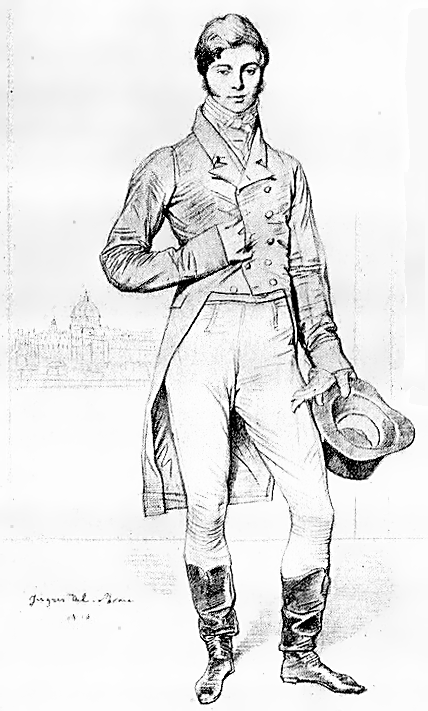
The illustrations are of a lady wearing 1815 walking costume, from Ackermann's Repository (at Wikipedia), and a sketch of Lord Grantham by J.A.D. Ingres, 1816, also from Wikipedia. In this context I think the lady looks as though she's been highly distressed by the ending of the Regency romance lines, or it may be that she's upset that Lord Grantham isn't paying her any attention.

Thursday, October 19, 2006

Not-so-secret Children and Babies

Today I want to go, if not from the sublime to the ridiculous, at least from the Platonic ideal to the more prosaic reasons why children might be included in romances.

First of all, children may, as suggested in the Symposium, be the embodiment of a couple's love. However, although children can be read as proof of a couple's continuing love and affection (or at least, of an active sex-life), they may be indicative of little more than considerable fecundity and a lack of contraceptives. In Georgette Heyer's The Grand Sophy, for example, Lady Ombersley, a minor character, is described in the following terms: Twenty-seven years of wedlock had left their mark upon her; and the dutiful presentation to her erratic and far from grateful spouse of eight pledges of her affection had long since destroyed any pretensions to beauty in her' (1951: 2). Despite being referred to as 'pledges of her affection', it's clear that the children are not the result of the sort of romantic love one would expect the hero and heroine of a romance to feel for each other.

New babies, as well as being 'pledges of affection' may also serve to reinforce the depiction of a society undergoing change. According to Pamela Regis one of the essential elements of the romance genre is 'Society Defined' and 'Near the beginning of the novel the society that the heroine and hero will confront in their courtship is defined for the reader. This society is in some way flawed' (2003: 31). Regis also describes some additional 'accidental elements characteristic of the romance novel' (2003: 38) which occur towards the end of the novels and these include the wedding/dance/fete which demonstrates that 'Society has reconstituted itself around the new couple(s) and the society comes together to celebrate this' (2003: 38). If the hero and heroine have children together these can be interpreted as being among the first new members of this new, 'reconstituted' society, and a hope for the future.

From the point of view of the plot, children and babies can often provide a reason for a hero and heroine to meet or work closely together for the first time, or, in the case of many of the secret-baby books, to come back into contact with each other. Babies and children may be a source of conflict between the hero and heroine but they cannot simply walk away because the children have needs (for care, a home etc) which force the hero and heroine into close proximity and oblige them to work with each other.

Whether or not babies are intrinsically romantic, however, is another matter. For Kimber, children are on her list of things in the romance genre which are 'Not Romantic':
what could be less romantic than having to keep the sex quiet in case Junior wakes up in the night and comes down looking for a drink of water? Or when Little Susie gets a life-threatening fever or is kidnapped by the villain? Although better a son, since then your hero can effortlessly become the male role model/father figure that Young Master desperately needs.
The combined effects of dirty nappies, sleep deprivation, the baby's crying and the physical and emotional consequences of childbirth do not create the ideal circumstances for romantic interludes. Even if the baby is not the heroine's, she and the hero would still have to deal with the sleep deprivation, the nappies, crying, feeding etc. Babies in romance novels do tend to be remarkably easy to care for, but this is not necessarily unrealistic given that:
  • (a) some people have more help than others (for example, in historicals set among the aristocracy one might expect the heroine to have the help of a nursemaid or two)
  • (b) some people's experiences of this stage in a baby's life are better than others (some babies quickly sleep through the night and fall into a routine easily, for example)
  • (c) not all mothers experience negative physical or emotional consequences of childbirth.
Personally, however, I find the easy-care babies so often found in romances intensely irritating, but that's probably due to extreme jealousy on my part, because my baby was very far from the ideal in this respect.

Nicola Marsh is an author who used to think that children were 'contraception on legs', but after writing some romances featuring children, she changed her mind. In the comments on that blog post Fiona Lowe added that 'I reckon children are a GREAT way to showcase the softer side of our hero'. They certainly are seen to have that effect on the perception of Sophy, the heroine of Heyer's The Grand Sophy. Following Sophy's devoted nursing of her sick young cousin, Sophy's very conventional suitor, Lord Bromford, says that:
"[...] even Mama owns herself to have been moved by the devotion of Miss Stanton-Lacy to her little cousin!" [...] Lord Bromford, who had started to repeat O woman, in our hours of ease! [...] pronounced: "Any doubts that might have been nourished of the true womanliness of Miss Stanton-Lacy's character, must, I venture to say, have been lulled to rest." (1951: 224-225)
It's not simply that the ability to interact with children shows a 'softer' side, it's also that children, particularly young children and babies, are often considered innocent.
Around the enlightenment period of the eighteenth century, popular conceptions of childhood changed. Society adopted the idea of the "blank slate" and beginning life in a state of unconsciousness. Art reflected the transition: no longer vessels of psychological and sexual awareness, children became asexual, physically neutral, and psychologically unaware. The "Romantic child" was born. [...] No longer considered little adults in need of moral reform, children became icons of innocence and naivete onto which adults could project their own hopes, dreams, and ideals.
As a result of this belief in their innocence, the approval of children, like that of dogs and other animals, is often an indication that a character who may appear wicked, depraved, or merely lacking in conscience, in fact has redeeming features. For example, here's a short conversation from Heyer's Frederica, between Felix, the heroine's young brother, and the self-centered Lord Alverstoke, the hero, who has already met, and successfully dealt with Lufra, Frederica's very large and unruly dog:
before suffering himself to be led away by Charis, [Felix] took his leave of the Marquis, and said eagerly: "And you will take me to Soho, won't you, sir?"

"If I don't, my secretary shall," replied Alverstoke.

"Oh! Well - Well, thank you, sir! Only it would be better if you came with me yourself!" urged Felix.

"Better for whom?" demanded his lordship involuntarily.

"Me," replied Felix, with the utmost candour. "I daresay they would show you anything you wanted to see, on account of your being a - a second-best nobleman, which I know you are, because it says, in a book I found, that Marquises come directly after Dukes, so--"
In addition to this ability to bring out the best in adults, 'out of the mouth of babes and sucklings' can come forth truths that adults would either leave unspoken, or of which adults might otherwise remain in ignorance.

It has to be admitted that, on occasion, the children in romance can bear an unfortunate resemblance to those George Eliot mentions in her description of 'Silly Novels by Lady Novelists' (1856):
There are few women, we suppose, who have not seen something of children under five years of age, yet in "Compensation," a recent novel of the mind-and-millinery species, which calls itself a "story of real life," we have a child of four and a half years old talking in this Ossianic fashion -
"Oh, I am so happy, dear gran'mamma; -- I have seen, -- I have seen such a delightful person: he is like everything beautiful, -- like the smell of sweet flowers and the view from Ben Lomond; - or no, better than that -- he is like what I think of and see when I am very very happy; and he is really like mamma, too when she sings; and his forehead is like that distant sea," she continued, pointing to the blue Mediterranean; "there seems no end -- no end; or like the clusters of stars I like best to look at on a warm fine night [...]"
Luckily child prodigies are not the only, or even the most frequent, sort of child depicted in romance. There are plenty who are interesting characters in their own right, with their own particular flaws and quirks. For example Lou, the heroine of Jessica Hart's Contracted, Corporate Wife, says of her teenaged children:
'I’d like to be able to say that I had raised a couple of thoughtful, unmaterialistic, community-minded children who understood that the love and security you strive to give them mattered more than the latest brand of trainers or the newest computer game, but sadly they’re not like that at all!’
‘Oh?’ said Patrick, rather taken with the idea that Lou’s children weren’t the paragons he would have expected them to be. He found her attitude refreshing. He’d had to listen to too many mothers telling him how clever and talented and generally marvellous their children were.
‘They’re not bad kids,’ said Lou, ‘but they’re like all their friends. They want to be in with the in-crowd, to be like everyone else and to have what everyone else has. [...].’ (2005: 41)
In romances with more realistic portrayals of children, the hero and heroine's difficulties in caring for children and babies may provide an interesting source of discussion for the adults, revealing their own experiences of childhood. In Polly Forrester's Jewel Under Siege, for example, the hero is a Frank, on crusade, while Elena Rethel is a Byzantine merchant. Their ideas about child-rearing reveal much about the adults' different cultures:
'You'll spoil that child, if you haven't already.'
'Oh, but he's only a baby, my lord. Not even three years old, yet.'
'Time enough to be spoiled by rich food and an indulgent mother. Well-born Franks are sent from home at four to become pages. By then they're hardened enough to wait at tables and live with the hounds. That soon puts some character into them. Sink or swim.'
"I don't doubt it, my lord. Yet what sort of people raise their children among animals? [...]'
'People whose men are more than milk and water. Men who will fight for what they know is right, and will not dress in effeminate fashions [..]' (1990: 89-90)
The hero and heroine's attitudes towards children can be instructive in contemporary settings too, often giving clues about their own very different childhood experiences. In historical romances (of the non-wallpaper variety) attitudes towards childcare form part of the historical setting, reminding us that, in many respects, 'the past is a foreign country; they do things differently there'. As Jo Beverley observes
The way we portray children and parenting in books can be interesting. I don't think we can help bringing some modern sensitivities to it, but I like to try to get within the thinking of the day. For example in one of my books, CHRISTMAS ANGEL, Judith and Leander fall into fights about the raising of her children. She wants to protect them from hurt while he believes boys sometimes need the cane. Speaking from his own experience, he claims to have preferred it to endless lectures and tiresome punishments such as writing out pages of the Bible. And he adds that as Bastian won't escape being beaten at school, he might as well learn to accept it with dignity. That, to me, is true to the times, but it bothered some readers.
There's a lot of variation in the way children and babies are portrayed, depending on factors such as the level of realism with which they are described, the historical setting and the ages of the children. Sometimes children seem to be included mainly for their cuteness factor, and because they provide a source of conflict or otherwise propel the plot forwards. At others, the children are well-developed characters in their own right.
  • Forrester, Polly, 1990. Jewel Under Siege (Richmond, Surrey: Harlequin Mills & Boon).
  • Hart, Jessica, 2005. Contracted, Corporate Wife (Richmond, Surrey: Harlequin Mills & Boon).
  • Heyer, Georgette, 1951. The Grand Sophy (London: The Book Club).
  • Regis, Pamela, 2003. A Natural History of the Romance Novel (Philadelphia: University of Pennsylvania Press).