Showing posts with label Sandra Schwab. Show all posts
Showing posts with label Sandra Schwab. Show all posts
Thursday, April 10, 2014
Free Access to Articles on Disability in Romance
For a limited period only, access to the Journal of Literary and Cultural Disability Studies is free. It's a great opportunity to get hold of:
Baldys, Emily M. “Disabled Sexuality, Incorporated: The Compulsions of Popular Romance”. Journal of Literary and Cultural Disability Studies 6.2 (2012): 125-141.
Cheyne, Ria. “Disability Studies Reads the Romance.” Journal of Literary and Cultural Disability Studies 7.1 (2013): 37-52.
Schwab, Sandra. “‘It Is Only with One’s Heart That One Can See Clearly’: The Loss of Sight in Teresa Medeiros’s The Bride and the Beast and Yours until Dawn.” Journal of Literary and Cultural Disability Studies 6.3 (2012): 275–289.

Monday, October 22, 2012
Sandra on Seeing Clearly

It's not a question that can be answered fully in just one paper, so Sandra focuses her discussion on two novels by Teresa Medeiros. As stated in the abstract, Sandra concludes that "Medeiros rejects various dominant cultural stereotypes about visual impairment and disability such as the disempowerment and perceived helplessness of blind characters" but she adds that,
even if in The Bride and the Beast the lack of sight becomes a vehicle to criticize the body cult in romance fiction and even if Yours until Dawn rejects many common stereotypes about disability and closes with a reference to the old body, the literal cure in both novels aims at normalizing the bodies of the protagonists and thus results in what Davis has called “the neutralizing of the disability” (542). In regard to visual impairment, this is a common trope in romance fiction, whereas other forms of disability are often used to enhance the dark appeal of the male protagonist and act as externalizations of his inner wound. Though the genre thus creates new stereotypes about disability, [...] it generally rejects depictions of disability as a disempowering force that creates helplessness and dependence. (288)-------
Schwab, Sandra. “‘It Is Only with One’s Heart That One Can See Clearly’: The Loss of Sight in Teresa Medeiros’s The Bride and the Beast and Yours until Dawn.” Journal of Literary & Cultural Disability Studies 6.3 (2012): 275–289.
Thursday, February 11, 2010
Romance and "The Cultural Production of Disability"
present difference: the cultural production of disability was a conference held in Manchester this year from the 6th to the 8th of January. The full programme can be found here. Included in it was a session on "Genre Fiction" which featured the following papers:
Those links will take you to details about the speakers, and to synopses of their papers, but I've cut and pasted in the synopses here to try to preserve them for posterity, just in case the original webpages about the conference are taken down.
- Ria Cheyne Liverpool Hope University
‘We are both maimed’: Disability and Trauma in Historical Romance
This paper explores the relationship between disability representation and genre conventions in the historical romance subgenre, focusing on the work of bestselling author Mary Balogh. Balogh’s novels frequently feature disabled characters. I focus on two novels featuring disabled heroes, The Secret Pearl (2005) and Simply Love (2006). In these novels, the war-wounded hero’s physical trauma is equated with psychological trauma suffered by the heroine. ‘We are both maimed’, as the hero of Simply Love puts it. Yet this recognition of kinship is not enough to ensure the successful conclusion of the romance plot; before the hero and heroine can be permanently united, the hero has to confront his own internalisation of what Carol Thomas terms the psycho-emotional aspects of disability, and understand himself as worthy of the heroine’s love.
Balogh’s use of disability allows her to create a compelling romance narrative, a refreshing antidote to the blandly attractive couples who populate the genre. Equally, though, the conventions of historical romance – particularly its combination of a contemporary sensibility with a setting remote in time – allow her to do particular things with disability representation. Disability is frequently marginalised in romance narratives (rendered invisible by the eyes of love or even cured by love) but in Balogh’s work impairment is accepted as an integral part of the beloved, is a part of everyday life, and disability is located in society as well as in the individual body. Rather than enforcing normalcy, then, Balogh’s novels challenge it.- Kathleen A. Miller, University of Delaware
What’s At Stake?: Dis/Ability in Tanya Huff’s and Charlaine Harris’s Contemporary Vampire Romance Fiction
With the phenomenal commercial success of Stephenie Meyers’s Twilight series, vampires—and, more specifically, vampire-human romance narratives—have become big business. Reading Tanya Huff’s Blood Price and Charlaine Harris’s Dead Until Dark, as well as their television adaptations (respectively, Blood Ties and True Blood), through the conventions of romance and female gothic genre fiction, I suggest that these texts present readers with messages of female freedom and gender equality. But as scholarship by Rosemarie Garland Thomson and Martha Stoddard Holmes on the literature of disability helps us to see, these feminist statements also come filtered through the texts’ compelling narratives of disability. Each work advances a red-herring theory that vampirism is actually a disability, a form of chronic illness; nonetheless, despite their “disability,” the vampires prove to be “hyper-able” — destined to live eternally, impervious to most bodily threats, and uncannily gifted as lovers. Yet vampires are not the only ones to challenge categories of ability and normalcy in these texts, for the central human characters are disabled heroines, who also prove extraordinarily able. Huff’s female protagonist has a degenerative eye condition, while Harris’s protagonist identifies her telepathy as a “disability.” Through their status as heroines with seemingly disabling “differences,” they display their various abilities, including their strength, insight, and romantic desirability. Furthermore, negotiating and embracing their disabilities leads them to challenge existing notions of gender roles and to construct new alternatives for female accomplishment. Much like that of the supernatural vampire, the disabled female physical body becomes extraordinary, as it helps the protagonists to counter threats of violence and to protect themselves and those around them. In these works, as I will demonstrate in my paper, women authors are using the trope of disability to reclaim the female body in the popular imagination, even as they contribute to the reinvention of the vampire romance genre.- Sandra Martina Schwab, Johannes Gutenberg-Universität, Mainz, Germany
"It is only with one's heart that one can see clearly": The Loss of Sight in Teresa Medeiros's The Bride and the Beast and Yours Until Dawn
The ability to see clearly and the loss of sight play an important role in the historical romances The Bride and the Beast (2001) and Yours Until Dawn (2004) by the American author Teresa Medeiros. While Yours Until Dawn features a blind hero, large parts of The Bride and the Beast are set during the night, and the darkness makes the heroine unable to see the face of the male protagonist. In both books the physical inability to see clearly is not only connected to a lack of recognition, but is also indicative of a lack of psychological insight. In Medeiros's two novels blindness thus functions as a symbol for internal problems the characters have to overcome in the course of the stories, namely their inability and unwillingness to face the truth about oneself and others. This psychological blindness also hinders the development of the love relationships. Therefore in both books the happy ending is dependant on the protagonists learning the same lesson the Fox teaches Saint-Exupéry's Little Prince: "It is only with one's heart that one can see clearly. What is essential is invisible to the eye."
Thursday, January 07, 2010
Sandra posts about Kathleen Givens
 As mentioned at Kathleen Givens's website, "Kathleen passed away in early January 2010" and there have already been a number of posts written by people who knew and loved her and her works. Sandra, in her post at Unusual Historicals, writes that Givens's Kilgannon
 was one of the first romances I read as romance fiction (I had read Victoria Holt and Penelope Williamson before, but had thought them historical novels), and I still remember how thrilled I was to have found a genre of historical fiction where heroines are strong and happy endings are guaranteed. And so Kilgannon became one of the books that inspired me to write my first romance novel.
In 2005 I was working on a paper on the depiction of Scotland in American romance novels and decided to use Kilgannon as my main example. I contacted Kathleen and she graciously agreed to answer a few questions about the book. [...] She was a great author and a wonderful person, and I will miss her very much.
Thursday, December 17, 2009
Congratulations, Sandy!
 She has slain her papery dragon and convinced her oral examiners of her prowess so she is now Dr Sandra Schwab! Her thesis is titled
 "Of Dragons, Knights & Virgin Maidens - Dragonslaying and Gender Roles from Richard Johnson to Modern Popular Fiction." It's basically an overview of the development of the dragonslayer story from 1596 to 2002, covering Elizabethan romance, folk literature, nineteenth-century & early-twentieth-century medievalism, fantasy and romance. The focus is mainly on the development in Britain, but I also discuss a few German ("Kinder- und Hausmärchen"!) and US American texts.
The origami dragon was designed and made by OrigamiWolf and copied in accordance with the Attribution-Non-Commercial-Share Alike license.
Friday, November 06, 2009
Heyer and Austen: Historical vs. Contemporary Fiction

This weekend I'm travelling (but not in the stylish conveyance depicted on the left) to Lucy Cavendish College, Cambridge, where I'll be presenting a paper on didacticism and The Nonesuch at a colloquium titled "Re-reading Georgette Heyer." I'm planning to take notes of the other speakers' presentations so that I can write up a summary when I get back. In the meantime, I thought I'd leave those not able to attend with a post about Georgette Heyer.
Lillian S. Robinson, in her 1978 essay "On Reading Trash" states that "Most of this essay will be focused on a contrast between the works of Jane Austen and those of Georgette Heyer" (202). The comparison seems to have been prompted by the way in which Heyer's novels have been marketed:
Georgette Heyer is the acknowledged Queen of the Regency romance (later paperback editions make some such peculiar claim), and it is a clear selling point to say that the book you are touting is just like "a" Georgette Heyer [...]. But for Heyer herself there can be only one predecessor sufficiently glamorous and sufficiently connected in the public mind with the Regency period and that is Jane Austen. (208)For Robinson "the comparison can only prove disappointing" (208) yet she suggests that "Once the absurd incongruity of any connection between the two writers is duly acknowledged and assigned its proper weight, it has much to tell us about female literary experience" (202). Robinson's sense of the "absurd incongruity of any connection" between Austen and Heyer is based on her assessment of their respective literary merit (or lack of it, in the case of Heyer). Having made the comparison at some length, however, she concludes that
I can imagine no greater waste of energy than an elaborate demonstration that Jane Austen is a better writer than Georgette Heyer. In drawing so extensive a comparison between the two, my intention has not been to belabor the obvious points about what makes a great writer great. (220)Personally, I'm rather less sure of what "obvious points" there are that make "a great writer great." I'm fairly sure that some of the writers who've been acclaimed as "great" in one period have gone out of fashion in others, so I'd have been interested to know the criteria by which Robinson judged greatness.
In her essay, the "extensive [...] comparison" she makes focuses on the differing ways in which Heyer and Austen present details of customs, dress, etc. Heyer's novels, Robinson states, "concentrate on precisely those minutiae of dress and décor that Austen takes for granted" (208). Can the presence of such details be sufficient to determine a lack of "greatness"? Robinson describes this sort of material in Heyer's novels as "pseudoinformation not because it is untrue [...] but because, ultimately, it reveals nothing about the society that fostered an institution like Almacks as its elite marriage market" (212) whereas Austen "communicates a far more vivid sense than we can attain to of the daily reality" (216) of life in the Regency period. I think this perhaps underestimates the amount and variety of historical information that Heyer's novels do convey about the Regency period. The "pseudoinformation" collected and organised by Jennifer Kloester (who will also be at the Heyer colloquium this weekend) in Georgette Heyer's Regency World makes for quite a substantial book. Heyer's information may not be of the type that most interests Robinson, but I think she goes too far in labeling it "pseudoinformation."
In addition, that Austen can convey a "vivid sense [...] of the daily reality" of living in the Regency period must surely be ascribed, at least in part, to the fact that Austen was writing contemporary novels, for a contemporary audience. Heyer was writing historical fiction, for a modern audience, a fact of which Robinson is well aware. Sarah Bower (2004) has noted that
Madame Bovary, Jane Eyre and Pride and Prejudice are not historical novels; their authors were writing about their own contemporary society, though, thanks largely to Andrew Davies, we are inclined to categorise them as period or costume dramas. The difference is, I think, self-evident.Bower, however, does not seem to have found it so entirely self-evident as to make her own work superfluous, and her essay explores some of the ways in which "historical setting can heighten the effect of the romance." One of the ways derives from
the physical attributes of this “other country” called the past [which] can have an important role in raising the temperature of a romance. [...] What could be more romantic than Ivanhoe, armed and visored, under the escutcheon of the Disinherited Knight, tilting for love and English honour in the lists at Ashby de la Zouche?As for the "pseudoinformation" so scorned by Robinson, Helen Hughes's response, as summarised by Sallie McNamara, might be that it owes its presence to the different requirements of historical fiction: "She argues that the language used, details of clothing, and so on, relating to the period, create a sense of verisimilitude" (85). Robinson acknowledges that they do serve this purpose but phrases her recognition of this in pejorative language:
Heyer [...] tells us about colors, cut, fabric, and trimming, [...] not only because the acquisition and display of clothing are more central to the existence of Heyer's heroines than they are to Austen's, but in order to invest the novels with that meretricious quality Henry James would have called "the tone of time." (208)If Robinson had wished to compare like with like, she could perhaps have compared Heyer's novels to texts such as Sir Walter Scott's historical novels (including Ivanhoe, the novel mentioned by Bower), some of which were published before Austen's death but were set in much more distant historical periods. Robinson does not do so, however, and her insistence on comparing works of contemporary fiction with works of historical fiction, and then denigrating the latter because they are less authentic in representing the period in question than the former, suggests an inherent preference for contemporary fiction which neither Heyer nor any other author of historical fiction could entirely overcome. Robinson believes that
since historical fiction almost invariably takes the position that progress is desirable and that which in character, taste, or judgment most resembles present Western civilization is best of all, the context is created for a melioristic approach to historical process. At the same time, human personality tends to be portrayed as static, in that the most admirable and heroic characters have a modern view of themselves and what happens to them. The general impression one comes away with is that things used to be different (harder) for women way back then (whenever), but that women themselves were precisely the same [...] in what they needed, asked, or found in life. (207)I think Robinson is correct in believing that historical fiction may have much to tell a careful reader about the period in which it was written but she gives little evidence to support her assertion that "historical fiction almost invariably takes the position that progress is desirable and that which in character, taste, or judgment most resembles present Western civilization is best of all." Perhaps some, if not all, offer authors and readers space to make comparisons between the past and the present which are less conclusively in favour of modernity. Sallie McNamara suggests that
The historical romance offers distance from the period in which it is written. Anxieties or tensions in relation to the contemporary society (of gender and sexuality) can be reworked within a constructed historical setting. (84-85)Jane Austen may have been "aware that new social forces do encroach on the way of life - prosperous, decorous, and cultivated - that is the common heritage of Mansfield, Pemberly, Hartfield, Kellynch, Norland, and Northanger" (Robinson 214) but Heyer was also aware of "new social forces" encroaching, as is evident from her statement that she was "made violently unwell by the reflection that I am being forced to contribute towards a Welfare State of which I utterly Disapprove" (Aiken Hodge 122). Heyer, it would seem, did not believe that "present Western civilization is best of all," at least not in all respects. Sir Walter Scott, too, may have expressed in his novels some of the "Anxieties or tensions" which existed in his period. Sandra Schwab believes that "Sir Walter Scott, whose historical novels filled with knights, adventure and romance (Ivanhoe anybody?), certainly has to shoulder a large part of the blame" for Victorian medievalism which sought to "revive the spirit of the Middle Ages, the great ideals of "the days of old when knights were bold" (or at least what were thought to be the ideals of the knights of old)--in one word: CHIVALRY." Historical fiction which seeks to revive the spirit of an earlier age can surely not be read as an unambiguously triumphant statement to the effect that "progress is desirable and that which in character, taste, or judgment most resembles present Western civilization is best of all" (Robinson 207).
Historical fiction, then, while it may seek to teach the reader something about the period in which it is set, or at least be full of "pseudoinformation" may also, obliquely, suggest much about its authors' views of their own historical period, and those views may be rather more varied than Robinson seems to have recognised.
- Aiken Hodge, Jane. The Private World of Georgette Heyer. 1984. London: Arrow, 2006.
- Bower, Sarah. "Proud Protestations." Solander: The Magazine of the Historical Novel Society 8.1 (May 2004): 24-26.
- McNamara, Sallie. "Georgette Heyer: the Historical Romance and the Consumption of the Erotic, 1918-1939." All the World and Her Husband: Women in Twentieth-century Consumer Culture. London: Cassell, 2000. 82-96.
- Robinson, Lillian S. "On Reading Trash." 1978. Sex, Class, and Culture. New York: Methuen, 1986. 200-222.
- Schwab, Sandra. "Social Movements: Victorian Medievalism." Unusual Historicals, 23 April 2008.
Tuesday, July 07, 2009
Here be Dragons! And Fairytales and Romance Writers

Sandra's still fighting with dragons, almost literally so, since they're the topic of her dissertation, so to encourage her I thought I'd link to an online short story about a dragon. It's not a romantic story, but in "The Last Dragon" by Janet Gover the heroine is also struggling with a manuscript, albeit as an illustrator rather than as an academic, so it seemed appropriate:
There was a manuscript in that folder lying on a chair. An epic tale of heroism.... of knights and dragons and beautiful princesses. It was a story to delight any small child. Clare had one more week to illustrate the tale, or the author and publisher would turn elsewhere. She wouldn’t blame them. The few sketches she’d tried in the past few weeks had been lifeless and dull. Like the endless days she was now living.Since that one's not a romance, I thought I'd better include some that are. Here's another short story by Janet Gover, this time based on a fairytale and titled "Fairy Godmothers Need Not Apply." Fairytales seem to have inspired quite a few romance authors (you can browse SurLaLune's list of just a small selection of some fairytale inspired romances, if you're interested).
She desperately hoped things would be different in this place. Wales was full of dragons. She would find inspiration. Her muse would return. Starting tomorrow!
To finish off, I'll link to one last short story by Janet Gover. This one is a metaromance, and I haven't mentioned one of those at TMT for quite a while. It's called "The Romance Writer." The metaromance includes excerpts from a novel being written by the eponymous romance writer, and the romance reader in the story describes what she reads as "very good; easily as good as anything on her bookshelves." It's always struck me as a bit risky for a writer to include texts supposedly written by her/his characters and which are accepted, within the work of fiction, as being of high quality. What happens if the real reader assesses them differently? Does that change the whole impact of the piece? And how does it affect the real reader's impression of the real author's own writing?
The Welsh dragon is from Wikipedia.
Sunday, February 22, 2009
Reading the Romance: The Mainz Syllabus
As I've already announced in an earlier post, next winter I will give a course on British romance fiction at Mainz University. It will be one of our (brandnew) undergrad seminars 1, which are intended to give students a historical overview of one particular genre.
I've chosen a mixture of a chronological and thematic approach for the course, and these are the thematic blocks I've come up with so far:
1 Reading the Romance
This block will probably include a mini-history of the genre, and we will read excerpts from theoretical works on romance fiction (probably Radway, Flesch, Regis).
2 Austen Ever After
Austen's lasting influence on the genre.
Texts:
Jane Austen, Pride & Prejudice (I've taught P&P once before, and it was great fun for me to incorporate the research I had done for my novels in the course)
Georgette Heyer, Regency Buck (aka the book I'm currently reading; at the moment I'm thinking about what would be the best way to give the students access to the wealth of historical background in the novel - more presentations, perhaps?)
Presentations on:
Helen Fielding, Bridget Jones's Diary
Alexandra Potter, Me and Mr Darcy
3 Gothic Delights
Text:
Victoria Holt, Mistress of Mellyn (that will be a nice trip back into my own past: in my teens I read umpteen of Holt's novels)
Presentations on:
the gothic novel as a genre
Jane Eyre
Rebecca (probably)
4 101 Years of Mills & Boon
Text:
probably Lucy Gordon, The Italian's Wife by Sunset
Presentation on:
the history of M&B
~*~
I'm not yet quite sure what to do with Barbara Cartland. I'll definitely have to mention her somewhere, somehow, especially as her heroines are so very different from Heyer's. I'm also thinking about including Hull's The Sheik on the reading list, but I still have to read it myself before I decide where and how to place it. Of course, I also have to consider the time frame of the course: I've already got four novels I want to discuss, and I need two lessons for each at the very least.
So what do you think?
I've chosen a mixture of a chronological and thematic approach for the course, and these are the thematic blocks I've come up with so far:
1 Reading the Romance
This block will probably include a mini-history of the genre, and we will read excerpts from theoretical works on romance fiction (probably Radway, Flesch, Regis).
2 Austen Ever After
Austen's lasting influence on the genre.
Texts:
Jane Austen, Pride & Prejudice (I've taught P&P once before, and it was great fun for me to incorporate the research I had done for my novels in the course)
Georgette Heyer, Regency Buck (aka the book I'm currently reading; at the moment I'm thinking about what would be the best way to give the students access to the wealth of historical background in the novel - more presentations, perhaps?)
Presentations on:
Helen Fielding, Bridget Jones's Diary
Alexandra Potter, Me and Mr Darcy
3 Gothic Delights
Text:
Victoria Holt, Mistress of Mellyn (that will be a nice trip back into my own past: in my teens I read umpteen of Holt's novels)
Presentations on:
the gothic novel as a genre
Jane Eyre
Rebecca (probably)
4 101 Years of Mills & Boon
Text:
probably Lucy Gordon, The Italian's Wife by Sunset
Presentation on:
the history of M&B
~*~
I'm not yet quite sure what to do with Barbara Cartland. I'll definitely have to mention her somewhere, somehow, especially as her heroines are so very different from Heyer's. I'm also thinking about including Hull's The Sheik on the reading list, but I still have to read it myself before I decide where and how to place it. Of course, I also have to consider the time frame of the course: I've already got four novels I want to discuss, and I need two lessons for each at the very least.
So what do you think?
Thursday, February 12, 2009
Reading the Romance

Would you like to take a course on the history of British romance fiction? Then come to Mainz this autumn!
In the next winter semester I will teach a course called "Reading the Romance," in which we will trace the development of British romance from Austen to Heyer to Bridget Jones, from the gothic novels of the eighteenth century to Jane Eyre to The Mistress of Mellyn. And, of course, we will also discuss Mills & Boon and their role in the evolution of romance in Britain.
Needless to say that I'm thrilled to pieces!
Friday, October 03, 2008
Negotiating Gender Relations: Penny Jordan's They're Wed Again
At the Feminism and Popular Culture Conference last year, Laura gave a paper on "Feminism Revisits Mills & Boon: Second and Third Wave Contexts and Struggles in Two Mills & Boon Lines," in which she argued that
one can find parallels between the social and economic contexts in which many heroines of the M&B 'Modern' / Harlequin Presents line find themselves, and society as critiqued by Second Wave feminists. One could characterise the line as being one where there is conflict between men and women, creating an impression of a battle of the sexes [...]This conflict between men and women is typically emphasised by an inequality of power and social status at the beginning of a novel: the hero has the advantage because of his wealth and the power it involves,* while the heroine is often less well off and overall in a more vulnerable position than the hero. Yet by the end of the novel, the external and internal conflicts have been overcome and, as Laura wrote in her blog post, the heroine "has achieved sexual fulfillment, equality within marriage and the freedom to pursue her career should she wish to do so."
 When I read Penny Jordan's They're Wed Again (1999/2008) I was forcibly reminded of Laura's paper, not because Jordan's book is a typical M&B Modern romance, but because it's not. They're Wed Again is a second-chance-at-love story about a divorced couple who meet again before the wedding of the heroine's niece due to a mix-up with the invitations. The story of their marriage is told in flashbacks as both protagonists ponder on what went wrong with their marriage and where they made mistakes. This premise in itself is rather unusual: many second-chance-at-love stories within in the Modern line involve some sort of revenge plot** and a hero who thinks himself wronged by the heroine.
What lay at the root of the protagonists' problems in Jordan's novel is just as unusual because it turns a typical Modern / Presents scenario upside down: "It had been a private joke between them in those early days that she was the one with the large salary and the company car, whilst he was the one still eking out a meagre living on a grant" (Jordan 8). Yet the joke soon turns sour when Luc, the hero, feels more and more inadequate: "'It hurt me that I couldn't afford to provide you with the material things you wanted, that I wasn't the one paying the mortgage, that I couldn't go out and order that bed you wanted ...'" (Jordan 71). The financial inequality in their marriage challenges Luc's masculinity and he feels "demeaned" (Jordan 71) because he cannot not fulfill the traditional role of the provider and breadwinner in the family. In the intervening years, however, he has come to realise that it was wrong to let old gender roles dictate his life:
Certainly it had seemed impossible at the time for them to be able to reconcile their growing differences, but in the years since then his position [he is a Maths professor] had given him plenty of opportunity to observe and consider the changes taking place in the way the sexes related to one another and ran their relationships. (Jordan 53)In hindsight, he now acknowledges, "If I was proud then it was a false pride. My pride should have been in you, in what you were doing for both of us, in what we are achieving by working together." (Jordan 71)
The heroine, on the other hand, used to be a career woman, and at one point her husband "accused her of putting her career above their marriage" (Jordan 39). But just as Luc now views his behaviour in the past in a different light, so does Belle:
[...] she was beginning to respond to a previously unacknowledged need to allow things into her life other than her work, beginning to admit to a sense of awareness that there were certain things she was missing out on [...] (Jordan 39)In They're Wed Again Jordan thus explicitly discusses gender relations and makes questions of gender and equal opportunities a central focus of her story. In contrast to many other M&B Modern / Harlequin Presents novels, the battle between the sexes took place in the past (and eventually resulted in the break-up of Luc and Belle's marriage). When the story opens, the protagonists are now equal in all ways, and they have also reached a more balanced view on gender relations and on combining career and family. Thus, one could argue that the problems the protagonists face in the past of the novel are those of Second Wave Feminism, while the present stands for Third Wave Feminism and its struggles. Remarkably, this difference is perceived by the characters themselves. Comparing the young couple whose wedding they will attend, with themselves, Luc says, "'Fortunately his generation has a far healthier and more flexible attitude towards interchanging the traditional roles than ours perhaps did'" (Jordan 48, emphasis mine).
In the paper I mentioned at the beginning of this post, Laura argued that issues of Third Wave Feminism are more likely to be found in another line of Harlequin Mills&Boon: in the Romance line: "The second line I looked at is the 'Romance' line and the heroines of this line find themselves in a context which more closely resembles those in which Third Wave Feminists have reached adulthood." And again, she quoted from the submission guidelines: "the guidelines state that the novels must be 'About a hero and heroine who are equal (they need each other, their strengths and weaknesses balance the other's).'" As I have shown, Jordan's novel transcends these guidelines and combines elements from the Modern / Presents line with those from the Romance line.
- Penny Jordan. They're Wed Again. The Mills & Boon Centenary Collection. Richmond: Harlequin Mills & Boon, 2008.
* Indeed, many of the M&B Modern heroes are what I call uber-alpha males: they are not only billionaires, no, they are Greek/Italian/Spanish billionaires because it would seem that the blood runs hotter in the veins of men from southern Europe than in those from dear, old England.
** One author who is great with revenge plots is Lynne Graham: see Claiming His Wife and Child, an anthology published as part of the "Queens of Romance" series in 2006. It contains two novels from 2000 and 2001 respectively, One Night with His Wife and Duarte's Child. As the second title implies, there are also secret babies involved.
Friday, May 09, 2008
Sandra Schwab - Bewitched
 The response of reviewers to Sandra Schwab's Bewitched has ranged widely, from an A- at The Good, The Bad, The Unread, where Sandy M. stated that Schwab's "books are always innovative," through a 4-star review at Romantic Times where Kathy Robins rather intriguingly declared that it "captures the aura of the Regency," to a D at AAR, whose Cheryl Sneed felt that the language in which the book was written was anachronistic:
 At times it is very modern in tone and I felt like Schwab was channeling Chandler Bing when Sebastian says things like, "I am so going to break your heart." And then there's Sebastian's favorite expletive: "heck." Heck?! This seemed so out of place that I had to look it up. First recorded use: 1865. But more than the historical inaccuracy is that this is so not how an English nobleman, a rakish man about town, would choose to express himself when perturbed.One might, of course, feel that the anachronisms are innovative. You can read two long excerpts, of the whole of the prologue and first chapter, and see what you think. Sandra herself has written that "the prologue for Bewitched opens with a panorama of the English Midlands, which was inspired by Tennyson's 'Lady of Shalott.'" That poem, first published in 1833, "recasts Arthurian subject matter loosely based on medieval sources" (Wikipedia) but reflects Victorian attitudes towards women.
One can perhaps see parallels between Schwab's Victorian-influenced Regency setting (with medieval, and even more ancient elements) and the Victorian period's medievalism which, as Sandra has observed, created a "romanticized version of the Middle Ages."
 If the Victorians' Middle Ages was a romanticised and idealised version of the past rather than an accurate recreation of it, Schwab's novel, which draws on Victorian sources and is clearly marked as unreal by the inclusion of magic, has a similar approach to history. Many of the details are historically accurate, but the end result is like a fruit punch which takes the Regency period as its basic ingredient, passes it through a modern sieve and then mixes it with a good dollop of magic and a splash of Victorian spirit.
The description of the way in which Amy and Fox savour the taste of an alcoholic beverage they consume reminded me of a scene in Lewis Carroll's Alice in Wonderland:

she found a little bottle on it, [...] and round the neck of the bottle was a paper label, with the words `DRINK ME' beautifully printed on it in large letters. [...] It was all very well to say `Drink me,' but the wise little Alice was not going to do that in a hurry. `No, I'll look first,' she said, `and see whether it's marked "poison" or not' [...] However, this bottle was not marked `poison,' so Alice ventured to taste it, and finding it very nice, (it had, in fact, a sort of mixed flavour of cherry-tart, custard, pine-apple, roast turkey, toffee, and hot buttered toast,) she very soon finished it off. (Chapter 1)Fox and Amy's drink isn't marked as "poison" either, so they drink and:
A wave of red rolled towards him. Cinnamon and clove enveloped him in their mingled scent as the punch flowed into his mouth and exploded on his tongue. Wine and cinnamon and clove and a dreadful bitterness. And salty like tears. He grimaced and put his glass down. [...] He took another cautious sip. The bitterness was still there, if somehow muted. In fact, it tasted better now. (45)Like the drink which causes Alice to shrink, the punch that Amy and Fox consume has a very unexpected side effect (it seems extremely apt that the novel was published under Dorchester's Love Spell imprint). There is an echo of this scene later in the book, when a non-magical punch is prepared while Amy plans to tell Fox the truth about their earlier drink (217). Here's the description of Admiral Reitz preparing punch:
a special punch ceremony was held at Rawdon Park [...] the whole family assembled at a table in the drawing room. Admiral Reitz, it appeared, would act as the Master of Ceremonies. The children skipped from one foot to the other with excitement. "Feuerzangenbowle, Feuerzangenbowle," [....] The door opened and Ramtop, the butler, appeared, carrying an enormous pot filled with fragrant, steaming red wine. [...] Admiral Reitz made a bow in Amy's direction - "what we need for it is this: dry red wine boiled with orange slices, sticks of cinnamon, and cloves. A pair of tongs" - he picked up the item from the tray - "long enough to be laid across the top of the pot, and a sugarloaf." He took the white cone and wedged it into the tongs before he put them onto the pot. "And then, the most important ingredient: rum." (214-15)Schwab's Admiral Reitz, like Carroll's Alice, is a real person placed in a fictional world.1 As we are told in the author's note, "Bernhard Reitz is one of the leading critics in the field of British theatre [...] and he always serves Feuerzangenbowle at our annual Christmas parties at his house." Schwab also mentions there that "he is known to have reacted adversely to the suggestion to stage a performance of in-yer-face theatre (which usually includes a certain amount of violence, rape, exploding trash cans and the like) in his sitting room." In Bewitched the performance takes place elsewhere:
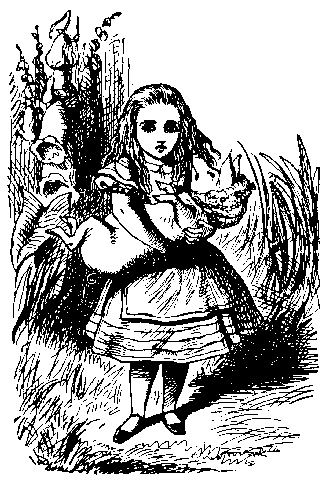
The admiral, coming to the table [...] "[...] have you heard of the latest theatrical scandal, Rawdon? [...] It has come to my ears that a certain nobleman, who shall remain unnamed, chose to have a production staged in his private theater [...] what if I tell you that the aforementioned production involved some ... um ..." He coughed delicately. "Flinging off of clothes?" [...] Underneath his mustache, the admiral's lips twitched. "And not only that. There were also some monkeys involved, or so I've heard. To top it all, a rubbish can was blown up onstage. Followed by a potted apple tree." [...]In the course of her research for her PhD thesis Sandra's been working on Sir John Tenniel's illustrations, including those of Alice in Wonderland and Through the Looking-Glass. One secondary text she acquired on the subject,
Shaking his head, Lord Rawdon took a fortifying sip of coffee. "I must say, this sounds quite in-yer-face." (111-12)
Frankie Morris's ARTIST OF WONDERLAND, [is] a book on the life and art of John Tenniel. It has already turned out to be a great find: one of the most exciting things, imo, is that Morris argues that many characters in Tenniel's illustrations are simply children or adults in costumes instead of a "real" rabbit or a "real" Duchess with a really big head.The almost bewildering number of animal metaphors Schwab uses to describe the human characters reminds me of Tenniel's illustrations, and their occasional metamorphoses may recall those of the baby in Alice in Wonderland who turns into a pig. The Admiral's "short, grayish blond moustache and dark suit lent him a faint resemblance to a sea lion - an uncommonly lean sea lion. One who wore a white and green striped shirt" (92). I imagine him looking a little like Tenniel's illustration of the walrus. The hero of the romance is Sebastian "Fox" Stapleton. He "stretched lazily, like a great cat before it goes on the prowl" (6) and he can look "like a big, fat tomcat that had just devoured a particularly tasty mouse" (16) but Amelia, our heroine (also known as Amy), believes that he is "as cold as a fish" (7). Amy herself, whom Fox admits is "lovely [...] in the way of a plump, golden partridge" (40), or perhaps "a quail" (42) is his prey. The predator will find himself trapped: an observer seeing them together states that "the Fox was stepping up to the bait in the trap" (39). Amy is also described as the worm that attracts the cold fish: "the fish has caught the worm" (39) and others are keen to ensure that "the fish is truly hooked" (40). Amelia is not, however, an entirely defenceless creature, for Fox imagines she would be capable of "peck[ing] [...] the poor chap to death with her sharp retorts" (41) and he observes her "Snapping and yapping like a rat terrier" (42).
Other characters are also compared to animals. Fox's servant sometimes looks at him "like a wounded doe" (29). A mysterious stranger has "movements as graceful as a cat" (13). Amy thinks that Fox's friend Drew, "With his curly blond hair and soulful brown eyes [...] reminded her of an overlarge puppy dog" (23) and when in love he "spout[s] the most nonsensical notions that would do any March hare proud" (16). Isabella Bentham observes that "all men sighed over Amy like a herd of dimwitted mooncalves" (11) and Isabella's mother had "what would have been a kind smile if her eyes hadn't glittered like a mad ferret's" (24), although Drew describes her as a "jabbering magpie" (31) . During a society event "the hum of voices rose and fell as if the guests had turned into a swarm of bees" (42). No wonder Amelia concludes that "all of London was filled with the strangest people" (24-25) and we, the readers, can imagine them in all their animal strangeness in a similar fashion to the way in which Alice's sister imagines "the strange creatures of her little sister's dream" (Chapter 12).
Part of the action of the novel is described in chess terminology:
Stapleton will want to go and visit his family soon. [...] thanks to our little intervention, he won't be able to stand even the thought of being apart from the object of his lovesickness for too long. [...] You should make sure your daughter accompanies them. [...] And then we shall make our Sicilian Dragon breathe fire.Lewis Carroll's Through the Looking-Glass "is loosely based on a game of chess, played on a giant chessboard with fields for squares" (Wikipedia).
Bentham looked at him blandly. "Dragon?" he asked.
The man looked him up and down. "Not a player of chess then." (52-53)
Another connection between Bewitched and the Alice stories, though perhaps a rather tenuous one, may be made via Alice's fall down a rabbit hole:
The rabbit-hole went straight on like a tunnel for some way, and then dipped suddenly down, so suddenly that Alice had not a moment to think about stopping herself before she found herself falling down a very deep well. Either the well was very deep, or she fell very slowly, for she had plenty of time as she went down to look about her and to wonder what was going to happen next. [...] suddenly, thump! thump! down she came upon a heap of sticks and dry leaves, and the fall was over. (Chapter 1)Goldschmidt suggested that "The fall down the rabbit hole was a symbol of sexual penetration, the doors surrounding the hallway represented female genitalia" (Leach) and William Empson
thought it all came down to wombs:Leach may state that these are "historically baseless womb-analogies" but they have indubitably helped to shape the reception of the text, which has long been perceived to have sexual undercurrents. Schwab's novel, being a romance, can be quite explicit about sexuality and sexual symbolism, and it ends, rather than begins, with a scene set in the "womb of the Earth Mother" (305), through which the characters seem to have "slipped through the web of time into the pagan past" (306) and in the epilogue one might think of them as having arrived, to quote the words from Alice in Wonderland, "upon a heap of sticks and dry leaves, and the fall was over."
the salt water {of the pool of tears} is the sea from which life arose; as a bodily product it is also the amniotic fluid ... The symbolic completeness of Alice's experience is, I think, important. She runs the whole gamut: she is a father in getting down the hole, a fetus at the bottom, and can only be born by becoming a mother and producing her own amniotic fluid... (Leach)
One other issue which attracted my attention while reading the novel was the apparent doubling of some of what Pamela Regis would describe as the "eight essential elements of the romance novel" (30). There would appear to be two points "of ritual death," an element which Regis describes as marking "the moment in the narrative when the union between heroine and hero, the hoped-for resolution, seems absolutely impossible" (35). In the first of these scenes the heroine must literally "die first, if only in ritual" (211) and there is then a second, longer period later in the novel during which Amy again comes close to death. It's also possible to think of the characters as falling in love twice and thus undergoing two "Declaration" (34) scenes "in which the hero declares his love for the heroine, and the heroine her love for the hero" (34), and undergoing two betrothals, scenes in which "the hero asks the heroine to marry him and she accepts; or the heroine asks the hero, and he accepts" (37). This doubling perhaps reflects the way in which the world of the novel exists on two levels, one more normal and rational, and the other magical.
There may also be a doubling of one of the "accidental elements characteristic of the romance novel" (Regis 38). Cheryl Sneed commented that the "There is a 120 page section, right in the middle of the book, in which Amy and Sebastian are sickeningly, treacly, blissfully in love" and "all is sweetness and light, which, frankly, was mind-numbingly boring." It occurs to me that this central section, in which the hero and heroine are blissfully in love and surrounded by the hero's loving family (including cute nephews and a niece) who are gathered together to celebrate both the hero and heroine's engagement and Christmas, is not dissimilar in tone to that of many epilogues. Regis has written that the "Wedding, Dance, or Fete" is one of the three "accidental elements" and is a scene which demonstrates that "Society has reconstituted itself around the new couple(s) and the community comes together to celebrate this" (38). The celebratory tone that usually accompanies the "Wedding, Dance, or Fete" is one which characterises this section of the novel. The true epilogue of the novel in fact includes much less "sweetness," though its function of demonstrating that society is "reconstituted" is made quite explicit: "they walked on into the reborn world."
- Carroll, Lewis. Alice's Adventures in Wonderland. The Millennium Fulcrum Edition 3.0.
- Carroll, Lewis. Alice Through the Looking-Glass. The Millennium Fulcrum Edition.
- Leach, Karoline. "Tony Goldschmidt and the Freudian Influence." The Victorian Web. Adapted with permission of author and publisher from the opening chapter of Karoline Leach's In the Shadow of the Dreamchild. London: Peter Owen Ltd, 1999.
- Regis, Pamela. A Natural History of the Romance Novel. Philadelphia: U of Pennsylvania P, 2003.
- Schwab, Sandra. Bewitched. New York: Dorchester, 2008.
1 The real people whom Carroll placed within his fictional world are described here. It is perhaps interesting to note that both Carroll and Schwab are incorporating elements of their academic life into their fiction. Both also include text from other fictions in their own work:
In the Victorian Era children had to learn many moralizing poems by heart. Carroll altered some of these (once very familiar) verses for the Alice books, of course to the amusement of the Liddell sisters. Unfortunately these poems are hardly remembered nowadays, so the fun of the parody has disappeared for the greater part. (Lenny's Alice in Wonderland site)For her part, Schwab includes excerpts from a number of poems (including John Keats's La Belle Dame Sans Merci) and The Horrible Histories of Mayence. This is "a fictional book, yet the direct quotations are all taken from an 1824 edition of The Seven Champions of Christendom" (Author's Note). [The entire text of Richard Johnson's The Seven Champions of Christendom is available online and in pdf via Google Books.] Schwab has quoted from this text, but changed the names of the characters. I think one can safely assume that she has given them the names of members of "Team Reitz" to whom she dedicated the novel, with the hope that they would "enjoy your adventures as bold knights and fair maidens!"
Fox notes how some of the events in The Horrible Histories recall events that have happened recently to him, Amy and the other characters: "It seemed fantastical, as if the characters of a book had stepped out of their story and into the real world" (293). In Carroll's Through the Looking-Glass the relationship between texts and reality is a little different, since Alice steps into a world inhabited by characters from nursery rhymes, such as Humpty Dumpty and the Lion and the Unicorn.
------
The illustrations for this blog post include Evelyn de Morgan's The Love Potion, from Wikipedia and John Tenniel's illustrations of the Drink Me scene in Alice in Wonderland, via Wikimedia Commons. I also think there's some similarity between Jessie Willcox Smith's version of Alice (1923) and Annett Louisian, on whom Schwab based her description of Amelia Bourne.


Friday, May 02, 2008
A Winning Collection
 Elizabeth Litchfield, a reader of this blog, has won the 2008 T. Kimball Brooker Prize for Undergraduate Book Collecting, awarded by the University of Chicago Library.
 The competition is based on the care and judgment by which the student has shaped the collection. Monetary value and number of books are not critical in determining a winning collection. Primary consideration is given to discrimination and judgment in building the collection around the collector's interest.Elizabeth's essay about her collection is titled "A Library of Love: Challenging the Social Order One Couple (or Threesome?) at a Time" and includes a list of the books in it, and some very interesting observations about a selection of them.
Elizabeth writes that her
work with Resources for Sexual Violence Prevention here on campus has interested me in how romance communities are struggling with questions of sexuality and violence within the framework of the courtship plot. I collect romances that take up themes of sexual violence, either by explicitly challenging paradigms of male power in the intimate realm or by uncritically incorporating partner violence into the courtship. I also seek out romances that challenge heteronormativity or that struggle with incorporating ambiguous sexualities into the courtship plot. These books are windows into how communities of women are struggling with questions of identity and power under the cover of pink typeface and floral covers.In addition, she includes many "cross-genre works and books of genre fiction that reference the romance. I am always delighted when I find a covert romance hiding in another section of the bookstore, and reading these romances with a curious and critical eye yields fascinating stories."
On her blog Elizabeth adds "The sweetest part of the whole deal? Displaying eight books (including this one) in the Reg for eight weeks." I'm sure Sandra will appreciate the honour.
Congratulations, Elizabeth!
Elizabeth's new blog, Reader, I Married Him, already includes posts discussing masculinity and the problem of chivalry (with reference to Susan Elizabeth Phillips’s It Had To Be You and Robyn Carr’s Virgin River books) and racism in the romance genre.
The photo of Regenstein Library at the University of Chicago is from Wikipedia.
Sunday, January 27, 2008
Putting the History into the Historical #1
 In the course of the recent discussion on what does or doesn't constitute plagiarism when writing fiction, and how, why and when authors should document their sources, it became obvious there is a lot of confusion about the kind of research that goes into a historical romance and how this research is incorporated into the individual story. I thought it might be a good idea to clear up some of this confusion, and for this reason I started a series of talks about research on my podcast. The first episode of "Putting the History into the Historical" is now online and deals with historical London as a setting in fiction. I list all the general works on London I own (this includes a happy, squealing dive into my new 19th-century guide book), as well as more specific works on the Holland House circle and Albany, which I used for THE LILY BRAND and BETRAYAL respectively.
Here are a few of the online sources I mention in the podcast:
Greenwood's Map of London (1827)
Images of 19th-century London
More info about Albany with many pictures (that's where I found the picture of the Rope Walk above).
And finally, here's a picture of Holland House from Princess Marie Liechtenstein's HOLLAND HOUSE:

Saturday, January 26, 2008
Reviewing, Literary Criticism, and "Bad Taste"




This post was one I was going to put up directly after the Internet Event of Stupendous Proportions, but the rather more serious Internet Event of Even More Stupendous Proportions Concerning Allegations of Plagiarism intervened.
However, the original Event did spark some thoughts which still seem relevant. They're mostly Sarah's thoughts, so I'll quote from her at length, but I'll also throw in something that Sandra wrote recently, as well as mixing in a good stiffening of Northrop Frye and a sprinkling of quotes from a variety of other sources. I hope the end result won't be too indigestible.
Sarah wrote that:
The one thing this exercise has done for me is show me again how different are the tasks of reviewing and literary criticism. [...] I can analyze a book I despise (did it for my dissertation!), because it’s not about personal taste, but about what I can say about the book’s _______ (construction, organization, historical context, images of gender/class/race, etc.). When I was a baby graduate student, one of my advisers said “It’s not about whether I like the book, but whether I can say anything interesting about it” and I was horrified! Shocked, I tell you! And I promised myself I’d never get to that point. But getting to that point was what learning how to be a literary critic was all about. And I actually ended up arguing in my dissertation that analyzing books we dislike is *important* to understanding the culture we’re trying to analyze. It’s just as important, in fact, as analyzing books we love. [...]Northrop Frye also described this difference between the task of the reviewer (whom he called "the public critic") and that of the literary critic. He stated that
As my husband just pointed out to me as I read this to him, you’ll notice that Laura and Eric and I never said in our posts whether we liked the book. That came up later in comments [...]. Because in reading the book in order to analyze it, liking it or not was not part of my thought process. [...]
All this is to say that I really love reading the reviews [...] but it’s a completely different skill from literary criticism (which is not to say you guys don’t analyze–you do, but in totally different ways from what we do at TMT), and that fact boggles my mind every time I read a really good review, even (especially?) if the book is awful (or, more likely, just not brilliant).
It is the task of the public critic to exemplify how a man of taste uses and evaluates literature, and thus show how literature is to be absorbed into society. But here we no longer have the sense of an impersonal body of consolidating knowledge. The public critic tends to episodic forms like the lecture and the familiar essay, and his work is not a science, but another kind of literary art. (8)If reviews are "another kind of literary art" that may explain why some of them, the better ones, can entertain, infuriate, amuse and/or move us, even though we may never read the novel the reviewer is writing about.
Literary critics, on the other hand, are much less likely to move their reader emotionally, although we may frequently be irritating and can occasionally attempt to amuse our readers. Literary criticism at its best creates a sense of intellectual awe at the way in which the critic has succeeded in marshalling the evidence from the text and other relevant sources into an orderly, logical form. Frye asks:
What if criticism is a science as well as an art? Not a "pure" or "exact" science, of course [...]. The writing of history is an art, but no one doubts that scientific principles are involved in the historian's treatment of evidence, and that the presence of this scientific element is what distinguishes history from legend. (7)
It seems absurd to say that there may be a scientific element in criticism when there are dozens of learned journals based on the assumption that there is, and hundreds of scholars engaged in a scientific procedure related to literary criticism. Evidence is examined scientifically; previous authorities are used scientifically; fields are investigated scientifically; texts are edited scientifically. Prosody is scientific in structure; so is phonetics; so is philology. (8)
Everyone who has seriously studied literature knows that the mental process involved is as coherent and progressive as the study of science. A precisely similar training of the mind takes place, and a similar sense of the unity of the subject is built up. (10-11)Yes, and those like Sandra, who are forced to read the work of fledgling literary critics are more than aware of quite how much training is required in order to master the rules of the subject:
- Document your frigging sources! ALL of them!!! No matter whether you use direct or indirect quotations. (If you don't document your sources, your teacher will be p.o. and you will fail the class.)
- Prove your statements by referring either to the primary text(s) or to secondary sources.
- It helps if you stick to the facts that are mentioned in the primary text: if the hero's childhood is never mentioned anywhere in the text, analysing the hero's childhood is ... not such a good idea.
- Fictional characters are not real people.
- Making sweeping statements about the historical background of a literary text is usually not a very good idea either: because if you do, you have not only failed to stick to Rule #2, but in most cases you are also spectacularly wrong.
- Logic is a fine thing. Apply it freely and apply it often.
- All primary and secondary sources you use in your paper should be listed in the bibliography.
- The bibliography is supposed to consist of more than one secondary source.
at no point is there any direct learning of literature itself. Physics is an organized body of knowledge about nature, and a student of it says that he is learning physics, not nature. Art, like nature, has to be distinguished from the systematic study of it, which is criticism. It is therefore impossible to "learn literature": one learns about it in a certain way, but what one learns, transitively, is the criticism of literature. Similarly, the difficulty often felt in "teaching literature" arises from the fact that it cannot be done: the criticism of literature is all that can be directly taught. Literature is not a subject of study, but an object of study [...]. Criticism [...] is to art what history is to action [...]: a verbal imitation of a human productive power (11-12).The reviewer, however, is giving a description of his or her experience of reading a text (for example whether it was a disappointment or a gripping read, how the reviewer related to the characters, whether the plot carried the reviewer along or whether her suspended disbelief crashed to the ground through a plot hole). SB Candy recently wrote a post about "bad taste" in which she stated that
unlike the absolute relativists (how d’you like THAT particular turn of phrase, eh?), I do think there’s such a thing as objective measures for how good or bad a book is, and that sometimes, you love something absolutely terrible, and other times, you dislike something that’s actually good.The literary critic, as Sarah noted, does not primarily concern him or herself with his or her experience as a reader of the text, or with making declarations about "good" or "bad" taste, but instead relates to the texts in a very different, much less emotional way: placing the text in a literary context, providing textual evidence for his or her assertions, and not deliberately distorting the evidence by omitting to mention counter-evidence also present in the text.
Although there were some dissenting voices, the majority of reviewers seemed to feel, with Candy, that "Wulfric is a politically correct hero, and hot damn, does that ever make him tiresome," and Meriam observed that there is something "deeply ironic [in the fact] that a novel which disproves many of Bindel's charges against romance failed to satisfy so many romance readers. What can you do?" Some time ago Jayne Ann Krentz wrote about some young editors who tried to change the genre in response to criticism like Bindel's:
The first target of these reforming editors was what has come to be known in the trade as the alpha male. These males are the tough, hard-edged, tormented heroes that are at the heart of the vast majority of bestselling romance novels. These are the heroes who made Harlequin famous. These are the heroes who carry off the heroines in historical romances. These are the heroes feminist critics despise.I'm a literary critic, not a psychologist, so I'm not going to venture into in-depth discussions of people's fantasies, particularly when they're ones I don't share, but I think this internet event has been more than a condensed version of that long-ago experiment described by Krentz. As Sarah said, it's illustrated the difference between reviews and literary criticism, and from the point of view of literary criticism, as Eric said on the Romance Scholar list:
[...] Why did we dig in our heels and resist the effort to turn our hard-edged, dangerous heroes into sensitive, right-thinking modern males?
[...] We did it because, in the romance genre, the alpha male is the one that works best in the fantasy. (107-108, emphasis added)
This really is a big deal [...] because for the first time that I know of romance readers and reviewers and scholars are all focusing, however briefly, on the same book at the same time, as part of a concerted effort. (It's also the first time that I know of when a single category romance has been written about at length by multiple scholars. Few romance novels get any critical attention at all; I'd love to see this as a model for future group efforts.)
- Frye, Northrop. Anatomy of Criticism: Four Essays. 1957. Oxford: Princeton UP, 2000.
- Krentz, Jayne Ann. "Trying to Tame the Romance: Critics and Correctness." Dangerous Men and Adventurous Women: Romance Writers on the Appeal of the Romance. Ed. Jayne Ann Krentz. Philadelphia: U of Pennsylvania P, 1992. 107-14.
The image is of Christine de Pisan giving a lecture. It's taken from Wikipedia. She wrote poetry, prose and engaged in literary criticism:

As a feminist, Christine de Pizan directly challenged the destructive and demeaning attitudes towards women of a popular book of her day, Le Roman de la Rose, by writing Epistres du debat sur le Roman de la Rose (c. 1402), and arguing rather for the equality of women. (A Celebration of Women Writers).As we've been discussing ferrets, I can't help but note that this latter work included the line "And do you not know that a small weasel is able to attack and destroy a great lion?"
Monday, January 14, 2008
Sample Source
While looking for info on confectionaries in the early nineteenth century, I've just stumbled across this lovely book on Google Books. Now that's what I call a great source for historical sweets! Guess whose future hero will have a fondness for bergamot drops.

About this book Read this bookThe Complete Confectioner: Or, The Whole Art of Confectionary Made Easy ... By Frederick Nutt
Btw, if you haven't yet discovered the wonders of Google Books, go exploring straight away. This service is just fantastic, not just for authors of historical fiction researching Regency sweets or snuff shops, but also for scholars of eighteenth- and nineteenth-century literature (I'm not quite sure how many older books they have scanned in). With Google Books you can make full-text searches in all books that have been registered with Google or have been scanned in by Google. You don't always get a full view (even if the book in question is no longer under copyright), but the limited preview or even the snippet preview can be helpful. You can also limit your search to books published within a specific time.
All in all, it's definitely a neat tool!
About this book Read this bookThe Complete Confectioner: Or, The Whole Art of Confectionary Made Easy ... By Frederick Nutt
Btw, if you haven't yet discovered the wonders of Google Books, go exploring straight away. This service is just fantastic, not just for authors of historical fiction researching Regency sweets or snuff shops, but also for scholars of eighteenth- and nineteenth-century literature (I'm not quite sure how many older books they have scanned in). With Google Books you can make full-text searches in all books that have been registered with Google or have been scanned in by Google. You don't always get a full view (even if the book in question is no longer under copyright), but the limited preview or even the snippet preview can be helpful. You can also limit your search to books published within a specific time.
All in all, it's definitely a neat tool!
Friday, October 26, 2007
Barbara Cartland
 Sandra recently discovered that her students, when shown a photo of the lady in question, were unable to recognise Dame Barbara Cartland, perhaps the most famous, and certainly one of the most prolific, romance authors the world has ever known. Sandra was truly shocked, as am I, for Cartland has no equal and was, in many ways, the embodiment of (and possibly the source of) many of the stereotypes about romance authors.
As Mary Cadogan has observed, Cartland's novels
underpin the traditional pattern of female fragility and male dominance [...]. The role of the raffish hero is simply to awaken the innocent heroine to broader and deeper areas of experience and passion. Luxuriantly named leading ladies - Magnolias, Darcias and Honoras - progress from fearing to fancying the men into whose arms they have been thrust. The novels are slim, with little space for the slow stop-go arousing of mutual understanding and ardour that the genre generally demands. Action abounds; the pace never slackens as heroines are trundled through chases and abductions and forced marriages until in the final clinches the high-flown assertions of devotion can be delivered, with supreme confidence by the male characters ('you have given me your heart, and I think too your soul'), and more haltingly by the heroines ('without your love the world is ... empty and dark, and I would rather ... die than go on living'). (197)Here's an example of the type of hero and heroine Cadogan's describing:
He had for so long associated with sophisticated women who belonged to the raffish and rather fast set that surrounded the Regent at Carlton House that he had forgotten, if he had ever thought of it, that there were girls as pure and innocent as Alexia.The final kiss is often a moment of almost mystic intensity:1
But in his soul he knew that this was what he had always wanted in his wife. [...]
"I love you, my darling!" he said. "I love you so overwhelmingly, so completely, that it is going to take me a lifetime to tell you how much you mean to me."
"I love you ... too!" Alexia murmured. "But there do not seem to be enough words in which to ... express it."
"I told you your vocabulary was limited," the Marquis said with a smile. (Problems of Love, 146-147)
She felt a sudden flame shoot through her body; she felt as if he drew her like a magnet into his keeping and that he would never let her go. She felt her lips respond to his and knew that this was a love which would never alter or grow less.Cartland died in May 2000, at the age of 98, but her legacy, including a bright pink website, lives on.
She felt him draw her closer still until they were one; indivisible - one heart, one soul, one love for all eternity. (Runaway Heart, 301-302)
Here's part of the obituary which appeared in The New York Times:
Throughout her professional life, Dame Barbara possessed a most uncommon ability: she was able to turn out 50,000-word novels at the rate of two a month. During the 1980's, when she was hardly young, she routinely produced 23 titles a year. With all of it she still managed to live the good life in Camfield Place, her gracious 400-acre estate in Hertfordshire, with Twi-Twi, her Pekingese, and with her white Rolls-Royce ever at the ready, a pink mohair rug neatly folded in the back seat, there to keep guests comfortable when they were driven to her home from the station.BBC Radio 4 recently aired a documentary about her, Encounters with the Pink Dame, presented by Liz Kershaw, but currently the link isn't playing the right programme so you may find yourself listening to a documentary about yuppies driving fast cars along London's motorways instead. However, if you'd like to listen to Speed, Greed and the M25, in which "James May uncovers the secret history of the M25 Road Race and looks back at the greed of the late 1980s as Porsche-driving city traders indulged in illegal contests of speed", you can either listen to it via the link for the Cartland documentary or find it here. There is in fact a tenuous connection between the two programmes, because in her younger days "Barbara Cartland came to Brooklands [a "race track, now marooned in the suburbs of Weybridge in Surrey"] because she was a gossip columnist [...] Brooklands was where all the gossip was. They used to call it 'the Ascot of motor racing'." (The Telegraph, 2006).
And although her name may not have been taken seriously by the more serious students of comparative literature or by the subscribers to literary supplements, about one billion copies of her 723 books were printed and sold in 36 languages. Bantam and Jove Publications were among her several American publishers.
She has appeared in The Guinness Book of Records as the world's best-selling author, breaking records for 18 years.
- Cadogan, Mary. And Then Their Hearts Stood Still: An Exuberant Look at Romantic Fiction Past and Present. London: Macmillan, 1994.
- Cartland, Barbara. The Problems of Love. London: Corgi, 1978.
- Cartland, Barbara. The Runaway Heart. 1961. Long Preston, North Yorkshire: Magna, 2002.
- Greer, Germaine. The Female Eunuch. 1970. London: Paladin, 1971.
1 Germaine Greer, commenting sarcastically on a scene in one of Cartland's novels in which the hero kisses the heroine's hand, observed that "when handkissing results in orgasm it is possible that an actual kiss might bring on epilepsy" (178). Cartland does describe kisses as being so intense that they resemble other authors' descriptions of orgasm, or religious ecstasy.
The photo is of the cover of Tim Heald's biography of Dame Barbara Cartland. It shows her in one example of the type of pink dress that came to be almost her trademark.
Thursday, October 04, 2007
Thursday Thirteen on Mills&Boon Novels
Given last week's BBC Radio 4 programme on Guilty Pleasure -- 100 Years of Mills&Boon, I thought it only fitting to dedicate this week's Thursday Thirteen to some of my favourite Mills&Boon novels. You can read the results here. Enjoy!
Sunday, August 26, 2007
Feminism and Popular Culture: The Three Musketeers in Newcastle

Earlier this year Laura, An and I all went to the 20th Annual Feminist and Women's Studies (UK and Ireland) Association Conference on "Feminism and Popular Culture" in Newcastle-upon-Tyne. What follows is a short summary of the chick lit panel on the first day of the conference.
~*~
Kerstin Fest (University College Cork): "Nannies, Personal Assistants and Domestic Goddesses: Female Labour in Contemporary Chick Lit"
Fest started discussing the tension in Victorian literature between ideals of femininity and the working woman, and continued to show that the problem femininity vs. working woman also exists in contemporary chick lit. Typically, in chick lit a low-status job denotes a "good woman", whereas higher-status jobs are held by "bad women," and thus importance is still placed on traditional female virtues.
The workplace is usually depicted as cold, cut-throat, and a masculine sphere, which is no proper place for the empathetic heroine. Consequently, career women or simply women who are successful in their jobs are masculinized, or even demonized.
In the following Fest proved her thesis by analysing three chick lit novels from three different authors:
NANNY DIARIES
Because the heroine comes from a loving family, she is suitable for childcare and loving relationships. The novel contrasts the middle-class heroine with the cold and corrupted upper-class villainess, who has got no time for her child.
DEVIL WEARS PRADA
Again, the novel contrasts the good heroine, an all-American girl, with the villainess, a female boss stripped of her human features. According to Fest, the moral of the book is to curb one's ambition, or else you'll lose your soul and femininity.
UNDOMESTIC GODDESS
In this novel, love and femininity are not to be found in London, but in the country, which is another example of the defemininizing influence of the work place.
Thus, chick lit can in many ways be regarded as a backlash against feminism: it is about the Angel in the House instead of girl power.
~*~
Rocio Montoro (University of Huddersfield): "Cappuccino Fiction and Feminism: A Stylistic Perspective on Chick Lit"
Montoro chose a stylistic approach to analyse texts, and contrasted the heroine's stance towards feminism with what her voice reveals. The paper certainly brought up a number of good points, but was also terribly flawed in many respects. First of all, Montoro came up with a new term, "cappuccino fiction," because just like cappuccino these books leave a sweet taste in your mouth [her words, not mine!!!]. However, from her definition it didn't become clear why she needed this new term in the first place, or whether the term referred to chick lit or romance or both. Only when she continued with her analysis it turned out the term was meant to refer to chick lit, because she contrasted cappuccino fiction with romance fiction, namely books by Barbara Cartland and typical Mills&Boon [Harlequin, for the Americans] novels. She concluded that heroines of cappuccino fiction are more active than those in typical romance fiction, partly because of the omniscient narrator in romance. [As you can see, it didn't really come as a surprise when she revealed in the following the discussion that she hadn't actually read a romance.]
~*~
Elena Pérez Serrano (University of Lleida): "Chick Lit and Marian Keyes: Pro-Feminism or Pro-Patriarchy?"
Serrano analysed the novels by Marian Keyes in order to find out whether chick lit is a profeminist genre or whether it upholds patriarchal values. In order to answer this question she compiled two different lists:
patriarchal discourses (as found in Keyes's novels)
- women need men
- singles are pathetic
- marriage is the only option
- traditional family = shelter
- women should always look good
- women were made to procreate
- your job won't make you happy
VS
feminist messages (as found in Keyes' novels)
- whole woman
- is there a 2nd sex?
- not female eunuchs anymore
- single girls – let's celebrate!
- are men necessary?
- lies and myths about beauty
- the revolution from within
Serrano concluded that chick lit contains both patriarchal and feminist discourses, and that the patriarchal elements have been introduced due to commercial purposes.
~*~
It so happened that An Goris and I sat side by side during this panel, which we didn't know at the beginning. We only found out later when I felt the somewhat urgent need to join the discussion and rectify some assumptions about romance, and An figured I must be either Laura or Sandra, since we were the only three romance gals at the conference.
Subscribe to:
Posts (Atom)