Showing posts with label Victorians. Show all posts

Friday, December 18, 2020

Congratulations and Recent Publications

First of all, I'd like to congratulate the 2020 winners of the RWA Academic Research Grant. The

RWA Academic Grant Committee has recommended and the RWA Board of Directors has approved Dr. Julie E. Moody-Freeman, an Associate Professor in African and Black Diaspora Studies at DePaul University, and Hannah E. Scupham, a doctoral student in Literature at the University of Kansas, as recipients of the 2021 RWA Academic Research Grant. 

and here are more details about the research for which they've received the grants:

‘Lift as We Climb’: Black Romance Writers, Social Justice, and Institution Building, Dr. Julie E. Moody-Freeman

Grant funds will be used to aid in her research that will examine black writers’ representations of racial uplift in which their romantic plots and produce one season of the Black Romance Podcast, which documents the history of the production and publication of Black Romance through Dr. Moody-Freeman’s conversations with writers, editors, journalists, and scholars.


Sensual Politics: Modern Romance Novel Reading and Reimagination of the Victorian Past, Hannah E. Scupham

Grant funds will be used to fund dissertation research. Scupham’s work focuses on how contemporary popular romance novels set in the nineteenth-century century seek to challenge and change modern readers’ imaginations of the nineteenth-century, specifically on issues of gender, sexuality, and race.

Here are some recent publications, one of which, by Caroline Duvezin-Caubet, touches on the same area of research as Scupham's, and it's free to read online.

Duvezin-Caubet, Caroline, 2020. "Gaily Ever After: Neo-Victorian M/M Genre Romance for the Twenty-First Century." Neo-Victorian Studies 13.1: 242-269.

Intan, Tania, 2020. "Formula Romance Dalam Perfect Romance Karya Indah Hanaco: Kajian Sastra Feminis." Alayasastra 16.2: 301-316. [More details here.]

Murias, Rosana, 2021. "In Grey and Pink: The Image of the Bride through the Spanish Postwar Novela Rosa." The Bride in the Cultural Imagination: Screen, Stage, and Literary Productions. Ed. Jo Parnell. Lanham, Maryland: Lexington Books. 17-34. [More details here.]

Thursday, June 07, 2012

Brushing Aside Criticism


When one's a reader of a type of fiction about which sweeping negative generalisations are made, it can feel satisfying to respond with equally sweeping but positive generalisations. Some of those negative generalisations probably do deserve to be consigned to the dustbin of history. Others, though, contain rather more than a grain of truth and so, having recently come across a number of freshly written critiques of romance, I felt it was appropriate to share them here.

The first is Amanda Joyal's M.A. thesis, "From Victorian Literature to the Romance Novel: Disability and the Courtship Plot," which comes complete with its own counter-example. It
is largely concerned with popular romance novels as a site of criticism for disability because of its widespread popularity and locates Victorian fiction such as Jane Eyre and Olive as the predecessors of modern romance novels. Stereotypes of disability that pervade Victorian literature tend to be present in the modern romance; characters desire cures for their disabilities and operate as pitiable figures within the courtship plot. I analyze the ways in which the disabled protagonists of Yours Until Dawn, Stranger in Town, and Annie's Song must be rehabilitated by their partners in order to be a viable participant in the courtship plot. For male characters, this involves reclamation of their masculinity in order to compensate for the feminization of their disability. Disabled female characters seem to have very little involvement in their own rehabilitation and instead rely on their male partners. In contrast, the heroine of Mouth to Mouth needs no rehabilitation in order to be seen as a sexual partner. Laurel represents a unique case that disability scholars should pay more critical attention to.
Unfortunately, I haven't been able to find any more detail about the thesis, other than that it was completed in 2012 at the University of Wyoming.
The second is by Cora Buhlert, who takes a closer look at the defence of romances which is based on the idea that they're "expressions of women's fantasies":
E.L. James [...] said [...] that the [Fifty Shades] trilogy is fantasy and portrays the sort of fantasy that people would not necessarily want in real life. We’ve heard this sort of explanation before as an apologia for the rapetastic bodicerippers of the 1970s and 1980s or for the continuing popularity of romances featuring ultra-possessive alpha males. And I cannot discount these explanations, because people have wildly different fantasies, as is their good right. But nonetheless, whenever I read another apologia that a book/film/series with stone age gender relations is just an expressions of women’s fantasies of ceding control, because they have to be so strong in real life all the time, I inevitably shake my head and think, “Whose fantasy exactly? Cause it sure as hell ain’t mine.”

I guess the main problem here is that a lot of what is considered romantic and swoonworthy in the Anglo-American part of the world, not just doesn’t do a thing for me, I actively dislike it. And I only wrote Anglo-American, because E.L. James, author of Fifty Shades of Grey, is British. But mainly, books like Fifty Shades of Grey or Harlequin Presents (which have several British authors as well) or the rapetastic bodicerippers of yesteryear are an American phenomenon and reflect the conflicted American attitudes about sexuality, namely that the only way a woman is allowed to enjoy sex without being labeled a slut is if she’s forced into it by an overpowering man. The old bodiceripper style romances were never as popular in Europe (including the UK) as in the US and most European readers I have spoken to actively hated them.
The third is from acrackedmoon at Requires Only That You Hate. The language is strong and I'm sure we could all think of romances which would serve as counter-examples. That doesn't invalidate her critique though: if anything, her "hatred and geekrage" seems to me to demonstrate the extent of the pain which romances can cause some people:
I don’t know about other queer women, but to me the prevalence of romance–not as a genre by itself, but romance as a pop-culture entity–fucked me up pretty severely [...] if you’re telling me that romance is categorically feminist, you’re contributing to this large damage in an insidious, silencing way. The proponents of romance-is-feminist school of thought like to pass such fiction off as inherently progressive because it is written mostly by women and targets women as an audience: it pushes the idea that reading these books is liberating and sex-positive and, what’s more, reading them is good for you. Because feminism! Liberation from the yoke of repression and sexual dissatisfaction!

Tell me this and I’ll kick you in the fucking teeth.

Yes, romance presents possibilities: as long as those possibilities involve finding a man. Yes, romance explores and depicts female desire: as long as that is a desire to have a cock shoved into your orifices. Yes, romance is about the “everywoman” whom we can all identify with as long as you can identify with a straight white woman from the first world. It reinforces the hegemony of what is normal, and what’s normal is straight sex, straight female desire, centering your life around the fantasy man, and being culturally rooted in the west. Romance enforces the hegemony of ethnocentricism, heteronormativity, and cultural imperialism. It’s not the only thing that does this: so does SFF, so does every other form of popular media.
Acrackedmoon is aware of the existence of lesbian and m/m romance; there are romances about people other than straight white women from the first world. Just, not a lot of them. Taken as a whole, popular romance fiction does marginalise certain kinds of stories and certain kinds of protagonists.

The image of various broom heads comes from Wikimedia Commons. It was originally published in the Dictionnaire encyclopédique de l'épicerie et des industries annexes (1904).

Thursday, May 05, 2011

CFPs: Forgotten Female Sensationalists & Middlebrow and Modernism


Here are two calls for papers which may be of interest even though they aren't explicitly about the romance genre.


The past thirty years have witnessed a transformation in our perception of the mid-Victorian literary field, due in large part to the extensive recovery of sensation fiction and a corresponding recognition of that genre’s importance in the literary debates, trends, and wider cultural practices of the period. As Andrew Maunder has recently suggested, “[i]t is now acknowledged that if sensation fiction is cut out of the picture it is impossible to gain an accurate sense of nineteenth-century literary historiography”. While scholarly work on sensation fiction has expanded greatly in the past few years, this work, until very recently, has focused on a narrow range of authors and works, with Wilkie Collins, Mary Elizabeth Braddon, and Ellen Wood retaining the preponderance of critical attention.

This special issue of Women’s Writing aims to contribute to our current understanding of sensationalism by turning the spotlight on the many forgotten female novelists and dramatists who contributed to the Victorian understanding of literary sensation. By moving beyond the women sensation novelists who have come to represent the genre (especially Braddon and Wood) our objective is to gain a fuller, more nuanced, understanding of the spectrum of writing that collectively worked to construct the concept of ‘sensationalism’ for Victorian readers and critics. We also hope to shed light on the specific concerns of female sensationalists, as the role of the ‘proper’ woman writer frequently conflicted with that of the supposedly immoral sensation author.

Articles might address whether there existed distinct forms of female sensationalism and whether such categorisations remain useful or limiting to current critics. We welcome essays on authors who have begun to receive renewed attention, such as Rhoda Broughton, Florence Marryat, and Ouida, as well as those who remain largely forgotten. Writers we would particularly like to consider in the issue include, but are by no means limited to:

• Rhoda Broughton
• Annie Edwardes
• Amelia B. Edwards
• Mary Cecil Hay
• Catherine Hill
• Mrs. Mackenzie Daniels
• Florence Marryat
• Mrs. J. C. Newby
• Ouida
• Dora Russell
• Felicia Skene
• Mrs Gordon Smythies
• Annie Thomas
• Melinda Young

Please submit articles for consideration between 4,000-7000 words to Anne-Marie Beller, Loughborough University (a.m.beller@lboro.ac.uk) and Tara MacDonald, University of Amsterdam (T.C.MacDonald@uva.nl) by 31 October 2011.

Contributors should follow the journal’s house style, details of which are to be found on the Women’s Writing web site. This is the new MLA. Do note that instead of footnotes, we use endnotes with NO bibliography. All bibliographical information is included in the endnotes. For example, we require place of publication, publisher and date of publication in brackets after a book is cited for the first time.


The Space Between: Literature and Culture, 1914-1945
Special Topics Issue 2013

The editors of The Space Between: Literature and Culture, 1914-1945 would like to announce a call for papers for the next special topics issue on Middlebrow and Modernism (volume 8), which will be guest edited by Genevieve Brassard, Phyllis Lassner, and Ann Rea.

Articles on non-canonical figures or understudied issues are especially appreciated, as are articles that address responses to art or arts culture within the contexts of the First or Second World Wars or interwar period. Articles might also consider issues related to the collective cultural memories of the wars. We are very interested in multidisciplinary interests and approaches such as film, radio, photography and the visual arts, journalism propaganda architecture, and music, and in particular work that directly engages with the points of contact between modernism and the middlebrow. Why was literary worth judged according to these distinctions at this point in history?

Deadline for submissions to this special topics issue is April 15, 2012.

Monday, December 01, 2008

What the Dickens! Lorraine Heath's In Bed with the Devil


What if
  • Oliver Twist's parents had been legally married and then, when Oliver was still a child, had been murdered in front of his very eyes
  • Oliver had joined Fagin's gang immediately afterwards
  • Mr Brownlow had, instead of being an old friend of Oliver's father, been an earl and Oliver's grandfather
  • the evil Monks had been an uncle rather than a half-brother and had been murdered by the child Oliver
  • Oliver had grown up, was now Lucian Langdon, Earl of Claybourne, but wasn't convinced he was truly the old man's grandson because he can't remember his supposed parents?
That's the premise of Lorraine Heath's In Bed with the Devil. It can be read for free online until 23 December 2008 as part of Avon's Love Gives Back promotion. As usual I'm not writing a review (although you can find reviews here, here, here, here, and here), but I've tried to avoid giving spoilers about aspects of the plot which don't relate to Dickens's novel. Charles Dickens's Oliver Twist is also available as a free online read. You can find a synopsis of its plot here, here and here.

I tend to find intertextuality of this sort amusing and interesting because it challenges the reader to find the similarities as well as the differences between the two texts and to identify the references to the original which appear in the newer novel. The fact that Heath is drawing on Oliver Twist wasn't immediately apparent, but it gradually became more so, until eventually inescapable proof of the connection was provided by the novel the heroine (Lady Catherine Mabry) has chosen to read to her dying father: "With a sigh, she sat back and lifted a book from the bedside table. 'Let's see what sort of trouble Oliver and the Artful Dodger are going to get into today, shall we?' " (47). The novel is mentioned again at various points in the novel, including when Catherine also "told her father the tale of the Earl of Claybourne. He'd seemed as entertained by the story as he was by Oliver Twist" (339). Finally, on her wedding day, Catherine learns that Lucian's full name is Lucian Oliver Langdon:
Oliver.
Holding his gaze as he gave her his vows, she wondered how much of his youth was contained in the words of the story that she'd recently read to her father. It seemed improbable, but not impossible. But it was a puzzle for another day. (365-66)
Within her novel Heath thus toys with the concept of reversing the direction of the source of inspiration. She proposes that the story of her own fictional character (based on Dickens's Oliver) may have been the inspiration for Oliver Twist. In fact, it is thought that Dickens may have based his Oliver on the real-life Robert Blincoe.

In addition to borrowing from Dickens to create her hero's backstory, Heath also pays homage to Dickens's work in the choice of names she gives her characters. Fagin is transformed into "Feagan, the kidsman who managed our rather notorious den of child thieves" (2) and Jack Dawkins, the Artful Dodger, becomes Jack Dodger:
"Dodger." In their youth, he'd been Dodger more often than Jack. He'd been skilled at dodging the hands that wanted to grab him when the target realized his pockets were being picked. (91)
As mentioned at Wikipedia,
In the tradition of Restoration Comedy and Henry Fielding, Dickens fits his characters with appropriate names. Oliver himself, although "badged and ticketed" as a lowly orphan and named according to an alphabetical system is, in fact, "all of a twist."[...] Toby Crackit’s is a reference to his chosen profession–housebreaking.
Other children in the gang Lucian belonged to derived their names from their professions: Dr William Graves spent his "youth as a grave robber" (207), Inspector James Swindler is so-called because "When I was young and in search of a name, it seemed appropriate" (182) and Lucian himself was known as "Luke Locke. I was very skilled at picking locks. Most of us were orphans, didn't know our real names anyway. But even for those who did, Feagan always insisted on changing their names. When they came to him, they started life anew" (262). For her part Frannie is "Frannie Darling because that's how Feagan referred to me. 'Frannie, darling, rub my feet.' 'Frannie, darling, fetch me a cuppa gin.' And so when your grandfather asked me my name, I said Frannie Darling" (52-53).

Lucian, unlike Oliver, never spends any time in the workhouse but Heath does include a reworked version of the famous scene in which Oliver asks for more food. Here it's Lucian, Earl of Claybourne, who's offering food while another little boy asks for more:
"Did you know they have lemonade, pastries, and lollipops over there? Would you like to buy some for you and your mum?" Claybourne asked.
Whit nodded enthusiastically, his weariness suddenly cured.
"Hold out your hand," Claybourne ordered.
Whit did.
"Fold it up." Claybourne demonstrated, closing his hand into a fist. Then he snapped his fingers. "Open your hand."
The boy did, his eyes growing wide at the ha'penny resting on his palm. [...]
He turned back to Whit. "Close your hand around the coin and say 'Please, sir, may I have more?'"
Whit closed his hand around the coin. "Please, sir, may I have more?"
Claybourne snapped his fingers. Whit opened his hand, his eyes wider than before. The ha'penny was gone. A sixpence rested on his palm. (219-220)1
Dodger's life-story is also altered. Catherine says of Dickens's Dodger that: "My heart did go out to the Artful Dodger, though. I was sorry he was transported. I hear it's a very harsh life, although I suspect there are those who deserve it" (340). Heath's heart seems to have gone out to the Artful Dodger too, and so instead of having him transported, she allows him to become a successful businessman who is the hero of Between the Devil and Desire, which is the sequel to In Bed with the Devil.

Some of the social themes of Dickens's work also reappear, in a somewhat modified form, in Heath's. Here are Catherine and Lucian discussing Dickens's work:
"I've been reading Oliver Twist to my father. It's the story -"
"I've read it."
"Did Dickens have the right of it?"
"He painted a very accurate portrait of life in the rookeries, yes." (162)
Heath continues the social critique present in Dickens's novel by having Lucian demonstrate concern about the treatment of young criminals. He's written to The Times: "what I argued in my letter was that children, even if over the age of seven, should not be held accountable for understanding the law and, therefore, shouldn't be punished as though they had the reasoning power of an adult" (163).

Lucian also explains that these children have not been "taught what is right and what is wrong" (163). He then admits that "I knew better. I don't know how I knew, but I did" (164). This is, of course, explicable if he really is the Earl of Claybourne and had been taught right from wrong by his parents before their deaths. Dickens's Oliver also has different moral values from his companions, but the reader was perhaps supposed to ascribe this to some innate genetic qualities:
Oliver [...], who has an air of refinement remarkable for a workhouse boy, proves to be of gentle birth. Although he has been abused and neglected all his life, he recoils, aghast, at the idea of victimizing anyone else.This apparently hereditary gentlemanliness makes Oliver Twist something of a changeling tale, not just an indictment of social injustice. (Wikipedia)
Another issue which is touched on in Dickens's novel is domestic violence. Sikes murders his girlfriend, Nancy. It is this issue rather than that of social justice which provides the driving force of Heath's novel. Interestingly,
The marks of domestic violence were not invisible in one crucial sphere of mid-nineteenth-century discourse. Stories, novels, and essays proliferate that relate incidents of violence against working-class women, prostitutes, and "fallen women," whether publicly in the streets, or domestically in their squalid homes [...]. Locating violence against women in the poor and working classes seems to have been an attempt by bourgeois society to quarantine the pestilence of violence to the "lower orders." (Lawson and Shakinovsky 8)
and
Descriptions such as "helpless women," and "woefully unwomanly, slatternly, coarse," indicate that the writers expect their bourgeois readers to recognize the victim "type" but not themselves to identify with her misfortune.
This discourse is quite naturally carried over to fictional representations of poor and working-class women's bodies [...]. For instance, Sikes's murder of Nancy in Dickens's Oliver Twist, grotesque and horrific as it is, is true to the "type" bourgeois readers are to expect from such degraded characters. (Lawson and Shakinovsky 9)
Heath, by contrast, locates domestic violence at the heart of a relationship between two people at the very top of the social hierarchy. The Duke of Avendale beats Winnie, his wife and Catherine's friend:
Tears rolled from Winnie's eyes. "Oh, Catherine, sometimes he terrifies me so. They say his first wife was clumsy and fell down the stairs. And his second slipped in the bedchamber and banged her head so hard on the floor that it killed her. I knew these tales, but I didn't doubt the veracity of them, not until after I was wed. He is so charming when he is not angry. Oh, but when he is displeased, he is most frightening." (42-43)
This suggests, correctly, that domestic violence is not solely an issue for the poor and the working classes, but is also one which can affect families from all parts of society. It also ensures that, although London has changed very considerably since Dickens's day, Heath's novel, though set in the same period, highlights an issue which is of relevance today.
--------


1 The original scene is in Chapter 2 of Oliver Twist:
Child as he was, he was desperate with hunger, and reckless with misery. He rose from the table; and advancing to the master, basin and spoon in hand, said: somewhat alarmed at his own temerity:

"Please, sir, I want some more."

The master was a fat, healthy man; but he turned very pale. He gazed in stupefied astonishment on the small rebel for some seconds, and then clung for support to the copper. The assistants were paralysed with wonder; the boys with fear.

"What!" said the master at length, in a faint voice.

"Please, sir," replied Oliver, "I want some more."

The master aimed a blow at Oliver's head with the ladle; pinioned him in his arms; and shrieked aloud for the beadle.

The photo of the cover of
Oliver Twist is from Wikimedia Commons. The word "dickens", which I capitalised in my title so that it also referred to the author, is "used to express annoyance or surprise when asking questions: what the dickens is going on?" and was originally "a euphemism for 'devil'" (Compact Oxford English Dictionary).

Friday, May 09, 2008

Sandra Schwab - Bewitched


The response of reviewers to Sandra Schwab's Bewitched has ranged widely, from an A- at The Good, The Bad, The Unread, where Sandy M. stated that Schwab's "books are always innovative," through a 4-star review at Romantic Times where Kathy Robins rather intriguingly declared that it "captures the aura of the Regency," to a D at AAR, whose Cheryl Sneed felt that the language in which the book was written was anachronistic:
At times it is very modern in tone and I felt like Schwab was channeling Chandler Bing when Sebastian says things like, "I am so going to break your heart." And then there's Sebastian's favorite expletive: "heck." Heck?! This seemed so out of place that I had to look it up. First recorded use: 1865. But more than the historical inaccuracy is that this is so not how an English nobleman, a rakish man about town, would choose to express himself when perturbed.
One might, of course, feel that the anachronisms are innovative. You can read two long excerpts, of the whole of the prologue and first chapter, and see what you think. Sandra herself has written that "the prologue for Bewitched opens with a panorama of the English Midlands, which was inspired by Tennyson's 'Lady of Shalott.'" That poem, first published in 1833, "recasts Arthurian subject matter loosely based on medieval sources" (Wikipedia) but reflects Victorian attitudes towards women.

One can perhaps see parallels between Schwab's Victorian-influenced Regency setting (with medieval, and even more ancient elements) and the Victorian period's medievalism which, as Sandra has observed, created a "romanticized version of the Middle Ages."

If the Victorians' Middle Ages was a romanticised and idealised version of the past rather than an accurate recreation of it, Schwab's novel, which draws on Victorian sources and is clearly marked as unreal by the inclusion of magic, has a similar approach to history. Many of the details are historically accurate, but the end result is like a fruit punch which takes the Regency period as its basic ingredient, passes it through a modern sieve and then mixes it with a good dollop of magic and a splash of Victorian spirit.

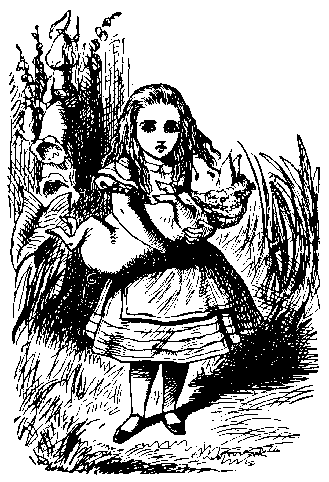
The description of the way in which Amy and Fox savour the taste of an alcoholic beverage they consume reminded me of a scene in Lewis Carroll's Alice in Wonderland:
she found a little bottle on it, [...] and round the neck of the bottle was a paper label, with the words `DRINK ME' beautifully printed on it in large letters. [...] It was all very well to say `Drink me,' but the wise little Alice was not going to do that in a hurry. `No, I'll look first,' she said, `and see whether it's marked "poison" or not' [...] However, this bottle was not marked `poison,' so Alice ventured to taste it, and finding it very nice, (it had, in fact, a sort of mixed flavour of cherry-tart, custard, pine-apple, roast turkey, toffee, and hot buttered toast,) she very soon finished it off. (Chapter 1)
Fox and Amy's drink isn't marked as "poison" either, so they drink and:
A wave of red rolled towards him. Cinnamon and clove enveloped him in their mingled scent as the punch flowed into his mouth and exploded on his tongue. Wine and cinnamon and clove and a dreadful bitterness. And salty like tears. He grimaced and put his glass down. [...] He took another cautious sip. The bitterness was still there, if somehow muted. In fact, it tasted better now. (45)
Like the drink which causes Alice to shrink, the punch that Amy and Fox consume has a very unexpected side effect (it seems extremely apt that the novel was published under Dorchester's Love Spell imprint). There is an echo of this scene later in the book, when a non-magical punch is prepared while Amy plans to tell Fox the truth about their earlier drink (217). Here's the description of Admiral Reitz preparing punch:
a special punch ceremony was held at Rawdon Park [...] the whole family assembled at a table in the drawing room. Admiral Reitz, it appeared, would act as the Master of Ceremonies. The children skipped from one foot to the other with excitement. "Feuerzangenbowle, Feuerzangenbowle," [....] The door opened and Ramtop, the butler, appeared, carrying an enormous pot filled with fragrant, steaming red wine. [...] Admiral Reitz made a bow in Amy's direction - "what we need for it is this: dry red wine boiled with orange slices, sticks of cinnamon, and cloves. A pair of tongs" - he picked up the item from the tray - "long enough to be laid across the top of the pot, and a sugarloaf." He took the white cone and wedged it into the tongs before he put them onto the pot. "And then, the most important ingredient: rum." (214-15)
Schwab's Admiral Reitz, like Carroll's Alice, is a real person placed in a fictional world.1 As we are told in the author's note, "Bernhard Reitz is one of the leading critics in the field of British theatre [...] and he always serves Feuerzangenbowle at our annual Christmas parties at his house." Schwab also mentions there that "he is known to have reacted adversely to the suggestion to stage a performance of in-yer-face theatre (which usually includes a certain amount of violence, rape, exploding trash cans and the like) in his sitting room." In Bewitched the performance takes place elsewhere:
The admiral, coming to the table [...] "[...] have you heard of the latest theatrical scandal, Rawdon? [...] It has come to my ears that a certain nobleman, who shall remain unnamed, chose to have a production staged in his private theater [...] what if I tell you that the aforementioned production involved some ... um ..." He coughed delicately. "Flinging off of clothes?" [...] Underneath his mustache, the admiral's lips twitched. "And not only that. There were also some monkeys involved, or so I've heard. To top it all, a rubbish can was blown up onstage. Followed by a potted apple tree." [...]

Shaking his head, Lord Rawdon took a fortifying sip of coffee. "I must say, this sounds quite in-yer-face." (111-12)
In the course of her research for her PhD thesis Sandra's been working on Sir John Tenniel's illustrations, including those of Alice in Wonderland and Through the Looking-Glass. One secondary text she acquired on the subject,
Frankie Morris's ARTIST OF WONDERLAND, [is] a book on the life and art of John Tenniel. It has already turned out to be a great find: one of the most exciting things, imo, is that Morris argues that many characters in Tenniel's illustrations are simply children or adults in costumes instead of a "real" rabbit or a "real" Duchess with a really big head.
The almost bewildering number of animal metaphors Schwab uses to describe the human characters reminds me of Tenniel's illustrations, and their occasional metamorphoses may recall those of the baby in Alice in Wonderland who turns into a pig. The Admiral's "short, grayish blond moustache and dark suit lent him a faint resemblance to a sea lion - an uncommonly lean sea lion. One who wore a white and green striped shirt" (92). I imagine him looking a little like Tenniel's illustration of the walrus. The hero of the romance is Sebastian "Fox" Stapleton. He "stretched lazily, like a great cat before it goes on the prowl" (6) and he can look "like a big, fat tomcat that had just devoured a particularly tasty mouse" (16) but Amelia, our heroine (also known as Amy), believes that he is "as cold as a fish" (7). Amy herself, whom Fox admits is "lovely [...] in the way of a plump, golden partridge" (40), or perhaps "a quail" (42) is his prey. The predator will find himself trapped: an observer seeing them together states that "the Fox was stepping up to the bait in the trap" (39). Amy is also described as the worm that attracts the cold fish: "the fish has caught the worm" (39) and others are keen to ensure that "the fish is truly hooked" (40). Amelia is not, however, an entirely defenceless creature, for Fox imagines she would be capable of "peck[ing] [...] the poor chap to death with her sharp retorts" (41) and he observes her "Snapping and yapping like a rat terrier" (42).

Other characters are also compared to animals. Fox's servant sometimes looks at him "like a wounded doe" (29). A mysterious stranger has "movements as graceful as a cat" (13). Amy thinks that Fox's friend Drew, "With his curly blond hair and soulful brown eyes [...] reminded her of an overlarge puppy dog" (23) and when in love he "spout[s] the most nonsensical notions that would do any March hare proud" (16). Isabella Bentham observes that "all men sighed over Amy like a herd of dimwitted mooncalves" (11) and Isabella's mother had "what would have been a kind smile if her eyes hadn't glittered like a mad ferret's" (24), although Drew describes her as a "jabbering magpie" (31) . During a society event "the hum of voices rose and fell as if the guests had turned into a swarm of bees" (42). No wonder Amelia concludes that "all of London was filled with the strangest people" (24-25) and we, the readers, can imagine them in all their animal strangeness in a similar fashion to the way in which Alice's sister imagines "the strange creatures of her little sister's dream" (Chapter 12).

Part of the action of the novel is described in chess terminology:
Stapleton will want to go and visit his family soon. [...] thanks to our little intervention, he won't be able to stand even the thought of being apart from the object of his lovesickness for too long. [...] You should make sure your daughter accompanies them. [...] And then we shall make our Sicilian Dragon breathe fire.
Bentham looked at him blandly. "Dragon?" he asked.
The man looked him up and down. "Not a player of chess then." (52-53)
Lewis Carroll's Through the Looking-Glass "is loosely based on a game of chess, played on a giant chessboard with fields for squares" (Wikipedia).

Another connection between Bewitched and the Alice stories, though perhaps a rather tenuous one, may be made via Alice's fall down a rabbit hole:
The rabbit-hole went straight on like a tunnel for some way, and then dipped suddenly down, so suddenly that Alice had not a moment to think about stopping herself before she found herself falling down a very deep well. Either the well was very deep, or she fell very slowly, for she had plenty of time as she went down to look about her and to wonder what was going to happen next. [...] suddenly, thump! thump! down she came upon a heap of sticks and dry leaves, and the fall was over. (Chapter 1)
Goldschmidt suggested that "The fall down the rabbit hole was a symbol of sexual penetration, the doors surrounding the hallway represented female genitalia" (Leach) and William Empson
thought it all came down to wombs:

the salt water {of the pool of tears} is the sea from which life arose; as a bodily product it is also the amniotic fluid ... The symbolic completeness of Alice's experience is, I think, important. She runs the whole gamut: she is a father in getting down the hole, a fetus at the bottom, and can only be born by becoming a mother and producing her own amniotic fluid... (Leach)
Leach may state that these are "historically baseless womb-analogies" but they have indubitably helped to shape the reception of the text, which has long been perceived to have sexual undercurrents. Schwab's novel, being a romance, can be quite explicit about sexuality and sexual symbolism, and it ends, rather than begins, with a scene set in the "womb of the Earth Mother" (305), through which the characters seem to have "slipped through the web of time into the pagan past" (306) and in the epilogue one might think of them as having arrived, to quote the words from Alice in Wonderland, "upon a heap of sticks and dry leaves, and the fall was over."

One other issue which attracted my attention while reading the novel was the apparent doubling of some of what Pamela Regis would describe as the "eight essential elements of the romance novel" (30). There would appear to be two points "of ritual death," an element which Regis describes as marking "the moment in the narrative when the union between heroine and hero, the hoped-for resolution, seems absolutely impossible" (35). In the first of these scenes the heroine must literally "die first, if only in ritual" (211) and there is then a second, longer period later in the novel during which Amy again comes close to death. It's also possible to think of the characters as falling in love twice and thus undergoing two "Declaration" (34) scenes "in which the hero declares his love for the heroine, and the heroine her love for the hero" (34), and undergoing two betrothals, scenes in which "the hero asks the heroine to marry him and she accepts; or the heroine asks the hero, and he accepts" (37). This doubling perhaps reflects the way in which the world of the novel exists on two levels, one more normal and rational, and the other magical.

There may also be a doubling of one of the "accidental elements characteristic of the romance novel" (Regis 38). Cheryl Sneed commented that the "There is a 120 page section, right in the middle of the book, in which Amy and Sebastian are sickeningly, treacly, blissfully in love" and "all is sweetness and light, which, frankly, was mind-numbingly boring." It occurs to me that this central section, in which the hero and heroine are blissfully in love and surrounded by the hero's loving family (including cute nephews and a niece) who are gathered together to celebrate both the hero and heroine's engagement and Christmas, is not dissimilar in tone to that of many epilogues. Regis has written that the "Wedding, Dance, or Fete" is one of the three "accidental elements" and is a scene which demonstrates that "Society has reconstituted itself around the new couple(s) and the community comes together to celebrate this" (38). The celebratory tone that usually accompanies the "Wedding, Dance, or Fete" is one which characterises this section of the novel. The true epilogue of the novel in fact includes much less "sweetness," though its function of demonstrating that society is "reconstituted" is made quite explicit: "they walked on into the reborn world."

  • Carroll, Lewis. Alice's Adventures in Wonderland. The Millennium Fulcrum Edition 3.0.
  • Carroll, Lewis. Alice Through the Looking-Glass. The Millennium Fulcrum Edition.
  • Leach, Karoline. "Tony Goldschmidt and the Freudian Influence." The Victorian Web. Adapted with permission of author and publisher from the opening chapter of Karoline Leach's In the Shadow of the Dreamchild. London: Peter Owen Ltd, 1999.
  • Regis, Pamela. A Natural History of the Romance Novel. Philadelphia: U of Pennsylvania P, 2003.
  • Schwab, Sandra. Bewitched. New York: Dorchester, 2008.

1 The real people whom Carroll placed within his fictional world are described here. It is perhaps interesting to note that both Carroll and Schwab are incorporating elements of their academic life into their fiction. Both also include text from other fictions in their own work:
In the Victorian Era children had to learn many moralizing poems by heart. Carroll altered some of these (once very familiar) verses for the Alice books, of course to the amusement of the Liddell sisters. Unfortunately these poems are hardly remembered nowadays, so the fun of the parody has disappeared for the greater part. (Lenny's Alice in Wonderland site)
For her part, Schwab includes excerpts from a number of poems (including John Keats's La Belle Dame Sans Merci) and The Horrible Histories of Mayence. This is "a fictional book, yet the direct quotations are all taken from an 1824 edition of The Seven Champions of Christendom" (Author's Note). [The entire text of Richard Johnson's The Seven Champions of Christendom is available online and in pdf via Google Books.] Schwab has quoted from this text, but changed the names of the characters. I think one can safely assume that she has given them the names of members of "Team Reitz" to whom she dedicated the novel, with the hope that they would "enjoy your adventures as bold knights and fair maidens!"

Fox notes how some of the events in The Horrible Histories recall events that have happened recently to him, Amy and the other characters: "It seemed fantastical, as if the characters of a book had stepped out of their story and into the real world" (293). In Carroll's Through the Looking-Glass the relationship between texts and reality is a little different, since Alice steps into a world inhabited by characters from nursery rhymes, such as Humpty Dumpty and the Lion and the Unicorn.


------

The illustrations for this blog post include Evelyn de Morgan's The Love Potion, from Wikipedia and John Tenniel's illustrations of the Drink Me scene in Alice in Wonderland, via Wikimedia Commons. I also think there's some similarity between Jessie Willcox Smith's version of Alice (1923) and Annett Louisian, on whom Schwab based her description of Amelia Bourne.

Saturday, May 19, 2007

Lydia Joyce - The Veil of Night (1: Home and Heart)

Lydia Joyce 'achieved bestsellerdom with The Veil of Night' (Publishers Weekly), her first published novel. Here are some reviews: an extremely positive one from A Romance Review, a fairly good one from All About Romance, and a not quite so positive one from The Romance Reader. You can also find an excerpt here.

As usual, this is not a review, and I may include spoilers. I want to focus on just one aspect of the novel: the imagery and symbolism of buildings.

The first chapter opens with the words
Graceless and sprawling, Raeburn Court was a pile of mottled limestone atop the bald hill. Lady Victoria Wakefield spied it while the coach was still some distance off, and she watched it steadily as they approached the park gate; after all, there was nothing else in the bleak landscape to catch her eye. As they drew near, the squat manor house grew only more blunt and ugly, its saw-toothed crenellations pierced by random, unbalanced spires stabbing the slate-gray sky. (2005: 3)
It would appear to match its master, Byron Stratford, Duke of Raeburn. The Court is 'sprawling' and when we first meet Byron he reclines at his ease, waiting for Lady Victoria's approach and later his signature 'sprawled across the sheet' (2005: 27), a word which appears again in another description of the house of which he is the centre: 'there was more unknown in the room behind her [where she has left Byron] than in all the rest of the sprawling, rotting manor house' (2005: 28).

During that first encounter Byron's 'presence filled the room' (2005: 24) in the same way that his house dominates the surrounding terrain, while his eyes match the colours of the landscape, 'brown or moss-coloured' (2005: 25). Joyce describes him in architectural terms:
The lineaments of his face were bold and strong - almost crude, as if he'd been blindly carved of stone - but they were no less attractive for a lack of patrician daintiness. How old he was she could not guess: certainly younger than the roughened skin of his face suggested. It was not marked with the scarring left by youthful blemishes but with a deeper weathering, as if he had stood barefaced to wind and sun for a score of years. [...]
His appearance was certainly unconventional, but it was also compelling (2005: 25, my emphasis)
Externally, then, Raeburn Court matches the appearance of its master. As for the interior, it parallels Byron's reputation:
Victoria took the opportunity to survey the room. The vast, unlit chamber stretched before her--the manor's original great hall, no doubt--its deep shadows scarcely pierced by the gray light filtering through the filthy mullioned windows, which trembled in their frames as another peal of thunder cracked overhead. Ancient, moldering tapestries flapped like living things in the steady draft flowing through the room, and enormous cobwebs fluttered against the black rafters in the dim recesses of the ceiling. (2005:7-8)
Such decay and neglect might seem to indicate Byron's immorality. He has a 'well-deserved reputation for being a dissolute reprobate' (2005: 12). Lydia Joyce provides the online equivalents of footnotes to the text, and one of those notes states that Raeburn Court,
has no "real world" model. I didn't like the traditional castle-ish construction so common in Gothics, so instead, I made it a mishmash of styles from many periods, which would give it a suitable spookiness without following the cliché too closely.
That unconventional 'mishmash of styles' might in architectural terms make the isolated Court not dissimilar to Byron who's 'a pariah not because of the acts he committed but because of the conventions he failed to keep' (2005: 4).*

Despite the apparent similarities between Byron and Raeburn Court, he only intends living there until the renovation of the Dowager House is complete. Victoria thinks it 'Strange that he should want to leave a house that seemed to suit him so well' (2005: 37), but Byron has reached the conclusion that it 'had been inhabited far too long by other men who had left their impressions upon it more indelibly than he could ever hope to. That was the secret of Raeburn Court, he had finally decided; it always made one feel a stranger' (2005: 72).

While the Court may resemble Byron's exterior appearance, it is the Dowager House which, as Victoria quickly realises, represents his inner life: 'She had the growing sensation that the house was a portrait of the duke, done in such precise detail that every idiosyncrasy in his nature was laid bare, if only she knew how to look at it.

Commenting on the Dowager House, Joyce admits that
I am an architecture freak. [...] Philip Speakman Webb [the architect] was part of the aesthetic movement in architecture that eventually birthed the Arts and Crafts style. In its early forms, it was simple and medievalist, though it had a number of characteristics that any Craftsman enthusiast would immediately recognize and appreciate. I wanted something that worked for Byron and spoke of who he was, and this movement really spoke to me. [click here for a short biography of Speakman Webb and links to photos of some furniture he designed]
The Dowager House 'speaks of who Byron is' because it combines the historical and the modern, making use of rich colours which are in keeping with Byron's connection with his lands:
She stood at the midpoint of a long, narrow chamber, once a hall, now divided by furniture and rugs into two distinct parlors decorated in tones of scarlet, purple, and umber. Like a Yorkshire sunset, she thought [...].
She crossed into the parlor [...] noting the heavy, simple lines of the furniture and the archaic paintings that hung on the walls. But the most striking feature was the narrow stained glass windows that flanked the fireplaces at the ends of the hall, four jewel-toned glowing pictures of slender, long-faced women with intricately draped robes and tumbling hair. [...]
"It is very different," she said. [...] "Most people would have made the house lighter, more delicate. This seems positively medieval." (2005: 86)
It is, literally 'positively medieval'. In Victorian medievalism
"[...] The Middle Ages were idealized as a period of faith, order, joy, munificence, and creativity [...] The Middle Ages became a metaphor both for a specific social order and [...] for a metaphysically harmonious world view. [...]" Chandler [...] convincingly shows us how the nineteenth turned back to the past as a way of criticizing the present and as a means to a better future. (Landow, quoting Chandler, 1973: 366)
I can't help but think that the stained-glass of the house (as contrasted with the covered windows of the Court) represent Byron's spirituality. He may appear evil to those who judge on appearances and he has 'behaved with the flamboyance of a born reprobate' (2005: 100) and encouraged all the 'mysterious rumors' (2005: 100) about him, but in truth it is simply the case that for him the seeing 'through a glass, darkly' (1 Corinthians 13: 12) is literal as well as metaphorical.

In addition, it becomes clear that Byron's medievalism extends to his attitude towards his tenants. The estate is in some difficulty as a result of the Industrial Revolution:
"I can't even find tenants for two tracts, and I've had to cut the rent on the others. There's not the money in wool there used to be, and the Raeburn flocks are poor at best. [...] Stoneswold and Weatherlea are half deserted because the weaving is all done in factories in Leeds. The weavers' families have all left or been reduced to menial labor."
Victoria realized that he cared - not just about property and income, but about the common villagers, too. There was perhaps something medieval in his concern, but if it was stained with feudal overtones, it had a certain chivalric element as well and was rather touching. (2005: 108)
While Byron's exterior appearance and his inner soul are symbolised by the two houses, Victoria, who owns no houses, nonetheless has a similarly deceptive 'façade of imperturbability' (2005: 10) which is later replaced by clothing which more accurately reflects her real personality. As far as society is aware, Victoria is what she appears to be:
she was fair [haired] and dowdy [...] austere to the point of severity [...] almost fiercely self-contained. [...] Every line of her bearing declared that she was a respectable old maid, from her tight, pale blonde bun and her prim, haughty smile to the hideously unflattering carriage dress. (2005: 11)
No-one apart from Victoria knows that her clothes 'had been marked by unrelieved austerity for fifteen years now, first from an excess of puerile anguish, then from self-abhorrence, and now partly from habit and partly from the intangible security such a uniform offered' (2005: 5). Byron, however, quickly notices that:
From the back, not even the awkward lines of her unflattering corset could disguise the grace of her lithe figure, the unconscious seductiveness in the arch of her neck.

The prim dress and severe bun angered him suddenly. He saw them thrust between them as a barrier, keeping him beyond her spinsterish defenses. (2005: 19)
The crinoline and corset are 'defences': the dress and crinoline forming the outer walls, while the corset is an inner barrier, all demonstrating the severe austerity of a medieval castle. Byron is sure that Victoria has chosen to 'lock herself' (2005: 22) within them and looks at her with a 'proprietary gleam [...] in his eyes, that of a lord surveying territory soon to be his' (2005: 40). He senses that which is hidden within her walls: 'the soul of the wind-mad woman who escaped the stifling parlors and drawing rooms of Rushworth Manor to gallop across the tenants' most distant fields' (2005: 22). What he doesn't realise is that Victoria has 'locked herself' within the citadel of her clothing because, 'There was no barrier, no stronghold of virginity to interrupt his entrance' (2005: 66-67).** What she had hidden within the fortress of her austere clothing was not her virginity, but her sexuality, and when Byron buys her new clothes 'there was a native sensuality that permeated the air about her now that she no longer imprisoned it behind walls of whalebone and black taffeta' (2005: 79, my emphasis).


* Regarding the 'mishmash' of styles:
The first time he'd seen the building [...] he'd seen the hideousness of it, the sprawling wings of every imaginable age of architecture appended to the main mass of limestone at haphazard angles. Yet even then, it had called to him. Even then, it had whispered of secrets and darkness and ancient passions burned into the rock. (2005: 72)
** I touched briefly on the metaphorical aspects of virginity as depicted in romance in my post about metaphorical medicine and 'the sexual metaphor which casts woman as a castle besieged by suitors is a commonplace in the erotic literature of the classical world and Middle Ages (it is the metaphor that underpins the whole of the Roman de la rose)' (Foster Gittes 2005: 21).
  • Foster Gittes, Tobias 2005. '"O vendetta di Dio": The Motif of Rape and Retaliation in Dante's Inferno', MLN, 120.1: 1-29.
  • Joyce, Lydia, 2005. The Veil of Night (New York: Signet Eclipse).
  • Landow, George P., 1973. 'A Dream of Order: The Medieval Ideal in Nineteenth-Century English Literature. By Alice Chandler. Lincoln: University of Nebraska Press, 1970. pp. 278', Modern Philology, 70.4: 366-369.

I apologise for using the Foster Gittes, and Landow's review of Chandler's book. I could no doubt have found more authoritative texts dealing with these subjects, including Chandler's book, but as I'm blogging rather than writing an academic paper, I tend to use sources I can access via the internet.

The picture on the cover of the book is taken from 'a photograph of a famous mission in Arizona'.

The castle is Krak des Chevaliers, a '"concentric castle" in which each ward was placed wholly within another which enveloped it' (Wikipedia). It 'was built by the Hospitaller Order of Saint John of Jerusalem from 1142 to 1271' and is now a World Heritage site.

Monday, January 29, 2007

Augusta Jane Evans - St. Elmo (1 - Women and Marriage)

Augusta Jane Evans's 'novels were popular on both sides of the Mason-Dixon line, although during the Civil War her works made their way north only through the daring of blockade runners' (Fekete Trubey 2005: 125) and St. Elmo (1866) (an alternative, paginated, online edition is available here)
was her most popular book, setting new sales records that prompted her publisher, G. W. Carelton, to announce that a million people had read it within four months of its first appearance. At once a traditional sentimental novel and a scholarly exploration of female intellectualism, St. Elmo depicts its heroine, Edna Earl, at war with herself, struggling with the accepted limits of femininity. Her brilliant career as an author pits her very body against itself: in the act of writing, she masochistically neglects her body while striving to maintain her pious, self-abnegating character. Given the novel’s postwar context, it is fascinating that Evans couches her heroine’s struggle with the competing roles of wife and writer in the slippery terms of slavery and freedom. (Fekete Trubey 2005: 125)
St. Elmo himself became 'a cult figure who several decades later was to inspire Margaret Mitchell' (Cadogan 1994: 41) and 'Augusta Jane Evans's St. Elmo was considered as recently as 1947 to be one of the ten most popular novels ever published in the United States' (Kolba 1980: 38).

Although the novel was undoubtedly a bestseller, its quality was questioned. It was parodied in Charles Henry Webb's St. Twel'mo, or, The Cuneiform Cyclopedist of Chattanooga (1867). In one review written in 1902 the reviewer observed that 'There never was a book written more open to ridicule. And yet, when that inclination to ridicule comes we pause, half ashamed. For under all the pompous phraseology we feel that there was a story to be told; that not a line of it was penned that was not inspired by sincerity and a belief in lofty ideals' or, as a very much more recent reader from the Young Ladies Christian Fellowship puts it: 'Even though the Latin phrases went right over my head, I was able to grasp a little of the vastness of the author’s knowledge by her references to history and science I had never even learned. Strong characters, and the heroine’s refreshing perspective on life would make the book in and of themselves—but the story of love, trust, and forgiveness is one you will never forget'.

The term 'sentimental novel', which is used to describe St. Elmo refers to:
a popular form of fiction that gained popularity in America from the late 18th century to the mid-19th century (although there are still manifestations of it today). In general, sentimentalism is didactic in form, “artless” in style, sincere in its tone, melodramatic in its plotting, and addressed overwhelmingly to a female readership. Often, the term “sentimentalism” is used in two senses:

1. An overindulgence in emotion, especially the conscious effort to induce emotion in order to enjoy it; expressing a “sensibility,” or susceptibility to emotions and sentiments (as opposed to logic or reason).
2. An optimistic overemphasis of the goodness of humanity, representing in part a reaction against Calvinism, which regarded human nature as depraved. (Derek P. Royal)
In other words, many of these novels can be viewed as precursors of the modern romance novel.

St. Elmo is prefaced by a quotation from John Ruskin:
Ah! the true rule is--a true wife in her husband's house is his servant; it is in his heart that she is queen. Whatever of the best he can conceive, it is her part to be; whatever of the highest he can hope, it is hers to promise; all that is dark in him she must purge into purity; all that is failing in him she must strengthen into truth; from her, through all the world's clamor, he must win his praise; in her, through all the world's warfare, he must find his peace."
I'm not sure precisely where this is taken from, but the sentiments seem identical to those in Ruskin's essay 'Of Queens' Gardens', in Sesame and Lilies, which deals with the question of chivalry and the role of women. St. Elmo is Augusta Jane Evans' contribution to the debate about these issues, and it is one which was very important at the time:
Many of the historical changes that characterized the Victorian period motivated discussion and argument about the nature and role of woman — what the Victorians called "The Woman Question." The extension of the franchise by the Reform Bills of 1832 and 1867 stimulated discussion of women's political rights. (from The Norton Anthology of English Literature online)
John Stuart Mill 'was the most influential English-speaking philosopher of the nineteenth century' (Stanford Encyclopedia of Philosophy) and in his The Subjection of Women he argued for equality between the sexes and the extension of the franchise to women. Both ideas are ridiculed by St. Elmo, who declares that 'I am quite as far from admitting the infallibility of man as the equality of the sexes. The clearest thinkers of the world have had soft spots in their brains [...] and you have laid your finger on the softened spot in Mill's skull, "suffrage". That is a jaded, spavined hobby of his'. Edna too is appalled by the idea of women voting:
my study of Mill's philosophy assures me that, if society should be turned over to the government of his theory of Liberty and Suffrage, it would go to ruin more rapidly than Frederick's province. Under his teachings the women of England might soon marshal their amazonian legions, and storm not only Parnassus but the ballot-box, the bench, and the forum. That this should occur in a country where a woman nominally rules, and certainly reigns, is not so surprising, but I dread the contagion of such an example upon America. [...] I think, sir, that the noble and true women of this continent earnestly believe that the day which invests them with the elective franchise would be the blackest in the annals of humanity, would ring the death-knell of modern civilization, of national prosperity, social morality, and domestic happiness! and would consign the race to a night of degradation and horror infinitely more appalling than a return to primeval barbarism.
Evans therefore sides with Ruskin on the issue of whether or not women should be 'Queens' of the hearth and Edna's second novel, titled Shining Thorns on the Hearth, is dedicated to 'my countrywomen, the Queens who reign thereon'. Nonetheless, Evans vehemently argues that women can benefit from an education and can, as writers, have much to contribute to their society. Her criticism of duelling points to a conflict of values within patriarchy. As Johnson observes,
Ironically, the southern brand of patriarchy, characterized by a pervasive obligation to personal honor, vowed to protect white women but was undermined by the premier expression of such honor: the duel. In practical and theoretical ways, the code of honor also undermined the minimal legal protections upon which a woman might rely. The duel could deprive women of economic and protective benefits when male relatives died in duels. (2001: 16)
Johnson goes further and suggests that not only does Evans criticise the practice of duelling, but also that she 'presents duels [...] as metaphorical representations of masculine violations of legal, religious, and familial codes' (2001: 14-15).

Within the novel St. Elmo is the embodiment of patriarchy's destructive power, and he is reclaimed for Christianity and chivalry by Edna, who has, among other works, written a 'little tale [...] to portray the horrors and sin of duelling', while another of her articles causes a 'rejoicing wife' to write her a letter 'eloquent with thanks for the good effect produced by a magazine article on a dissipated, irreligious husband and father, who, after its perusal, had resolved to reform'. As the quotation from Ruskin suggests, Edna's mission with regards to St. Elmo is that 'all that is dark in him she must purge into purity'. At the time it was a common view of women's mission in life: 'Nineteenth-century Americans believed that women had a particular propensity for religion. The modern young woman of the 1820s and 1830s was thought of as a new Eve working with God to bring the world out of sin through her suffering, through her pure, and passionless love' (Lavender). As I've discussed earlier, this redemptive role is a frequent one for heroines in romance, and the heroine's purity is hightened by contrast with the hero's extreme depravity. St. Elmo is compared to Lucifer himself: when he observes Edna he 'looked at the kneeling figure locked so closely in his mother's arms, [...] over his stern face broke a light that transformed it into such beauty as Lucifer's might have worn before his sin and banishment' and later when Edna refuses his proposal of marriage she states that 'I am no vicegerent of an outraged and insulted God! [...] I shrink with unconquerable dread and aversion, and would almost as soon entertain the thought of marrying Lucifer himself. [...] Go yonder to Jesus. He only can save and purify you'. It is, however, his love for Edna and the efficacy of her reproaches which begins his conversion.

Perhaps it is the opportunity to exert and demonstrate the power of feminine virtue which, at least in part, explains the attraction that some women feel for a man in need of 'taming'. Certainly, it was a matter which puzzled the parodist Charles Henry Webb who wrote of St. Elmo:
How such a fellow could win the affections of refined and cultivated women, I can not understand. For I have tried original verses, and pet names, and bouquets, and gentlemanly behavior, and the sweet influences of modest and unpretending merit, all in vain. (24-25)
and here's one modern explanation:
The phenomenon of "women going for jerks" is a real one, but there is a very, very important thing missing from the usual understanding of it. It is, I believe, a product of women's enculturated fantasies that jerks really AREN'T jerks down deep in their most hidden souls. The usual La-La Land construct is that jerks are really powerful, confident, and misunderstood men that the Very Special Women Who Truly Love Them can bring into the Light. (Grey 2005)
Edna is indeed a Very Special Woman and she fulfils a wish expressed by St Elmo's cousin Estelle:
There is some terrible retribution in store for your libels on our sex! How I do long to meet some woman brave and wily enough to marry and tame you, my chivalric cousin! to revenge the insults you have heaped upon her sisterhood!
Edna demonstrates that she is a Very Special Woman in a variety of different ways. She is intellectually talented and determined to succeed as an author, despite the prejudices that stand in her way. Early on one character, a Mr Wood, states that 'The less book-learning you women have the better', but his wife swiftly responds with words which silence him:
"I don't see that it is any of your business, Peter Wood, how much learning we women choose to get, provided your bread is baked and your socks darned when you want 'em. A woman has as good a right as a man to get book-learning, if she wants it; and as for sense, I'll thank you, mine is as good as yours any day; and folks have said it was a blessed thing for the neighborhood when the rheumatiz laid Peter Wood up, and his wife, Dorothy Elmira Wood, run the mill. Now, it's of no earthly use to cut at us women over that child's shoulders; if she wants an education she has as much right to it as anybody, if she can pay for it. My doctrine is, everybody has a right to whatever they can pay for, whether it is schooling or a satin frock!"
Later, when young Edna, the heroine, pursues her search for knowledge, her guardian, Mrs Murray, tells Edna's tutor
"I think the child is as inveterate a bookworm as I ever knew; but for heaven's sake, Mr. Hammond, do not make her a blue-stocking."
"Ellen, did you ever see a genuine blue-stocking?"
"I am happy to be able to say that I never was so unfortunate."
"You consider yourself lucky then, in not having known De Stael, Hannah More, Charlotte Bronte, and Mrs. Browning?"
he then proceeds to explain to the young Edna what is meant by the term 'bluestocking':
"A 'blue-stocking,' my dear, is generally supposed to be a lady, neither young, pleasant, nor pretty (and in most instances unmarried); who is unamiable, ungraceful, and untidy; ignorant of all domestic accomplishments and truly feminine acquirements, and ambitious of appearing very learned; a woman whose fingers are more frequently adorned with ink-spots than thimble; who holds housekeeping in detestation, and talks loudly about politics, science, and philosophy; who is ugly, and learned, and cross; whose hair is never smooth and whose ruffles are never fluted. [...]" [...] "The title of 'blue-stocking,'" continued the pastor, "originated in
a jest, many, many years ago, when a circle of very brilliant, witty, and elegant ladies in London, met at the house of Mrs. Vesey, to listen to and take part in the conversation of some of the most gifted and learned men England has ever produced. One of those gentlemen, Stillingfleet, who always wore blue stockings, was so exceedingly agreeable and instructive, that when he chanced to be absent the company declared the party was a failure without the blue stockings,' as he was familiarly called. A Frenchman, who heard of the circumstance, gave to these conversational gatherings the name of 'bas bleu,' which means blue stocking; and hence, you see, that in popular acceptation, I mean in public opinion, the humorous title, which was given in compliment to a very charming gentleman, is now supposed to belong to very tiresome, pedantic, and disagreeable ladies. Do you understand the matter now?"
Resolute and confident in her own abilities, Edna ignores the advice in her first rejection letter from an editor (yes, there are metafictional elements to this novel):
Burn the enclosed MS., the erudition and archaisms of which would fatally nauseate the intellectual dyspeptics who read my 'Maga,' and write sketches of home life-descriptions of places and things that you understand better than recondite analogies of ethical creeds and mythologic systems, or the subtle lore of Coptic priests. Remember that women never write histories or epics; never compose oratorios that go sounding down the centuries; never paint 'Last Suppers' and 'Judgment Days'; though now and then one gives the world a pretty ballad that sounds sweet and soothing when sung over a cradle, or another paints a pleasant little genre sketch which will hang appropriately in some quiet corner and rest and refresh eyes that are weary with gazing at the sublime spiritualism of Fra Bartolomeo, or the gloomy grandeur of Salvator Rosa.
During her long reverie, she wondered whether all women were browbeaten for aspiring to literary honors; whether the poignant pain and mortification gnawing at her heart was the inexorable initiation-fee for entrance upon the arena where fame adjudges laurel crowns, and reluctantly and sullenly drops one now and then on female brows.
Edna's intellectual and moral qualities are coupled with extreme beauty and she shows an affinity for children which makes them love her. She receives many offers of marriage and as the embodiment of Evans' (and Ruskin's) ideal of femininity she offers an alternative to the caricature that St. Elmo paints in his description of intellectual women:
Without doubt, the most thoroughly ludicrous scene I ever witnessed was furnished by a 'woman's rights' meeting,' which I looked in upon one night in New York, as I returned from Europe. The speaker was a raw-boned, wiry, angular, short-haired, lemon-visaged female of very certain age; with a hand like a bronze gauntlet, and a voice as distracting as the shrill squeak of a cracked cornet-a-piston. Over the wrongs and grievances of her down-trodden, writhing sisterhood she ranted and raved and howled, gesticulating the while with a marvelous grace, which I can compare only to the antics of those inspired goats who strayed too near the Pythian cave, and were thrown into convulsions. Though I pulled my hat over my eyes and clapped both hands to my ears, as I rushed out of the hall after a stay of five minutes, the vision of horror followed me, and for the first and only time in my life, I had such a hideous nightmare that night, that the man who slept in the next room broke open my door to ascertain who was strangling me. Of all my pet aversions my most supreme abhorrence is of what are denominated 'gifted women'; strong-minded (that is, weak-brained but loud-tongued), would-be literary females, who, puffed up with insufferable conceit, imagine they rise to the dignity and height of man's intellect, proclaim that their 'mission' is to write or lecture, and set themselves up as shining female lights, each aspiring to the rank of protomartyr of reform. Heaven grant us a Bellerophon to relieve the age of these noisy Amazons! I should really enjoy seeing them tied down to their spinning-wheels, and gagged with their own books, magazines, and lectures!
Unfortunately some of these stereotypes about intellectual women, particularly feminists, persist, but such views are in the minority and nowadays women scholars are not warned of dire consequences should they persist in their studies, unlike Edna, whose success is won at great personal cost. As Mr Hammond warns her:
The history of literary females is not calculated to allay the apprehension that oppresses me, as I watch you just setting out on a career so fraught with trials of which you have never dreamed. As a class they are martyrs, uncrowned and uncanonized; jeered at by the masses, sincerely pitied by a few earnest souls, and wept over by the relatives who really love them. Thousands of women have toiled over books that proved millstones and drowned them in the sea of letters.
How many of the hundreds of female writers scattered through the world in this century, will be remembered six months after the coffin closes over their weary, haggard faces? You may answer, 'They made their bread.' Ah, child! it would have been sweeter if earned at the wash-tub, or in the dairy, or by their needles. It is the
rough handling, the jars, the tension of the heartstrings that sap the foundations of a woman's life and consign her to an early grave; and a Cherokee rose-hedge is not more thickly set with thorns than a literary career with grievous, vexatious, tormenting disappointments.
In the nineteenth-century it was thought by many that education, and particularly the rigorous intellectual activities which Edna pursues, could damage a woman physically:
Physicians saw the body as a closed system possessing only a limited amount of vital force; energy expended in one area was necessarily removed from another. [...] A young woman [...] who consumed her vital force in intellectual activities was necessarily diverting these energies from the achievement of true womanhood. She would become weak and nervous, perhaps sterile, or more commonly, and in a sense more dangerously for society, capable of bearing only sickly and neurotic children (Smith-Rosenberg & Rosenberg 1973: 340)
Edna develops heart troubles (literally as well as metaphorically due to her love for St. Elmo) and is prone to fainting fits which greatly alarm her friends. Her doctor warns her that if she does not stop writing she may die at any moment. Edna will not stop, however and it is only after St. Elmo has reformed (she has saved him spiritually), and the two have been married, that he puts a stop to her writing career (thus saving her physically). Edna accepts his decree without demur, because he is her husband. As we have seen previously, both Edna and Evans herself were opposed to women's suffrage and while acknowledging and celebrating women's talents, they believed that these should remain in the service of a woman's husband (should she have one):
Jealously she contended for every woman's right which God and nature had decreed the sex. The right to be learned, wise, noble, useful, in woman's divinely limited sphere; the right to influence and exalt the circle in which she moved; the right to mount the sanctified bema of her own quiet hearthstone; the right to modify and direct her husband's opinions, if he considered her worthy and competent to guide him; the right to make her children ornaments to their nation, and a crown of glory to their race; the right to advise, to plead, to pray; the right to make her desk a Delphi, if God so permitted; the right to be all that the phrase "noble, Christian woman" means.
But not the right to vote; to harangue from the hustings; to trail her heaven-born purity through the dust and mire of political strife; to ascend the rosta of statesmen, whither she may send a worthy husband, son, or brother, but whither she can never go, without disgracing all womanhood. (my emphasis)
That a wife can 'modify and direct her husband's opinions, only if he considered her worthy and competent to guide him' is an indication of how unstable a wife's power can be. Given the immense power that a husband will have over her, the Christian woman who aspires to be a Queen of the Hearth must be careful when deciding who to accept as a spouse. Edna rejects St. Elmo because
Surely you would not be willing to see me marry a man who scoffs at the very name of religion; who wilfully deceives and trifles with the feelings of all who are sufficiently credulous to trust his hollow professions [...]! What hope of happiness or peace could you indulge for me, in view of such a union? I should merit all the wretchedness that would inevitably be my life--long portion if, knowing his crimes, I could consent to link my future with his."
As Mr Hammond has earlier told another suitor of Edna's,
Edna Earl will never coax and persuade herself to marry any man, no matter what his position and endowments may be. She is not a dependent woman; the circumstances of her life have forced her to dispense with companionship, she is sufficient for herself; and while she loves her friends warmly and tenderly, she feels the need of no one. If she ever marries, it will not be from gratitude or devotion, but because she learned to love, almost against her will, some strong, vigorous thinker, some man whose will and intellect masters hers, who compels her heart's homage, and without whose society she can not persuade herself to live. (my emphasis)
It would seem, then, that Evans adheres strictly to St Paul's words on the matter of husbands and authority: 'the head of every man is Christ; and the head of the woman is the man; and the head of Christ is God' (1 Corinthians 11: 3) and his injunction 'Be ye not unequally yoked together with unbelievers' (2 Corinthians 6: 14).

As Johnson observes, for many readers' Evans' championship of women's literary ambitions sits awkwardly alongside the final authority of the husband:
The aspect of St. Elmo that most puzzles and disturbs critics is Edna's ultimate capitulation to St. Elmo in marriage. Although Evans is keenly aware of the abuses of a patriarchy without Christian reform, she ultimately argues for a more gentle version of masculine control. The simultaneous advocation of patriarchy and the recognition of its potential threat to women creates an ambivalence in St. Elmo that is jarring to modern readers. In the final scene of the novel, as Edna finally submits to St. Elmo in marriage, St. Elmo clearly dictates the terms of their relationship:
"Today I snap the fetters of your literary bondage. There shall be no more books written! . . . and that dear public you love so well, must even help itself, and whistle for a new pet. You belong to me now, and I shall take care of the life you have nearly destroyed in your inordinate ambition" (365). Edna's literary ambition has become "inordinate," only because St. Elmo's threat to her has been diminished and the patriarchy of her personal world has been reformed. (2001: 25)
As a result, 'Although Edna has in some sense tamed St. Elmo into compliance
with codes of law, family, and Christianity, in the end she simply allows him to preside over a reformed patriarchy that offers some protection to women' (Johnson 2001: 26).
  • Cadogan, Mary, 1994. And Then Their Hearts Stood Still: An Exuberant Look at Romantic Fiction Past and Present (London: MacMillan).
  • Carroll Smith-Rosenberg, Carroll & Charles Rosenberg, 1973. 'The Female Animal: Medical and Biological Views of Woman and Her Role in Nineteenth-Century America', The Journal of American History, 60.2: 332-356.
  • Fekete Trubey, Elizabeth, 2005. 'Emancipating the Lettered Slave: Sentiment and Slavery in Augusta Evans's St. Elmo', American Literature 77 (1): 123-150.
  • Johnson, Bradley, 2001. ‘Dueling Sentiments: Responses to Patriarchal Violence in Augusta Jane Evans’ St. Elmo’, The Southern Literary Journal, 33.2: 14-29.
  • Kolba, Ellen D., 1980. 'Stories for Sale', The English Journal, 69.7: 37-40.