Showing posts with label Maria-Isabel González-Cruz. Show all posts

Tuesday, April 26, 2022

New Publications: Comics, Second Hand Bookshops, Islands, Hispanisms, Race, Young People, Fatness, Radway and Chinese Readers

Brunet, Peyton and Blair Davis (2022). Comic Book Women: Characters, Creators, and Culture in the Golden Age. Austin: University of Texas Press. [Chapter 8 is about romance comics: https://doi.org/10.7560/324110-010]

Farooqui, Javaria (2022). "Romance in an Old Bookshop." The Bridge Magazine 1:66-69. [This is available freely online. It discusses the distribution of second-hand romances in Pakistan and the connection with social class.]

Fresno-Calleja, Paloma (2022). “Repurposing Fantasy Island: Lani Wendt Young’s Telesā Series and the Politics of Postcolonial Romance.” Interventions: International Journal of Postcolonial Studies. https://doi.org/10.1080/1369801X.2022.2054011

González-Cruz, María-Isabel. 2022. Hispanicisms in Romance Fiction. An Annotated Glossary. Lewiston, New York: The Edwin Mellen Press. [Details from the publisher.]

Hendricks, Margo (2022). Race and Romance: Coloring the Past. Arizona State University. [This is available to read for free online. This includes discussion of two novels by Beverly Jenkins and also Margo Hendricks's own romance novels (written as Elysabeth Grace).]

Herrera, Carolina M. (2022). Examining the relation between media engagement and developmental outcomes in adolescents and emerging adults: an exploration of engagement with and impact of young adult literature media among youth. PhD thesis, Rutgers, the State University of New Jersey. [Discusses romance reading.]

McDavis-Conway, Shana (2022). “Self-conscious, unapologetic, and straight: fat protagonists in romantic fiction.” Fat Studies. https://doi.org/10.1080/21604851.2022.2047337

Stetson, Suzanne (2022). "Reconciling Reader Response and Feminism in Late Twentieth-Century Erotic Historical Romances." INCITE: Journal of Undergraduate Scholarship 13.

Tang, Ning (2022). "Reading Online Romance Novels Is Related To Chinese Readers' View of Love." Academic Journal of Humanities & Social Science 5.2:32-45.


Wednesday, December 29, 2021

New publications: topics covered include Lovecraft, sexual orientation, fatness, race, identity, and religion

This will be the last of my new publication lists for 2021. Articles about romance have been continuing to appear (see below). This has also been a busy year for academic books on romance, and two more have been published just before the end of 2021. Although I haven't read either of them yet, I've collaborated with many of the authors of the essay collection and read an earlier version of the other.


Discursos e Identidades en la Ficción Romántica:
Visiones Anglófonas de Madeira y Canarias / Discourses and Identities in Romance Fiction: Anglophone Visions from Madeira and the Canaries is a bilingual essay collection (the same essays appear first in Spanish and then in English) edited by María Isabel González-Cruz. There is also a section related to teaching romance fiction. A list of the contents, along with topic tags, can be found in the Romance Scholarship Database. Excerpts are available from Vernon Press and Google Books.


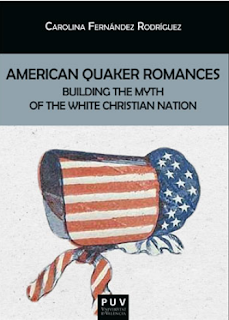
Fernández Rodríguez, Carolina (2021). American Quaker Romances: Building the Myth of the White Christian Nation. Valencia : Universidad de Valencia.

With the rise in recent years of the Christian romance market, dominated by American Evangelical companies, there has been a renewed interest in fictional Quakers. In the historical Quaker romances analyzed in this book, Quaker heroines often devote time to spiritual considerations, advocate the sanctity of marriage and promote traditional family values. However, their concern with social justice also leads them to engage in subversive behavior and to question the status quo, as illustrated by heroines who are active on the Underground Railroad or are seen organizing the Seneca Falls convention. Though relatively liberal in terms of gender, Quaker romances are considerably less progressive when it comes to race relations.

Thus, they reflect America's conflicted relationship with its history of race and gender abuse, and the country's tendency to both resist and advocate social change. Ultimately, Quaker romances reinforce the myth of America as a White and Christian nation, here embodied by the Quaker heroine, the all-powerful savior who rescues Native Americans, African Americans and Jews while conquering the hero's heart.

Here are links to: the publisher's website; an excerpt on Google Books; Amazon (ebook and paperback)


Hefner, Brooks E. (2021). Black Pulp: Genre Fiction in the Shadow of Jim Crow Minneapolis: University of Minnesota Press. [Excerpt available via Google Books. See in particular Chapter 2, "Romancing the Race: The Politics of Black Love Stories."]

Hernandez-Knight, Bianca (2021). "Race and Racism in Austen Spaces: Jane Austen and Regency Romance's Racist Legacy." ABO: Interactive Journal for Women in the Arts, 1640-1830 11.2.

Johnson, Brian (2022). "Weird Bedfellows: H. P. Lovecraft, m/m Romance, and the New Queer Families of Jordan L. Hawk's Whyborne & Griffin Series." Lovecraft in the 21st Century: Dead, But Still Dreaming. Ed. Antonio Alcala Gonzalez, Carl H. Sederholm. New York: Routledge. [Abstract]

Khumwongdee, Yanisa (2021). Reading and Rewriting Fat Romance: A Study of Twenty-First Century Thai and US Fat Romance Novels. PhD thesis, University of York. [Abstract

Moolla, F. Fiona (2021). "Her Heart Lies at the Feet of the Mother: Transformations of the Romance Plot in Leila Aboulela’s Minaret." African Journal of Gender and Religion 27.2:1-21.

Pierre, Zakiya (2021). Browsing in nuances: Using ethnographic research to design for the experience of browsing. Bachelor's thesis, Malmö University.

Pradhan, Anil (2021). "The literary field of queer cultural production in contemporary India: considering popular queer texts via Bourdieu." Runas: Journal of Education & Culture 2.4.

Weimer, Christopher (2021). "Romancing Weird Fiction: Lovecraftian Reinscriptions in Jordan L. Hawk's Whyborne and Griffin." Aeternum: The Journal of Contemporary Gothic Studies 8.1:61-76. [Download the whole issue.]


Wednesday, July 01, 2020

Details on how to attend the IASPR Conference online 10-17 July 2020!


I'm really pleased to be able to share details of the online 2020 IASPR Conference (10-17 July)


The sign-up page and details of presentations and round-table discussions are accessed from https://iaspr2020showcase.org/

Presenters include (but are not limited to!):

Kecia Ali
Loving in the Doom Years: Nora Roberts’ Chronicles of the One

Amanda Allen
How YA Literature Emerged from the Cold War Condemnation of Popular Romance

Javaria Farooqui
Reading Anglophone Historical Popular Romances in Pakistan

Maria Isabel González Cruz
Building a Glossary of Hispanicisms in a Corpus English Romances Set in the Canaries

Jayashree Kamblé
Recoloring London: Empire and Ethnicity in Popular Romance

María Ramos-García
Transatlantic Definitions of Whiteness in Louise Bergstrom’s Gothic Romances in the Canary Islands (1971-72)

Heather Schell
Love in a White Climate: Category Romance and the Anglosphere

Angela Toscano
Big Girls Don’t Cry or Get the Guy: Representations of Fatness in Romance

Andrea Anne I. Trinidad
“Kilig to the Bones!”: Kilig as the backbone of the Filipino Romance Experience

Friday, July 20, 2018

New to the Romance Wiki Bibliography: Lots of Free Items (including some in Spanish) on Australia, Cover Art, Publishing and more


Fletcher, Lisa, Beth Driscoll, and Kim Wilkins, 2018. 
"Genre Worlds and Popular Fiction: The Case of Twenty-First-Century Australian Romance", Journal of Popular Culture. Online First 16 July 2018. Excerpt
Golubov, Nattie, 2017. 
El amor en tiempos neoliberales: apuntes críticos sobre la novela rosa contemporánea. Ciudad de México: Bonilla Artigas, 2017. [Free from a variety of sites, including the Universidad Nacional Autónoma de México, Amazon and Academia.edu.]
González Cruz, María-Isabel, 2018. 
"Hispanismos en el discurso romántico de Harlequin y Mills & Boon. Ámbitos temáticos y funciones socio-pragmáticas". Moderna språk 112.1: 163-184. Abstract and link to pdf
Nelson, Elizabeth, 2015. 
"The Romance of Self-Publishing". Self-Publishing and Collection Development: Opportunities and Challenges for Libraries. Ed. Robert P. Holley. West Lafayette, Indiana: Purdue University Press, 2015. 149-157.[Whole volume available as a pdf here]
 
O’Mahony, Lauren and Olivia Murphy, 2018. 
'From polite society to the Pilbara: The ingénue abroad in Evelina and The Girl in Steel-Capped Boots', Outskirts 38:1-23. [Abstract and Pdf]
Pérez Casal, Inmaculada, 2018. 
"The Romance Novel as Bildungsroman in the Works of Rosamunde Pilcher and Lisa Kleypas". Taking Stock to Look Ahead: Celebrating Forty Years of English Studies in Spain. Ed. María Ferrández San Miguel and Claus-Peter Neumann. Zaragoza: Prensas Universitarias de la Universidad de Zaragoza, 2018. 139-144.[Whole volume available as a pdf here]
 
Spears, Jessica D., 2018. 
The Romance Novel Cover. MA Thesis (Art History). City University of New York (CUNY), Hunter College, 2018. Abstract and link to pdf.
Washington, AlTonya, 2015. 
"An Indie Author in a Library World". Self-Publishing and Collection Development: Opportunities and Challenges for Libraries. Ed. Robert P. Holley. West Lafayette, Indiana: Purdue University Press, 2015. 139-147.[Whole volume available as a pdf here]

Saturday, March 24, 2018

New to the Wiki: Romance in Africa, Spain and India; Pen-names; Genre; Cover Art


Achieng’, Okang’a Nancy, 2017. 
"A Cosmopolitan National Romance: A Study of In Dependence by Sarah Ladipo Manyika." MA thesis, Faculty of Humanities, University of the Witwatersrand, Johannesburg. Pdf available. [About an African novel which it seems might or might not be a romance, depending on how one defines "African romance" (since the author argues that African romance is more expansive than the US definition).]
González Cruz, Maria Isabel, 2017. 
'Exploring the dynamics of English/Spanish codeswitching in a written corpus', Alicante Journal of English Studies / Revista Alicantina de Estudios Ingleses 30: 331-355. Abstract and link to pdf
Lessard, Victoria, 2017. 
'Marketing Desire: The "Normative/Other" Male Body and the "Pure" White Female Body on the Cover Art of Cassie Edwards' Savage Dream (1990), Savage Persuasion (1991), and Savage Mists (1992)', MA thesis, McGill University. Pdf available
 
Neville, Lucy, 2018. 
Girls Who Like Boys Who Like Boys: Women and Gay Male Pornography and Erotica. Cham, Switzerland: Palgrave Macmillan. Excerpt
 
Pérez Casal, Inmaculada, 2016. 
“Love in Times of Crisis: An Approach to Contemporary Romance Novels in Spain.” Journal of Artistic Creation and Literary Research 4.2: 62-70. Pdf available
Pérez Casal, Inmaculada, 2018. 
“Mass-market romance and the question of genre: N. Sparks, E. L. James and D. Gabaldon.” Oceánide 10. Pdf available
Rudisill, Kristen, 2018. 
“Full-Blooded Desi Romance: Contemporary English-Language Romance Novels in India.” Journal of Popular Culture. Online First. Excerpt
 
Taylor, Jessica, 2018. 
'Animating Creative Selves: Pen Names as Property in the Careers of Canadian and American Romance Writers', American Ethnologist 45.1: 112-123. Abstract

Wednesday, December 27, 2017

New to the Wiki: Feminism, Language, Virgin River and Sexuality


If you've got some spare time over the holidays, you might want to take a look at some of these: a lot of them are available online.
English, Jessica, 2017. 
Reading the Romance: Through the Eyes of a Millenial Feminist.” Masters Thesis. Eastern Washington University.
 
González Cruz, María Isabel, 2017. 
"Conciencia Sociolingüística e Hispanismos en un Corpus de Novela Rosa Inglesa." Pragmática Sociocultural/Sociocultural Pragmatics 5.2: 125-149. Abstract in Spanish and English, article in Spanish, pdf available.
 
Johnson, Heather., 2017. 
"Yorkshire English in Georgette Heyer's The Unknown Ajax." Schwa: Language and Linguistics 14: 57-70.
 
Malinowska, Anna, 2017. 
'Paternal Structures of the Romance', Romanica Silesiana 12: 40-52. Abstract
 
Russell, Shanon, 2014. 
"Dangerous Young Men: Themes of Female Sexuality and Masculinity in Paranormal Romance Novels for Young Adults." Masters Thesis. University of Ottawa.
 
Sandbakken, Asta Margrethe, 2016. 
"Feeling Men: Masculinity, Sexuality, and Emotion in the Contemporary Romance." MA Thesis, University of Oslo
 Simon, Jenni M., 2018. 
Consuming Agency and Desire in Romance: Stories of Love, Laughter, and Empowerment. Lanham, Maryland: Lexington. Excerpt

I'm not the only person who adds entries to the Romance Wiki's Academic Bibliography. Christina Martinez has recently added the following:

Neuhaus, Jessamyn and John Neuhaus. 2015. 
"'Sometimes It Feels More Like a Commune Than a Town': Envisioning Utopian Possibilities in Robyn Carr's Virgin River Romance Novels." Studies in Popular Culture, vol. 37, no. 2, 2015, pp. 25-42. Excerpt
Stafford, Jane. 2016. 
"Romance in the Backblocks in New Zealand Popular Fiction, 1930–1950: Mary Scott's Barbara Stories." Popular Fiction and Spatiality: Reading Genre Settings, Lisa (ed. and introd.) Fletcher, Palgrave Macmillan, 2016, pp. 63-78.

Saturday, July 08, 2017

The Canary Islands in London (July 2017)


The Canary Islands group of romance scholars will be at EUPop2017 (The 6th international conference of the European Popular Culture Association at the University of the Arts London) on 27 July to present a panel:

"Sociolinguistic awareness in a corpus of popular romances set in the Canaries" - María Isabel González Cruz

"Sights and Insights into Spaces of Romantic Desire: Representations of Landscape and Place in contemporary romance Novels set in the Canary Islands" - Mª del Pilar González de la Rosa

"The Exotic ‘Other’ in Jane Arbor’s Golden Apple Island" - María del Mar Pérez Gil

"Cultural symbols, myth and identity in four 20th century English popular romance fiction novels set in the island of Tenerife" - María Jesús Vera Cazorla

Thursday, February 23, 2017

News and Events: Indian romance, CFP for Genre Fiction conf in Brisbane,

Bowling Green State University's Popular Culture Scholars Association hosted a talk today by Kristen Rudisill

You might be able to read that if you click on it but if not, here's a transcript of the abstract:
Post-Colonial Romance Reading and Writing in India

At the end of the 20th century, India was the "largest sales outlet in the world" for the Mills & Boon romance novels produced primarily in English. The post-colonial nation flirted with its own English-language romances in the mid-1990s, but Rupa's & Company's Indian romance line was considered "fake" and "unrealistic" by contemporary Indian women readers. Then in 2008, Mills & Boon opened an Indian office, which started soliciting manuscripts from Indian writers. In 2009, avid romance reader Sandhya Sridhar started Pageturn Publisher, with the label "Red," to publish English-language novels that she billed as "full blooded desi romance." This paper looks at the shifts in the Indian cultural imaginary that took place across that fifteen year period to think about why Red has been able to connect with India[n] readers while the Rupa novels flopped. This paper examines the idea of "desi romance" as a new sub-genre of romance novels, and explores the boundaries of the sub-genre as defined by Red. It also takes into consideration issues of representation, culture, and identity to argue that Red is filling a niche that exists in the Indian market in addition to those filled by Mills and Boon and regional-language romances.
----

Genre Worlds: Popular Fiction in the 21st Century

CALL FOR PAPERS

Academic Conference in association with GenreCon
State Library of Queensland, Brisbane 10 November 2017
Abstract Deadline: 21 April 2017
Convenors: Dr Kim Wilkins, Dr Beth Driscoll, and Dr Lisa Fletcher
All artistic work… involves the joint activity of a number, often a large number, of people…. The work always shows signs of that cooperation” – Howard S. Becker, Art Worlds.
Popular fiction is one of the most dynamic cultural and commercial divisions of twenty-first century publishing. Internally, it is organised along the lines of genres, creating what we call ‘genre worlds.’  This conference will consider the ways that contemporary genre worlds function as sectors of the publishing industry, as social and cultural formations, and as bodies of texts. Who is publishing popular fiction? Who is reading it? How do genre communities form, and how do texts circulate within them? How are terms like popular fiction, genre fiction, commercial fiction and trade publishing used, and what do they suggest about the way that popular fiction is conceived of and valued, by the industry and academy alike?
We invite abstracts for presentations on aspects of Australian and international popular fiction genres, industries, markets and communities. Submissions are welcome from scholars across the humanities and social science disciplines, including those working in cultural studies, publishing studies, sociology, cultural economics, literary studies and creative writing.
Possible topics include:
  • Close and distant reading of works of contemporary popular fiction
  • Career trajectories and models of authorship in popular fiction, within and across genres
  • Social media and popular fiction
  • Distribution and routes to readers, including studies of booksellers, libraries, and the use of advanced reading copies
  • Popular fiction readers, reading practices, and fan cultures
  • Pleasure and popular fiction
  • The material formats of genre texts and paratexts, including studies of ebooks, print books, and audiobooks
  • Systems of value and gatekeeping in popular fiction, including blogging, reviewing, booktubing, bestseller lists, prizes, festivals, and events
  • Genre writing and reading groups, both online and offline
  • The spaces and places of popular fiction, including studies of book tourism
  • The economics of genre fiction: persistent and emergent business models, including self-publishing, author services, marketing strategies, and sales patterns
Plans for publications arising from the conference include a special issue of Australian Literary Studies. To be considered for inclusion, full papers of between 5,000 and 10,000 words will be due by 9 December 2017.
200-300 word abstracts should be sent to Kim Wilkins at the School of Communication & Arts, University of Queensland, at k.wilkins@uq.edu.au, by 21 April 2017.

[The call for papers came from here.]

-----

No mention's made here of romance, but in case it's of interest:

Call for Proposals: 21st Century Genre Fiction

The Bloomsbury 21st Century Genre Fiction series seeks new titles addressing innovative trends and development in contemporary genre writing, considering the function of genre in both reflecting and shaping sociopolitical and economic developments of the twenty-first century. The series provides exciting and accessible introductions to new genres in twenty-first-century fiction for fans and critics alike. Exploring the history and uses of each genre to date each title in the series analyses key examples of new genres since the year 2000.

More details here.

----

And finally, new to the Romance Wiki bibliography is:
González-Cruz, Maria-Isabel, 2016. 
"Discourse Types and Functions in Popular Romance Fiction Novels ("Work in Progress")." On the move: Glancing Backwards To Build a Future in English Studies Ed. Aitor Ibarrola-Armendariz and Jon Ortiz de Urbina Arruabarrena. Bilbao: Universidad de Deusto. 265-271.

Wednesday, November 30, 2016

CFP: International Seminar on Linguistic and Cultural Others in Romance

International Seminar on
LANGUAGES AND CULTURES IN CONTACT IN THE ROMANCE NOVEL


UNIVERSIDAD DE LAS PALMAS DE GRAN CANARIA
(Canary Islands, Spain)
June 21st-23rd 2017

Romance novels have often been dismissed by critics because of their nature as a popular genre and for being written and read largely by women. However, in the last decade a number of scholars have approached the study of the romance novel with critical rigor and avoiding the condescending treatment of previous analyses. Quite often in romance novels we encounter characters that have very different backgrounds: come from different countries and cultures, speak different languages, belong to very different social strata or are, in some other way, an “Other” to the rest of the characters and/or the intended readers. This International Seminar invites proposals in which the main characters or other important characters in the text can be considered as “Other”, with special consideration given to linguistic and cultural others. Possible topics include, but are not limited to:

-       English-language novels that take place in the Canary Islands or other Atlantic /Caribbean islands
-       Paradise discourse
-       Cross-cultural clashes
-       Languages in contact: codeswitching and/or language mixing
-       Bilingualism, biculturalism and identity
-       Metalinguistic references and/or speech representation
-       The “Other” as a romance hero or heroine
-       Gender discourses

This International Seminar is organized by the “Discourse, Gender & Identity” Project Group (grant FFI2014-53962-P, funded by the Spanish Ministry of Economy and Competitiveness) and the Research Team “Sociolinguistic & Sociocultural Studies” working at the ULPGC Department of Modern Languages. We invite proposals for paper presentations which must be sent as an email attachment by January 31st 2017 to isabel.gonzalezcruz@ulpgc.es

Abstracts will not exceed 350 words (excluding the references) and will outline the topic to be discussed in 20-minute sessions followed by ten minutes for discussion. The following details should also be provided in the abstract: 1) Title of paper 2) Name and affiliation of each author 3) email address of each author 4) between 3 and 5 keywords.

All proposals will be reviewed within four weeks of submission. The main language of the Seminar will be English but presentations in Spanish will also be considered.

Further information about registration, accommodation and details about publication of selected papers will be provided shortly in a second call for papers.

Wednesday, May 25, 2016

Conference Programme for the 6th International IASPR Conference (23-25 June 2016)


The full conference programme is now available here. Among the papers are:

Elin Abrahamsson, Stockholm University, Sweden:
“Consuming Passions: a queer reading of the popular romance genre through the concept of masturbation”

Katherine Morrissey, Rochester Institute of Technology, New York:
“Keeping It Classy: Studying Sex and Romance”

Len Barot, Bold Strokes Books, New York:
“Diversity in Lesbian Romance Fiction: The Impact of Gender and Race on Marketing and Sales”

Heather Schell, George Washington University, DC:
Two Nerdy History Girls: Historical Romance Novelists as Teachers of History”

Caryn Radick, Rutgers University, New Jersey:
“Writing about History and Becoming Part of the Historical Record: Romance Writers’ Use of Archives and Archival Collections Documenting Popular Romance”

Jessica Matthews, George Mason University, Virginia:
“Romance as Propaganda: White Fantasy of Indian Love in the 19th –century ‘Civilize the American Indian’ Movement”

Javaria Farooqui, Institute of Information Technology, Lahore, Pakistan:
“‘Raging Seas and Cloudy Skies’: Macro to Meso Level Psychosemantic Movement in Stephanie Laurens’ Black Cobra Quartet

Erin Young, SUNY Empire State College, New York:
“Love in the Last Frontier: An Analysis of Alaskan Romance Novels”

Margot Blankier, Trinity College, Dublin:
“‘The Sweetest Story Ever Told’: ‘Cinderella’ as American Dream Narrative”

Pavla Stefanska, Masavyk University, Czech Republic:
“Blurring the Lines: Irish mythology and symbolism in Nora Roberts’ The Cousin O’Dwyer’s Trilogy

Eric Murphy Selinger, DePaul University, Chicago:
“‘Use Heart in Your Search’: Erotic Faith, the Heart Sutra, and the Allusive Art of My Beautiful Enemy

Jayashree Kamble, Assist. Prof. of English, City University of New York:
“Epistemes and Cultural Dominants: What Popular Romance Novels’ Heroes and Heroines Tell Us About Postmodernity”

Lesley Ann Smith, Curtin, University, Australia:
“Understanding the Formula”

Maryan Wherry, Independent Scholar & Writer, Quad-Cities, Illinois:
“Love and the American Dream in Popular Romance”

Amy Burge, Edinburgh University, Scotland:
“‘Shipping magnates and oil sheikhs’: Decoding the exotic hero in ‘Harlequin Presents’ romance novels, 2000-2015”

Kecia Ali, Boston University:
“Triangulating Desire: Navigating Islamland, Arabiastan, and Romancelandia in Suzanne Brockmann’s Into the Night

Sarah Ficke, Marymount University, Virginia:
“When Vampires Meet Clockwork: Fantasy Creatures in Steampunk Romance”

Maria-Isabel González-Cruz, Universidad de Las Palmas de Gran Canaria, Canary Islands, Spain:
“Intercultural and interlingual relations in a corpus of popular romance fiction novels”

Mallory Jagodzinski, Bowling Green State University, Ohio:
“Playing Tricks: Neoliberalism, Postfeminism, and Postraciality in Theresa Romain’s Secrets of a Scandalous Heiress”

Hsu-Ming Teo, Macquarie University, Australia:
“When a Jew loves a Nazi: Romance novels and the Holocaust”

Amira Jarmakani, San Diego State University:
“Radioactive Love: Mapping Desire from Agrabah to Abbottabad”

Jonathan Allan, Brandon University, Canada:
“What is the Ever After doing in Happily Ever After? Temporality and Futurity”

Maria Ramos-Garcia, South Dakota State University:
“Creating the Sense of an Ending in Urban Fantasy”

Sunday, November 08, 2015

Romance Research in the Canary Islands and Australia


In the Canary Islands, Dr. María-Isabel González-Cruz (Associate Professor, Universidad de Las Palmas de Gran Canaria, Spain) is leading a project on:
Discourse, Gender and Identity in a Corpus of Popular Romance Fiction Novels on the Canaries and Other Atlantic Islands [Discursos, género e identidad en un corpus de novela rosa inglesa ambientada en Canarias y otras islas atlánticas] (Reference FFI2014-53962-P)

The novels in this corpus are all set, wholly or partially, in the Atlantic islands (mostly the Canaries) and are written by English Harlequin/ Mills & Boon female authors. The project begins with a corpus of 20 novels set in the Canaries, while the corpus on Madeira and other islands has just begun to be built, including only 2 novels at the moment. The texts cover a time span of almost five decades, from 1958 to 2004, which allows for an analysis of the evolution of their discourse.

The protagonists are usually a native islander hero, or an Englishman with local ancestors, who falls in Jove with an English heroine who either visits or settles temporarily on one of the islands, which are typically described as a paradise with very different sociocultural traditions. Both the narrator and the characters are aware of the sociocultural and linguistic differences and often make reference to them. This provides an interesting framework and material to carry out a variety of analyses related to a number of challenging issues, including identity and otherness, paradise discourse, and intercultural and even linguistic contact, since the texts are written in English but interspersed with Spanish and Canarian (also Portuguese) terms and expressions. These words and phrases perform different communicative functions and reach a wide international readership who become familiar with them. This may contribute, to some extent, to their diffusion and eventual adoption by readers of English or other speech communities, as González-Cruz (2011b) has argued. [...]

In short, our purposes in this Research Projects are as follows:
  1. to carry out an interdisciplinary study of the texts we have compiled so far
  2. to keep searching for more books in order to enlarge both corpora, the main Canarian corpus and the one referring to other Atlantic islands,
  3. to make a comparative analysis of the novels set in this area.
-----
I don't know which novels are included in the 20-book corpus. Can you think of any books you think should be included? I can pass on any suggestions.
-----


Dr Lisa Fletcher recently announced on the RomanceScholar listserv that she's
part of a research team just awarded a 3-year (2016-2018) Australia Research Council (ARC) Discovery Project grant of A$316,000 to study 21st-century Australian popular fiction, including romance. This interdisciplinary project brings together researchers from the University of Queensland (Kim Wilkins, David Carter), the University of Melbourne (Beth Driscoll), and the University of Tasmania (me).

Our project summary: This project intends to conduct a systematic examination of 21st-century Australian popular fiction, the most significant growth area in Australian trade publishing since the turn of the century. Its three areas of investigation are the publishing of Australian popular fiction; the interrelationships between Australian popular fiction and Australian genre communities; and the textual distinctiveness of Australian popular novels in relation to genre. Research is designed to centre on 30 novels across three genres, building a comprehensive picture of the practices and processes of Australian popular fiction through detailed examination of trade data, close reading of texts, and interviews with industry figures.
-----

The maps of Australia and the Canary Islands came from Wikimedia Commons and are either in the public domain or made available under a Creative Commons licence.

Saturday, October 10, 2015

New to the Wiki: The Canary Islands, Fatherhood, First World War Romance, Interracial Romance, Orphans, SEALS

Items whose titles are hyperlinked are currently available free online in their entirety.
 
Chelton, Mary K., 2015. 
"Readers' Advisory: There Seem to be More SEALs in Romance Fiction than in the US Navy, and if so, Why Does it Matter?" Reference & User Services Quarterly 55.1: 21-24. Abstract
Edlins, Mariglynn. 
"Superhero, Sleeping Beauty, or Devil? The Making of Orphan Myths and Public Administration". [What stories exist that might influence how street-level bureaucrats think about children who are separated from their parents? [...] In this paper, I explore the narratives of superhero stories, romance novels, and horror films in order to identify the orphan archetypes they portray.]
González-Cruz, Maria-Isabel. 2015. 
"Love in Paradise: Visions of the Canaries in a Corpus of Popular Romance Fiction Novels". Oceánide, Journal of the Spanish Society for the Study of Popular Culture SELICUP, vol. 7.
 
Jagodzinski, Mallory, 2015. 
Love is (Color) Blind: Historical Romance Fiction and Interracial Relationships in the Twenty-First Century. PhD dissertation, Graduate College of Bowling Green State University. [This dissertation analyzes three historical romance novels — Secrets of a Scandalous Heiress by Theresa Romain (2015), The Duke of Shadows by Meredith Duran (2008) and The Heiress Effect by Courtney Milan (2013)]

King, Laura, 2015
The Perfect Man: Fatherhood, Masculinity and Romance in Popular Culture in Mid-Twentieth-Century Britain’, in Love and Romance in Britain, 1918-1970, ed. Alana Harris and Timothy Willem Jones (Houndmills, Basingstoke: Palgrave Macmillan), pp. 41–60.
Potter, Jane, 2015. 
"‘Khaki and Kisses’: Reading the Romance Novel in the Great War." Reading and the First World War: Readers, Texts, Archives. Ed. Shafquat Towheed and Edmund G. C. King. Houndmills, Basingstoke: Palgrave Macmillan. 29-44. Excerpt