Moore, Jeania Ree V. (2026). Literature of Hope: Reading Romance in the Religious Lives of Black Women. PhD thesis, Yale University. [Links to abstract, and selected quotations]
Maybe I've simplified things a little in the title of the post due to the allure of alliteration. But there's definitely a lot in these recent publications about race/ethnicity and racism.
As always, if there's a hyperlink in the title, that means it's freely accessible online.
----
Abdullah-Poulos, Layla
(2023)
"Sisters, Skanks, and Jezebels: American Muslim Fiction and the Other Woman."
The Bloomsbury Handbook of Muslims and Popular Culture. Ed. Hussein Rashid and Kristian Petersen. London: Bloomsbury.
205-214. [Excerpt here.]
The closing date for early-bird registration for the IASPR conference is 31 March. There's a hybrid as well as an in-person option.
The BBC has published an article with the annoying premise that, as the most formulaic genre of popular fiction, romance is presumably the most at risk of being produced by artificial intelligence. However, the article does also mention that
Last year, sales of romantic fiction in the US shot up by 52.4%, compared with an increase of just 8.5% for adult fiction overall.
Sexual fantasy and wish fulfillment is all over the place in romance.
But while wish fulfillment and smoothing out rough edges (I mean, is
douching sexy? Apparently not, because—while showers are prolific—these
guys never do it.) is one indisputable component of genre romance, it
also often contributes to certain groups of readers feeling invisible.
Fantasy is great and all, but sometimes it would be nice also to stop
the barrage of input that maybe something’s broken because one hasn’t
met one’s perfect Romance Novel Partner yet, and that’s why one
struggles to orgasm / doesn’t enjoy penetration / doesn’t enjoy sex at
all / fill in the blank.
And on the topic of inaccuracies/fantasies, Scientific American offers a reminder that wolves generally do not behave the way that shifter/werewolf romances imply they do: "The idea that wolf packs are led by a merciless dictator, or alpha wolf,
comes from old studies of captive wolves. In the wild, wolf packs are
simply families."
This year's issue of the Journal of Popular Romance Studies has begun to appear online, and includes:
McDade, Monique
(2023).
California Dreams and American Contradictions: Women Writers and the Western Ideal.
Lincoln:
University of Nebraska Press. [There is a chapter on Eva Rutland, and though the focus is not on her romance novels, this is the first significant academic work about her. See the RSDB for more details.]
This will be the last of my new publication lists for 2021. Articles about romance have been continuing to appear (see below). This has also been a busy year for academic books on romance, and two more have been published just before the end of 2021. Although I haven't read either of them yet, I've collaborated with many of the authors of the essay collection and read an earlier version of the other.
Discursos
e Identidades en la Ficción Romántica: Visiones Anglófonas de Madeira y Canarias / Discourses and Identities in
Romance Fiction: Anglophone Visions from Madeira and the Canariesis a bilingual essay collection (the same essays appear first in Spanish and then in English) edited by María
Isabel González-Cruz. There is also a section related to teaching
romance fiction. A list of the contents, along with topic tags, can be
found in the Romance Scholarship Database. Excerpts are available from Vernon Press and Google Books.
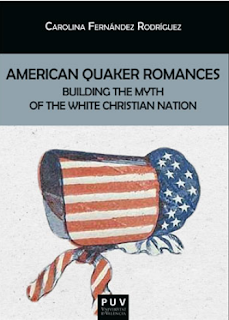
Fernández Rodríguez, Carolina (2021). American Quaker Romances: Building
the Myth of the White Christian Nation. Valencia : Universidad de
Valencia.
With the rise in recent years of the Christian romance market,
dominated by American Evangelical companies, there has been a renewed
interest in fictional Quakers. In the historical Quaker romances
analyzed in this book, Quaker heroines often devote time to spiritual
considerations, advocate the sanctity of marriage and promote
traditional family values. However, their concern with social justice
also leads them to engage in subversive behavior and to question the
status quo, as illustrated by heroines who are active on the Underground
Railroad or are seen organizing the Seneca Falls convention. Though
relatively liberal in terms of gender, Quaker romances are considerably
less progressive when it comes to race relations.
Thus, they
reflect America's conflicted relationship with its history of race and
gender abuse, and the country's tendency to both resist and advocate
social change. Ultimately, Quaker romances reinforce the myth of America
as a White and Christian nation, here embodied by the Quaker heroine,
the all-powerful savior who rescues Native Americans, African Americans
and Jews while conquering the hero's heart.
Hefner, Brooks E.
(2021).
Black Pulp: Genre Fiction in the Shadow of Jim Crow
Minneapolis:
University of Minnesota Press. [Excerpt available via Google Books. See in particular Chapter 2, "Romancing the Race: The Politics of Black Love Stories."]
Johnson, Brian (2022). "Weird Bedfellows: H. P. Lovecraft, m/m Romance,
and the New Queer Families of Jordan L. Hawk's Whyborne & Griffin
Series." Lovecraft in the 21st Century: Dead, But Still Dreaming. Ed.
Antonio Alcala Gonzalez, Carl H. Sederholm. New York: Routledge. [Abstract]
Khumwongdee, Yanisa
(2021).
Reading and Rewriting Fat Romance: A Study of Twenty-First Century Thai and US Fat Romance Novels.
PhD thesis, University of York. [Abstract]
Weimer, Christopher
(2021). "Romancing Weird Fiction: Lovecraftian Reinscriptions in Jordan L. Hawk's Whyborne and Griffin."Aeternum: The Journal of Contemporary Gothic Studies8.1:61-76. [Download the whole issue.]
Hughes, Bill
(2021).
"Genre Mutation in Young Adult Gothic: The Dialectics of Dystopia and Romance in Holly Black's The Coldest Girl in Coldtown."
Young Adult Gothic Fiction: Monstrous Selves/Monstrous Others. Ed. Michelle J. Smith and Kristine Moruzi. Cardiff:
University of Wales Press. [More details here.]
Nickel, Eleanor Hersey
(2020).
Christian Popular Culture from The Chronicles of Narnia to Duck Dynasty.
Eugene, Oregon:
Wipf and Stock Publishers. [There is a chapter about Francine Rivers's Redeeming Love. Excerpt available here.]
Parnell, Claire, Andrea Anne Trinidad & Jodi McAlister(2021).
"Live literature in the Philippines: an ethnographic study of #RomanceClass and reading as performance."Creative Industries Journal. Online First. [Abstract]
Pierre-Robertson, Petronetta (2021). "Literature as an Agent of Change." Gender and Domestic Violence in the
Caribbean. Ed. Ann Marie Bissessar and Camille Huggins. Palgrave Macmillan,
Cham. 87-103. [More details here and here.]
Burke,
Nicola, 2020. Mills and Fur: Feminism and Femininity in the
Supernatural Romance. PhD, Western Sydney University. [Available for download.]
González-Cruz, María-Isabel, 2021.
"On the Discoursive Construction of the Spanish Hero in Intercultural Romances."
International Handbook of Love: Transcultural and Transdisciplinary Perspectives, Ed. Claude-Hélène Mayer and Elisabeth Vanderheiden. Cham: Springer.
749-767. [Abstract here.]
Hackett, Lisa J. and Jo Coghlan, Jo, 2021. "The History Bubble: Negotiating Authenticity in Historical Romance Novels." M/C Journal 24.1.[Open access online.]
Izharuddin, Alicia, 2021. "'Redha tu Ikhlas': The Social–Textual Significance of Islamic Virtue in Malay Forced Marriage Narratives Religions 12.5 (310). [Available for download.]
Kraxenberger, Maria,
Christine A. Knoop and Winfried Menninghaus, Winfried, 2021. "Who reads contemporary erotic novels and why?" Humanities and Social Sciences Communications
8. [Available for download.]
Kuchta, Estella Carolye, 2021.
"Imagining Love: Teen Romance Novels and American Teen Relational Capacity."
International Handbook of Love: Transcultural and Transdisciplinary Perspectives, Ed. Claude-Hélène Mayer and Elisabeth Vanderheiden. Cham: Springer. 827-842. [Abstract here.]
McGurl, Mark, 2021.
"Unspeakable Conventionality: The Perversity of the Kindle."American Literary History. Online First. [Abstract]
Romantic Escapes: Post-Millennial Trends in Contemporary Popular Romance Fiction. Ed. Irene Pérez Fernández and Carmen Pérez Ríu, Carmen. Bern:
Peter Lang, 2021. [This is a book which includes a number of essays on romance. The link provided is to the entry in the Romance Scholarship Database, which includes a list of the contents.]
Rader, Kara, Shelly R. Hovick & Elisabeth Bigsby, 2021. "'Are You Clean?' Encouraging STI Communication in Casual Encounters through Narrative Messages in Romance Novels." Communication Studies. Online First. [Abstract]
I probably shouldn't have let this post grow for so long as it's rather long now.
Abdullah-Poulos, Layla, 2016.
“Muslim Love American Style: Islamic-American Hybrid Culture and
Native-Born American Black Muslim Romance.” MA thesis, SUNY Empire State
College, 2016. Excerpt
“Manners, Money, and Marriage: Austen, Heyer, and the Literary Genealogy of the Regency Romance”. After Austen: Reinventions, Rewritings, Revisitings. Ed. Lisa Hopkins. Cham, Switzerland: Palgrave Macmillan, 2018. 81-101. [This focuses on the "social and sexual precarity" of female characters, in particular in Heyer's Regency Buck.]
Glennemeier, Jaelyn, 2018.
“And he was an Arab!:” Imperial Femininity and Pleasure in E. M. Hull's 1919 Desert Romance, The Sheik', Honors thesis, University of Kansas. Abstract and link to pdf [Bonnie Loshbaugh reports that this contains details of "a 1922 interview with [E. M.] Hull in Nash’s and Pall Mall Magazine, and implies that it includes a photograph of Hull in front of her home." With the centenary of the publication of The Sheik coming up, it might be nice if someone could put this online.]
Gunne, Sorcha.
‘Gender, Genre and Modernity: Popular Romance Fiction in Ireland’, Handbook of Modern Irish Fiction, Ed. L Harte. Oxford: Oxford University Press [in press]. [I've added this to the section about chick lit, because that's what the content mostly seems to discuss.]
Hopkins, Lisa, 2018.
"Georgette Heyer: What Austen Left Out". After Austen: Reinventions, Rewritings, Revisitings.
Ed. Lisa Hopkins. Cham, Switzerland: Palgrave Macmillan, 2018. 61-79.
[This chapter looks in detail at military metaphors/language used by
Heyer, as well as her allusions to Austen.]
"Making the Modern Girl: Fantasy, Consumption, and Desire in Romance Weeklies of the 1920s". Women's Periodicals and Print Culture in Britain, 1918-1939: The Interwar Period. Ed. Catherine Clay, Maria DiCenzo, Barbara Green, and Fiona Hackney. Edinburgh: Edinburgh University Press.
Sewell Matter, Laura, 2007.
“Pursuing the Great Bad Novelist”, The Georgia Review 61.3 (2007): 444-459.
"Queering Settler Romance: The Reparative Eugenic Landscape in Nora Strange's Kenyan Novels", Archiving Settler Colonialism: Culture, Space and Race.
Ed. Yu-ting Huang and Rebecca Weaver-Hightower. Abingdon: Routledge,
2019. 190-204 ??. ["Williams reads Nora Strange’s interwar romance
novels as they archive settler preoccupation with white sexuality in a
settled space. In Strange’s novels, a repressed and declining Britain
needs the “Edenic paradise” of Kenya to let loose British sexual
vitality. The Kenyan environment tests would-be parents for their moral
and physical fitness in producing good settler children and awakens
healthy heterosexual desires to ready parents for reproductive duty."]
The main aim of ERIH has
been from its very beginnings to enhance global visibility of
high quality research in the humanities published in academic journals
in various European languages all over Europe. The index enables
researchers to better understand and promote the national and
international importance of their research. (About)
Bea and Leah Koch, the sister duo who founded and own Los Angeles’ romance bookstore The Ripped Bodice,
have signed an overall deal with Sony Pictures Television [...]. The Koch sisters will partner with Sony to
develop romance-focused projects for television based on their unique
connection to romance readers and authors.
Abhija Ghosh (Jawaharlal Nehru University, New Delhi) on ‘Orchestrating Romance: Nineties Romance Genre, Film Song and Bollywood’
Diana Holmes (University of Leeds), on ‘Plaisirs d’amour: love and popular fiction in contemporary France’
Lucy Sheerman (independent researcher) on ‘Reader I Mirrored Him: the recasting of romance tropes in Jane Eyre fanfiction'
If that makes you want to write a paper about love, then the call for papers for "Love, etc", A conference sponsored by the “Uses of Literature” Research Project at the University of Southern Denmark, October 3-4, 2019might be of interest. The closing date for submissions is November 15 2018.
Alternatively, there are still a few days left before the closing date for submissions to the ACLA Book Lovers seminar: "Book Lovers welcomes abstracts that touch on any aspect of love". Abstracts must be received by Thursday,
September 20, 2018 at 9 a.m. EST. The American Comparative Literature Association's 2019 Annual
Meeting will take place at Georgetown University in Washington, DC,
March 7th-10th, 2019.
There's also been a call for papers for a panel on Muslim Popular Culture in Asia: Aesthetics and Politics at the German Association for Asian Studies’ (DGA)'s biannual Conference on Contemporary Asia, which will be held in April 3–5, 2019 in Würzburg, Germany. The deadline for all paper proposal submissions is October 7, 2018, 6:00pm (CET).
In August a team from the Surgery and Emotion project introduced visitors to the Science Museum to Mills & Boon romances:
One participant said it was ‘such a fun station’ and that they’d ‘learnt
a lot about Mills & Boon books’. Another commented it was ‘so fun’,
‘a good idea for an activity’, and that it encouraged her to think
about ‘the cultural impact of medical fiction’. One attendee described
it as an ‘awesome stall’, explaining that they ‘didn’t know anything
about Mills & Boon before, it’s really made me think’. Finally, one
visitor remarked that it was a ‘super enjoyable’ activity, and that
they’d ‘learnt a lot about how the novels were ahead of their time,
regarding females’ roles in a medical setting’.
Sourcebooks is releasing new editions "of 11 of Heyer’s Regency romances as part of the
Georgette Heyer Signature Collection" (Keira Soleore). The books in the "Georgette Heyer Signature Collection" include
praise from scores of bestselling authors, sharing their
love of Heyer and why she’s such a gem. Each book includes a fun
glossary of Regency slang, plus an Afterword by Heyer’s official
biographer Jennifer Kloester, with fascinating insights about what Heyer
thought about her own books and what was going on in her life at the
time she was writing them. A Reading Group Guide helps readers delve
into discussion of Heyer’s time and ours, and why the more things
change, the more they stay the same (human nature for sure!).
The IASPR 2018 conference now has its programme online but prior to that appearing there was a lot of very thorough tweeting by a number of attendees, using #iaspr18. Since Kat (@BookThingo) has really comprehensive threads, I've used the threadreaderapp to bundle her tweets together and I'm linking to them below.
Session 1 - Romancing Australia, with papers by Amy T. Matthews and Amy Mead (Flinders University), Kate Cuthbert and Jodi McAlister (Deakin University) SEE THREAD
There's more about changes affecting cover art, as discussed by Kate Cuthbert, here, from Claire Parnell via the @PopFicDoctors: Coverart and here's a podcast interview with Jodi McAlister in which she discusses her paper: Podcast. In addition, Renée Dahlia has written a blog post about the session.
Session 2 - Gender and Sexuality, with papers by Ellen Carter (University of Strasbourg), Christina Vogels (AUT New Zealand) and Andrea Anne Trinidad (Ateneo de Manila University, Philippines) SEE THREAD
Renée Dahlia's written a blog post about this session.
Here's a podcast from New Zealand Radio with Christina Vogels about her PhD thesis, titled It's a masculinity sort of thing: Young men talk about the rules of (hetero)romantic relationships.
Session 3 - Places and Spaces of Love, with papers by Kecia Ali (Boston University), Jacqueline Jones (LaGuardia CC, City University of New York) and Vassiliki Veros (University of Technology, Sydney) SEE THREAD
A similar presentation by Vassiliki Veros on "Exploring library metadata and how it can marginalise romance fiction" is up on YouTube.
Session 4 - Keynote Panel on “Romancing Popular Fiction Studies: A Theory of Genre Worlds” by Beth Driscoll (University of Melbourne), Lisa Fletcher (University of Tasmania) and Kim Wilkins (University of Queensland) SEE THREAD and, from Jodi McAlister, with more graphics: See thread
There's also a podcast recorded with the presenters in advance of this panel: Podcast
Session 5 - History and Romance, with papers by Stephanie Russo (Macquarie University), Jennifer Wallace and Francesca Pierini (Academia Sinica, Taiwan).
Kat had to miss most of this session, so the thread is by Jodi McAlister: SEE THREAD
Philippa B's summary of Stephanie Russo's paper on "Georgette Heyer’s Unruly Eighteenth Century" can be found here.
Phillipa B's summary of Pierini's presentation about "Italian timelessness" can be found here.
Jennifer Wallace writes romance as Jennifer Hallock and she's put her paper up on her website in two parts. Part one looks at how the bestsellers in historical romance are
disproportionately: (1) set in Great Britain; (2) overpopulated with
nobles; and (3) selective in their historical accuracy. Part two looks at how the aggregate impact of these chronotopes can be
harmful to our understanding of history, to the romance market as a
whole, and particularly to authors of diverse books. For links to more graphics and a way to help Jennifer crowdsource historical romances which differ from the chronotope she identified, go here and scroll to the end of the post.
Phillipa B's summary of Jennifer Wallace's "History Ever After: Fabricated historical chronotopes in romance genre fictions" can be found here.
Session 6 - Power and Patriarchy, with papers by Heather Schell (George Washington University), Nattie Golubov (Centro de Investigaciones sobre América del Norte, Universidad Nacional Autónoma de México), Therese Dryden (University of Newcastle) and Jayashree Kamblé (LaGuardia CC, City University of New York) SEE THREAD
Philippa B's post about Heather Schell's "The Soft Power of Popular Romance" can be found here.
Philippa B's post about Nattie Golubov's "Dangerous loves endangered: nationalism, violence and territoralization in US paramilitary romance fiction" is here.
Philippa B's summary of Therese Dryden/Michelle Douglas's "The Single Mother and the Law: Romance novels making room for female voices in patriarchal spaces" is here.
And details of Jayashree Kamblé's “One of the Guys? Eve Dallas as a Masculine Worker Heroine in J.D. Robb’s In Death series", also by Philippa B.
Session 7 - 19th Century Legacies, with papers by Sarah Ficke (Marymount University), Steven Gil and Lucy Sheerman SEE THREAD
See Renée Dahlia's blog post about the session.
Details here about Sarah Ficke's “House, Home, and Husband in Historical Romance Fiction", from Philippa B.
Steven Gil's "Beloved Monstrosity: Romance and Romanticism in Frankenstein" has been summarised by Philippa B.
Philippa B has summarised Lucy Sheerman's “Reader, I mirrored him: the recasting of romance tropes in Jane Eyre fanfiction" here.
Session 8 - Muslim and Middle Eastern Romance, with papers by Kathrina Daud (University of Brunei), Claire Parnell (University of Melbourne), Javaria Farooqui (University of Tasmania) and Amy Burge (University of Birmingham) SEE THREAD
See Renée Dahlia's blog post about the session.
Philippa B's posted about Kathrina Daud's "Muslims reading romance: Bruneian considerations of “Halal” and romance novels" here.
The abstract of Claire Parnell's “Reading and Writing Muslim Romance Online” and notes on the session by Philippa B can be found here.
Philippa B's post on Javaria Farooqui's “The Kitchen and Beyond: Romantic Chronotope of Pakistani Popular Fiction" is here.
Amy Burge's “Girls of Riyadh and Desperate in Dubai: Reading and writing romance in the Middle East" is summarised here by Philippa B.
Session 9 - Romancing Chinese Worlds, with papers by Fang-Mei Lin (National Taiwan Normal University), Huike Wen (Willamette University), Jin Feng (Grinnell College) and Erin S. Young (SUNY Empire State College) SEE THREAD (by Jodi McAlister)
See Renée Dahlia's blog post about the session.
The abstract of Huike Wen's “On the Way to a Better Life: Countryside themed romance in recent Chinese Television" and some additional comments from the paper are provided by Philippa B here.
Philippa B also provides these for Jin Feng's “Life Is Elsewhere: The Economy of Food and Sex in Chinese Web Romance”
and for “Romance in Chinatown: The Love Stories of Edith Maude Eaton” by Erin S. Young.
Session 10 - South/South-East Asian Romance Communities with a paper by Meghna Bohidar (University of Delhi)
Bohidar: young romantic couples are less concerned with caste and religious differences, however they still shape subjectivity e.g. through taste. #IASPR18pic.twitter.com/QrvvM5tZFt
For those who can't read the text in that photo, it contains a definition of an important term used in Bohidar's paper: "Habitus is a set of microbehaviors consisting of a matrix of perceptions, appreciations, and actions that are unconsciously ingrained based on one's class position"
SEE THREAD and Philippa B's summary of Meghna Bohidar's “Negotiating Romantic Love in India: Family, Public Space, and Popular Cinema"
The session then moved on to Kat Mayo's interview of/conversation with Mina V. Esguerra
Session 11 - Subversions of Race, Culture and History with papers by Eric Murphy Selinger (DePaul University), Mallory Jagodzinski (Indiana University South Bend) and Johanna Hoorenman (Utrecht University) SEE THREAD and, from Jodi McAlister, A SUPPLEMENTARY THREAD
The abstract of, supplemented by notes by Philippa B on, Eric Murphy Selinger's “The Wild Heart of the Continent: Love and Place in Sherry Thomas’s Silk Road Romance Novels”
The same, but for Mallory Jagodzinski's “Love is (Color) Blind: Race, Belonging, and Nation in 21st Century Historical Romance Fiction" is here.
Again, an abstract followed by comments by Philippa B, this time on “‘You stayed’: Love, law and the reservation in Jenna Kernan’s Apache Protectors series" by Johanna Hoorenman.
Session 12 - Love in Other Worlds with papers by Donna Hanson (University of Canberra), María T. Ramos-García (South Dakota State University), Athena Bellas (University of Melbourne) and Kristin Noone (Irvine Valley College) SEE THREAD and coverage of the FINAL PAPERS in this thread by Jodi McAlister.
Philippa B's post about Donna Hanson's “Love in Outer Space: Science fiction romance
—
the ideal place to explore gender and
love” can be found here.
María T. Ramos-García's “Representations of Otherness in Paranormal Romance: Nalini Singh and J.R. Ward” is summarised by Philippa B here.
I've now come across a couple of reports on the recent Georgette Heyer conference. Sophie Weston mentions that
A terrific paper from Vanda Wilcox made
the point that, however precise Heyer’s grasp of strategic issues at
Waterloo might have been, her officers “embody World War I values and
leadership style”. At the same time Heyer’s other ranks (gorgeous Gideon
Ware’s straight-talking soldier servant, for instance) are basically
WWI Tommies in red coats, rather than Wellington’s rapists and
pillagers. Convinced me completely.
Her full report can be found here. The evening discussion session is described here by Nicola Cornick.
On 29 June, at the Gendered Emotions in History conference held at the University of Sheffield there was a paper on romance, presented by:
Agnes Arnold-Forster (QMUL) - Gender, Emotions, and Professional Identity in Twentieth Century Medical Mills and Boon Novels
The EUPOP2018 conference will be held from July 24th – 26th, 2018. One of the keynote speeches is by
Professor Petr A. Bilek (Charles University, Prague)
Distant Encounters of the Third Kind: Why Is Popular Culture Not Popular within Central European University Curricula?
The International Association for the Study of Popular Romance (IASPR) is proud to announce the winner of the first annual Conseula Francis Award for the best unpublished essay on popular romance media and / or the logics, institutions, and social practices of romantic love in global popular culture. The winning essay this year is “The Stable Muslim Love Triangle – Triangular Desire in Black Muslim Romance Fiction," by Layla Abdullah-Poulos of SUNY Empire State College: a groundbreaking study of "the amalgamation of Islamic, Black American, and American notions of love, courtship, and sexual dialogue" in this emerging textual corpus.
As the winning essay, "The Stable Muslim Love Triangle" will receive a $250 USD cash prize and be published in the peer-reviewed Journal of Popular Romance Studies. Abdullah-Poulos will also join the the panel of judges for next year's Francis Award.
The Francis Award is in honor of Conseula Francis, whose work on popular romance fiction focused on African American authors and representations of Black love. Essays submitted to the competition may focus on work in any medium (e.g., fiction, film, TV, music, comics, or advice literature) or on topics related to real-world courtship, dating, relationships, and love; priority for the Francis Award will be given to manuscripts that address the diversity of, and diversities within, popular romance and romantic love culture: e.g., diversity of race, ethnicity, gender, religion, class, sexuality, disability, or age.
Associate provost and professor of English and African American Studies at the College of Charleston, Francis was the author of The Critical Reception of James Baldwin: 1963-2010 (2014) and the editor of Conversations with Octavia Butler (2009). In 2010, she was awarded a research grant by the Romance Writers of America for “Uncommon Pleasures: Textual Pleasure and Female Sexual Agency in Contemporary African American Romance and Erotica,” a project focused on the work of Beverly Jenkins and Zane. An essay drawn from this research, “Flipping the Script: Romancing Zane’s Urban Erotica,” was published shortly before her death in Romance Fiction and American Culture: Love as the Practice of Freedom? Francis wrote about Zane for the NEH-funded Popular Romance Project, as well as about romantic representations of Barack and Michelle Obama during the 2012 presidential campaign.
The annual deadline for submissions for the Francis Award is December 1, and the winner will be announced in April or May of the following year. All submissions should be sent to Erin Young, Managing Editor of the Journal of Popular Romance Studies, at managing.editor@jprstudies.org. Please put “Francis Award” in your subject line. All submissions must be Microsoft Word documents, with citations in MLA format; in keeping with JPRS publication guidelines we will consider essays of 5000 to ~10,000 words in length. Please remove your name or the name of any co-authors from the submitted manuscript; in your cover-letter email, please provide your contact information (address, phone number, e-mail address) and a 150-200 word abstract of the submission.
The judges for the Francis Award will be a mix of established and emerging scholars in the field of Popular Romance Studies, chosen by IASPR; each winner will be invited to join the judging team for the following year.
"Renegotiating romantic genres: Textual resistance and Muslim chick lit." Journal of Commonwealth Literature. Online first. 1-17. [Abstract]
Newns examines Leila Aboulela's fictional The Translator and Shelina Zahra Janmohamed autobiographical Love in a Headscarf:
Through their
manipulation of secular romantic forms, they present readers with more
nuanced articulations of Muslim womanhood that fuse feminist and
religious concerns. Aboulela’s novel The Translator (1999) and Janmohamed’s memoir Love in a Headscarf
(2009) appropriate the domestic novel and chick lit genres,
respectively, and recast them within an Islamic signification system.
Newns doesn't mention popular romance except in passing, but Aboulela's novel is compared in some detail to Jane Eyre, while Janmohamed's book is compared to chick lit.]
Sinner, Carsten, 2012.
"Fictional orality in romance novels: Between linguistic reality and editorial requirements." The Translation of Fictive Dialogue. Ed. Jenny Brumme and Anna Espunya. Amsterdam: Rodopi. 119–136.
In constructing the characters' social context, interpersonal distance is overtly manifested in some languages. Carsten Sinner [...] illustrates the conscious efforts made by German translators of English-language romance novels to recreate the highly conventionalized use of the terms of address Sie (distant) vs du (close), and even to ensure verisimilitude in the switch from one to the other, a protocol regulated by various parameters (age, superiority, personality). (22)
Carsten Sinner [...] attests to the "sanitization" strategy (term coined in Kenny 1998) followed by German publishers of romance novels through their translation style-sheets. Any feature of speech that may have a negative impact on the reader's opinion of the 'good' character has to be attenuated or even deleted, no matter the consequences for the verisimilitude of the situation. The difficulty does not lie in finding the model of language that is homologous to the source text colloquial variety but rather in achieving plausibility without shocking the reader. (23-24)
Other things generally omitted in the translation because of the publisher's style prescriptions are religious allusions and anything seen as nationalistic, heroic in a military sense, etc, which sometimes appears in the American originals. (133)
Keira Soleore has posted summaries of papers presented on romance at the recent PCA/ACA conference:
The Popular Culture Association and American Culture Association's national conference was on Tuesday, March 22 in Seattle. I attended five of the seven sessions in the Romance Area, which was chaired by Eric Selinger of DePaul University.