Friday, June 27, 2008

Society Defined


Pamela Regis has written that "Near the beginning of the [romance] novel, the society that the heroine and hero will confront in their courtship is defined for the reader. This society is in some way flawed; it may be incomplete, superannuated, or corrupt" (31). This impression of a flawed society is changed by the end of the novel:
In a scene or scenes the promised wedding is depicted, or some other celebration of the new community is staged, such as a dance or a fete. The emphasis here is on inclusion, and this scene is promised in every romance, even if it is not dramatized. Society has reconstituted itself around the new couple(s) and the community comes together to celebrate this. (38)
Of course, one of the flaws in society may be that it expects people to pair up as "heroine and hero," female with male. What happens to those who are rejected by their families because they can't? One hopes they'd find a new community, a new "family," as supportive as the one depicted in Ann Somerville's Means of Support (Chapter 1 and Chapter 2).

Somerville's fantasy/speculative fiction story Slipping Under further explores the connections between the individual and the rest of society and reaffirms the importance of love and human contact in a world which, in its busyness and increasing use of the internet and telephone, can leave individuals feeling isolated, anonymous, unknown. Being "in the closet" (or being rejected by one's family for coming out of it) doesn't help to foster feelings of connectedness either. The fact that this is fantasy/speculative fiction enables Somerville to explore this theme in a way that I found very powerful, because it makes real what could, in a contemporary romance, never go further than a metaphor. I don't want to say more because I don't want to give any spoilers, but maybe we can discuss it further after people have read the story, which is available for free here.

Ann gives a warning on her webpage that
The stories on this site are intended for mature audiences. They will include, from time to time, some sexually explicit scenes between couples of various genders within the context of longer stories, and address adult issues. There may also be occasional descriptions of explicit violence. Please don't click on any link on this site if you are underage, or likely to be disturbed by this kind of content, or stories with mature themes of any kind.
She has a lot of free stories there, but the ones I've chosen to highlight here don't contain "explicit violence."

  • Regis, Pamela. A Natural History of the Romance Novel. Philadelphia: U of Pennsylvania P, 2003.
The illustration can be seen in more detail at Wikipedia where it is described as a "Half-section of the Chinese painting Night Revels of Han Xizai, handscroll, ink and colors on silk, 28.7 x 335.5 cm. Original by Gu Hongzhong (10th century), 12th century remake of the Song Dynasty." Another Wikipedia entry observes that "the painting, which is a masterpiece of the era's artwork, portrays servants, musicians, monks, children, guests, hosts all in a single societal environment, serves as an in-depth look into 10th-century Chinese social structure."

Friday, June 20, 2008

Open Not the Door


Katrina Britt's Open Not the Door (1978) might also be titled "open not the pages unless you don't mind reading some rather overt moralising, traditional ideas about femininity and some nationalist stereotypes".

Here's a statement from Laraine, the heroine of the novel, on the issue of cohabitation: "lots of people do appear to be living together if you believe the press, but there are many more who are decent and clean-living, and I happen to be one of them" (43).

"Clean-living" young women, it is further revealed, take an immense interest in feminine undergarments (unlike the non-clean-living young women, who it is implied may even dispense with night-wear altogether, or at very least show little interest in it!):
Margaret [...] signalled Laraine to follow her to a chintz-covered chest serving as a seat. Inside was the kind of cobwebby negligé a girl dreams about, frothy silk and lace with ribbons, all delicately made.
Laraine breathed in the delicate scent of pot-pourri as the garments were revealed between layers of tissue paper.
'They're gorgeous!' she cried. 'Thanks for showing them to me.'
Margaret replaced each garment almost reverently. 'I think every girl should have beautiful things to wear on her honeymoon. A pity that girls today don't seem to think much beyond a nightdress, and not always that. They miss such a lot by not being so essentially feminine.' (116)
Charles, who's the type of hero who, when angry, is prone to forcing the heroine's "lips to the will of his. [...] He was all cruel strength, punishing lips, and bone-cracking arms whipped tightly around her. When he released her, Laraine was like one who had been shocked out of her senses, pain and ecstasy together. Her bruised lips trembled at the thought" (154-55) eventually describes Laraine as
everything I'd looked for in a woman, demure, feminine, good company, with your lovely eyes filled with compassion for a poor little hedgehog and a girl in a wheelchair. I loved your sense of humour, your courage, your understanding and tolerance of human frailty. (186)
So there you go. Now you know what you have to do if you want to be a truly "feminine", "clean-living" woman.

Another aspect of the novel which I noticed, and which I thought I'd mention is the way in which particular national characteristics (which one might well term "national stereotypes") are presented.

Laraine, on arriving in Scotland looks around her: "She was imagining a land peopled by a fierce army of Borderers, big handsome horsemen, proud and independent, men who had inspired Walter Scott to immortalise them in his Waverley novels" (17). Charles's statement on the matter of the national character is that:
We Scots might descend from a savage race of Borderers, but we do now manage to live in a civilised manner. The traditions of the past are still dormant within us and we're a fiercely independent and proud race. [...] However, we respect and love our women, our land and our heritage. (37)
Laraine comes to the conclusion that
The world that Charles moved in was far different from her own. His was a world of wild Border country where old beliefs still existed from ancestors which made her own look pale in comparison [...]. They had carried the stamp of a fierce proud race, and Charles was no exception. (110)
There's also a brief description of an Italian doctor, which gives Britt the opportunity to generalise about the appearance of Italians: "Of medium height, with sleek black hair and liquid dark eyes gleaming [...] Dottore Padrilli was handsome with the beautiful bone structure of face often to be seen among the Italians" (175).

However complimentary they may be, such descriptions of individuals (or groups of individuals) which refer to their nationality as though this in itself ensures physical and/or emotional homogeneity are problematic. In the nineteenth century "a series of authors divided Europe's population into discrete and homogeneous national groups on the basis of sexual characteristics. These pseudo-objective taxonomies reflect the arbitrary figments of nationalist fantasy" (Maxwell 266). Unlike Britt's romances (and, in fact, many other romances which describe the exotic attractions of the foreign hero), many of these nineteenth-century male writers were particularly interested in describing female beauties and
They examined "specimens" for unique "characteristics"; botanical metaphors were frequent. An 1881 article in Leipzig's Illustrierte Zeitung, for example, discussed "the unique specialties of female local flora" in an article on Vienna's "Female Types." A German fashion magazine similarly wrote that Spanish women "grow and bloom in the fertile soil of Iberia, without troubles, without culture, like the flowers and fruits of this blessed land." Pseudoscientific authors suggested that readers, too, could learn to classify women by nationality, just as they might learn how to classify various shrubs or beetles. (Maxwell 268)
This pseudoscience did not restrict itself to outlining the physical characteristics of women along national lines. Personality as well as appearance were thought to be determined by nationality:
Jakob Ignjatović, a Serbian lawyer who briefly sat in the Hungarian parliament [in his] 1865 essay "The Serb and His Poetry" [which] appeared in the Slavisches Centrallblatt, a German-language newspaper published in Saxony. Ignjatović argued that [...]:
In every people [...] feminine beauty has a particular character. The German woman is characterized through her sky blue eye, her golden-yellow hair, the tenderness of her whole being, and her soft heart;—the Greek woman by her regular facial features, her fiery eyes, her proportional figure, and the lively expression of her heart;—the Italian by her beautiful oval face, her sly eyes, her adorable voice, and the lightness of her movements;—the Englishwoman by her friendly expression, the fullness of her developed body, and her worthy figure;—the Frenchwoman by her animated complexion, the loving expression of her face, and her noble bearing;—the Hungarian by the purity of her complexion, the Caucasian, almond-shaped eyes, trustfulness, and the expression of openness;—the Arabian her exceptionally beautiful deep, dark complexion, the whiteness of her teeth, the bold gaze and the masculine, almost angry features on her face.
All women are beautiful, but the character of their beauty depends on their nationality. This text powerfully illustrates how readily pseudoscientists ignored obvious facts: Ignjatović knew that not all German women have "golden-yellow" hair nor all Hungarian women good complexions.(Maxwell 277-78)
One might also observe that not all Englishwomen have friendly expressions, soft hearts are not solely to be found among German women and so on.1 Researchers from the University of Manchester's PUG (Public Understanding of Genetics) project observed in a recent leaflet that
Race, ethnicity, nationality are overlapping ways of thinking about how humans are different from and the same as each other. [...] Racial thinking often uses ideas of “natural” bodily substances - for example, “blood” - that are supposedly shared by people of similar geographical origin and transmitted through descent and that, in this way of thinking, shape both physical appearance and culture. Today, racial thinking is scientifically seen as invalid (1-2)
and
Genetics sees all humans as the same because, as a species, our common evolutionary origin in Africa means that we all share more than 99% of our genetic material. Genetics also sees humans as different because there are variations in genetic make-up. Although there is still some debate on the matter, most geneticists now think that these variations do not correspond to what people think of as racial, ethnic or national categories. There is no clear genetic basis for racial, ethnic or national thinking. (2-3)
I wonder when we'll see the door close on racial stereotypes (the Scottish barbarian, the arrogant, domineering Spanish/Italian/Greek macho hero, the noble Native American savage) in the romance genre.
  • Britt, Katrina. Open Not the Door. London: Mills & Boon, 1978.
  • Maxwell, Alexander. "Nationalizing Sexuality: Sexual Stereotypes in the Habsburg Empire." Journal of the History of Sexuality 14.3 (2005): 266-290.

1 Here's some more from Ignjatović, describing the Serbian woman:
She does not have the lightness and enchantingness of the Italian;—nor the docility of expression and loving heart of the Frenchwoman;—nor the solid and solicitous sweetness of the Englishwoman;—nor the light-hearted trustfulness and openness of the Hungarian;—but she does have something of the self-respect and pride of the Spaniard. She has the most in common with the Arabian woman. . . . All these characteristic features unite in the Serbian woman to an expression of heroism, through which she distinguishes herself from the women of all other nations. (qtd. in Maxwell 279)
He also produced a description of men of various different nationalities:
Every nation [...] has its own characteristic beauty. The German is handsome because of his gold-colored hair and soft blue eyes, the Frenchman because of his ideals and friendly facial expressions, the Spaniard because of his proud eyes, the Arab his dark complexion. The Serb, by contrast, does not have a soft appearance: his eyes spew fire. For this reason, the costume of a warrior suits him. The sight of a Serb in a frock coat is almost comical. (qtd. in Maxwell 287)

Friday, June 13, 2008

Optional Romance Exam

Eric's written an end-of-term report on his romance fiction class.
Whatever the life-skills they learned or missed, students came away with more respect for the genre, and most had at least one author, sub-genre, or series they planned to read after graduation. This afternoon I’ll order the books for my next romance classes. Some new ones will join the mix: Gwyneth Bolton’s Sweet Sensation, Beth Pattillo’s Heavens to Betsy (my first in-class Inspy), and Devil’s Cub, by Georgette Heyer, comes back into print in August, just in time for the fall survey. While I get the next round of syllabi in order, you might have some fun with this: the optional final exam for my senior seminar. I gave it on Tuesday, and guess what? Nobody came! All too busy working on their papers, I guess.
If you'd like to take the exam, the questions (on Linda Howard's Mr. Perfect, Loretta Chase's Mr. Impossible, J. R. Ward's Dark Lover, Laura Kinsale's Flowers from the Storm and Joey W. Hill’s Natural Law) are up, over at Romancing the Blog!

The picture isn't of Eric's students. It's from Wikipedia.

Sunday, June 08, 2008

Connie Brockway and Colonialism


Over at Reader, I Married Him Elizabeth is analysing Connie Brockway's As You Desire.

There are excerpts of the novel here and here, and a variety of rave reviews here, here, here. I did manage to find one slightly more critical review, which can be found here.

Elizabeth's post isn't a review, it's "a close reading of Connie Brockway’s As You Desire focusing on anti-colonial and Orientalist tensions within the book." Elizabeth elaborates both on the ways in which
Orientalist and romance novel tropes will be set up and elaborated upon at great length. These tropes will then be revealed as moments of intensely parodistic humor and dispelled by the actions or words of the “real” characters. [...] Brockway deftly takes up Orientalist stories and refashions them with parodistic humor into a world where Egypt is normalized, England is romanticized, and the entire process of constructing the other is laid bare as a foolish and ultimately immature process. Yet there are also elements of the book that did not ring true for me, moments where Orientalist themes were embraced as well as mocked.
and she takes a closer look at the real historical context in which the novel is set and the extent to which this is (or isn't) reflected in the novel. For example
The increasingly urbanized, educated, and technologically proficient class of Egyptians and Turkish-Circassian elites who by 1890 were articulating powerful and complex desires for national sovereignty is largely absent from the text. The first woman’s periodical, al-Fatah, was published in Alexandria in 1892. Political journals had been printed and distributed within Egypt as early as the 1870s. These journals catered to the increasing portion of Egyptians who were literate, politically engaged, and self-consciously nationalist. Fierce debates over the social roles of religion, women, national identity, and modernization were unfolding in Cairo just as they were unfolding in other urban centers of the time: London, Paris, Berlin, Istanbul, New York, Chicago… Cairo’s struggle to constitute an Egyptian form of modernity was vibrant, complex, and contemporary with European debates over the same issues.

Brockway conveys only a hint of this complexity.
Whether or not you've read the novel, I'd encourage you to go and read what Elizabeth has to say about it.

Friday, June 06, 2008

When is a Pearl Necklace not just a Pearl Necklace?


When a literary critic thinks about its symbolism, of course.

Sarah's over at Romancing the Blog, giving some details about the classes she recently taught as part of the North Carolina State University Encore! program. She spent some time analysing the symbolism of a scene in one romance, only to be told later, by the author of the novel, that no such symbolism had been intended.

Sarah observes that
Literary critics talk about the Intentional Fallacy. Wikipedia helpfully tells us that “W.K. Wimsatt and Monroe Beardsley in their essay ‘The Intentional Fallacy’ (1946 rev. 1954)” wrote that “the design or intention of the author is neither available nor desirable as a standard for judging the success of a work of literary art.” Academics often ask where the meaning of a text resides: is it in the text itself, is it solely in the reader, or is it in the mingling of the two, the combination between how the reader, with her unique personal experiences, reads a text with its unique references and descriptions. If Claudia didn’t “mean” to construct a particular symbolic structure, does that make it any less valid when the reader’s experience is improved by believing that those symbolic structures are there? If the reader finds symbolism in a text, doesn’t that mean that it’s there, whether or not the author intended for it to be there?
I'm one of those who believes that "the meaning of a text resides [...] in the text itself." I believe (and yes, writing about belief in the context of textual analysis is making me feel like I belong to a branch of literary critics who resemble the Protestant Reformers in advocating a return "ad fontes") that the words of the text are the main source of evidence when a reader is trying to understand what that text means. So if, for example, a pearl necklace is mentioned, and all we are told in the text itself is that the heroine likes pearl necklaces, it's going to be more difficult to sustain an argument that the necklace has a particular symbolism. However it would make the critic's argument more convincing if she could show that the perceived symbolism helps to illuminate a particular theme in the work, or the characterisation.

That's one of the main reasons I prefer prose to poetry, by the way. There tends to be a much greater volume of words in a novel, which makes it easier to find larger quantities of evidence against which one can test one's hypothesis.

One may also place the text in its cultural and historical context in order to assess whether or not a particular interpretation is convincing. If a particular symbolism is extremely well known, it's more likely to have influenced the author e.g. if the author writes a scene in which a young woman is offered an apple by a snake, it would seem very likely that the scene alludes to the story of Eve in the Garden of Eden. Some cases are much less clear, and in yet others it may in fact be obvious that the symbolism or allusion could not possibly have been intended by the author. To give an extreme example, if a literary critic wants to believe that a medieval poet was thinking about Buffy the Vampire Slayer as he wrote a particular poem, that's the critic's prerogative, but it's not going to convince me and I'm not going to believe that the poem really contains symbolism which alludes to Buffy.

Thirdly, one can ask the author what she intended, or read what the author has written about her own work. This might be helpful in terms of proving that the author has, indeed, watched a few episodes of Buffy the Vampire Slayer, but it's not so helpful in ruling out possible influences. Most authors seem to describe their process of writing as one which, particularly in a first draft, can be a bit mysterious (hence the talk about Muses and the subconscious). Regardless of what the author was consciously intending, she may have been influenced by her cultural context, the reading she's done in the past, the traditions of the genre in which she writes, etc.

Ultimately, I suppose, whether any of this matters depends on what we're trying to do when we analyse texts. Are we assuming that a text will be basically coherent (though it may include some elements which run counter to certain other elements) and there is one correct way to interpret it? If so, then it's not surprising we'd talk about "evidence." We're thinking of the critic as the literary equivalent of a detective, building up a case by organising the clues in order to find the pattern which makes sense of them and, finally, presenting them to the judge (the peer review process). As Sarah's observed, one may or may not believe that's the purpose of literary criticism or of reading.

If one believes that the process of reading is most valuable because of what it can do for the reader, and how it can illuminate the reader's life, or if one believes that "the meaning of a text resides [...] solely in the reader" then talk of evidence and authorial intention may become completely irrelevant.

--------

The photo is of Margherita of Savoy, Queen of Italy, from Wikipedia. According to a website which has photos of her wearing many of her pearl necklaces
Queen Margherita’s passion for pearls became legendary and she would rarely be seen without some pearls of her enormous and most exquisite collection. One of her necklaces, with 280 pearls, came from Queen Maria Adelheid of Sardinia, born Archduchess of Austria, the late wife of her father-in-law, King Vittorio Emanuele II. It had been bought in Prague by Maria Adelheid’s brother, Archduke Leopold. Another and even more impressive necklace was actually formed by several necklaces given in four years by her husband, King Umberto, and was formed by 684 pearls!
Pizza Margherita is named after her:
In 1889, Rafaele Esposito of the Pizzeria di Pietro e Basta Cosi (now called Pizzeria Brandi) baked pizza especially for the visit of King Umberto I and Queen Margherita. To make the pizza a little more patriotic-looking, Esposito used red tomato sauce, white mozzarella cheese and green basil leaves as toppings.
So now I know the symbolism that's present in a Pizza Margherita!

Monday, June 02, 2008

IASPR and JPRS: Call for PEOPLE


This is a Call For People, rather than a Call For Papers. It is time for an academic society for the study of popular romance fiction, with all the rights and privileges appertaining thereunto, like a journal and conferences. So we have decided to start one! "We" being myself, Eric Selinger, and a few other people who are already interested in being involved.

The society will be called The International Association for the Study of Popular Romance (IASPR) and the journal will be an online, open-source journal called The Journal of Popular Romance Studies (JPRS).

So, we're looking for people who might be interested in helping us build these institutions. Do you want to get in on the ground floor? Do you already have experience in the hierarchy of an academic organization or with an academic journal that you'd love to share with us, even if you don't want to be involved in the day-to-day aspects of running either? Please let us know! For minimum involvement, for example, we're going to need people to act as peer reviewers for the journal, so please let us know your specific area of interest in romance novels (paranormals? inspirationals? Regencies? heroes? romances published in the 1950s?). For maximum involvement, we're going to need journal editors and IASPR board members. We especially need the input of people who might have done any of this before, so you can at least tell us what to avoid! :)

For now, the contact person for both the society and the journal is myself, Sarah Frantz. Comment here with a way to contact you and I'll email you post-haste. (Or you can contact me at my Gmail account, which is my full first and last names as one word.)

Let me know what you're interested in doing (A highly-valued affinity for numbers? You could be Treasurer! Technical Know-how? We need Web Gurus! Organization? We need a Membership Chairperson!). Or if you don't know specifically what you might be able to contribute, but are really interested in being a part of the process, let us know that, too! We promise, we'll find a use for you.

Sunday, June 01, 2008

Dangerous Reading

In an article published last year and titled "Harm in reading romance novels?" one could read the following warning:
many romance novels are not as harmless as they look. In fact, some marriage therapists caution that women can become [...] dangerously unbalanced by these books’ entrancing but distorted messages. (Feldhahn)
Concerns about women's reading are nothing new. This week I've been reading Kate Flint's The Woman Reader 1837-1914. She suggests that in this period considerable effort was expended in attempting to answer the question "what moral, sexual, religious, ideological dangers may lie in a woman’s being absorbed by so preoccupying a pursuit?" (4). However, as she also notes, even in that period "the debate about what women should, and should not read, and how they read, was not a new one, nor has it disappeared" (16). According to Flint
Renaissance prescriptive remarks concerning woman's reading were remarkably close, in outline, to ones which were repeated during the next three centuries [...]. Whilst too great an acquaintance with light reading might lead her sexually astray, either in imagination or reality, it would also distract her from developing intellectually and spiritually. Edward Hake makes this point in A Touchestone for this time present (1574): "Eyther shee is altogither kept from exercises of good learning, and knowledge of good letters, or else she is so nouseled in amorous books, vaine stories and fonde trifeling fancies, that shee smelleth of naughtinesse even all hir lyfe after" (qtd. in Flint 23).
One can easily find modern equivalents of this moral condemnation of women's reading of "amorous books" which may ensure that the reader "smelleth of naughtinesse." Just recently one Christian former reader of romances wrote that
An editor casually described the genre's most sexually explicit fare as soft-core pornography. I was horrified. That remark put an entirely new spin on my romance addiction—and explained why these books were so difficult to put down. [...] Romance novels could have caused dissatisfaction with my husband; I knew of wives who compared their all-too-ordinary Mr. Steadys to the books' rich and handsome heroes. (Marvin)
It has often been suggested that women readers are particularly vulnerable, liable to be excessively influenced by fiction:
in an article of 1859 by the critic and moral crusader W. R. Greg, entitled ‘False Morality of Lady Novelists’. He states that:
novels constitute a principal part of the reading of women, who are always impressionable, in whom at all times the emotional element is more awake and more powerful than the critical, whose feelings are more easily aroused and whose estimates are more easily influenced than ours, while at the same time the correctness of their feelings and the justice of their estimates are matters of the most special and preeminent concern. (Flint 4)1
From a very different perspective, but nonetheless also seeking to shield women from writing which may damage their characters, we can turn to Julie Bindel. It wasn't that long ago that we analysed her article about Mills & Boon romances (in considerable detail). She claimed that romance was "propaganda [...]. I would go so far as to say it is misogynistic hate speech" and her main concern was that "such novels feed directly into some women's sense of themselves as lesser beings, as creatures desperate to be dominated."

Yet others have detected harmful elements in fiction, but felt that the reader could nonetheless benefit from if guided and supervised in her reading:
Mary Hays, for example, writing to a woman friend in 1793, advised her not to be too alarmed at her daughter’s predilection for novels and romances. More, Hays thinks, would be lost by forbidding these than by taking the opportunity to discuss the books with her, since this would damage the daughter’s confidence without correcting her taste. [...] Hays claims that ‘The love of the marvellous, or of extraordinary and unexpected coincidences, is natural to young minds, that have any degree of energy and fancy.’ To avoid risking the loss of these characteristics, a mother should read with her daughters, should converse with them about the merits of various authors, and should ‘accustom them to critical and literary discussions’. Eventually, they, like their mothers, should disapprove of anything that has ‘an improper and immoral tendency’. (Flint 30)
A modern equivalent can be found in the advice offered by Diana Mitchell, a ninth-grade teacher:
I decided I might instead learn to use these books in ways that can provoke thought and encourage readers to look closely at what these novels really say, especially about male and female roles. By helping students become conscious of such issues as the gender expectations shown in the books, I can help them think about their own values and expectations for males and females. [...] this questioning process may be slow, but, over a period of time, with gentle urging from the teacher, romance-series readers can learn to be more objective about what they read.

Thus, since many of our female students have a natural attraction to the romance series either as a way of finding solace in an increasingly demanding world or as a way to reassure themselves of happy endings, we as teachers need to use this interest as an opening instead of fighting the losing battle of warning students against reading them.
Greg was particularly worried about the effects of " 'light literature;' [...] this literature is effective by reason of its very lightness: it spreads, penetrates, and permeates, where weightier matter would lie merely on the outside of the mind" (144). It is true that for all that romance has often been described as "fluff," a sort of candy-floss for the brain, it does deal with a great many serious topics. Linda K. Christian-Smith, for example, wrote in 1990 that
woven throughout teen romance fiction’s saga of hearts and flowers is an accompanying discourse that a woman is incomplete without a man, that motherhood is women’s destiny, and that a woman’s rightful place is at home. These themes are part and parcel of the New Right’s political and cultural agenda regarding women, representing the conservative restoration of women to their “proper” place in society.(2)
Also commenting on the moral and ideological content of romance, though this time romances written for adults, Robin stated that she sees
love and relationships (especially marriage) as inherently political, because of the power negotiations involved. And because Romance is so particularly focused on the idealization of love and marriage (historically, at least, for the marriage part), I see it as intrinsically political, as well — active in creating different images of a social ideal.
and in the same comments thread RfP commented that
A lot of romances strike me as political, though I’m not always sure the author is aware of the strength of the subtext. In that respect it’s much like so many other issues in romances–some authors are mindful of it, some relatively unreflected, some put substantial effort into working through the issue.
Similarly, some readers are mindful of the subtexts, while some may not reflect on them much at all (though they may angrily reject a novel which appears to "preach" at them). It can be difficult to work out the precise relationship between a reader and the books she reads. To what extent is any woman reader influenced by what she reads, and how much do factors such as her own pre-existing attitudes, her social context, her individual personality etc affect both her interpretations of what she reads and the selections she makes when at the library or bookshop?

Furthermore, why is the female reader still of so much interest? It could be to do with the fact that, nowadays, on average women tend to read more fiction than men. Maybe, because I work on romance, which is a genre mostly written by women and mostly read by women, I've just not seen the studies which analyse the dangers of reading for men. But could it be that women are still seen as fundamentally different from men in how we read and respond to literature? Is it that we are considered more likely than men to absorb ideas about who we are and what we should be from our reading? Or is it that because women have traditionally had less power, even small changes in our attitudes are seen as posing a significant challenge to the status quo and so our reading of particular texts must, depending on the author's view, either be strongly encouraged or strongly discouraged?

And finally, isn't it interesting that the centuries-old tradition of concern about women readers seems to have focussed, in the present day, on women readers of romance? This is a genre which has been criticised by some for encouraging women to have overly sexual thoughts and become dissatisfied with their husbands, and yet has also been criticised by others for not making women dissatisfied enough with their husbands, gender roles etc. It would seem that any genre that's thought of as one written by women for women, and which deals with the issues of women's sexuality, aspirations and gender roles, is likely to remain controversial.2

1 It should be noted that Greg criticises a number of novels for not concluding happily but instead presenting the reader with "a picture of love abandoned and happiness trampled under foot in obedience to misty and crooked notions of what honour and dignity enjoin" (155).

2 As I've said before, I tend to stress the diversity, rather than any supposed homogeneity, within the genre and among its readers. If one accepts that such diversity exists, it becomes much more difficult to come to any definitive conclusions about whether the genre as a whole is harmful or beneficial to its readers.


The illustration is Robert Martineau's The Last Chapter (1863) and I found this copy via Wikimedia Commons. Flint describes this painting as one which depicts a woman
reading for escapist pleasures. She is unmistakably caught up in one of the fashionably controversial 'sensation novels'. As we watch her consuming the text avidly, by firelight, we conclude that the book has the power to keep her up and awake beyond the customary hour at which the house goes to bed. Her pose is testimony to the compulsive nature of these fictions: moreover, the lighting of the picture and the angle from which she is portrayed invest her with something of the melodramatic mystery and self-importance of the heroines about whom she reads. (3)
The text of Greg's article, along with a great many other Victorian primary texts on the topics of the "Condition of Women," "Empire" and "Science, Evolution, and Eugenics" are available from the University of Minnesota.

Friday, May 23, 2008

RWA Academic Research Grant: The State of Romance Scholarship


As a requirement to receive disbursement of the RWA Academic Research Grant, I had to write a description of the "State of the Scholarship" in romance criticism. I jump-started myself at Romancing the Blog, but took a while longer to finish the essay. I thought I'd post it here (slightly edited), to let y'all see the exciting times we have ahead of us in romance scholarship. So, without further ado:

The Future's So Bright, We'll All Need Shades

I can say without reservation that romance scholarship has never been better and the future is even brighter.

Since the early 1980s, there has always been a steady trickle of academic books and articles about popular romance fiction. Every year or two another book would be published or dissertation written that seemed either to excoriate or defend popular romance fiction. Recently, however, two noticeable changes have occurred in the publishing field. First, the trickle is now a steady stream of books and articles. And secondly, rather than the general tendency to hold one of two polar positions about popular romance fiction, current academic research into popular romance fiction has the critical mass now to be generally much more nuanced. It is generally accepted now that romances are worthy of being studied, as any cultural artifact is. As such, we recognize now that popular romance novels are themselves contested cultural artifacts, potentially reactionary and revolutionary at the same time. Current academic study teases out the different narrative strands of ideological influence in popular romance fiction, while respecting the texts, and while recognizing that the authors and readers that make up the romance community are knowledgeable, desirous, autonomous subjects.

One example of the critical mass of study is the exponential increase in a serious presence of popular romance fiction at academic conferences. The Romance Area of the Popular Culture Association, chaired by Eric Selinger and Darcy Martin, had ten panels at the PCA national conference in April 2008, up from no panels in 2006. Eric Selinger is organizing a one day invitational conference on popular romance and American culture to be hosted by Princeton University in April 2009 and the First Annual International Conference on Popular Romance will be hosted by the Queensland Institute of Technology in Brisbane, Australia in August, 2009, in conjunction with the annual conference of the Romance Writers of Australia. Additionally, a group of scholars hope to present two or three panels at the annual conference of the Romance Writers of America in July 2009, to demonstrate to the romance writing community what it is that academics actually do, and to emphasize the fact that we are fans of popular romance fiction as well as critics.

One thing the recent conference panels on popular romance fiction have demonstrated is the caliber of work being done, not only by full-time academics, but by graduate students. An Goris, Shruthi Vissa, Severine Olivier, Glinda Hall, Jayashree Kamble, Joanna Fedson, to name a few, are doing intensely theoretical graduate work on popular romance fiction that provide brilliant promise for the next ten years of academic study of romance. Goris is tackling formal genre theory in her dissertation, while Vissa and Kamble examined popular romance in light of postcolonial theory and racial and gender categories in theirs. Olivier uses sophisticated translation theory to examine European translations of romance novels, while Fedson provides much-needed analysis of inspirational romance. Hall's dissertation expands romance criticism into Heritage Studies, while Hsu-Ming Teo, a lecturer in Australia, is an historian. While the current crop of academic critics of popular romance fiction studied in other topics and then came to romance after they wrote their dissertation or well into their career (Pamela Regis is an Americanist, Eric Selinger is a critic of poetry, I am an eighteenth-century scholar, for example), the current graduate students are writing their dissertations on popular romance and will hopefully get hired with that specialty, raising the profile of popular romance as a legitimate topic of study across academia.

One thing I thought of after I sent off the document two days ago is the truly international status of romance scholarship. It's not solely grounded in the USA, but is strong in the UK, in Europe, and especially in Australia and the surrounding island nations. This international focus is particularly exciting, because the readership for romance is so international, that it's important that the criticism is as well.

Online romance communities are both cause of and contributing factor to the increase in quality academic work on romance novels. Reader blogs like Smart Bitches Who Love Trashy Books and Dear Author, communities like All About Romance, individual writer blogs like Jenny Crusie's Argh Ink, and joint author blogs like Fog City Divas and Goddess Blogs, to name just a few, all contribute to an intelligent, respectful, and analytical conversation about popular romance. On the academic side, there is an active Romance Scholar listserv for up-to-the-minute discussions of issues affecting romance scholarship, a continually updated bibliography of Academic Romance Scholarship on the Romance Wiki, as well as Teach Me Tonight, a joint academic blog about popular romance fiction.

Finally, the three larger romance-related projects I will be pursuing this summer (in addition to the three individual articles about romance I plan to write) reveal the ever-expanding scope of current romance scholarship. The anthology of academic essays I am editing with Eric Selinger, The Mind of Love: New Perspectives on Popular Romance, has just been accepted for publication by McFarland, for a September 1, 2008 delivery date and publication (hopefully in soft-cover) in 2009. While editing the volume, I am also working to launch the International Association for the Study of Popular Romance (IASPR), attached to which will be the online, peer-edited Journal of Popular Romance Studies (JPRS). Finally, Eric Selinger, Pamela Regis, and I will be working hard to complete a proposal for a Cambridge Companion of Popular Romance Fiction, which, if accepted, will provide a volume that will be marketed for classroom use across the English-speaking world, as well as providing the study of popular romance fiction much-desired academic legitimacy.

As an academic, it is literally a one-in-a-million chance to be able to build a field like this from the ground up, but that's exactly what's happening right now. The opportunity to be involved in that process, and to guide it to a certain extent, is both terrifying and exhilarating. But I believe that I and my colleagues are more than up to the task.


The image of the pink sunglasses is from GirlProps.com.

Tuesday, May 20, 2008

My Route From Here

Last week I was in the library, doing research, and it so happened that first I re-read Deborah Lutz's The Dangerous Lover, about "The dangerous beloved [who] hides a secret melancholy interiority that flashes out in passionate violence and rage" (2) and then turned to Julia Wood's article about how women in violent relationships seek to understand them through
western culture’s primary gender narrative, which prescribes and normalizes dominance and superiority for men and deference and dependence for women. Participants also relied on romance narratives – which entailed both fairy tale and dark versions – to make sense of violence in their relationships. (239)
Wood isn't writing specifically about romance novels (though the report here about her article seems to have misunderstood the term "romance narratives" and assumed Wood meant "romance novels"). Wood argues that "Humans rely on narratives to make sense of their lives" (241). These "Narratives are not strictly personal accounts, or stories; instead, they are decisively social, which is to say culturally constructed, sustained, reproduced, and sometimes altered" (241). We can think, for example, of Sternberg's theory of love as a story. According to Wood, "Narratives are most urgently sought when experience does not make sense" (242), such as when a partner becomes abusive:
Immersed in this incoherence, women search out a way to narrate themselves and their experiences. One option is to interpret a relationship so that it is consistent with the culturally favored romance narrative and the gender narrative that infuses it. Entirely compatible with the fairy tale view of romance, the primary gender narrative casts men as domineering, superior, and aggressive and casts women as subordinate, forgiving, loyal, and accommodating. (243)
An alternative narrative to which some of the women interviewed by Wood turned was
one that constructs violence as typical in romantic relationships. The dark script claims that it is normal for men to have ‘bad spells,’ [...] and it is normal for romantic relationships to be hurtful to women. The dark romance narrative also insists that abuse and unhappiness are not reasons to abandon the relationships because women are supposed to be forgiving and because they need men to be complete. (253)
In addition,
Framing both versions of the romance narrative were knowledge and acceptance of the primary gender narrative authorized in western culture. This gender narrative stipulates that it is normal/appropriate for men to be controlling and dominating, and it is normal/appropriate for women to defer and subordinate themselves and their interests. (247)
Lutz explains the figure of the dangerous lover ("The dangerous beloved [who] hides a secret melancholy interiority that flashes out in passionate violence and rage" (2)) in terms of understanding the self: "The dangerous lover narrative makes the [...] argument about ontology [...] that our 'true' selves reside in what is most strange and enemy-like, in the dangerous other" (x-xi). I have no doubt that this is a valid approach to the figure of the dangerous lover, but so is Wood's, and viewed through the analysis presented in Wood's article, the dangerous lover would also play a part in legitimising particular "romance narratives" which, in turn, can be used by some women to explain/legitimise their experiences within abusive relationships.

This sharp difference in possible readings re-echoed in my mind when I read Meriam's recent post about romance and politics:
I’ve always considered romance a bloodthirsty genre, rarely shying away from the gory details of a violent death or torture scene (recalling an early Nora Roberts’ thriller still makes me blanch). I’ve read romance novels that deal with rape and domestic abuse and child molestation. Blood and lust go hand in hand with love and romance. [...]

For such a highly politicized genre (I think romance is all about the negotiation of power) romance is also a genre that tends to steer clear of overtly political stances, or straightforward social commentary.
Aoife responded that
The problem with introducing age-differences, political views, race and social commentary is that:

a) They are polarising. A significant number of readers are turned off by the inclusion of these in a genre they read for escape.
But what happens if, as is the case for RfP, "A lot of romances strike me as political, though I’m not always sure the author is aware of the strength of the subtext"? How then do you find "escape" when the texts you read present you with subtexts you find politically or culturally problematic? I also wonder if the fact that so many of them have been written by authors, and for readers, who live in a different cultural context from mine often makes those subtexts even more obvious (because less normal and comfortable) to me. As Jules Jones recently wrote,
The US and the UK have a lot of things in common, including (more or less) a language. But now and then you trip over something where the culture is so wildly different that people on one side or the other may not even be able to grasp how utterly different the other culture is.
Whatever the reason, I feel like I'm tripping over quite a few things in romances. I'm getting so sensitised to the many elements which I read as political but which for the target audience are presumably the "norm" or are aspirational elements, that I feel distanced from a lot of romances and am finding it more and more difficult to read them for "escape." Instead, I can't stop myself thinking about the subtexts of these romances.

I picked up Mary Balogh's No Man's Mistress recently, skipped to the back (I sometimes read the endings of romances first when I'm unsure of what to expect) and was horrified by this scene in which the hero, Ferdinand, punishes Kirby, the man who forced the heroine into prostitution:
Kirby merely covered his injured nose with both hands.
"I am a peaceable man," he wailed.
And so it was punishment pure and simple. And coldly and scientifically meted out. It would have been easy to render him unconscious with a few powerful blows. And it would have been easy to pity a man whose physical stature and condition gave him no chance whatsoever of winning the fight. But Ferdinand did not allow himself either the luxury of fury or the weakness of pity.
This was not for himself or for the spectators. This was not sport.
This was for Viola.
He had said he was her champion. He would avenge her, then, in the only way he could, inadequate as it was - with his physical strength.
She was his lady, and this was for her.
The spectators had grown strangely quiet and Ferdinand's knuckles on both hands were red and raw by the time he judged Daniel Kirby to be within the proverbial inch of his life. Only then did he draw back his right fist and drive it up beneath the man's chin with enough force to send him into oblivion. (332)
I'd call that torture. According to the Convention against Torture and Other Cruel, Inhuman or Degrading Treatment or Punishment
the term "torture" means any act by which severe pain or suffering, whether physical or mental, is intentionally inflicted on a person for such purposes as [...] punishing him for an act he or a third person has committed or is suspected of having committed, [...] when such pain or suffering is inflicted by or at the instigation of or with the consent or acquiescence of a public official or other person acting in an official capacity.
Technically Ferdinand is not acting in an official capacity, but the fact that this scene takes place in the presence of "fifty or so [...] chosen witnesses [...] By now there is probably no one in the ton who does not know. [...] Everyone knows that the villain who preyed upon you has been publicly humiliated and published" (344-45) means that in the world in which the novel is set, he is the instrument of justice. It's not an uncommon in romance novels for the hero to be cast as the defender of the heroine and the one who administers violence to those who have attacked her, but it's hardly unproblematic. As Elizabeth has observed
Men’s protection can be welcome, valuable, even life saving. Yet in the end, this chivalry reinforces the idea that women are only safe if under male protection. The flip side of this coin is that women outside of male protection are fair game, a threat that is often targeted in very particular ways at openly lesbian women. Either way, women’s voice in consent is lost. Ignored by this equation is the fact that sexual violence is a crime overwhelmingly committed by intimates and acquaintances.
Or as Wood puts it,
The established gender narrative defines women as needing men. Women are waiting to be rescued, waiting to have their lives and themselves completed by a man. [...] They are socialized to believe that their value and happiness depend on ‘catching a man.’ Women who accept the gender narrative that links their self-worth inextricably to having a male partner are at risk for believing that they must sustain romantic relationships, even destructive ones. (243)
I've always been aware of the variety that exists within the genre and I know that I cannot possibly read every single romance written, so even if I avoid the novels whose depictions of gender roles, violence or politics I find problematic, I can still find lots of romances to read and enjoy on an emotional level, and the ones that I find problematic may still provide fodder for thought and analysis. However, I'm not sure that a blog's the best place for me to do that analysis. I know that by "thinking out loud" as I'm doing in this post, I may offend some people (e.g. readers who loved Balogh's novel), and because a blog post is written relatively quickly, I won't have had the time or resources to put together all the evidence required to bring sub-texts to the surface and fully examine them. In addition, I think I'd prefer to focus on other aspects of the genre or individual romances which I find more enjoyable, but even with them I'm finding that I want to spend more time and exploring the issues and the novels in detail than is really desirable on a blog.

Looking back on my blog posts here, I've noticed that I've gradually been writing more and more in individual posts, and posting less frequently. I think I've now reached the point where I'll only write long blog posts occasionally, and spend more time writing full-length essays (in the hope that by the time I've finished them, there will be a suitable journal in which to publish them). I'll have to see if I can relearn the art of writing short blog posts on topics which don't ask to be expanded into essays.
  • Balogh, Mary. No Man's Mistress. New York: Dell, 2001.
  • Lutz, Deborah. The Dangerous Lover: Gothic Villains, Byronism, and the Nineteenth-Century Seduction Narrative. Columbus: Ohio State UP, 2006.
  • Wood, Julia T. “The Normalization of Violence in Heterosexual Romantic Relationships: Women’s Narratives of Love and Violence.” Journal of Social and Personal Relationships 18.2 (2001): 239-261.
The first painting is Caspar David Friedrich's Wanderer Above the Sea of Fog, from Wikipedia. Whatever the original meaning of it was, I read it as an individual looking forwards and spotting the issues which, although they're usually submerged beneath the sea of fog, sometimes partially emerge from it and hint at the amount of subtext that lurks below.

The second painting is "Chivalry" (1885) by Sir Frank Dicksee, from Wikimedia Commons.

Saturday, May 17, 2008

Sampler of Short Stories in Several Sub-genres

Laura Vivanco


Over at the Smart Bitches, someone's got an unusual request:
The course I'm designing is primarily on the *rhetoric* of the romance (and just plain romance itself)--how it's talked about, portrayed in the media, presented in bookstores, used in advertisting, etc. However, in order to give my students a better sense of the genre as a whole, I'd like to give them reading assignments from the primary source material.

[...] Are there anthologies of diverse short romance fiction out there? Anthologies that have samples from paranormal, suspense, regency, contemporary, even inpsirational? Are there anthologies that incorporate multi-ethnic, interracial, or basically anything other than all-white, all the time romances? If not, can the Bitchery recommend some short stories that I might build into a coursepack for my students? I'd like a diverse sampling from across the genres.
I'm a little concerned about copyright issues, but it occurred to me that problem could be avoided if the students were introduced to a range of online short romance stories. So far I've come up with the following list, some of which I've discussed on this blog previously, but quite a few of which I haven't:

Jo Beverly's The Christmas Wedding Gambit (historical with white, English, heterosexual, aristocratic protagonists)

Jennifer Crusie's Meeting Harold's Father (contemporary, American, heterosexual protagonists)

Lynn Emery's A Darker Shade of Midnight (contemporary romantic suspense paranormal with African-American, heterosexual protagonists)

Eva Gale's The Seduction of Gabriel Stewart (historical erotic inspirational romance, heterosexual white American protagonists)

Matthew Haldeman-Time's Ten Weird Things (contemporary with white gay male American protagonists)

Georgette Heyer's The Black Moth (full-length historical romance with aristocratic, heterosexual, English protagonists)

Monica Jackson's The Choice (paranormal contemporary with heterosexual African-American protagonists)

Jayne Ann Krentz's Congratulations, You've Just Won (contemporary, heterosexual protagonists)

Mercedes Lackey's Balance and its sequel, Dragon's Teeth (fantasy, heterosexual protagonists)

Bettie Sharpe's Ember (erotic romance reworking of a fairytale, paranormal, with heterosexual protagonists)

Linnea Sinclair's Silent Run (which she describes as "futuristic", with heterosexual protagonists) and Tales from the Second Chance Saloon: Macawley's List (science fiction with heterosexual protagonists)

Deborah Smith's Sweet Hope (contemporary, white American heterosexual protagonists)

I think this list includes stories from most of the major romance sub-genres, and includes a variety of different kinds of protagonists. Do you know of any others you'd add to the list? Or if you can think of a print anthology, maybe you could add your suggestion to the comments at the SB's site.


The sampler is from the Museo Vasco, Bilbao and the photo of it can be found at Wikimedia Commons.

Tuesday, May 13, 2008

Penguin: (Millenia) Black and White


Over the past few months there have been quite a lot of discussions both here and elsewhere about the way in which romances featuring black protagonists, written by black authors, tend to be placed in "AA romance" lines, and are often shelved in the "AA section" rather than the "romance" section. During those discussions mention has been made of non-black authors who've written romances featuring black characters, and whose romances didn't get treated in the same way as the romances written by black authors and featuring black protagonists. Although Millenia Black isn't a romance author, her experience highlighted the importance of the race of the author, not simply the race of the characters, in determining the ways in which a book will be marketed and shelved. In addition, once her publisher became aware that she was black, they expected her to write about black characters. As a result, Millenia Black (the pen name of Nadine Aldred) brought a lawsuit against Penguin (a pdf of the complaint she filed can be found here, via On Point). As summarised on one blog written by a "best-selling author [...] trapped in the shadows [...]. Me and every other author of color in the publishing industry":
In or about September of 2002, plaintiff Aldred self-published her first novel, entitled The Great Pretender, under the pen name Millenia Black. The work of fiction centers around the topic of ­marital infidelity, and contains an additional subtle component, in that all of its subject matter and characters are devoid of racial characteristics. [...] Aldred is not described by race anywhere in the self-published version of The Great Pretender and neither does her photograph appear. [...]

In the latter half of December 2004, and as a direct result of the successful marketing of the self-published edition of The Great Pretender, Penguin became interested in Aldred’s current and future work. [...]

On information and belief, defendants’ employee and agent, Kara Cesare, who was assigned by Penguin to be Aldred’s editor, asked plaintiff’s agent, Sara Camilli, whether she had ever met Aldred in person and whether Aldred was black or white. Camilli responded that Aldred is black.

For its version of The Great Pretender, Penguin revised the original cover art by superimposing two non-white women over the image of the burning weddi­ng bands. Penguin published and marketed The Great Pretender using the revised cover art.

Plaintiff objected to the use of false racial identifiers on the cover art of The Great Pretender, but Penguin published the work as such over Aldred’s objections.
Millenia Black then wrote a second novel:
The Great Betrayal focuses on marital infidelity and family secrets. As initially written by Aldred, The Great Betrayal’s characters are described as ­white.

After reviewing the manuscript, Penguin demanded that Aldred re-write the characters so as to render them African American or race-neutral.

Thereafter, Penguin showed Aldred its intended cover art, which portrayed an unmade bed with the face of an African American woman and the back of an African American man superimposed above it.

On information and belief, Penguin intended to classify and style The Great Betrayal as African American fiction/literature, based solely on plaintiff’s race and without regard to the subject matter of the book.
Today (link via Monica Jackson's blog) Millenia Black posted that she is "very pleased to share that the matter has now been resolved to my satisfaction through an agreement, the terms of which can never be discussed."

That's the second time in recent months that Signet (a division of Penguin Group USA) has taken action to rectify an unethical situation. The other involved Cassie Edwards:
Romance writer Cassie Edwards and publisher Signet Books have decided to break up after allegations emerged in January that in she lifted passages in several of her books from other sources.

"Signet has conducted an extensive review of all its Cassie Edwards novels and due to irreconcilable editorial differences, Ms. Edwards and Signet have mutually agreed to part ways," the publisher said in a statement Friday.

"Cassie Edwards novels will no longer be published with Signet Books. All rights to Ms. Edwards' previously published Signet books have reverted to the author." (Hillel Italie, via the Smart Bitches)

And to celebrate the result of the Penguin's deliberations (I imagine it standing, as in the photo above, staring into the water while trying to decide what to do) here are two free online reads that are, at least in part, about justice.

The first is A Darker Shade of Midnight, by Lynn Emery, a paranormal romantic suspense story set in Louisiana.

The second, much shorter story, Tea with a Stranger, is by Isolde Martyn and begins in Port Jackson, Australia, in 1796.


The photo of the pensive-looking penguin was taken by Jerzy Strzelecki, and I found it at Wikimedia Commons.

Friday, May 09, 2008

Sandra Schwab - Bewitched


The response of reviewers to Sandra Schwab's Bewitched has ranged widely, from an A- at The Good, The Bad, The Unread, where Sandy M. stated that Schwab's "books are always innovative," through a 4-star review at Romantic Times where Kathy Robins rather intriguingly declared that it "captures the aura of the Regency," to a D at AAR, whose Cheryl Sneed felt that the language in which the book was written was anachronistic:
At times it is very modern in tone and I felt like Schwab was channeling Chandler Bing when Sebastian says things like, "I am so going to break your heart." And then there's Sebastian's favorite expletive: "heck." Heck?! This seemed so out of place that I had to look it up. First recorded use: 1865. But more than the historical inaccuracy is that this is so not how an English nobleman, a rakish man about town, would choose to express himself when perturbed.
One might, of course, feel that the anachronisms are innovative. You can read two long excerpts, of the whole of the prologue and first chapter, and see what you think. Sandra herself has written that "the prologue for Bewitched opens with a panorama of the English Midlands, which was inspired by Tennyson's 'Lady of Shalott.'" That poem, first published in 1833, "recasts Arthurian subject matter loosely based on medieval sources" (Wikipedia) but reflects Victorian attitudes towards women.

One can perhaps see parallels between Schwab's Victorian-influenced Regency setting (with medieval, and even more ancient elements) and the Victorian period's medievalism which, as Sandra has observed, created a "romanticized version of the Middle Ages."

If the Victorians' Middle Ages was a romanticised and idealised version of the past rather than an accurate recreation of it, Schwab's novel, which draws on Victorian sources and is clearly marked as unreal by the inclusion of magic, has a similar approach to history. Many of the details are historically accurate, but the end result is like a fruit punch which takes the Regency period as its basic ingredient, passes it through a modern sieve and then mixes it with a good dollop of magic and a splash of Victorian spirit.

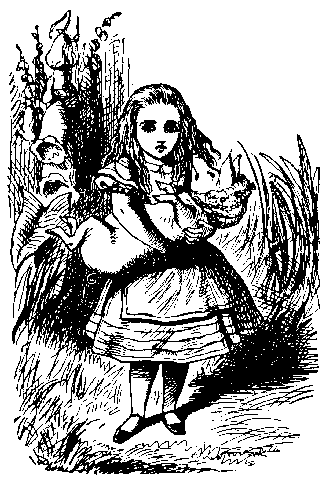
The description of the way in which Amy and Fox savour the taste of an alcoholic beverage they consume reminded me of a scene in Lewis Carroll's Alice in Wonderland:
she found a little bottle on it, [...] and round the neck of the bottle was a paper label, with the words `DRINK ME' beautifully printed on it in large letters. [...] It was all very well to say `Drink me,' but the wise little Alice was not going to do that in a hurry. `No, I'll look first,' she said, `and see whether it's marked "poison" or not' [...] However, this bottle was not marked `poison,' so Alice ventured to taste it, and finding it very nice, (it had, in fact, a sort of mixed flavour of cherry-tart, custard, pine-apple, roast turkey, toffee, and hot buttered toast,) she very soon finished it off. (Chapter 1)
Fox and Amy's drink isn't marked as "poison" either, so they drink and:
A wave of red rolled towards him. Cinnamon and clove enveloped him in their mingled scent as the punch flowed into his mouth and exploded on his tongue. Wine and cinnamon and clove and a dreadful bitterness. And salty like tears. He grimaced and put his glass down. [...] He took another cautious sip. The bitterness was still there, if somehow muted. In fact, it tasted better now. (45)
Like the drink which causes Alice to shrink, the punch that Amy and Fox consume has a very unexpected side effect (it seems extremely apt that the novel was published under Dorchester's Love Spell imprint). There is an echo of this scene later in the book, when a non-magical punch is prepared while Amy plans to tell Fox the truth about their earlier drink (217). Here's the description of Admiral Reitz preparing punch:
a special punch ceremony was held at Rawdon Park [...] the whole family assembled at a table in the drawing room. Admiral Reitz, it appeared, would act as the Master of Ceremonies. The children skipped from one foot to the other with excitement. "Feuerzangenbowle, Feuerzangenbowle," [....] The door opened and Ramtop, the butler, appeared, carrying an enormous pot filled with fragrant, steaming red wine. [...] Admiral Reitz made a bow in Amy's direction - "what we need for it is this: dry red wine boiled with orange slices, sticks of cinnamon, and cloves. A pair of tongs" - he picked up the item from the tray - "long enough to be laid across the top of the pot, and a sugarloaf." He took the white cone and wedged it into the tongs before he put them onto the pot. "And then, the most important ingredient: rum." (214-15)
Schwab's Admiral Reitz, like Carroll's Alice, is a real person placed in a fictional world.1 As we are told in the author's note, "Bernhard Reitz is one of the leading critics in the field of British theatre [...] and he always serves Feuerzangenbowle at our annual Christmas parties at his house." Schwab also mentions there that "he is known to have reacted adversely to the suggestion to stage a performance of in-yer-face theatre (which usually includes a certain amount of violence, rape, exploding trash cans and the like) in his sitting room." In Bewitched the performance takes place elsewhere:
The admiral, coming to the table [...] "[...] have you heard of the latest theatrical scandal, Rawdon? [...] It has come to my ears that a certain nobleman, who shall remain unnamed, chose to have a production staged in his private theater [...] what if I tell you that the aforementioned production involved some ... um ..." He coughed delicately. "Flinging off of clothes?" [...] Underneath his mustache, the admiral's lips twitched. "And not only that. There were also some monkeys involved, or so I've heard. To top it all, a rubbish can was blown up onstage. Followed by a potted apple tree." [...]

Shaking his head, Lord Rawdon took a fortifying sip of coffee. "I must say, this sounds quite in-yer-face." (111-12)
In the course of her research for her PhD thesis Sandra's been working on Sir John Tenniel's illustrations, including those of Alice in Wonderland and Through the Looking-Glass. One secondary text she acquired on the subject,
Frankie Morris's ARTIST OF WONDERLAND, [is] a book on the life and art of John Tenniel. It has already turned out to be a great find: one of the most exciting things, imo, is that Morris argues that many characters in Tenniel's illustrations are simply children or adults in costumes instead of a "real" rabbit or a "real" Duchess with a really big head.
The almost bewildering number of animal metaphors Schwab uses to describe the human characters reminds me of Tenniel's illustrations, and their occasional metamorphoses may recall those of the baby in Alice in Wonderland who turns into a pig. The Admiral's "short, grayish blond moustache and dark suit lent him a faint resemblance to a sea lion - an uncommonly lean sea lion. One who wore a white and green striped shirt" (92). I imagine him looking a little like Tenniel's illustration of the walrus. The hero of the romance is Sebastian "Fox" Stapleton. He "stretched lazily, like a great cat before it goes on the prowl" (6) and he can look "like a big, fat tomcat that had just devoured a particularly tasty mouse" (16) but Amelia, our heroine (also known as Amy), believes that he is "as cold as a fish" (7). Amy herself, whom Fox admits is "lovely [...] in the way of a plump, golden partridge" (40), or perhaps "a quail" (42) is his prey. The predator will find himself trapped: an observer seeing them together states that "the Fox was stepping up to the bait in the trap" (39). Amy is also described as the worm that attracts the cold fish: "the fish has caught the worm" (39) and others are keen to ensure that "the fish is truly hooked" (40). Amelia is not, however, an entirely defenceless creature, for Fox imagines she would be capable of "peck[ing] [...] the poor chap to death with her sharp retorts" (41) and he observes her "Snapping and yapping like a rat terrier" (42).

Other characters are also compared to animals. Fox's servant sometimes looks at him "like a wounded doe" (29). A mysterious stranger has "movements as graceful as a cat" (13). Amy thinks that Fox's friend Drew, "With his curly blond hair and soulful brown eyes [...] reminded her of an overlarge puppy dog" (23) and when in love he "spout[s] the most nonsensical notions that would do any March hare proud" (16). Isabella Bentham observes that "all men sighed over Amy like a herd of dimwitted mooncalves" (11) and Isabella's mother had "what would have been a kind smile if her eyes hadn't glittered like a mad ferret's" (24), although Drew describes her as a "jabbering magpie" (31) . During a society event "the hum of voices rose and fell as if the guests had turned into a swarm of bees" (42). No wonder Amelia concludes that "all of London was filled with the strangest people" (24-25) and we, the readers, can imagine them in all their animal strangeness in a similar fashion to the way in which Alice's sister imagines "the strange creatures of her little sister's dream" (Chapter 12).

Part of the action of the novel is described in chess terminology:
Stapleton will want to go and visit his family soon. [...] thanks to our little intervention, he won't be able to stand even the thought of being apart from the object of his lovesickness for too long. [...] You should make sure your daughter accompanies them. [...] And then we shall make our Sicilian Dragon breathe fire.
Bentham looked at him blandly. "Dragon?" he asked.
The man looked him up and down. "Not a player of chess then." (52-53)
Lewis Carroll's Through the Looking-Glass "is loosely based on a game of chess, played on a giant chessboard with fields for squares" (Wikipedia).

Another connection between Bewitched and the Alice stories, though perhaps a rather tenuous one, may be made via Alice's fall down a rabbit hole:
The rabbit-hole went straight on like a tunnel for some way, and then dipped suddenly down, so suddenly that Alice had not a moment to think about stopping herself before she found herself falling down a very deep well. Either the well was very deep, or she fell very slowly, for she had plenty of time as she went down to look about her and to wonder what was going to happen next. [...] suddenly, thump! thump! down she came upon a heap of sticks and dry leaves, and the fall was over. (Chapter 1)
Goldschmidt suggested that "The fall down the rabbit hole was a symbol of sexual penetration, the doors surrounding the hallway represented female genitalia" (Leach) and William Empson
thought it all came down to wombs:

the salt water {of the pool of tears} is the sea from which life arose; as a bodily product it is also the amniotic fluid ... The symbolic completeness of Alice's experience is, I think, important. She runs the whole gamut: she is a father in getting down the hole, a fetus at the bottom, and can only be born by becoming a mother and producing her own amniotic fluid... (Leach)
Leach may state that these are "historically baseless womb-analogies" but they have indubitably helped to shape the reception of the text, which has long been perceived to have sexual undercurrents. Schwab's novel, being a romance, can be quite explicit about sexuality and sexual symbolism, and it ends, rather than begins, with a scene set in the "womb of the Earth Mother" (305), through which the characters seem to have "slipped through the web of time into the pagan past" (306) and in the epilogue one might think of them as having arrived, to quote the words from Alice in Wonderland, "upon a heap of sticks and dry leaves, and the fall was over."

One other issue which attracted my attention while reading the novel was the apparent doubling of some of what Pamela Regis would describe as the "eight essential elements of the romance novel" (30). There would appear to be two points "of ritual death," an element which Regis describes as marking "the moment in the narrative when the union between heroine and hero, the hoped-for resolution, seems absolutely impossible" (35). In the first of these scenes the heroine must literally "die first, if only in ritual" (211) and there is then a second, longer period later in the novel during which Amy again comes close to death. It's also possible to think of the characters as falling in love twice and thus undergoing two "Declaration" (34) scenes "in which the hero declares his love for the heroine, and the heroine her love for the hero" (34), and undergoing two betrothals, scenes in which "the hero asks the heroine to marry him and she accepts; or the heroine asks the hero, and he accepts" (37). This doubling perhaps reflects the way in which the world of the novel exists on two levels, one more normal and rational, and the other magical.

There may also be a doubling of one of the "accidental elements characteristic of the romance novel" (Regis 38). Cheryl Sneed commented that the "There is a 120 page section, right in the middle of the book, in which Amy and Sebastian are sickeningly, treacly, blissfully in love" and "all is sweetness and light, which, frankly, was mind-numbingly boring." It occurs to me that this central section, in which the hero and heroine are blissfully in love and surrounded by the hero's loving family (including cute nephews and a niece) who are gathered together to celebrate both the hero and heroine's engagement and Christmas, is not dissimilar in tone to that of many epilogues. Regis has written that the "Wedding, Dance, or Fete" is one of the three "accidental elements" and is a scene which demonstrates that "Society has reconstituted itself around the new couple(s) and the community comes together to celebrate this" (38). The celebratory tone that usually accompanies the "Wedding, Dance, or Fete" is one which characterises this section of the novel. The true epilogue of the novel in fact includes much less "sweetness," though its function of demonstrating that society is "reconstituted" is made quite explicit: "they walked on into the reborn world."

  • Carroll, Lewis. Alice's Adventures in Wonderland. The Millennium Fulcrum Edition 3.0.
  • Carroll, Lewis. Alice Through the Looking-Glass. The Millennium Fulcrum Edition.
  • Leach, Karoline. "Tony Goldschmidt and the Freudian Influence." The Victorian Web. Adapted with permission of author and publisher from the opening chapter of Karoline Leach's In the Shadow of the Dreamchild. London: Peter Owen Ltd, 1999.
  • Regis, Pamela. A Natural History of the Romance Novel. Philadelphia: U of Pennsylvania P, 2003.
  • Schwab, Sandra. Bewitched. New York: Dorchester, 2008.

1 The real people whom Carroll placed within his fictional world are described here. It is perhaps interesting to note that both Carroll and Schwab are incorporating elements of their academic life into their fiction. Both also include text from other fictions in their own work:
In the Victorian Era children had to learn many moralizing poems by heart. Carroll altered some of these (once very familiar) verses for the Alice books, of course to the amusement of the Liddell sisters. Unfortunately these poems are hardly remembered nowadays, so the fun of the parody has disappeared for the greater part. (Lenny's Alice in Wonderland site)
For her part, Schwab includes excerpts from a number of poems (including John Keats's La Belle Dame Sans Merci) and The Horrible Histories of Mayence. This is "a fictional book, yet the direct quotations are all taken from an 1824 edition of The Seven Champions of Christendom" (Author's Note). [The entire text of Richard Johnson's The Seven Champions of Christendom is available online and in pdf via Google Books.] Schwab has quoted from this text, but changed the names of the characters. I think one can safely assume that she has given them the names of members of "Team Reitz" to whom she dedicated the novel, with the hope that they would "enjoy your adventures as bold knights and fair maidens!"

Fox notes how some of the events in The Horrible Histories recall events that have happened recently to him, Amy and the other characters: "It seemed fantastical, as if the characters of a book had stepped out of their story and into the real world" (293). In Carroll's Through the Looking-Glass the relationship between texts and reality is a little different, since Alice steps into a world inhabited by characters from nursery rhymes, such as Humpty Dumpty and the Lion and the Unicorn.


------

The illustrations for this blog post include Evelyn de Morgan's The Love Potion, from Wikipedia and John Tenniel's illustrations of the Drink Me scene in Alice in Wonderland, via Wikimedia Commons. I also think there's some similarity between Jessie Willcox Smith's version of Alice (1923) and Annett Louisian, on whom Schwab based her description of Amelia Bourne.