Showing posts sorted by relevance for query feminist critique. Sort by date Show all posts

Monday, September 16, 2019

Romance Research Wins Award at BGSU

From the BGSU website:
Bowling Green State University Libraries announced that Elizabeth Brownlow, a Ph.D. student in American Culture Studies, has been named as the 2019 recipient of The Roberta Gellis Memorial Paper Award. Brownlow’s paper “Distinguishing Feminist Readerships and Shaping Genre in the Online Community Romance Novels for Feminists” explores the ways in which “community members resist the image of the “typical” romance reader and the stigma attached to it by engaging with the genre through feminist critique and the sharing of personal experience to “save face” in a world that tells them one cannot be both feminist and a romance reader.” The Roberta Gellis Memorial Award honors the best graduate and undergraduate papers written using the resources of the Ray & Pat Browne Library for Popular Culture Studies and pertaining to the fields of science fiction, fantasy, mystery, or romance fiction.
Brownlow gave a paper at last year's BGSU conference on researching the romance. It was on a related topic, and here's the abstract:
How do online spaces allow feminist romance readers to define and negotiate feminism for themselves? How do these readers define which romance novels are feminist, and which are not? In this case study, I will look at the popular romance review blog, Romance Novels for Feminists (RNFF). In 2009, Jackie C. Horne, a romance novelist, former children’s book editor, and literary scholar, established RNFF to review and comment on romance novels in all subgenres. RNFF does not explicitly state criteria for book selection, only stating that it “strives to review only books that in its opinion espouse and/or encourage feminist value.” RNFF’s reviews of feminist romance novels are based on a no-grading system intended to open up conversations about feminism and fiction. The reviews on RNFF allow for dialogue amongst readers, responding to both the books themselves and to Horne’s reading of them. This paper will explore the traits that Horne homes in on for her selection of “feminist romance” criteria as well as the traits that blog responders find most important. I will focus particularly on claims of sexist and feminist contradictions in these reviews. Moments of agreement and disagreement between reviewer and responders suggest romance readers are using online spaces such as RNFF to determine what feminism means to them as well as to form and articulate opinions on what does and does not count as feminist in the genre.

Thursday, February 09, 2012

Review of a Review of EIKAL

Back when I had time on my hands (ha!), I briefly flirted with starting a blog reviewing chick flicks and romcoms. I like my movies the way I like my books: smart, interesting, sexy, and with an HEA. I was tired of reading between the lines of professional reviews excoriating romcoms and chick flicks for not being Weighty and Meaningful, trying to figure out if I’d like the movie. I was sick to death of movie reviewers expecting these movies to be something they weren’t, something they had no intention of being, something that would defeat their very purpose and goals as chick flicks and romcoms. This kind of reviewing always seemed to be more about the reviewer and their insecurities about genre than the film itself. And that has always felt to me deeply unfair and frustratingly dismissive of a whole genre of creative expression that often does have weight and meaning to viewers who enjoy it.

And thus we come to Jessica Miller’s review of Sarah Wendell’s Everything I Know About Love, I Learned from Romance Novels (henceforth: EIKAL). EIKAL, according to Miller, is “boosterism” at its worst – incoherent, badly formatted, lacking distance from its subject, unhip, uncool, fawning even. What the romance genre needs, Miller argues, is sustained academic analysis about its literary merit, not heartwarming (even cloying) stories about what readers have learned from it.

I disagree and do so on a number of levels. Although I (obviously, I hope) believe that romance needs sustained academic exploration, I think that what EIKAL does is a necessary good. I also think Miller is expecting EIKAL to be what it never had any intention of being, what it doesn’t want to be, what – in fact – it has no business being (something, in my opinion, that Wendell understands, although that’s not really relevant to a review of the book itself). And in failing to meet and critique the book on its own terms, the review came across as ironically and unintentionally derisive toward the genre and its readers.

Four paragraphs in, Miller provides three paragraphs of background about SBTB and Wendell’s career as a romance-positive media pundit. Miller strongly implies that Wendell and Tan “scored” a book contract for their first book, Beyond Heaving Bosoms (henceforth BHB), because they destroyed the career of (plagiarizing) romance author Cassie Edwards. As I said in my comments at the review site, the facts are wrong: although BHB was published in April 2009, almost 18 months after the posts in January 2008 about Edwards’ plagiarism, the publishing world being as slow as it is, Wendell and Tan “scored” their book contract in 2007 and were deep in the process of writing BHB when they broke the Edwards story. And while Miller responded to me at the site that “Luckily, nothing hangs on the timeline, as far as I can see. I was trying to give the OLM reader a general sense of the Wendell’s history, not making a judgment in any way about that history,” I think, in fact, that the judgmental – even personally pointed – tone (Tan departs for “greener pastures,” implying, for instance, that Wendell’s career as a “man titty media pundit” is something she has to settle for, is the best she can get) colors the rest of the review. The tone of these paragraphs cradles and contextualizes the rest of the review, almost implying that the review hinges on an incorrect view about Wendell’s history and success more than it rests on the merits of the book itself.

However, Miller follows this highly questionable history with a fairly brilliant summary of the goals and aims of EIKAL:

The premise of Everything I Know is clear from its title: romance novels offer life lessons, especially about love and relationships. The critics who assume romance novels feature gorgeous, perfect people “meeting cute” and slipping effortlessly into a happily ever after are wrong: romance novels tell the stories of flawed people who struggle and face the same challenges as any average reader. Reading romance novels has a positive impact on readers’ lives, teaching them about everything from effective communication and mutual respect to being happy with themselves and enjoying sex. And to the extent that romance novels do contain fantasy sex, perfect love, and the kind of triumphant overcoming of impossible odds that makes for a compelling narrative, romance readers, aware that it’s fantasy, can still be inspired, comforted, or moved in ways that make them better, wiser people. Everything I Know takes the romance genre and its readers seriously, insisting that the genre’s central concerns—especially romantic love, sex, and relationships—are vital human interests that are often unfairly trivialized owing to their association with femininity. Wendell’s claims are substantiated by an abundance of reader testimony, author interviews, and some industry-sponsored research. While Wendell undoubtedly chose the responses that best supported her own hypothesis, Everything I Know offers romance readers a unique platform for sharing the impact these novels have had on their lives.

Yes, this is exactly what EIKAL is, which is why what comes before and after in Miller’s review is so problematic.

I will not comment here on Miller’s claims about EIKAL’s size, formatting, repetitiveness, or audience confusion. I don’t disagree with a lot of what Miller says in this section – EIKAL is not, in fact, even close to perfect – and I appreciate the frankness of her critique here.

I do, however, disagree with Miller’s turn to scrutinize Wendell’s “specific claims” about “reader engagement” and with her subsequent critiques of the book on those grounds.

First of all, Miller seems to imply that Wendell’s contributing readers/authors must be uncritical readers, because how they “manage to glean the good stuff from the bad” amounts to an utter mystery. But then, in the next paragraph, Miller claims that readers have a “diversity of . . . engagement with the genre” that Wendell ignores. It seems contradictory to claim, on the one hand, that readers are so uncritical and morally naive that they’ll be led astray by immoral representations in the novels they read, and then, on the other, condemn Wendell for not recognizing or for deliberately ignoring the nuances of her contributors’ experiences. And this contradiction goes to what I think is the fundamental problem in Miller’s review, which is that the book is being judged against Miller’s personal standards of feminism and literary value, rather than whatever standards the book establishes for itself (and if these are contradictory, then that is another, more pertinent, level of critique to be pursued).

In an apparent attempt to question Wendell’s over-generalizations and simplifications of her contributors’ experiences, Miller next turns to discuss her experience of reading Wendell’s book “as a feminist.” (My reference to Wendell and not EIKAL is intentional here, since Miller often refers to Wendell when critiquing the book, another aspect of the review I find troubling.) In the process, though, she (re)creates a fairly standard Second Wave feminist critique of the romance genre. More often than not, the review comes across to me as a debate between Miller’s feminism and what Miller (sometimes rather condescendingly) perceives Wendell’s feminism to be. This is particularly apparent, for example, at the point where Miller feels “dismay” at the anecdote by the reader who comes home from work and reads 30 minutes of Harlequin before preparing dinner. While Miller notes (echoing Radway almost perfectly) that such an anecdote begs the question of the second shift, she does not consider the possibility that the woman is a single mother, or that for any number of reasons there is no partner with whom the second shift labor can be shared. Moreover, the shifts in the review back and forth between a critique of the reader anecdotes and a critique of Wendell as author further confuse Miller’s analysis and forefront the judgments she is making as personal rather than critically embedded in the terms of the text itself.

Miller then calls for an entirely different evaluation of the romance genre: “It’s time to stop evaluating romance novels in terms of their putative effects on (women) readers, and to pay more attention to their literary merit and ability to provide pure pleasure.” I’m very unclear what Miller means by “pure pleasure.” Why is “pure pleasure” (whatever it is) better (as it obviously must be) than the pleasure that Wendell’s contributors say time and again that they received from romance novels?

More pertinent, however, to my own work and to most valid literary criticism of the romance genre is the combative dichotomy Miller constructs between reader response and literary merit as valid ways to examine the genre. Modern literary criticism is not, in fact, in the business of determining literary merit. Whether that’s a good thing or not is another question with much spilled ink to its name, but that’s just not what we as literary critics do anymore. I can say just as much about a novel that I think is truly bad from the standpoint of literary merit and “pure pleasure” as I can say about one that I think is brilliant (in fact, I spent a whole chapter of my dissertation doing precisely that). Literary criticism is not about picking the good novels from the bad. It’s about analyzing cultural phenomena. From that perspective, EIKAL is more valuable precisely as evidence of reader response to the genre than any list of the 100 Best Romances. Which is not necessarily to say that EIKAL is successful in what it sets out to do; the problem is discerning that initial aim (or aims) and evaluating the book on those terms, something that lies at the heart of both literary criticism and reviewing from an academic perspective.

Academically, for instance, I use BHB as evidence of the “received wisdom” of the deeply-knowledgeable romance reader, the “superfan,” if you will. Which is to say, when Wendell and Tan conflate Woodiwiss’ The Flame and the Flower and Rosemary Rogers’ Sweet Savage Love as pretty much the same book, I use that as evidence in my own discussion of these blockbuster historical romances that this is how twenty-first century romance readers in general see these two books and the disparate genres they spawned, despite their significant differences from each other. I do not expect BHB or EIKAL to be anything other than what they claim to be, what they try to be, and what, I argue, they succeed in being. I do not expect BHB to be a vigorously researched academic critique of the romance genre. Nor do I expect EIKAL to be a rigorous scientific survey of a representative sample of readers. I expect them both to be what they claim they are: BHB is an exploration of the genre that defends the genre for what it does right and lovingly brings it to task for what it screws up, while EIKAL is a loving exploration of reader interaction with the genre that provides readers with both a voice and the arguments to defend their reading habits. Miller may disagree with my assessment of EIKAL’s success in achieving its aims, but I wish she had done it on the book’s own terms, so that any debate about the review could be based on the book itself and not an external standard of academic worthiness.

The difference between applying literary criticism to the genre or to EIKAL is important and generally ignored in Miller’s review. That Miller is writing the review from an academic perspective might account for some of this disconnect, although I don’t think it accounts for all of it. Some is, I think, a product of a conflation of literary critique of the genre from within the genre, and critique of a work that is more about readers than the genre itself.

I think, in fact, that there’s a disconnect between EIKAL’s aims as a proudly fond exploration of reader response, and Miller’s entirely laudable desire to have genuine deep critique of the genre. Wendell is not attempting in EIKAL to analyze the genre, nor does she have any pretentions to being able to perform literary criticism. Wendell is focused on demonstrating that her contributors (romance readers and authors) are intelligent, conscious consumers of the genre they (we) all love so much. She is also attempting to provide readers with a validation of their own reading choices and to provide non-readers with something to think about (hence, as Miller rightly points out, its confusing tone shifts at times). EIKAL might not, as Miller points out, change any minds, but it gives readers a voice to relate the (pure?) pleasure they find in the romance genre. And there’s nothing wrong with that. Miller’s review, on the contrary, suggests that there is, indeed, something wrong with that. This is not only a provocative implication, but also a different question from what the book is and whether or not it succeeds in being what it claims to be.

ETA Full Disclosure: I'm quoted two or three times in EIKAL. I responded to Wendell's SBTB posts asking for input and she quoted me from there, not from a personal interview. I am, however, also friendly with Wendell and occasionally share meals with her. But then I've also shared meals with Miller.

Thursday, February 23, 2012

Colleagues at Work


Over at the Popular Romance Project, Pamela Regis reveals what she's been working on recently:
I love the history of literature—watching the growth and branching of genres across the centuries. Lately I’ve been researching the history of the American romance novel, which, I quickly realized, involved pretty much starting from scratch. There was no list of American romance novels that I could peruse for suggestions for study texts, no “romance novel” subject heading in databases.
Amy Burge recently "gave a paper to the Centre for Modern Studies Postgraduate Forum at the University of York in a panel entitled 'Feminist Narratives'." The paper, titled "‘Weird and kinky and medieval’: Gender, Sexuality and the Idea of the ‘Medieval’ in Modern Popular Sheikh Romance," is up in full at Amy's blog. Amy observes that
The model used for Mills & Boon’s fictional east appears to be the hypermodern and western-friendly nations of the United Arab Emirates, particularly Dubai, thus providing the requisite exoticism, with none of the restrictions frequently outlined in the contemporary media. Moreover, most Westerners cannot name all of the United Arab Emirates, indicating the ease with which even the real Middle East can become fictionalised. The geographical shift from old colonial obsessions to a new political geography centred around the United Arab Emirates indicates a particular shift in the political tensions of sheikh novels: a liberal ally in the Middle East, but with the medieval (represented in the media by Iran, Iraq and Saudi Arabia) always pushing at the edges.
The novels also
reveal how deeply rooted ideas about the medieval are in issues relating to gender and sexuality. While you might not necessarily want to call Mills & Boon romances feminist narratives, although some have argued for the feminist credentials of romance novels, the vast majority of Mills & Boon readers and authors are women and romance novels frequently deal with issues commonly affecting women which are often excluded from public discourse, for example, marriage, relationships, children. Furthermore, these are precisely the aspects of sheikh romances which are described as medieval –female sexuality and the treatment of women. But, then, how ‘feminist’ is it to construct ‘medieval’ sexuality as desirable?
In the wake of an article in The Awl in which Maria Bustillos described romances as "feminist documents," Liz Mc2 explained why she doesn't think that's an accurate description:
“by, for and about women” is not the definition of feminist. Not any definition of feminist. Yes, there are lots of debates within feminism, but the definition isn’t content-free, just decide for yourself. Just because a woman chooses something does not make it a feminist choice or exempt from critique from a feminist perspective. Women’s choices can be constrained by society and sometimes by their own conventional views of gender. All-female enterprises can be both empowering in some ways and sexist in others, because they are not separate from the larger, still in some ways sexist culture. College sororities would be one example of this, I think. And I’m pretty sure Romance–individual books, the genre as a whole, and the industry itself–is another. How could it not be?

------
The image is an illustration from Samuel Richardson's Pamela, which Pamela Regis mentions in her post. It came from Wikimedia Commons.

Saturday, March 20, 2010

Review: Betz and Uszkurat on Lesbian Romance


Betz, Phyllis M. Lesbian Romance Novels: A History and Critical Analysis. Jefferson, NC: McFarland, 2009.

Uszkurat, Carol Ann. "Mid Twentieth Century Lesbian Romance: Reception and Redress." Outwrite: Lesbianism and Popular Culture." Ed. Gabriele Griffin. London: Pluto Press, 1993: 26-47.
---------

In her preface Betz acknowledges that she is "not the first to examine specifically lesbian works" (2). This is true, since lesbian romances have been discussed in earlier articles by Ehnenn (1998), Esquibel (1992), Hermes (1992), Juhasz (1998), Palmer (1998), Uszkurat (1993) and Weir and Wilson (1992) and in a PhD thesis by Pearce (2004).1 I can't guarantee that this is a comprehensive list of work on lesbian romances, but it does rather suggest that serious analysis of these texts really only got under way in the 1990s. The reasons for this are explored by Carol Ann Uszkurat.

Uszkurat has stated that "during the rise of the second women's liberation movement, which took an increasing interest in lesbianism throughout the 1970s, lesbian romance was ignored" and she asked "What was it that prevented lesbians from looking at a crucial part of their own cultural history?" (30). She suggests "that the answer to this question is, at least in part, associated with the rise of lesbian feminism from the late 1960s onwards and the attitudes towards pre-liberation movements' lesbianism promoted by some lesbian feminists" (30). Firstly, "Feminism in general provided a critique of the heterosexual demarcation of gender-assigned roles. This had a direct bearing on the way in which lesbian butch/fem role play was consigned to the dustbin of unsound practices" (31). I wonder if echoes of this critique of "butch/fem role play" can be found in Betz's book, and perhaps explain why she is apparently so keen to accept descriptions of heterosexual romances as texts which promote rigid gender binaries. They can therefore be contrasted with lesbian romances, in which "the main characters do not always embody a rigid set of contrasting qualities" (Betz 177).

Secondly, "the texts under consideration, lesbian romances of the 1950s, were produced at a time that was seen as deserving little or no respect" (Uszkurat 31), "There was, I would suggest, a definite link between the politics of lesbian feminism of the 1970s and the lack of critical regard dished out to pre-Stonewall popular paperbacks" (31). Uszkurat suggests that in the 1970s "the interest was in literally canonising those women whose writing could be re-categorised as some kind of feminist 'classic' belonging to a tradition of great women's writing" (32).

Thirdly, Uszkurat observes that
Both the initial and prevailing radical feminist readings of popular culture during the 1970s were infused with deep suspicion. In a feminist reification of the kind of orthodox Marxist/Frankfurt School that proliferated in the 1960s and popularised concepts such as 'mass/false consciousness', radical feminists rewrote 'dominant order' to mean 'oppressive patriarchy'. (35)
Uszkurat then turns to the psychoanalytic theories used by critics of heterosexual romances:
Time and time again, critics define desire by picking up on the kind of feminist psychoanalysis which mushroomed in the mid 1970s. Theorists like Dorothy Dinnerstein and Nancy Chodorow are used as the analytical hook on which to hang readings of popular romance. Not surprisingly, analysis that sought to dissect woman/man relations is both limited and highly problematic when looked at for transferable models that might offer some means of reading lesbian romance. (37)
Uszkurat demonstrates how Janice Radway's conclusions about romance readers, which are based on Chodorow, become problematic when applied to lesbians (and, as Uszkurat notes, Chodorow was also "Seemingly ignorant of the materialist dynamics that take the working-class mother out to work" (38)). Uszkurat also briefly mentions problems with the psychoanalytic underpinnings of Snitow, Modleski and Coward's work on heterosexual romances.

So, "If lesbian feminism is antagonistic towards psychoanalysis, it is hardly likely to take anything from readings of popular heterosexual romance which rely heavily on such perspectives" (42). Nonetheless, "This radical feminist mistrust [...] has been increasingly challenged in the 1990s" (43) and Betz, while noting differences between heterosexual and lesbian women in the context of Chodorow's theories as they appear in Radway, does not utterly reject those theories.

Uszkurat concludes her essay by turning to Diana Hamer and her work on "the lesbian paperbacks produced during the 1950s and 1960s" (43), in particular those of Ann Bannon, which are also discussed in some detail by Betz in her book, in her chapter on "pulps." Uszkurat notes that
'romance' as it is conceptualised in these openly lesbian texts is discounted by Hamer, because she rightly notes the lack of formula which, according to heterosexual feminists, is evident in heterosexual romance. This leads to a dismissal of any comparison with Mills and Boon because 'such a parallel is questionable in terms of generic conventions' (Hamer, p 50). But is there not room to consider how exactly 'romance' was part of the lesbian culture of the 1950s and why? I leave this question open. (44)
Betz does not really explore the issue of genre classification either, but the historical contexts she mentions should, I think, be borne in mind when attempting to classify lesbian romantic fiction. In earlier decades the less-than-optimistic outcomes for lesbian relationships which are portrayed in lesbian texts may well have been shaped not by the authors' preference for this kind of ending, but by the fact that even when, rather daringly, the characters' love dared to speak its name, it was not acceptable for that speech to be rewarded in print. Furthermore, lesbian readers may still have found the endings "Emotionally-Satisfying and Optimistic" (RWA) because, as Betz suggests, "they allowed the reader to imagine more positive outcomes" (46).
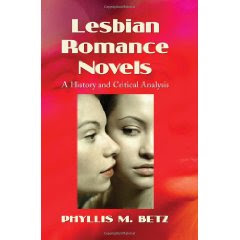


Betz notes that, in general, analysis of lesbian romantic fiction has tended to "concentrate on the pulp novels of the 1950s and early 1960s or is limited to discussions of Jane Rule's Desert of the Heart, Isabelle Miller's Patience and Sarah, Radclyffe Hall's The Well of Loneliness, and a small handful of other texts" (2). There are, however, some gaps in Betz's bibliography: I noticed that she does not include all the previous works on lesbian romance which I listed above.

To my knowledge Betz's study is the first book-length study of lesbian romances to be published by an academic press. She offers the reader "my analysis of one of the most prominent of the popular genres - the romance novel" and discusses "how lesbian authors utilize and adapt the form for their particular audience" (1). Given the diversity and size of the genre, this would seem a daunting undertaking, and Betz's book is only 219 pages long. Perhaps because of this, in her analysis of heterosexual romances she depends rather heavily on conclusions derived from secondary sources, particularly Janice Radway's Reading the Romance, Carol Thurston's The Romance Revolution, the Dangerous Men and Adventurous Women volume edited by Jayne Ann Krentz and Pamela Regis's A Natural History of the Romance Novel. Unfortunately, many of her statements about heterosexual romances suggested to me that she lacked first-hand knowledge of the primary sources:
The heterosexual hero and heroine usually enter their story as diametric opposites, in class, mobility, and power. Typically, the hero enjoys not only the privileges of his gender, but the constant expression of them; he is, to use Jayne Ann Krentz's term, the "alpha male" who dominates all of the other characters in the book, but most importantly the heroine ("Trying to Tame the Romance" 107). [...] Blond hair, lighter skin tones, and smaller builds are not attributes given to the hero; such figures become false heroes, temporarily misdirecting the heroine's desires in malicious or accidental ways, or they are subordinates to [sic] the hero. (92)
What, then, of "beta" heroes? What of the heroes who are blond, or shorter than the heroine, poorer, or younger? What of inter-racial romances featuring Black women and White men? All of these do exist, but Betz would appear to be entirely unaware of them. As the following quotation demonstrates, Betz's incomplete knowledge of heterosexual romances affects her assessment of lesbian romances:
the configuration of the lesbian couple does not fully replicate the model found in mainstream romance. This is, perhaps, the essential difference between the two genres: without a definite hero and heroine, the traditional romance cannot work: "In a romance novel, the relationship between the hero and the heroine is the plot. It is the primary focus of the story ..." (Krentz "Trying to Tame the Romance," 108, emphasis in text). He must be aloof; she must be able to connect. He must acknowledge his emotional need; she must accept the responsibility of nurturing those feelings. He must take and retain control; she must be willing to cede power. Even if the ending presents some awareness by the couple that both are responsible for maintaining the relationship, the conservative framework within which the romance works requires the recognition that male desire still directs it. This dynamic will be found in the pages of lesbian romance, but with important differences. (93-94)
Betz also makes generalisations about the structure of heterosexual romances. For example, despite frequently quoting from Pamela Regis, who was careful to note that the various elements she had identified "can appear in any order" (30), Betz seems to believe that "the typical romance [...] ends with the declaration of mutual love" (109) and she therefore states that lesbian romances are significantly different inasmuch as they continue
to explore the implications of that assertion beyond this ecstatic moment. Once the couple has accepted their attraction and expressed this acceptance by making love, their story is not complete. Particularly in more recent novels, the women must confront a variety of challenges that must be faced together. (109)
It may well be the case that the case that more lesbian romances than heterosexual ones end in this way, but Betz does not provide much evidence that this is the case. One scene she describes does indeed show the ongoing happiness of the lesbian couple many years after the conclusion of the events in the main body of the romance, but to me it did not seem radically different from many of the epilogues to be found in heterosexual romances.

Sweeping, and therefore somewhat inaccurate, generalisations about heterosexual romances could be of relatively little importance in a book about lesbian romance novels. Indeed, I wish I could focus solely on what Betz has to say about lesbian romances, because they have received far less scholarly attention than heterosexual romances. Unfortunately, I have felt obliged to write at some length about her opinions of heterosexual romances because Betz attempts to describe the defining features of lesbian romances by contrasting them with heterosexual romances. Given the apparently rather incomplete nature of her reading of heterosexual romances, I was less able to feel confident about her conclusions regarding the unique features of lesbian romances.

It is perhaps worth noting that Betz 's
reading of genre romances is a late development, partially coming from my teaching courses in popular/genre literature. My reading of lesbian romances has to be linked to my coming out, when I was looking for images of lesbians and lesbian life as well as models of behavior. (200)
Betz therefore praises the lesbian romance genre because it "positions the lesbian at its center and reframes her marginal status; this allows her to escape the stereotypic and homophobic depictions of the lesbian as deviant, disordered, and demonic" (196-97) and allows her to "momentarily experience the fantasy of complete acceptance" (197). That it is a "fantasy," however, is something on which Betz insists, because she believes that "The pursuit and maintenance of love is more complex than is described in the romance, and social expectations impinge on the couple's attempts to establish a private life more strongly than they do inside these narratives" (196). Indeed, Betz writes that
Perhaps no other genre is said to call for such a complete suspension of disbelief as the romance. Once a reader accepts the premise that life exists on other planets or that time travel is possible, science fiction novels make sense. While coincidence often plays a role in the solution to a crime, as long as the investigation adheres to the particular rubric of its type of mystery, a reader will accept the investigation's outcome.2 Romances, however, are seen as asking their readers to willingly overlook the reliance on extreme yet limited stereotypes, highly stereotyped characters, highly contrived plots, over-wrought themes, and unrealistic outcomes. (169-70)
Since Betz qualifies her initial sentence with "Perhaps," and ascribes the views she describes to some unidentified people ("is said to call," "are seen as asking") it does not seem entirely safe to assume that she shares these views, but her repeated use of the word "fantasy" to describe the genre does tend to make me think that this paragraph reflects her own opinions, as does her description of the characters in lesbian romances:
both main characters are stunningly attractive, although there tends to be a reliance on some variation of the butch/femme dyad common in lesbian literature [...] Like heterosexual romances lesbian romance narratives are situated within an exaggerated environment, where the focus and direction of the plot center on the progress of the romance. (15)
Betz's history of lesbian romance novels begins in Chapter One with a brief mention of "authors and texts that form, what can be called, the 'official canon' of lesbian writing: Virginia Woolf, Willa Cather, Djuna Barnes, and Gertrude Stein, among others" (27). As she notes, "Many of the lesbian authors of the late nineteenth and early twentieth centuries, in fact, did not even treat overt romantic relationships between women" (27) and "When two female characters express strong feelings and attachments for each other, they are generally framed within the context of the romantic friendship [...]. Elizabeth Stuart Phelps' The Silent Partner and Mary Wilkins Freeman's The Country of the Pointed Firs [Betz seems to have made a mistake here because Sarah Orne Jewett was the author of The Country of the Pointed Firs] typifies this situation" (27).

Turning to "Recognizable popular lesbian romance" (28), Betz begins with early novels in which
In each case, with the exception of Rule's Desert of the Heart and Miller's Patience and Sarah, the demands that the lovers adhere to society's conceptions of proper female looks and behavior destroys or limits not only their relationships but their very lives. [...] Throughout the pulps the recognition that a woman's desires for another woman are called deviant challenges her very sense of self, and the institutionalization, the deaths, and the emotional and social isolation that are offered as the only possible outcome for expressing such desire indicates the terrible price for transgressing social norms. (Betz 105)
The first novel to be described at any length by Betz is Radclyffe Hall's The Well of Loneliness and "Sally Cline states the [sic] Hall recognized the limitations within which she positioned her narrative and gave them [her characters] the ending that society would accept" (35).

In The Well of Loneliness the main character, Stephen Gordon (who despite her name is female), ends by relinquishing her lover to a man. A similar ending to a lesbian relationship can be found in Mary Renault's The Friendly Young Ladies. Betz then turns to lesbian "pulps", which "Between 1950 and the mid-1960s" were "the dominant format for descriptions of lesbian relationships" (40). This is followed by brief descriptions and analyses of Isabel Miller's Patience and Sarah, Jane Rule's Desert of the Heart and Rita Mae Brown's Rubyfruit Jungle.

In Chapter Two Betz moves on to Katherine Forrest's Curious Wine (1983), "considered a classic of modern lesbian romance" (63). Betz writes that,
Unlike Hall, Renault, and others, Forrest's lovers are presented not only as self-identified lesbians, but fully satisfied and confident with that identity. The ambiguity of the texts discussed in Chapter One disappears [...]. Ultimately, in the earlier romantic texts, the weight of the larger society diminished or destroyed any chance of lesbian love succeeding. Stephen Gordon surrenders Mary to a conventional heterosexual marriage; Leo willingly leaves Helen for Joe. The pulps portray lesbian desire and fulfillment as something either to be prevented, through death or institutionalization, or lesbian relationships as being incapable of providing any sense of stability or permanence. To be lesbian is to be tortured with self-doubt and self-loathing. (70-71)
This chapter also looks at the relationships depicted in other recent lesbian romances, including "Janet McClellan's Winter Garden, Claire McNab's Under the Southern Cross, and Shelley Smith's Horizon of the Heart" (73).

Betz's focus is on examining how "social codes are woven into the narrative" (85) and showing that "a lesbian-authored text not only gives the lesbian reader permission to look, but to look as a lesbian looks" (84). This means that she is not analysing the literary aspects of the novels, though she does mention that in Rule's Desert of the Heart the use of "Images of heat, blinding light, dust, all suggest the impossibility of relationships being able to survive" (50) and the way in which "Emily Dickinson's poetry [...] becomes a communicative bridge" (70) for the protagonists in Forrest's Curious Wine.

In Chapter 3 she describes the settings to be found in lesbian romances:
Like their mainstream counterparts, lesbian romances set their narratives within conventional settings. Perhaps the most common backdrop for the love story, especially in novels set in the present, is the city. The prominence of this environment reflects its importance in the history of gays and lesbians: the city has always been seen as providing the gay man or lesbian a surrounding in which the individual is able to express non-traditional sexual desire more openly. The city offers anonymity at the same time it facilitates the creation of a shared community. (86)
The social statuses of the characters is also examined:
the lifestyles enjoyed by the characters in lesbian romances tend to reflect a middle to upper-middle class status. [...] The portrayal of lesbians as economically successful is constantly reinforced in these books and may be seen as contributing to one aspect of the romance novel's creation of fantasy, not of romantic passion but of material comfort. (87)
and, as in many romances featuring heterosexual protagonists,
Many lesbian romances [...] utilize the contrast in the class status of the couple as either a complication that must be resolved if the happy ending is to be achieved or as a marker of suitability. B. L. Miller's Accidental Love constructs the romance around the first plot situation. (88) [Miller has made this novel available on her website, where it can be read for free]
In this, they resemble a great many romances with heterosexual protagonists: the "Cinderella" type romance story, between a poor(er) woman and a rich man is a common one. However, Betz suggests that in lesbian romances wealth can play an additional role: "The association of financial security with a lesbian identity attempts to bridge the gap between perceived deviance (lesbian) and socially approved status (wealth); the one condition assumes acceptance of the other" (87).

Betz also describes how
A particular sub-set of lesbian romance novels began to appear in the mid-1990s that brought together a group of women who work together [...], live in the same neighborhood [...], or enjoy and rely on long-standing friendships [...]. One of the prominent features of these group romances - because while they could be classified as comedies of manners like their mainstream counterparts, finding suitable, long-term partners is the narratives' starting point - is the shared environment in which the characters reside. Not surprisingly, these novels do not replicate the traditional romantic plot; the narrative tends to center on one of the group, tracing the ups and downs of her searches for romantic relationships. The circle of friends provides a full range of support, criticism, and blind dates. [...] The comic tone of these novels represents another distinguishing factor for [sic] more traditional romances. (90-91)
Betz herself raises the question of how to classify these novels, and I wonder if she might have found rather more parallels between them and their "mainstream counterparts" if she had looked for those counterparts among chick lit novels rather than in the romance genre.

The chapter concludes with a brief discussion of the impact on lesbian romance of another product of popular culture:
From its first broadcast [in September 1995], Xena, Warrior Princess teased its audience with suggestions of more than just a friendship between its two main characters. [...] While Xena and Gabrielle could play at being more than just friends, the requirements for keeping a mainstream audience prevented the relationship from crossing the boundary from play to actual romantic connection. Yet, it is this consummation that recent lesbian romance novels play out again and again. [...] What is striking in the majority of recent lesbian romances [...] is the authors' insistence on incorporating what can now be seen as iconic images and characterizations, especially since the show went off the air in 2000. In fact, the frequency of Xena- and Gabrielle-based characters is so common that some texts have begun to acknowledge the references. (107)3
In Chapter 4 Betz's "critical analysis" turns to the relationship between sex and love in the romance genre: "To separate sex from romance, in the final analysis, is rather like trying to separate the oxygen and hydrogen while attempting to drink water" (111). She suggests that
In many ways the incorporation of sexual intimacy functions in the same manner within the pages of the lesbian romance as mainstream romance. The couple desires the intensity of physical connection, since it signifies the moment of recognition of a mutual attraction and commitment between the lovers. Sexual passion and expression parallels emotional desire and articulation. [...] Unlike its heterosexual counterpart, however, the lesbian romance must contend with a mainstream essentialist view of the lesbian: the equation of sexual identity with sexual practice. (117)
Again comparisons with heterosexual romances abound. For example: "lesbian texts differ noticeably from heterosexual ones. Although contemporary traditional romances will describe the sex between the hero and heroine in explicit language, these scenes tend to be brief and limited in frequency" (122) and
The type of heterosexual romantic text influences how much explicit sexual content is allowed, but generally the number of sex scenes in mainstream straight novels is limited. The exception would be those novels that advertise themselves as explicitly erotic. However sex appears in these works, a distinct pattern of engagement can be discerned. The heroine's sexual awakening, for example, must come from the hero. (131)
If such statements contain inaccuracies about heterosexual romances, then they will fail to convince the reader that "lesbian texts differ noticeably from heterosexual ones." The quotations from, and descriptions of, lesbian sex scenes did not strike me as particularly different from many of those I've read in heterosexual romances (although, obviously, they describe two women's bodies instead of the bodies of a man and a woman). In addition I could see parallels between some of the novels Betz describes, in which one of the protagonists comes out as a lesbian during the course of a romance and learns eagerly from her more experienced partner, and the rapid learning curve of many romance virgins in heterosexual romance novels. Betz, however, states that "Unlike the romantic hero, who, traditionally, uses his sexual power to overwhelm the heroine's resistance and dominate her will, the more experienced lesbian in her romance will behave more as the teacher" (122).

Chapter 5 focuses on "the work of three well-known lesbian romance writers - Radclyffe, Karin Kallmaker, and Jennifer Fulton" (138). Betz apparently chose them because "While Radway's and Thurston's analyses are built on extensive surveys of romance readers" (3) Betz had no comparable source of information about lesbian romance readers and these three lesbian romance authors all have websites which "allow readers to contact the authors with their reactions, criticisms and questions. The answers open up the authors' writing processes, as well as their comments on issues such as the role of sex and the value of the work to its audience" (3). All three authors "express a strong sense of their awareness of writing for a specifically lesbian readership" (138), feel a "sense of responsibility for providing lesbian readers with recognizable and believable stories and characters" (139), "stress a commitment to representing as wide a range of lesbian experience as possible" (139) and "indicate an awareness that they are part of a particular lesbian literary tradition" (139). In addition to being authors, "Kallmaker is the editorial director for Bella Books; Fulton, the senior editor/acquiring editor for Bold Strokes Books; and Radclyffe [...] is the president and founder of Bold Strokes Books" (140).

In Fulton's True Love "most of the women of the group [including "Rosie, whose quest for true love provides the central narrative focus"] end in the same situation - single - as they began the story" (144) but Betz argues that the novel "must still be read as a romance novel because, even if only temporarily, members of the group [...] do experience the thrill of finding a compatible lover" (144). Apparently "Fulton's later romances adhere more closely to the traditional romantic framework" (144).

Karin Kallmaker
has paid close attention to the importance of community within the pages of her novels. [...] Finding one's heart's desire, as required by the romantic narrative, takes precedence, but Kallmaker emphasizes that the couple belongs to a wider world and has a responsibility to acknowledge that relationship as well as the private. (151)
Betz also notes Kallmaker's "deliberate references to other literature" (158), particularly Jane Austen's Pride and Prejudice.

Radclyffe specialises in romances in which
one or both of the main characters enters the story burdened by a past which impacts the present and which must be confronted and addressed if the character(s) will be able to pursue the relationship that has developed over the course of the narrative. (159)
Betz quotes a comment by Radclyffe:
"Some of the most powerful themes in my work, which I revisit frequently, are redemption, healing, and self-acceptance. These are classic themes in romance fiction and the sex of the character has nothing to do with the emotional landscape of the character or the challenges she faces in accepting and giving love." (160)
In Tomorrow's Promise one of the protagonists, Tanner, has sex with Adrienne but "cannot yet separate the two drives [emotional and physical] and returns to her 'normal' sexual behavior, indulging in one-night stands" (165). I found this intriguing, because I think it would be unusual for either of the protagonists in a heterosexual romance novel to find new sexual partners after having had sex with their hero/heroine. Betz does not analyse this, so I have no idea whether this kind of scenario is more common in lesbian romances than in heterosexual ones. There is some description of the metafictional elements in Love's Masquerade, in which Haydon Palmer, writing under the pseudonym of Rune Dyre, "is transcribing her relationship with Auden [who works for her publisher] in the fiction" (166) which Auden reads and "Their courtship for the first part of the novel is carried out through email and the submission Rune/Haydon sends to Auden" (166).

Chapter Six analyses the relationships between the novels and their readers:
The reader's importance to the success of the romance novel cannot be overlooked; every examination of the genre, whether critical or popular, emphasizes the impact readers' expectations of and responses to the texts not only has on their own preference, but on the writers of these works as well. (170)
Betz states that heterosexual romance novels show "the balance of opposites" and "this reconciliation of opposites is the reiteration and normalization of a conservative social construction of heterosexual relationships" (176). However
While lesbian romances retain the basic outlines of the heterosexual romantic plot and characters, they incorporate important variations that represent a specific lesbian sensibility, since these are written for a specifically lesbian audience. For example, the main characters do not always embody a rigid set of contrasting qualities. (177)
It would be surprising if lesbian romances did not "represent a specific lesbian sensibility" but if it is demonstrated by the presence of main characters who "do not [...] embody a rigid set of contrasting qualities" then many heterosexual romances, for example those with "beta" heroes, must also "represent a specific lesbian sensibility." As on earlier occasions, Betz's apparent lack of knowledge about heterosexual romances (or a reading of them which is based on the assumption that they must reproduce a "conservative social construction of heterosexual relationships") undercuts her insights into lesbian romance novels. Where Betz does see similarities with heterosexual romances, these do not seem to meet with great approval:
The impact of the heterosexual paradigm in the definition of a successful romantic outcome can be seen in the novels' maintaining of the notion that each woman has, and can find, her one true soul mate, thus encouraging the lesbian reader to imagine, at least during the reading of the novel, that such an achievement is possible. (179)
While I might not use the term "one true soul mate," the "notion" that women ( heterosexual, lesbian, bisexual etc) can find lifelong romantic partners does not seem to me to be an "achievement" which is only possible within the pages of a romance. Del Martin and Phyllis Lyon, for example, were together for over fifty years, until the former's death. Betz concedes that "given that even the concept of a successful lesbian relationship is discredited by mainstream society, the serious treatment of the search of one woman for emotional and physical fulfillment with another woman becomes reasonable" (180).

-----

1 Complete details of these texts can be found in the Romance Wiki bibliography. This list is not intended to be taken as a complete list of previous work on lesbian romance novels, but it does include some items not cited by Betz.

2 Elsewhere, in an earlier book, Betz has analysed depictions of sex and love in lesbian detective fiction. On pages 42-44 of her book on lesbian detective fiction Betz actually gives a brief overview of the heterosexual romance genre which gives a taste of her approach to the genre in Lesbian Romance Novels.

3 According to an article by Malinda Lo,
female/female slash, or femslash, has historically been quite rare. It was not until Xena: Warrior Princess, with its often quite overt subtextual homosexual relationship between Xena and Gabrielle, that the amount of femslash approached male/male slash in volume. Since Xena, other femslash pairings have included Seven of Nine/Janeway on Star Trek: Voyager; Buffy/Faith, Willow/Tara, and numerous other female/female pairings on Buffy: The Vampire Slayer; CJ and a number of female partners on The West Wing, and Olivia Benson/Alex Cabot on Law and Order: SVU, among others. [...]

The mother of all femslash is, without a doubt, Xena: Warrior Princess, which premiered in September 1995. Xena was unique in that it was a television program in which the hero and the hero's sidekick were both women. That relationship, between former warlord-turned-heroine Xena and the initially innocent bard Gabrielle, was one of the most three-dimensional relationships between women seen on television. That relationship also involved them in a number of sexually suggestive situations, as the two famously bathed together, shared mystical kisses, and sang to each other in melodramatic musical episodes.

Wednesday, November 22, 2006

The Romance Genre and Second and Third Wave Feminism

Elizabeth Bevarly posted yesterday about what it was like to be a girl coming of age in America in the 1970s. Particularly relevant to the romance genre was the message she, and many of her peers, received,
that if we wanted to reach our fullest potential, if we wanted to be strong, independent women, we had to do it ALONE. Movies like “An Unmarried Woman” and “My Brilliant Career” (both of which I loved) told us in no uncertain terms that we had to make a choice: Either fall in love and remain personally unfulfilled forever, or live a solitary life and find complete personal satisfaction.
She adds (in a comment attached to the original post) that: 'I’ve identified myself as a feminist since I learned what the word meant. I still consider myself such. But I think that’s the one place where the women’s movement went wrong. They should have told us, “Hey, we’re all equals now, so let’s work together to achieve great things.”'

Jenny Crusie's written about what it was like to grow up in an earlier decade:
I graduated from high school in the sixties. [...] The madness that defined women's lives back then was based on four Big Lies:

1. A woman wasn't a real woman until she was married.
2. A woman had to distort herself and deny her own identity in order to catch a man to marry. (Remember girdles, spike heels, inane laughter, playing dumb, and flunking math?)
3. Any husband was better than no husband.
4. Staying in a bad marriage was better than divorce because God forbid a woman should be unmarried again once she'd finally achieved the goal.
In many ways, the attitude that Elizabeth Bevarly describes was part of the backlash against the assumptions about women and marriage that Crusie describes. So what happened next? Well, I think that's where Third Wave feminism comes in. It's impossible to give a strict definition of Third Wave feminism, just as it's not possible to give a single definition of Second Wave feminism. Each is complex and comes in many different varieties, because as Jane Freedman, in her introduction to feminism makes clear, there is a huge diversity of thought covered by the term ‘feminism’:
as soon as you attempt to analyse all that has been spoken and written in the name of feminism, it becomes clear that this is not one unitary concept, but instead a diverse and multifaceted grouping of ideas, and indeed actions. [...] Any attempt to provide a baseline definition of a common basis of all feminisms may start with the assertion that feminisms concern themselves with women’s inferior position in society and with discrimination encountered by women because of their sex. Furthermore, one could argue that all feminists call for changes in the social, economic, political or cultural order, to reduce and eventually overcome this discrimination against women. Beyond these general assertions, however, it is difficult to come up with any other ‘common ground’ between the different strands of feminism. (2001: 1)
Broadly speaking,
If the First Wave comprised women like Elizabeth Cady Stanton and Susan B. Anthony, and the Second Wave gave us Betty Friedan, Gloria Steinem, and Shirley Chisholm, then the Third Wave includes young women who've grown up with the ideas of feminism but who are trying to define what it means for them now.(Baumgardner and Richards)
If you're looking for a quick (and therefore not very nuanced) breakdown of some of the differences between the Second and Third Waves you could look at this article by Alana Wingfoot. Third Wave feminists are often, I think, more concerned with sexism than they are with 'women's rights'. It's not that Third Wavers don't care about the rights gained by the struggles of Second Wave feminists, more that many Third Wavers take them as a given. My own favourite definition of feminism is by bell hooks: ‘Feminism is a movement to end sexism, sexist exploitation, and oppression’ (2000: viii). As she makes clear, this includes the sexist stereotypes which tell men what is ‘manly’, just as much as the sexist stereotypes which tell women what they must be and do in order to be considered ‘womanly’. Such stereotypes ignore, or seek to disguise, the huge diversity of interests and abilities among men and women. [In earlier posts I've discussed gender and 'stereotype threat' as well as gender and male authors of romance novels.]

These changes within society and within feminism have affected both the contents of romance novels (many romance novelists, for example, consider themselves feminists) and the way that the romance genre is perceived by academics. As Kay Mussell observed in 1997,
Twenty or so years ago, when academic feminists first became interested in the romance genre, there was wider agreement among feminists themselves on what the feminist agenda should be - and conventional romantic relationships, widely assumed to be discriminatory toward women, were not part of it. Thus romances were seen as threatening to female autonomy. But as feminism has matured - and as feminist scholars have come to recognize a broader range of female experience - some scholars have challenged those earlier notions in productive ways.
Mussell pinpoints unease with and suspicion of 'conventional romantic relationships' as the source of much of the feminist criticism of the romance genre. As I mentioned in an earlier post, many (particularly First and Second Wave) feminists have believed that marriage is inherently patriarchal and oppressive to women, and in the romance genre, the Happy Ever After ending usually involves marriage. However, as I also mentioned in that earlier post, not all feminists believe that marriage and feminism are incompatible and, as one Third Waver says about her wedding:
the second wave of feminism is bedrock to us. Wedding traditions carry the vestiges of male dominance, but they also have beauty and power that I feel entitled to. Two rings are better than none. The white dress signifies new life, not virginity. Sexual commitment enriches our pleasure in each other. We both kept our names. Two glasses broke under two heels at the ceremony's conclusion, claiming our cultural tradition but discarding the asymmetry. We took what we wanted from tradition and left the rest.
The feminist critique wasn't just about the institution of marriage, though, it was also about the power imbalances and gender expectations which shaped heterosexual relationships:
Romantic love as most people understand it in patriarchal culture [...] supported the notion that one could do anything in the name of love: beat people, restrict their movements, even kill them and call it a “crime of passion”, plead “I loved her so much I had to kill her.” Love in patriarchal culture was linked to notions of possession [...] Within patriarchy heterosexist bonds were formed on the basis that women being the gender in touch with caring emotions would give men love, and in return men, being in touch with power and aggression, would provide and protect. Yet in so many cases in heterosexual families men did not respond to care: instead they were tyrants who used their power unjustly to coerce and control. (hooks, 2000: 101)

Romance authors and readers were forcibly confronted with these issues in 1999 when:
The close-knit romance writers' community was devastated by the news of Richards-Akers' murder. It was the third such death by domestic violence among romance writers in the past three years (novelists Pamela Macaluso and Ann Wassall were also shot by their husbands in 1997 and 1996) (Salon, 1999)
When, in 1992, Mary Jo Putney described the appeal of the romance genre, her description contained many of the words which hooks used to criticise heterosexual relationships under patriarchy, and these are aspects of the genre which came under intense scrutiny in the aftermath of Richards-Akers’ murder, as discussed in the Salon article. This, though, is what Putney had to say in 1992:
Often the dark hero is obsessed with the heroine, driven by a primitive passion to possess her in every sense of the word. An aura of potential – and sometimes actual – violence hovers over such books. As Jayne Ann Krentz says, the male protagonist of a romance is often both hero and villain, and the heroine’s task and triumph is to civilize him (1992: 100)
She adds that:
The theme of the man who is “saved by the love of a good woman” is common in both life and romance. In reality savior complexes are dangerous because they encourage women to stay with abusive mates, but that is another story [...]. What matters in a romantic context is that healing the wounded hero is a fantasy of incredible potency. (1992: 101)
Unfortunately not all readers make this distinction between fantasy and reality. One feminist reader of romances wrote that:
I knew from the time I was 11 and got my hands on Victoria Holt's House of a Thousand Lanterns exactly what I wanted in a man: he had to be a rake, but not just any rake-oh no. He had to be a rake ready to settle down, a rake I could reform. He would meet me and all the many women he'd known before would fade into the past as he became swept away by my purity and goodness.

I didn't explicitly understand that romance novels were shaping me, but looking back the pattern is clear. I tried to be pure; I tried really hard. To little avail, but still I tried. And I found the worst men I could possibly find. Gorgeous and horrible, men who treated women like objects or angels of mercy but who never, as I learned only too late, had any intention of reforming.

[...] I could not break free from the stories about gender and romance those novels had embedded in my mind. Even when I knew they were unrealistic and sexist, still they stayed with me, as part of me, shaping who I looked to as attractive and who I looked past as unattractive.
One 2001 study of women in violent relationships, conducted by Dr Julia Wood found that:
People commonly use stories to make sense of their lives, placing themselves within those stories, said Wood: "Some of the images of men and women in these romance novels are entirely consistent with the dynamics of violent relationships."

Even if Prince Charming doesn’t hit, he often shares plenty of characteristics with the real-life man who does, Wood wrote: "Prince Charming is strong, powerful, sure of himself and commanding … control, domination and even violence fit equally well with Prince Charming and the Prince of Darkness. Women who seek to sustain a relationship that is fraught with chaos have available to them culturally legitimated narratives that reconcile what is irreconcilable, make sense of what is not sensible. These narratives … simultaneously license women's oppression."
A recently published book on rape law in Australia compares and contrasts these laws with the situations described in romance novels and, according to one reviewer :
For Larcombe, the critical link between rape scripts in law and romance fiction is the way romance fiction reproduces ‘gender hierarchy and a fiction of vulnerable feminine subjectivity’ (6). Larcombe explores the writing, production, distribution and content of Harlequin Mills and Boon fiction in Australia, arguing that love is the critical element that allows for the modification of ‘the hero’s desires’ the renegotiation of the ‘terms of heterosexual exchange’ (34). Despite responsiveness ‘to readers’ desires and preferences and to changes in women’s social and familial roles’ (138), these fictions continue to represent the negotiation of that heterosexual exchange as ‘the ultimate guarantor of feminine satisfaction’ (138). (Maher 2005)

Clearly there are many, many romance readers who do not find their romance reading problematic in the ways described above, and, in addition, it could be argued that romance has changed significantly over the past few decades. There are huge numbers of romances which do not feature abusive/possessive heroes. It nonetheless seems that some romances do tell stories which justify, or can be used to justify, the oppression of women, and which may be damaging for readers who see these novels as recipes for how to find a successful mate. Perhaps the way the alpha male has become more frequent in paranormal romances, where he not infrequently makes an appearance as a werewolf or vampire will help to signal more clearly the difference between the fantasy and reality.

In my next post I'm planning to take a look at Elizabeth Bevarly's The Thing About Men, to see what it has to tell us about gender and relationships.

----
  • Freedman, Jane, 2001. Feminism (Buckingham: Open University Press). Sample chapter available as a pdf document here.
  • hooks, bell, 2000. Feminism is for Everybody: Passionate Politics (Cambridge, MA: South End Press)
  • Maher, JaneMaree, 2005. ‘Scripts of Rape’, review of Wendy Larcombe’s Compelling Engagements: Feminism, Rape Law and Romance Fiction (Sydney: The Federation Press, 2005). Hecate’s Australian Women’s Book Review, 17.2.
  • Putney, Mary Jo, 1992: ‘Welcome to the Dark Side’, in Dangerous Men and Adventurous Women: Romance Writers on the Appeal of the Romance, ed. Jayne Ann Krentz (Philadelphia: University of Pennsylvania Press), pp. 99-105.

Thursday, September 01, 2011

Various Links


Jessica from Read React Review will be teaching Jennifer Crusie's Bet Me as part of her Ethics and Fiction course:
I decided I wanted to do two things in this unit: (1) ask whether genre fiction is as worthy a subject of ethical criticism as literary fiction (Wayne Booth explicitly says no, and most other ethical critics implicitly reject this possibility), and (2) introduce feminist critique as a mode of ethical critique. I also wanted something fun, since pretty much everything else I assigned is a real downer. I think Bet Me is a fun book that can work in all of those ways.
Sarah Frantz was interviewed by Heidi Cullinan and mentioned that
I’ve got an academic anthology I edited coming out next year: New Approaches to Popular Romance Fiction. My article in there talks about Joey Hill’s BDSM romance, Holding the Cards. I’m ALSO in the (very slow) process of writing a book called ALPHA MALE: POWER AND MASCULINITY IN AMERICAN POPULAR ROMANCE FICTION. I’ll have a chapter in there about m/m romance.
Linda Hilton has posted about her Honours thesis (from 2000) and mentions that
I was able to read one romance novel after another and see where the woman’s voice had been silenced, her power neutralized, her body appropriated, her desires perverted --- BUT, I could also see where the woman’s power and autonomy had been left intact, where she had submitted only because she had no choice and because it was the way to maintain what little autonomy was granted to her.
On a related note, DM guestblogged at Dear Author about the "Defeated Heroine." She
used to dismiss Radway and her work as elitist and blinkered, but after a recent glom of Madeline Hunter’s Regencies, and Lara Adrian’s Breed books (Adrian’s series title kinda says it all…) I started to feel uncomfortable. There seemed to be a message in these books, conscious or unconscious on the part of the authors, that supported Radway’s conclusions.
Sunita wrote a post about "Jewish stereotypes in Georgette Heyer’s novels." She notes with regards to The Grand Sophy that
The Sourcebooks version changes Heyer’s original wording from
The instinct of his race made him prefer, whenever possible, to maintain a manner of the utmost urbanity,
to
His instinct made him prefer, whenever possible, to maintain a manner of the utmost urbanity,
But editors can’t do much about the name, and they keep the stereotypical descriptors, e.g., “greasy” and “ingratiating,” not to mention the “Semitic nose.”
Apart from the importance of analysing the depiction of race in romances, this post also reminded me that one can't assume that the text of a second or subsequent edition of a romance is identical to that of the original. I don't know if Sourcebooks indicate that their edition differs from the original but I've certainly come across examples of romances in which changes have been made to a subsequent edition and there is no way a reader would know this unless she/he compared the two editions.

Given the popularity of romances about SEALs, I thought I'd mention that
WAR-Net was founded in 2010 by Kate McLoughlin and Gill Plain as a virtual and actual forum for scholars based in northern England and Scotland working on war representation. It now welcomes members from all over the UK and the rest of the world.

Next WAR-Net Meeting: 'Battle-Lines: War and Conflict in Popular Texts and Images' on 1 October 2011 at the University of Dundee.
Romance novels sell well in the Philippines:
written in street-level Tagalog, the books emerged in the early 1980s when an economic crisis forced the importers of western "chick literature" paperbacks to seek out alternatives. [...]

Romance author Maia Jose, who began writing in 1990, said the genre centred on the build-up of a romantic relationship that must end either in marriage or in a commitment.

"The book must be 128 pages long and it's a formula, so it must have a happy ending. If it doesn't have a happy ending the reader would be offended," the mother-of-three said.

The authors typically do not have any formal writing background, with housewives, students and moonlighting accountants among a mixed bag of storytellers.

Jose said she generally took between two and four weeks to write a book, while one particularly prolific writer once churned out nearly 100 in a year. (AFP, via The Independent)

Saturday, April 14, 2018

Day 2: Bowling Green State University's Romance Conference

As I mentioned in my last post, more details about the conference, which is being held on April 13-14, can be found here and you can follow events as they happen on Twitter, via #bgsuromcon18.

Today's papers are:

Contemporary Paranormal Romance: Theories and Development of the Genre’s Feminism (Or Lack Thereof)

Kathleen Kollman, Bowling Green State University


Paranormal romance is a contentious subgenre that some critics have castigated as being anti-feminist. Linda J. Lee writes that this subgenre features “male protagonists [who often] come from a cultural background in which men are dominant over women” (61), and Sandra Booth argues that paranormal romances featuring a monstrous hero and angelic heroine hearken back to highly patriarchal forms of gender roles, including consensual sex that reads like violent rape (96-99). However, as the genre proliferated beyond its initial surge in popularity in the 1990s, it—like romance novels generally—matured beyond its beginnings and manifested more complex ideologies. As Lee Tobin-McClain writes, the concept of “collective authorship” of romance causes it to be even more influenced by audience expectations than other literary genres (296), resulting in the need for heightened levels of feminist relationships in popular titles. In this essay, I will be exploring Tobin-McClain’s thesis, along with positioning paranormal romance as a twin heredity form sharing more features of horror and urban fantasy than may initially be apparent. As data points, I will be examining contemporary paranormal romance in the vampire subgenre, specifically Dead Until Dark (Charlaine Harris, 2001), A Quick Bite (Lynsay Sands, 2005), A Shade of Vampire (Bella Forrest, 2012), Immortal Faith (Shelley Adina, 2013), The Art of Loving a Vampire (Jaye Wells, 2013), and Bite Mark (Lily Harlem, 2016). Each of these six books represents an even more specific subgenre within vampire paranormal romance (urban fantasy, family saga, young adult, Amish romance, mystery, and ménage, respectively), and each was first published within the past two decades. By taking into account the scholarly genealogy of paranormal romance pre-2000, I will be seeking to assess whether the work written since that point continues to reflect those themes or if, in fact, several popular exemplars of the genre have grown to exhibit a more overtly feminist sensibility.
Love in the Time of Twitter: Identity, Relationships, and Fantasy in Modern Young Adult Romance
Patricia Ennis, Bowling Green State University
Social media has become pervasive in our society over the last 10 years. It has transformed the way we communicate and interact, has turned strangers into friends, and has allowed us to maintain a multitude of personalities, specifically curated for the platform in question. Who we are online is different than who we are in public which is itself different from who we are in private. Online we can be whoever we want to be. We can be idealized versions of ourselves. We can accept parts of ourselves we might otherwise deny or hide away those parts we — or others — might find objectionable. As the popularity of social media has increased, and as the internet has become less frightening and more widely seen as a tool of communication, so too has it become much more prevalent as a facet of young adult romantic fiction. In this paper, I analyze a number of recent novels in which social media and the internet plays a vital role and look critically at the way we construct identity and relationships online and the concerns, hopes, and anxieties modern teenagers face in these interactions. 
Not Cosplaying Around
Nicole Drew, Bowling Green State University
Novels like Fangirl by Rainbow Rowell have begun bringing fandom to the forefront of the romance genre. Cosplay, as a part of fandom, is also becoming more relevant in romance novels, but the depiction of the hobby is not always favorable. The goal of this paper is to compare the depiction of cosplay in romance novels from kink to hobby and to examine the treatment of cosplay in the romance industry and what impact it could have on those who actually participate in the hobby. I will use novels like Don’t Cosplay with my Heart by Cecil Castelucci (2018), Waiting for Clark by Annabeth Albert (20150, and A Different Kind of Cosplay by Lucy Felthouse (2015), as well as synopses for other novels like these with cosplay as an important part of the plot (or lack thereof). I will be comparing the way each novel addresses, utilizes, and treats cosplay and whether it is an accurate depiction of the cosplay community as a whole. There is plenty of study on the way audiences receive the content of romance novels; this paper will repurpose those studies for this particular subgenre to decide whether the portrayals could result in a fancified idea of those who participate in cosplay, including Stewart Hall’s audience reception theory and Ann Snitow’s example of literary analysis. I argue that most depictions are not accurate to actual cosplayers and that readers come away with false expectations of what cosplay is and how it operates.

Seriously Becky Don’t You Know Hallmark Christmas Movies are Just Romance Novels on Film?
Alexander Lester, Bowling Green State University
According, to Pamela Regis the conventions of Romance Novels are Simple and Finite. Each romance novel has eight essential elements that permeate throughout its plot. In this paper, I look at the correlation between two Hallmark Christmas Movies that were adapted from romance novels The Christmas Cottage, A Bramble House Christmas and compare them to Hallmark's made for TV movie Fir Crazy. I argue that the 8 essential elements are seen in made for TV Hallmark Christmas Movies as well as novels adapted for film thus making them Romance Novels are written for television.
I Found Romance at the Spinner Rack: The History & Evolution of Romance Comics
Charles Coletta
Following World War II, comic book publishers soon realized that sales of their superhero titles were starting to decline as the once-prominent genre was diminishing in popularity. To retain their readers’ interest, the publishers cancelled many of the superhero titles and diversified into other genres, such as science fiction, war, Westerns, crime, horror, and romance. Young Romance #1 (1947), which was created by the legendary team of Jack Kirby and Joe Simon, is widely regarded as the first romance comic. The pair produced and oversaw numerous romance comics for twelve years until Kirby left and transitioned to Marvel Comics. Young Romace gained great popularity and spawned numerous other titles featuring work by some of the industry’s top writers and artists. Aimed primarily at teen girl readers, the romance comics genre remained vital until the mid-1970s when the rise of the women’s liberation movement and sexual revolution caused the comics to seem overly innocent, bland, and accepting of traditional patriarchal concepts of women’s behavior and gender roles. This presentation will offer a history of the romance comics genre from the 1940s to the 1970s by looking at its creators, themes, and readership; it will also include an in-depth examination of the Kirby-Simon stories that helped establish the genre.

Romance covers in Brazil: online interactions between fandom and publishing houses
Giovana Santana Carlos, DePaul University
Book covers are very important for romance fandom (RODALE, 2015). They express the stories and the genre through images and design (MCKNIGHT-TRONTZ, 2002) becoming an important factor for the readers when buying a book. But not always the fan is content with the cover. While is possible to observe that sometimes the writer does not have power of decision related to the covers (GREENFELD-BENOVITZ, 2012), it becomes more complicated when the book is published in foreigner countries, depending on contracts between publishers. In Brazil the romance book market is formed by most of international titles and writers translated to Portuguese. Not always the books can have the same cover as the original, so they are adapted or completely changed. However, as Brazilian romance fans follow their favorite writers and know how the original cover was published, they use social network websites to express their opinion and interact with the publishing houses. These companies also have learned the importance of covers to fans and interact with the readers (JENKINS, 2008). Thus, in this presentation I intend to show cases of online interactions on Facebook between fandom and publishers in Brazil that depict two perspectives: first, covers changed after fan complains and, second, publishing houses posting options of cover for fan voting. The collected data on Facebook regards books from Megan Maxwell, J. R. Ward and Leisa Rayven. These interactions present the importance of fandom for the development and establishment of romance book market in Brazil.
She’s an Athlete, but Don’t Worry, She’s Still Beautiful; Images of Female American Football Players on Romance Novel Covers
Joanna Line, Bowling Green State University
This paper analyzes the portrayal of female American football players on the covers of the three romance novels in The Cleveland Clash Series from Crimson Romance and compares these covers to two Crimson Romance novels that portray male American football players, to explore similarities and differences between how female and male athleticism are depicted. While the storylines of The Cleveland Clash novels provide a space to challenge the American cultural ideology that femininity and athleticism are conflicting concepts, the covers of the romance novels affirm the femininity of the female athletes while indications of their athleticism are absent. On the other hand, the portrayal of male athletes affirms the association of masculinity with athleticism. The relationship between gender performance, athleticism, and visual portrayal will be explored through Butler’s concept of gender performativity, Mulvey’s concept of the male gaze, Duncan’s theory of discourse within sport photography, and Goffman’s framing theory to assert that the portrayal of female American football players on the covers of The Cleveland Clash Series demonstrate the conflicting ideology of femininity and female athleticism.

Wherefore Art Thou Fabio? 50 Years of Romance Novel Cover Design
Andrea J. Briggs, McDaniel College
The art of the romance novel cover is just as important in reflecting consumer desires as the material contained within its pages. This presentation provides a comprehensive look at cover art trends and tropes of popular romance novels ranging from the 1960s to today, as publishers have adapted to the changing market of readers, visually differentiating and defining subgenres of popular romance literature.
How Amazon has shaped the future of the Self-Published Author
Constance M. Phillips, MVRAI Published Author
Not that long ago self-publishing was looked down upon and referred to as vanity publishing, insinuating the author had more ego than talent. All that has changed over the last decade. When Amazon launched the Kindle, they made ebooks easily assessible to everyone. The voracious appetite of the avid reader created a high demand and savvy authors began looking at independent publishing.
This turned the traditional publishing industry on it’s ear and created a new business model for the independent and hybrid authors.
In this presentation I will look at how Amazon, and the success of their Kindle ereader, has forever changed the publishing industry—especially in the romance genre. I will also examine the lasting effects these changes have had on traditional romance publishing companies.

Researching Contemporary Settings without Traveling
Jill Kemerer
Authors don’t always have the option of researching a setting in person. Time, financial and physical constraints prevent many writers from heading out west or spending weeks in Paris. A novel’s setting shapes the story and influences the characters’ thoughts and actions. Readers want to experience the mountains or city where the book takes place, and extra care must be taken to get the details right.
One way to get an overall impression of an area is to read a memoir of someone who lived there. Another method is to use online tools such as Google Earth, weather data sites, cost of living comparison tools, historical websites and visitor guides. For sensory details and local flavor, social media networks can connect writers with people who reside in the area. For instance, Google+ has groups for photographers in many states. They’re generous with their knowledge and share great pictures.
With modern technology, memoirs and help from people who live there, any setting can come alive, and readers will feel transported to another place.

Romance Law School is Now In Session
Jill A. Smith, Georgetown University Law Center
Plotting a murder, divorce, or even a trip to traffic court for your novel’s characters? Do you know how to make that realistic? You already know what state your characters are in, but do you know what jurisdiction you’re dealing with? State? Federal? Is this a criminal matter? If so, has your character committed every element necessary to successfully charge them with a crime? Are you sure the law that you know about in your home state is the same as the state where you’ve set your book?
If these questions are making you panic, never fear, you need to consult a law librarian. But you should also be prepared for that encounter.
In this session, Georgetown Law Librarian Jill Smith (a.k.a. romance novelist Adele Buck) will teach you how to structure your research queries, both for research on your own and for interacting effectively and efficiently with law librarians (and how to find those sometimes elusive creatures so you can ask for their assistance). She will show you some free legal resources available on the internet and how to begin to navigate them. She will also cover common pitfalls and misunderstandings about how the law and civil and criminal court systems operate to ensure that your manuscript is lawyer-ready and librarian-approved.
The value of wearing two hats: Reflections of a romance writer by night/feminist media scholar by day
Jessica Birthisel, Bridgewater State University
By night, I’m likely to be tucked behind my computer, writing the spicy passages of my next contemporary romance novel under my pen name. By day, I’m likely to be teaching, analyzing or researching similar content as a professor of media studies and a feminist media scholar at a public university in New England. In this session, I’ll wear both hats, sharing my experiences of hopping across this line between producer and fan, between author and media critic, and how I’ve found these unique perspectives to inform one another in essential ways. First, I’ll share how my academic training in feminist media analysis has prepared me to join a vibrant (and growing) community of romance authors writing feminist, intersectional, women-centered and diversity-conscious romances, which I argue play a vital role within our current social and political climate. I’ll also discuss my process – and rationale – for applying a feminist critique to my own works-in-progress. Conversely, I’ll share how my experiences as a romance author and as an active member in the professional romance writing community (including the Romance Writers of America) have shaped my academic media scholarship in important and positive ways. Key considerations of the session include: the role of self-publishing in the diversification of the romance genre, romance’s potential for subverting social and cultural norms, and the increasingly blurred lines between production and reception.
Keynote- Dr. Kate Brown, Huntington University
Kate Brown, Huntington University
Originally from a suburb of Buffalo, New York, Dr. Kate Elizabeth Brown received her Bachelor of Science in Applied Economics and Management from Cornell University in 2004 and her Ph.D. in American History from the University of Virginia in 2015.
She specializes in American legal and constitutional history, politics in the colonial, early republic, and antebellum eras, as well as English legal history.
Dr. Brown was a 2017 recipient of an academic research grant from the Romance Writers of America for a project which explores how English common law and constitutionalism give fundamental structure and substance to the historical romance genre. She will be discussing her work and research.
Guest of Honor- Beverly Jenkins
Beverly Jenkins is the recipient of the 2017 Romance Writers of America Nora Roberts Lifetime Achievement Award, as well as the 2016 Romantic Times Reviewers’ Choice Award for historical romance. She has been nominated for the NAACP Image Award in Literature, was featured both in the documentary “Love Between the Covers” and on CBS Sunday Morning.Since the publication of Night Song in 1994, she has been leading the charge for multicultural romance, and has been a constant darling of reviewers, fans, and her peers alike, garnering accolades for her work from the likes of The Wall Street Journal, People Magazine, and NPR.