Showing posts with label Jessica Hart. Show all posts

Thursday, October 19, 2006

Not-so-secret Children and Babies

Today I want to go, if not from the sublime to the ridiculous, at least from the Platonic ideal to the more prosaic reasons why children might be included in romances.

First of all, children may, as suggested in the Symposium, be the embodiment of a couple's love. However, although children can be read as proof of a couple's continuing love and affection (or at least, of an active sex-life), they may be indicative of little more than considerable fecundity and a lack of contraceptives. In Georgette Heyer's The Grand Sophy, for example, Lady Ombersley, a minor character, is described in the following terms: Twenty-seven years of wedlock had left their mark upon her; and the dutiful presentation to her erratic and far from grateful spouse of eight pledges of her affection had long since destroyed any pretensions to beauty in her' (1951: 2). Despite being referred to as 'pledges of her affection', it's clear that the children are not the result of the sort of romantic love one would expect the hero and heroine of a romance to feel for each other.

New babies, as well as being 'pledges of affection' may also serve to reinforce the depiction of a society undergoing change. According to Pamela Regis one of the essential elements of the romance genre is 'Society Defined' and 'Near the beginning of the novel the society that the heroine and hero will confront in their courtship is defined for the reader. This society is in some way flawed' (2003: 31). Regis also describes some additional 'accidental elements characteristic of the romance novel' (2003: 38) which occur towards the end of the novels and these include the wedding/dance/fete which demonstrates that 'Society has reconstituted itself around the new couple(s) and the society comes together to celebrate this' (2003: 38). If the hero and heroine have children together these can be interpreted as being among the first new members of this new, 'reconstituted' society, and a hope for the future.

From the point of view of the plot, children and babies can often provide a reason for a hero and heroine to meet or work closely together for the first time, or, in the case of many of the secret-baby books, to come back into contact with each other. Babies and children may be a source of conflict between the hero and heroine but they cannot simply walk away because the children have needs (for care, a home etc) which force the hero and heroine into close proximity and oblige them to work with each other.

Whether or not babies are intrinsically romantic, however, is another matter. For Kimber, children are on her list of things in the romance genre which are 'Not Romantic':
what could be less romantic than having to keep the sex quiet in case Junior wakes up in the night and comes down looking for a drink of water? Or when Little Susie gets a life-threatening fever or is kidnapped by the villain? Although better a son, since then your hero can effortlessly become the male role model/father figure that Young Master desperately needs.
The combined effects of dirty nappies, sleep deprivation, the baby's crying and the physical and emotional consequences of childbirth do not create the ideal circumstances for romantic interludes. Even if the baby is not the heroine's, she and the hero would still have to deal with the sleep deprivation, the nappies, crying, feeding etc. Babies in romance novels do tend to be remarkably easy to care for, but this is not necessarily unrealistic given that:
  • (a) some people have more help than others (for example, in historicals set among the aristocracy one might expect the heroine to have the help of a nursemaid or two)
  • (b) some people's experiences of this stage in a baby's life are better than others (some babies quickly sleep through the night and fall into a routine easily, for example)
  • (c) not all mothers experience negative physical or emotional consequences of childbirth.
Personally, however, I find the easy-care babies so often found in romances intensely irritating, but that's probably due to extreme jealousy on my part, because my baby was very far from the ideal in this respect.

Nicola Marsh is an author who used to think that children were 'contraception on legs', but after writing some romances featuring children, she changed her mind. In the comments on that blog post Fiona Lowe added that 'I reckon children are a GREAT way to showcase the softer side of our hero'. They certainly are seen to have that effect on the perception of Sophy, the heroine of Heyer's The Grand Sophy. Following Sophy's devoted nursing of her sick young cousin, Sophy's very conventional suitor, Lord Bromford, says that:
"[...] even Mama owns herself to have been moved by the devotion of Miss Stanton-Lacy to her little cousin!" [...] Lord Bromford, who had started to repeat O woman, in our hours of ease! [...] pronounced: "Any doubts that might have been nourished of the true womanliness of Miss Stanton-Lacy's character, must, I venture to say, have been lulled to rest." (1951: 224-225)
It's not simply that the ability to interact with children shows a 'softer' side, it's also that children, particularly young children and babies, are often considered innocent.
Around the enlightenment period of the eighteenth century, popular conceptions of childhood changed. Society adopted the idea of the "blank slate" and beginning life in a state of unconsciousness. Art reflected the transition: no longer vessels of psychological and sexual awareness, children became asexual, physically neutral, and psychologically unaware. The "Romantic child" was born. [...] No longer considered little adults in need of moral reform, children became icons of innocence and naivete onto which adults could project their own hopes, dreams, and ideals.
As a result of this belief in their innocence, the approval of children, like that of dogs and other animals, is often an indication that a character who may appear wicked, depraved, or merely lacking in conscience, in fact has redeeming features. For example, here's a short conversation from Heyer's Frederica, between Felix, the heroine's young brother, and the self-centered Lord Alverstoke, the hero, who has already met, and successfully dealt with Lufra, Frederica's very large and unruly dog:
before suffering himself to be led away by Charis, [Felix] took his leave of the Marquis, and said eagerly: "And you will take me to Soho, won't you, sir?"

"If I don't, my secretary shall," replied Alverstoke.

"Oh! Well - Well, thank you, sir! Only it would be better if you came with me yourself!" urged Felix.

"Better for whom?" demanded his lordship involuntarily.

"Me," replied Felix, with the utmost candour. "I daresay they would show you anything you wanted to see, on account of your being a - a second-best nobleman, which I know you are, because it says, in a book I found, that Marquises come directly after Dukes, so--"
In addition to this ability to bring out the best in adults, 'out of the mouth of babes and sucklings' can come forth truths that adults would either leave unspoken, or of which adults might otherwise remain in ignorance.

It has to be admitted that, on occasion, the children in romance can bear an unfortunate resemblance to those George Eliot mentions in her description of 'Silly Novels by Lady Novelists' (1856):
There are few women, we suppose, who have not seen something of children under five years of age, yet in "Compensation," a recent novel of the mind-and-millinery species, which calls itself a "story of real life," we have a child of four and a half years old talking in this Ossianic fashion -
"Oh, I am so happy, dear gran'mamma; -- I have seen, -- I have seen such a delightful person: he is like everything beautiful, -- like the smell of sweet flowers and the view from Ben Lomond; - or no, better than that -- he is like what I think of and see when I am very very happy; and he is really like mamma, too when she sings; and his forehead is like that distant sea," she continued, pointing to the blue Mediterranean; "there seems no end -- no end; or like the clusters of stars I like best to look at on a warm fine night [...]"
Luckily child prodigies are not the only, or even the most frequent, sort of child depicted in romance. There are plenty who are interesting characters in their own right, with their own particular flaws and quirks. For example Lou, the heroine of Jessica Hart's Contracted, Corporate Wife, says of her teenaged children:
'I’d like to be able to say that I had raised a couple of thoughtful, unmaterialistic, community-minded children who understood that the love and security you strive to give them mattered more than the latest brand of trainers or the newest computer game, but sadly they’re not like that at all!’
‘Oh?’ said Patrick, rather taken with the idea that Lou’s children weren’t the paragons he would have expected them to be. He found her attitude refreshing. He’d had to listen to too many mothers telling him how clever and talented and generally marvellous their children were.
‘They’re not bad kids,’ said Lou, ‘but they’re like all their friends. They want to be in with the in-crowd, to be like everyone else and to have what everyone else has. [...].’ (2005: 41)
In romances with more realistic portrayals of children, the hero and heroine's difficulties in caring for children and babies may provide an interesting source of discussion for the adults, revealing their own experiences of childhood. In Polly Forrester's Jewel Under Siege, for example, the hero is a Frank, on crusade, while Elena Rethel is a Byzantine merchant. Their ideas about child-rearing reveal much about the adults' different cultures:
'You'll spoil that child, if you haven't already.'
'Oh, but he's only a baby, my lord. Not even three years old, yet.'
'Time enough to be spoiled by rich food and an indulgent mother. Well-born Franks are sent from home at four to become pages. By then they're hardened enough to wait at tables and live with the hounds. That soon puts some character into them. Sink or swim.'
"I don't doubt it, my lord. Yet what sort of people raise their children among animals? [...]'
'People whose men are more than milk and water. Men who will fight for what they know is right, and will not dress in effeminate fashions [..]' (1990: 89-90)
The hero and heroine's attitudes towards children can be instructive in contemporary settings too, often giving clues about their own very different childhood experiences. In historical romances (of the non-wallpaper variety) attitudes towards childcare form part of the historical setting, reminding us that, in many respects, 'the past is a foreign country; they do things differently there'. As Jo Beverley observes
The way we portray children and parenting in books can be interesting. I don't think we can help bringing some modern sensitivities to it, but I like to try to get within the thinking of the day. For example in one of my books, CHRISTMAS ANGEL, Judith and Leander fall into fights about the raising of her children. She wants to protect them from hurt while he believes boys sometimes need the cane. Speaking from his own experience, he claims to have preferred it to endless lectures and tiresome punishments such as writing out pages of the Bible. And he adds that as Bastian won't escape being beaten at school, he might as well learn to accept it with dignity. That, to me, is true to the times, but it bothered some readers.
There's a lot of variation in the way children and babies are portrayed, depending on factors such as the level of realism with which they are described, the historical setting and the ages of the children. Sometimes children seem to be included mainly for their cuteness factor, and because they provide a source of conflict or otherwise propel the plot forwards. At others, the children are well-developed characters in their own right.
  • Forrester, Polly, 1990. Jewel Under Siege (Richmond, Surrey: Harlequin Mills & Boon).
  • Hart, Jessica, 2005. Contracted, Corporate Wife (Richmond, Surrey: Harlequin Mills & Boon).
  • Heyer, Georgette, 1951. The Grand Sophy (London: The Book Club).
  • Regis, Pamela, 2003. A Natural History of the Romance Novel (Philadelphia: University of Pennsylvania Press).

Wednesday, October 11, 2006

Plato in Dialogue with the Romance Genre

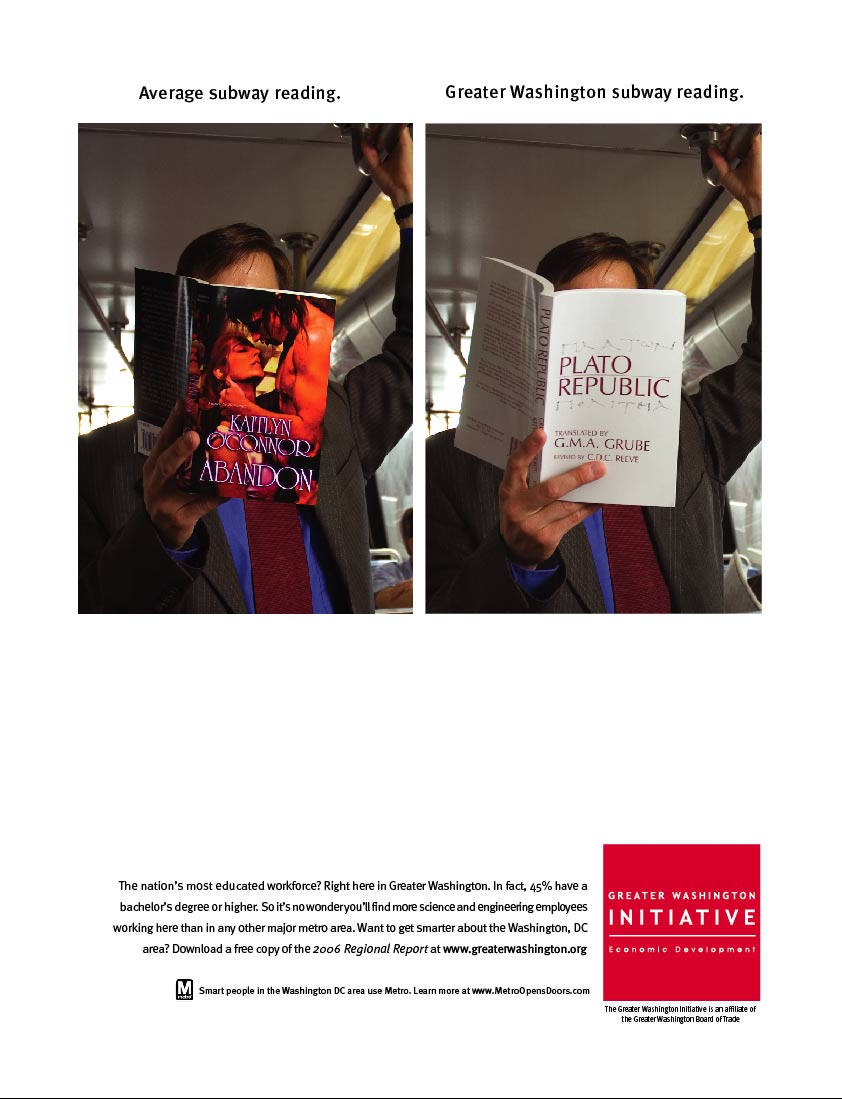
It all started out with an advert on the Washington DC Metro which was reported to the Smart Bitches. The resultant furore was reported by both The New York Times and The Washington Post, followed by comments on each article by the Smart Bitches and even more comments as the debate raged on. In the advert 'Greater Washington subway reading' material, epitomised by Plato's Republic, was being contrasted with 'average subway reading', represented by a romance novel. The implication was that Greater Washington's metro travellers, part of 'The nation's most educated workforce', of whom '45% have a bachelor's degree or higher', are well-educated people of the sort who read Plato, whereas less well-educated people read romance. For obvious reasons there were plenty of romance readers who took exception to this. For one thing, according to the RWA's statistics, 42% of romance readers 'have a bachelor's degree or higher'.

Inspired by all this controversy, I thought I'd take a look at the book which sparked all the outrage, namely Plato's Republic. It wasn't long before I came across an issue which, while dealt with only briefly in this passage from the Republic, is of vital importance to the romance genre. Cephalus, an elderly man, recalls
the aged poet Sophocles, when in answer to the question, How does love suit with age, Sophocles, --are you still the man you were? Peace, he replied; most gladly have I escaped the thing of which you speak; I feel as if I had escaped from a mad and furious master. His words have often occurred to my mind since, and they seem as good to me now as at the time when he uttered them. For certainly old age has a great sense of calm and freedom; when the passions relax their hold. (Book I, Jowett translation)
In both the classical period and in the Middle Ages, love was often seen as a form of madness:
The disease of love, according to medieval physicians, is a disorder of the mind and body, closely related to melancholia and potentially fatal if not treated. In their view, however, lovesickness did not afflict everyone alike: the sufferer was typically thought to be a noble man. (Wack 1990: xi)
If lovesickness was generally thought to result in depression and melancholy in the Middle Ages,
that is not the way it is depicted in the majority of ancient literary texts. Lovesickness, displayed in a violent or manic fashion, receives descriptions in almost all of the periods of ancient literature.(Toohey 2004: 61)
There were, however, believed to be different types of love - eros, philia and agape, and for a more detailed discussion of Plato's ideas on love see, for example, this entry from the Stanford Encyclopedia of Philosophy.

In Plato's Symposium it is explained that
love is always directed towards what is good, indeed that goodness itself is the only object of love. When we love something, we are really seeking to possess the goodness which is in it. Not temporarily of course, but permanently. And from there Plato gives his first definition of love: ‘Love is desire for the perpetual possession of the good.’ [...] But although all things love, and all men are in some sense lovers, few recognise the object of their love, that which motivates their striving, that which underlies their every desire, that which will ensure ‘perpetual possession’. This object Plato calls the Good or absolute beauty. (Amir 2001)
We may recall that Frye wrote:
We may think of our romantic, high mimetic and low mimetic modes as a series of displaced myths, mythoi or plot-formulas progressively moving over towards the opposite pole of verisimilitude
According to Frye, romances in the high mimetic mode come in for criticism because 'the interest in this sort of displaced myth “tends toward abstraction in character-drawing, and if we know no other canons than low mimetic ones, we complain of this.”' Could it be, then, that romances of this type, which are criticised for having stereotypical, unrealistic characters and plots, are in fact exploring love as the pursuit of 'the Good or absolute beauty'? To take as an example an old but important novel in the development of the genre, E. M. Hull's The Sheik, we find that the heroine, Diana Mayo (her very name recalls that of a goddess) is referred to as 'The divinity' (page 4) and one of her admirers exclaims that 'Beauty like yours drives a man mad' (page 7). In romances of the high mimetic type, the lovers are usually extremely beautiful/physically attractive, and intensely possessed of particular virtues (courage, in the case of Diana Mayo, humility and self sacrifice in the case of many other heroines, bravery in the case of many heroes). They are personifications of aspects of 'the Good' or 'absolute beauty'. Romances in the low mimetic mode, i.e. romances where the characters are more 'realistic' perhaps show how love can be compatible with daily living, without the lovers falling into the dangerous madness warned about by classical and medieval physicians.

Plato told stories, relating his ideas through the characters of Socrates and his interlocutors. Socrates is depicted using simple examples in order to approach philosophical truths, such as when he asks 'When horses are injured, are they improved or deteriorated?' during the dialogue regarding justice. It seems to me that this is not totally dissimilar to the way that romances, rather than discuss relationships or love in the abstract, ground their investigation into the causes and effects of love in a particular situation, so that it may be more easily understood by the reader.

I'd also like to take a closer look at old age, which was where we began when I quoted from the Republic. Do 'the passions relax their hold' in old age? And is this what is portrayed in the romance genre? I think it very often is, in the sense that the majority of romances portray young lovers. Sandy Oakes, for example, states that 'a romance works best when the experience is new—the younger hero and heroine falling in love for the first time'. But passion at an older age is not simply an issue affecting the characters within novels: it is also an issue which affects the perception of the romance readers, as explored in a recent At the Back Fence column at AAR, where Robin Uncapher commented that 'It’s not only younger people who find the idea of an older reader disconcerting. It’s all of us, including those of us who have passed that 40th birthday'. Michelle Buonfiglio articulated the unease that older readers can feel when they realise that they are feeling an attraction to a character who is much younger than they are: 'is it just plain creepy to think guys who are 10, 15, 20 years younger than I are sexy as hell?'. And although many romances only show passionate, romantic love between younger characters, there are some which feature older characters. Michelle mentions Candice Hern's Just One of Those Flings" which has as its hero 'an alpha younger man who's crazy about an older woman. Our heroine's got to convince herself that his attraction to her is real, not some fetish; that her desirablity transcends her age'. Age is also an issue in Jessica Hart’s Contracted: Corporate Wife. The heroine is divorced, and the mother of a fourteen-year-old girl and an eleven-year-old boy:
She was attractive enough, but she had to be at least forty-five, and it showed in the lines around her eyes.
That cool, composed look had never done anything for him, anyway. He liked his women more feminine, more appealing, less in control. And younger. (2005: 6).
Patrick, the character making these observations, is himself ‘in his late forties’ (2005: 10). His opinion of Lou begins to change when she smiles:
Lou smiled up at the barman as he materialised out of the gloom, and Patrick’s hand froze in mid-tap as he felt a jolt of surprise. He hadn’t realised that she could smile like that.
She never smiled at him like that. [...] Not the warm, friendly smile she was giving the barman now, lighting her face and making her seem all at once attractive and approachable. (2005: 10)
The double standard, which generally leads people to consider an age-gap more appropriate if the man is the older of the couple, is directly challenged by Lou:
The boy was clearly trying to impress Lou, Patrick thought disapprovingly, watching his attempts at banter. She had only smiled at him, for heaven’s sake. Anyone would think that she was hot, instead of nearly old enough to be his mother. Just what they needed, a barman with a Mrs Robinson fixation. [...] Patrick glowered at the barman’s departing back. ‘Thank God he’s gone. [...]’
‘I thought he was charming,’ said Lou, picking up her glass.
She would.
‘Don’t tell me you’ve got a taste for toy boys!’
‘No – not that it would be any business of yours if I did.’ [...]
‘You don’t think it would be a bit inappropriate?’ he countered.
Lou stared at him for a moment, then sipped at her champagne. ‘That sounds to me like a prime case of pots and kettles,’ she said coolly. (2005: 11)
As Lou observes, Patrick’s girlfriends ‘look a good twenty years younger’ than him (2005: 12). She also acknowledges that ‘She was a middle-aged woman and it was well known that you became invisible after forty’ (2005: 12). Of course, this being a romance, Patrick eventually loses his arrogance and after that evening he starts to think of Lou in a new way.

Jennifer Crusie is another author who has written a romance about a heroine who is over forty. In Anyone But You, a forty-year-old heroine is paired with a thirty-year-old hero. The heroine's attempts to make her body into the ideal of female beauty are shown to be futile; this is not a novel in the high mimetic mode. Instead she realises that 'I wanted to give him a perfect body, and all he wanted was mine' (2006: 218).
  • Amir, Lydia, 2001. 'Plato’s Theory of Love: Rationality as Passion', Practical Philosophy, November 2001, Volume 4.3: 6-14.
  • Crusie, Jennifer, 2006. Anyone But You (Richmond, Surrey: Harlequin Mills & Boon).
  • Hart, Jessica, 2005. Contracted, Corporate Wife (Richmond, Surrey: Harlequin Mills & Boon).
  • Toohey, Peter, 2004. Melancholy, Love, and Time: Boundaries of the Self in Ancient Literature (Ann Arbor: University of Michigan Press).
  • Wack, Mary Frances, 1990. Lovesickness in the Middle Ages: The ‘Viaticum’ and its Commentaries, University of Pennsylvania Press, Middle Ages Series (Philadelphia: University of Pennsylvania).

Sunday, October 08, 2006

Jessica Hart - Mistletoe Marriage

Jessica Hart's Contracted: Corporate Wife won the Romantic Novelists' Association Romance Award 2006 and her Christmas Eve Marriage won a RITA in 2005, in the Best Traditional Romance category.

Mistletoe Marriage has not, as far as I know, won any awards; the one reader review at Amazon.com is lukewarm, describing it as 'pretty standard fare for a Harlequin romance', while at the Romantic Times the reviewer's final comment that the novel 'triumphs over its oft-used premise, finding some lovely, genuine emotional levels' may be read either as damning with faint praise or as an accurate summary of the novel's main strengths. In my opinion Hart's novel makes use of traditional plot and character contrasts in ways which query some of those traditions, much as Austen uses contrasts in Sense and Sensibility to critique aspects of Romanticism, or, in Emma, contrasts the furtive romance between Jane Fairfax and Frank Churchill, with the long-standing friendship, which changes to romantic love, between Emma and Mr Knightley. Among the fairytales I know, Mistletoe Marriage reminds me of the story of Snow White and Rose Red. In the version told by the Brothers Grimm there are two sisters:
one was called Snow-white and the other Rose-red. They were as good and happy, as busy and cheerful, as ever two children in the world were, only Snow-white was more quiet and gentle than Rose-red. Rose-red liked better to run about in the meadows and fields seeking flowers and catching butterflies [...] The two children were so fond of each other that they always held each other by the hand when they went out together, and when Snow-white said, “We will not leave each other,” Rose-red answered, “Never so long as we live,” and their mother would add, “What one has she must share with the other.”
Sophie, the heroine of Mistletoe Marriage reminds me of Rose-red:
Sophie's hair [...] was a bit like her personality - wildly curling and unruly [...] At first glance her hair was a dull brown, but if you looked closely you could see that there were other colours in there too: gold and copper and bronze where it caught the light.
The quirkiness of Sophie's personality was reflected in her face. Vivid, rather than strictly pretty (2005: 7)
Like Rose-red, Sophie loves the countryside, whereas her sister Melissa, 'In spite of growing up on a farm [...] had never been a great one for getting her hands dirty' (2005: 26) . Melissa is more like Snow-white: 'She was sweet and fragile and helpless, and few men were immune to her appeal' (2005: 14) with 'her hair like spun gold and her violet eyes and that smile that made the sun come out' (2005: 26). These sisters are also devoted to each other: Sophie makes a 'sacrifice' that 'few sisters would have made' (2005: 16), breaking off her engagement to Nick when she realises that Nick and Melissa have fallen in love, and Melissa truly appreciates this and 'was [...] bound up in guilt about what she called 'stealing' Nick' (2005: 53).

In the fairytale the sisters have a playmate, who also calls himself their lover, and who is a bear:
They tugged his hair with their hands, put their feet upon his back and rolled him about, or they took a hazel-switch and beat him, and when he growled they laughed. But the bear took it all in good part, only, when they were too rough, he called out,

“Leave me alive, children,
“Snowy-white, Rosy-red,
Will you beat your lover dead?”
The bear first makes his appearance in the winter, the season in which Mistletoe Marriage is set. Bram, the hero of Mistletoe Marriage gives hugs which are
incredibly comforting [...] when he held you enclosed in those powerful arms you felt safe and secure, and insensibly steadied. He didn't need to say a thing. You could just cling to his strong, solid body and feel the slow, calm beat of his heart and somehow let yourself believe that everything would be all right (2005: 5-6)
Bram, like the bear, is not an exotic creature: 'He had never lain on a tropical beach under a leaning coconut palm and he didn't want to. Give him a hillside and a gorse bush in bloom any day' (2005: 19). His name, 'Bram', is, therefore extemely appropriate since according to one baby-naming website the name is 'of Scottish, Irish and Gaelic origin, and its meaning is "bramble; a thicket of wild gorse'.

In the fairytale the two sisters encounter a very grumpy dwarf, who expects them to rescue him, but who gives them no thanks for their efforts. Finally the bear kills the dwarf:
“I am a King’s son,” he said, “and I was bewitched by that wicked dwarf, who had stolen my treasures; I have had to run about the forest as a savage bear until I was freed by his death. Now he has got his well-deserved punishment.” Snow-white was married to him, and Rose-red to his brother
Bram was once engaged to Melissa, but the engagement was broken off. What Sophie and Bram come to realise is that a bear is really much, much better off with a woman who loves the countryside, and what Sophie needs to learn is that beneath the surface of her beloved friend the bear is an extremely attractive man. I'm afraid that Melissa, in Jessica Hart's story, falls in love with someone who is more like the dwarf, but disguised as a prince, and while both of the sisters fall in love with him, Sophie (whose name means 'wisdom') is the one who recognises Nick for what he is: a grumpy, self-centered man who selfishly puts others to great trouble (at one point in the story he needs to be rescued, rather like the dwarf in the fairytale). Bram metaphorically 'kills' the dwarf when Sophie's love for Nick dies.

Jennifer Crusie has said that romance is 'a genre that relies heavily on the tradition of the tales even while requiring their revision for reader satisfaction' (This Is Not Your Mother's Cinderella: The Romance Novel As Feminist Fairy Tale) and on this blog Sandra has examined the way in which 'romance fiction employs various elements of fairy tales'. It seems to me that even if Jessica Hart was not deliberately re-writing the story of Snow-white and Rose-red, her novel can be read as a reworking of various elements that are common in fairytales (two sisters, prince in disguise, grumpy dwarf, marriage). Sophie's friend Ella says 'So what if it's not a fairy tale? Make your own fairy tale' (2005: 101), and that is what Jessica Hart does for Sophie, by reworking the fairytale and questioning many conventional ideas about what's romantic. Bram, for example, chooses a ruby engagement ring for Sophie, rather than a conventional diamond one. This reinforces the colour difference between Sophie (redish hair) and Melissa (blonde) in a way which changes the fairytale to suit Sophie:
It was perfect. Cinderella must have felt the same uncanny sense of rightness as the glass slipper had been slipped onto her foot. The ring sat on Sophie's hand as if it had been made for her finger. [...] 'It's different, isn't it? But that's what makes it special.'
'Like you.' (2005:116)
It is Melissa who has a beauty that in most fairytales would make her the heroine and, like fairytale heroines, 'it was hard to get past her beauty to the person underneath' (2005: 106): 'Melissa was someone to be adored, so fragile, so lovely, that you feared she might dissolve into a dream if you reached out for her' (2005: 112).* Nick is the epitome of tall, dark and handsome: 'Nick was a dream come true [...] with his good looks and his glamour and his smile that made her go weak at the knees' (2005: 97), he has 'dark good looks [...] daredevil arrogance' (2005: 126) and is 'Alpha man incarnate' (2005: 126). Nick and Melissa fall in love in the most romantic of ways: 'He saw Melissa. He took one look at her and fell [...] in love with her' (2005: 14) and 'Melissa fell in love for the first time when she saw Nick [...]. She looked completely bowled over. She couldn't take her eyes off him' (2005: 15). But, despite all this perfection and the way they seem to be the most romantic of couples, they are not the hero and heroine of this particular fairytale romance, and in fact there are shown to be problems in their marriage. Slowly, the illusion of perfection that surrounds them, and unquestioning acceptance of the conventional trappings of romance, are peeled away. Sophie compares Bram's common-sense proposal, made for practical reasons, across the kitchen table, with Nick's (prior to him meeting Melissa): 'Nick had arranged a romantic restaurant, candlelight, soft violins playing, even a rose... Didn't that indicate a lack of imagination on his part?' (2005: 97). Nick's choice of ring was equally conventional: Bram asks, 'disparagingly', 'I suppose Nick bought you a diamond?' and Sophie replies 'He did, as a matter of fact' (2005: 120). Nick later insists that diamonds are 'what a real engagement ring should be' (2005: 132), while Melissa realises how well the ruby ring suits Sophie. The point isn't that diamond rings, or proposals made over candle-lit dinners, are intrinsically unromantic, but rather that all of Nick's choices show a lack of thought about Sophie's personality. Instead of choosing what will appeal to her and showing his love and understanding of her through his choices, he simply follows convention.

Bram observes that 'You can make anyone believe anything if the trappings are right [...] It's all about appearances' (2005: 120), but Sophie isn't interested in appearances. She says that 'Surely the important thing is that Bram and I are marrying each other [...] The rest of the wedding stuff doesn't really matter, does it?' (2005: 103). Even though she says this before she falls in love with Bram, her feelings about the details of the wedding don't change. When she adds that 'I'm sure no one will care what our wedding is like' (2005: 103) her mother sighs at her 'naivety' and replies 'You've always been such a romantic' (2005: 103). Sophie, then, is a true romantic because her interest is not in the usual outward signs of love such as the white wedding dress or the diamond ring, which, because of their conventional nature, may not best suit the particular bride or her circumstances. Sophie would rather have a
dress so stunning that it had been given the window to itself. Cut low over the shoulders and close around the waist, it fell in a flurry of chiffon layers in gold and copper and bronze and red. It glowed like a flame, so warm and so vibrant you could almost hold out your hands and warm yourself on its richness and its colour.
Sophie took one look at the dress and fell in love with it. Now, there was a dress to be married in - a dress that would make you feel joyous and sexy and vibrant. Surely the way you should feel when you were getting married. (2005: 107)
The dress matches the colour of her hair, and again made me think of Sophie as Rose-red, the imagery used to describe it matches that used to describe Sophie's love for Bram, as well shall see. This dress suits Sophie's vibrant personality, and Bram recognises that and buys the dress for her. Sophie's mother, on the other hand, insists that Sophie 'look the perfect conventional bride' (2005: 109), so on her wedding day Sophie wears the dress her mother's chosen for her, but on that occasion she barely cares what she's wearing: she turns up wearing 'black rubber boots, liberally splattered with dried mud, that peeked out from beneath the ivory silk' (2005: 185). When her mother complains, Sophie declares 'I'll get married in my socks' (2005: 186), which is what she does. For Sophie, then, the conventional trappings of romance are hardly important at all: 'Bram was everything that she needed. Her best friend. Her lover. Her husband.' (2005: 186).

Sophie's feelings about Nick remind me of the discussions we've been having here about mystery, power imbalances, risk and the erotic:
Being with Nick had never felt safe [...] There had always been an element of risk in their relationship. [...] She had never been able to relax completely with Nick for fear that she would lose him. Even when she had been at her happiest it had felt as if she were on [the] point of exploding with the sheer intensity of it all. It had been a dangerous feeling, but a wonderful one too. Loving Nick had made her feel electric, alive. (2005: 25)
With Bram, however
This wasn't the desperate, dramatic love she had felt for Nick. In the very fibre of her being Sophie knew that her love for Bram was deeper, truer, stronger than that. Loving Nick had been a firework that had exploded in her world in dazzling colours, only to fizzle out without trace. [...] Loving Bram was a flame that had glowed steadily deep inside her, growing so slowly that she hadn't even noticed until it burned in every part of her (2005:161-162)
  • Hart, Jessica, 2005. Mistletoe Marriage (Richmond, Surrey: Harlequin Mills & Boon Limited).
* As Crusie notes, fairytale heroines tend to lack personality, though they are always beautiful:
Well, I had Sleeping Beauty, who got everything she'd ever wanted because she looked really good unconscious. Or there was Snow White, who got everything she'd ever wanted because she looked really good unconscious. Or there was Cinderella, who should be given some credit for staying awake through her whole story, but who got everything she'd ever wanted because she had really small feet.

Monday, August 28, 2006

Politics in Contemporary Romances

In Teresa Southwick’s To Kiss a Sheikh the heroine is a ‘former beauty queen, the pride and joy of her hometown’ (2005: 7). At dinner with the royal family of El Zafir, the King asks her ‘do you have a political affiliation in your country?’ (2005: 33) and her response is:

“Yes, Your Majesty. I’m a Republicrat.” [...]
“Republicrat?” Fariq frowned. “I studied the politics of your country, but I have never heard of this party.”
“Neither has anyone else. It has a membership of one. Basically I take the best from the Democrats and Republicans, then vote my conscience.” (2005: 33)
Apart from the fact that this made me imagine a new species of rodent, which would take its place alongside the elephant and donkey, this scene instantly brought to mind part of the film Miss Congeniality, where the contestants in a beauty contest are being asked about the one thing that would most improve society, and all of them (except the undercover detective, played by Sandra Bullock, disguised as ‘Gracie Lou Freebush’) immediately give a pat, acceptable response:
Contestant1: I would have to say, world peace.
Contestant2: Definitely, world peace.
Contestant3: That's easy. World peace.
Contestant4: World peace.
Interviewer: What is the one most important thing our society needs?
Gracie Lou: That would be harsher punishment for parole violators, Stan.
Gracie Lou: And, world peace.
Interviewer: Thank you, Gracie Lou.
The heroine of To Kiss a Sheikh is a beauty queen, so perhaps the similarity isn’t surprising. It's not that a desire for world peace, or a choice to be a 'Republicrat', can't be a sincere and principled stand, it's just that, as presented in the context of To Kiss a Sheikh and Miss Congeniality, the way the responses is framed presents them as acceptable to all, non-controversial. But is a non-controversial, non-party-political response representative of the treatment of politics in all contemporary romances?

I have read contemporary romances, including Crusie’s Welcome to Temptation, in which some of the characters are running for office and/or are politicians, but again, the situations in the books I’ve read have been non-party-political. Here’s an example from Karen Templeton’s Swept Away:
Luralene was asking Ivy how her mayoral campaign was going [...]. She still wasn’t quite sure how she’d gotten hoodwinked into running for mayor, although she seemed to recall the Logan brothers, the youngest of whom was her son-in-law, had a lot to do with it. But when eighty-something Cy Hotchkins decided not to run for reelection – it would’ve been his sixth term, but term limits were not a big issue in a town of a thousand where most people were just happy somebody was willing to do the job – who should throw her forty-year-old pillbox into the ring but Arliss Potts, the Methodist preacher’s wife known more for her culinary eccentricities than her leadership qualities. And before Ivy knew it, her daughter Dawn, the town’s only attorney, had gotten a petition going and amassed enough signatures to get Ivy on the ballot. (2006: 21)

But just because contemporary romances avoid references to political parties doesn’t mean they don’t deal with politics. If one accepts that the personal is political, then every romance could be considered political in the sense that romances deal with the politics of gender relationships, but there are plenty of romances which touch on other political issues. Whats remained a constant in my reading experience is that the politics is not presented in a party-political way. For example, here’s a hero, who’s just taken over a business, and the heroine, the PA he inherited, discussing employment issues as they relate to employees with families:
‘After the last time, I vowed I’d never have a PA who was a mother again.’
‘Very family-minded of you,’ said Lou.
Patrick’s brows drew together at the unconcealed sarcasm in her voice. ‘I haven’t got anything against families,’ he said. ‘It’s up to individuals whether they have a family or not, but I don’t see why I should have to rearrange my life around other people’s children. [...]’
[...] ‘You’re obviously not aware of the fact that Schola Systems has always had a very good reputation for family-friendly policies,’ she admonished him. ‘I was lucky to get a job there when I had to go back to work and the children were small, and especially to have such an understanding boss. Bill Sheeran was always flexible when people needed time at home for one reason or another.
‘It won him a lot of loyalty from the staff,’ she added warningly, ‘so if you were thinking of holding parenthood against your employees, you might find yourself without any staff at all!’ (Hart 2005: 16-17)
This is a political issue. In the UK the government has introduced policies giving workers the right to ask for more flexible working-hours (though employers are not obliged to agree). The Trades Union Congress (TUC), like Lou, argues that flexibility from employers leads to a happier, more productive, more loyal workforce:
Our long hours culture creates rigidity and promotes a downward spiral of disincentives to workers. A situation where 11 million UK workers say that they want to increase or decrease their hours of work cannot be good for business. This mismatch must impact adversely on the size of the recruitment pool, labour turnover, motivation and productivity. In fact, the way to utilise the skills of a changing, more feminised workforce is through strong partnerships to develop mutually beneficial patterns of working time organisation as is common in Europe. (TUC report, 2005)

Or how about the environment? In Jayne Ann Krentz’s Sweet Fortune Jessie, the heroine, has been involved in exposing an environmental organisation, DEL, which was a cover for a fraudster who was tricking people into investing in non-existent technologies which he claimed would help to tackle climate change. Talking to her sister, Elizabeth, she comments:
“ [...] There aren’t any easy answers and there’s still so much we don’t know about ecology and the environment.”
“I can sort of see why people got excited about what Edwin Bright [the fraudster] was selling.”
“So can I,” Jessie said. “Too bad it wasn’t for real. (Krentz 1999: 268)
Climate change is, of course, both an environmental and a political issue.

Given the large number of characters in contemporary romances who have worked, or still do work, in the military and the police, romances can bring up issues such as gun control, the death penalty and foreign affairs. In Marilyn Pappano’s The Bluest Eyes in Texas, for example, the hero has fought in ‘the war in Iraq [...] where he’d spent more than a year and the Afghani mountains’ (2006: 10). As a result, ‘According to the United States Army, Logan was a hero, with commendations, medals and scars to show for it’ (2006: 120). One of the questions raised in the course of the novel, however, is whether this automatically makes him a hero in the eyes of the heroine and the reader. The heroine certainly doesn’t view him this way until close to the end of the novel, and therefore if she thinks of him as a hero it isn’t because of his military record. The villain, in fact, has also served in the army, and, very briefly, the novel raises the question of whether the army, as well as creating ‘heroes’ may also occasionally exacerbate violent tendencies:
Mac’s criminal record as a kid had been mostly petty stuff – shoplifting, vandalism, brawling. He’d never used a weapon, never done any real harm to anyone ... as far as the authorities had known. Had war taught him to enjoy killing or would he have graduated to murder regardless?
“He liked fighting,” Logan said quietly. “He was more gung ho about going to Iraq than anyone else in our company. He never seemed to feel a moment’s remorse over killing anyone. It got his adrenaline pumping, got him all psyched up.” (2006: 199)
The question is never resolved, but it is raised, as is the issue of the death penalty. The heroine muses that
She thought death was the only just punishment for what Mac had done to the Jensens ... but after he’d gone to trial. After he’d been convicted by a jury of twelve citizens. After he’d been sentenced to die. That was just. (2006: 221)
Later, however, Logan says that Mac would ‘rather die than go to prison. Being locked up in a cell the rest of his life is the worst punishment he can imagine’ (2006: 239). Clearly neither the hero nor heroine have any moral objection to the death penalty, though they may occasionally feel that there are fates worse than death for certain offenders. And perhaps it’s because I’m in the UK, but I can’t help but notice how many guns there are in many contemporary romances set in the US. In this novel, for example, the heroine notices the weapons in the trunk of the hero’s car:
Gun cases. Two obviously held pistols; the other two were for longer guns. He didn’t intend to take any chances with MacGregor. [...] But logic aside, the weapons made her uncomfortable. Sure, she carried a gun – two of them at the moment – but strictly in self-defense. [...] But going looking for someone armed to the teeth – that was more like hunting (2006: 28)
From my perspective, coming from a country with ‘some of the strictest gun legislation in the world’, both of them are ‘armed to the teeth’, and there is no way this story could have been set in the UK, because both of them would have been in breach of the law.

Contemporary romances, then, do touch on political issues, even if in a non-party political way. They may not discuss the issues in great detail, but one wouldn’t necessarily expect that in a work of fiction. And for a genre often accused of being ‘fluff’, romances can include serious reflections on some extremely important political issues. Here’s one final example. Charlie, the hero of Crusie’s Charlie All Night, and St Thomas More may not have a lot in common, but they do share an intense respect for the law:
“Listen to me,” Charlie said and the intensity in his voice stopped her in midsentence. “One of the biggest problems this country has is that people think a law is only a law if they agree with it. And if they don’t, it’s all right to kick guys like Joe [who is gay] out of the service and bomb abortion clinics because there’s a higher law at work. And that’s garbage [...] The law is the law [...] You can’t choose which part of it you like and which you’re going to ignore. It’s not a salad bar [...]. The whole thing stands, or the whole thing goes. [...]” (2005: 228)
And here is More, as portrayed in Robert Bolt’s A Man for All Seasons:
More: [...] I know what’s legal not what’s right. And I’ll stick to what’s legal.
Roper: Then you set Man’s law above God’s!
More: No far below; but let me draw your attention to a fact – I’m not God. [...]
Roper: So now you’d give the Devil benefit of law!
More: Yes. What would you do? Cut a great road through the law to get after the Devil?
Roper: I’d cut down every law in England to do that!
More (roused and excited): Oh? (Advances on Roper) And when the last law was down, and the Devil turned round on you – where would you hide, Roper, the laws all being flat? (Leaves him) This country’s planted thick with laws from coast to coast – Man’s laws, not God’s – and if you cut them down – and you’re just the man to do it – d’you really think you could stand upright in the winds that would blow then? (1968: 38-39)
----
  • Bolt, Robert, 1968. A Man for All Seasons: A Play of Sir Thomas More, ed. E. R. Wood (London Heinemann Educational Books).
  • Crusie, Jennifer, 2005. Charlie All Night (Richmond, Surrey: MIRA Books).
  • Hart, Jessica, 2005. Contracted, Corporate Wife (Richmond, Surrey: Harlequin Mills & Boon).
  • Krentz, Jayne Ann, 1999. Sweet Fortune (London: William Heinemann).
  • Pappano, Marilyn, 2006. The Bluest Eyes in Texas (Richmond, Surrey: Silhouette Books).
  • Southwick, Teresa, 2005. To Kiss a Sheikh (Richmond, Surrey: Harlequin Mills & Boon).
  • Templeton, Karen, 2006. Swept Away (Richmond, Surrey: Silhouette Books).